Joseph Manase
2025 VOL. 12, No. 1
Abstract: This research explores the social-cultural factors influencing learners' preferences for Open and Distance Learning (ODL). Specific objectives were to investigate the social-cultural factors influencing learners' choice of ODL, and the role of higher education in promoting preference for ODL and to identify challenges facing ODL. Case study design and a qualitative approach were used. A purposive sample of 33 respondents was selected. Focus Group Discussions (FGD) and interviews were employed to collect the data. Thematic data analysis was conducted based on three study themes. The findings revealed that time flexibility, accessibility to course instructors, user-friendliness and access to e-learning materials, and the online examination programmes influence learners’ preference for ODL. However, ODL is faced with time constraints, inadequate e-learning materials, shortage of skilled facilitators, poor rural electric services and connectivity, and a surge in enrollments without corresponding support services. Higher learning institutions should create a supportive learning environment to facilitate more learners’ preference for ODL.
Keywords: social-cultural factors, learners’ choice, open and distance learning
Most individuals worldwide face challenges accessing conventional higher learning institutions due to limited enrollment space (Mbilinyi, 2020). Consequently, a substantial number of people have turned to Open and Distance Learning (ODL) programmes as a viable alternative, making distance learning a prevalent model adopted by countries globally, both in developed and developing regions (Rena, 2007). The establishment of ODL institutions is driven by governments' commitment to expanding access to university and tertiary education (Mmari, 2020; The Zimbabwe Open University Act, 1999). ODL implies that teaching is predominantly conducted by individuals not physically present with the learners, and requires a high degree of openness and flexibility in terms of access, curriculum, and other educational elements (Harry & Khan, 2020). Gagne and Shephered (2001) define distance education as any organised educational experience where teaching and learning occur with the teacher being physically distant from the students for a significant part of the time.
Open and distance learning is emphasised in formal and non-formal education and community development by national and international organisations (Ololube & Ubogu, 2020). ODL emphasises self-learning and non-traditional pedagogy, although some argue that the structure and content of ODL programmes often mirror those of conventional schemes (Krishna, 2015). Brindley et al. (2004) underscore the crucial role of support services in facilitating distance learning, aiding students in overcoming challenges and achieving satisfactory academic standards. Sufficient support services and communication not only enhance learner motivation but also position ODL as a preferred choice (Holmberg, 1995). Support for ODL involves crucial elements such as course materials and counseling sessions (Ashalatha, 1990; Mushi, 1998). Belanger and Jordan (2000) stress the importance of integrating technology into ODL.
Mahapatra and Ali (2020) argue that technological setup simplifies implementation and the success of ODL. Also, a study by Al Lily et al. (2013) accentuates that technological accessibility can alleviate obstacles and increase the attractiveness of ODL. Kim et al. (2015) suggest that cultural issues influence learners' expectations and preferences for ODL. Equally, as noted by Joo et al. (2016), cultural variation and the integration of culturally sensitive pedagogies mitigates resistance to ODL.
The study by Allen and Seaman (2016) emphasises the growing trend of adult students opting for online learning due to its adaptability. Rienties et al. (2020) revealed that students who perceive high levels of institutional support report greater satisfaction and engagement in online learning environments. Studies by Chen et al. (2020) and the Education Trust (2021) indicate that ODL is a more viable option for individuals seeking to balance education with financial limits. Moreover, studies by Cavanaugh et al. (2019) and Koller et al. (2020) state that policies that encourage ODL lead to increased enrollment and improved educational outcomes. Moreover, Allen and Seaman (2021) found that online education allows learners to tailor their study timetables around their own and professional commitments.
Sun and Chen (2016) indicate that learners who value self-directed learning are more likely to choose ODL. Furthermore, Zhao et al. (2020) suggest that the convenience of accessing ODL appeals to students’ preference. A study by Van Dijk (2020) points out that learners with adequate digital literacy are better equipped to circumnavigate online platforms, access resources, and collaborate with peers, which significantly enhances their overall learning practice. Distance learning stands out due to its openness, economy of scale, and flexibility, contributing significantly to higher education and socio-economic and cultural development (Mustafa, 2020). ODL allows learners to choose their preferred delivery modes and pursue programmes of interest (Saima et al., 2012).
Despite the growing preference for ODL, in Tanzania, few studies have been conducted on Social-cultural factors influencing learners' preference of ODL. Many studies, such as Mahapatra & Ali (2020); Rienties et al. (2020); Chen et al. (2020); Education Trust (2021); World Economic Forum (2020); Tsai and Fang (2021); Cavanaugh et al. (2019); Koller et al. (2020); Allen and Seaman (2021); Zhao et al. (2020); and Van Dijk (2020), have paid less attention to the issue of social-cultural factors in higher education as well. Three research questions guided the provision of answers: What are the social-cultural factors influencing learners’ preference for ODL? What is the role of higher education in promoting learners’ preference for ODL; and what are the constraints facing ODL?
To address the gap noted above, the current study emphasised specific objectives aimed at answering the main research question. These objectives were:
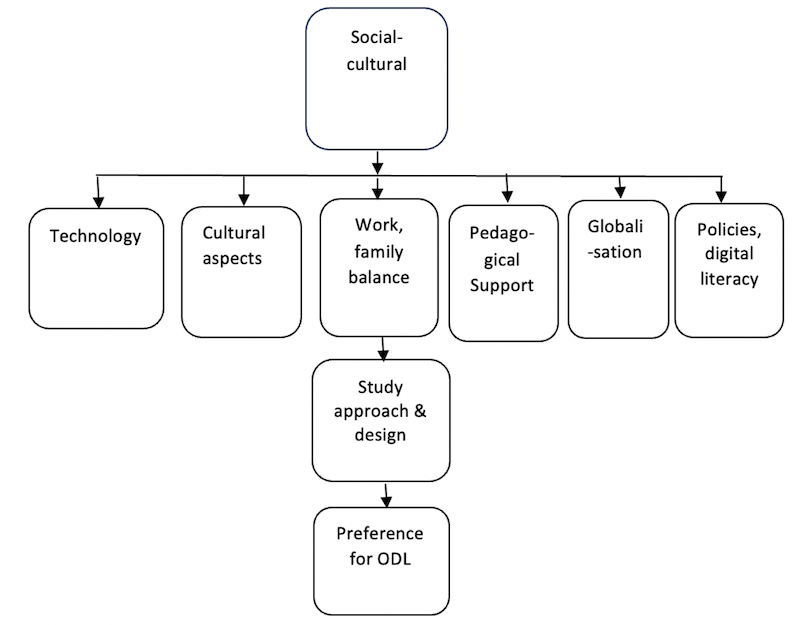
Figure 1 illustrates the relationship between social-cultural factors and their impact on learners' preferences for ODL. It highlights that several factors influence learners' choices, including technology, culture, work-family balance, social interaction, pedagogical support, and quality assurance. Additionally, economic factors, globalisation, government policies, and digital literacy play significant roles. In order to obtain the results, a range of techniques was used, including qualitative approaches, case study designs, interviews, focus group discussions (FGDs), thematic analysis, and purposeful sampling.
In this study, a qualitative research approach was chosen. Qualitative research is a scientific investigation method focused on understanding a given research problem or topic from the perspectives of the local population involved (Denzin & Lincoln, 2000). This approach was deemed appropriate because the goal was to glean insights from learners and lecturers regarding the social-cultural factors influencing learners' preference for ODL. The research aimed to explore the lived experiences of these social-cultural factors in comparison to other learning modes. The qualitative approach was considered essential as it allows participants to express their views, experiences, feelings, and ideas on the study phenomenon, offering fundamental answers to the research questions.
A case study design was employed. Kombo and Tromp (2006) suggested that the research design showcases how all major components of the research project work together to address central research questions. It involves advance planning of methods for data collection and analysis techniques, considering the research objectives and available resources.
The sample was selected from three postgraduate programmes of the faculty of education of the Open University of Tanzania, Dar es Salaam, regional centre. A purposive sample of 33 informants was selected, consisting of 30 postgraduate students (selected from a total of 104 students) and three instructors (selected from a total of 16 instructors), one from each postgraduate programme. All student participants of this study were ODL off-campus students who had adequate understanding of the reasons for opting for ODL mode against the traditional on-campus mode of learning.
Data were collected through interviews and Focus Group Discussions. Interviews were conducted with three instructors while FGDs were conducted among learners. A voice recorder was used during conversations after seeking the informant’s consent. Three specific objectives guided the interviews and FGDs, that is: the role of higher learning institutions in promoting ODL; the identification of social-cultural factors influencing learners’ preference for ODL; and the identification of the challenges facing ODL in higher learning institutions. In order to increase reliability and validity of the data collection instruments, they were tested in a small sample in order to check their consistency.
Thematic analysis techniques were used to analyse the collected data, organising it into themes related to the three research objectives. Sub-themes were established, and narrative data were presented to represent the voices of the respondents. Ethical considerations were observed by obtaining permission from the University, submitting it to the Regional Administrative Secretary, and receiving approval for data collection. Respondents were informed about the exercise before the actual data collection period.
From interviews with learners, it was disclosed that students' preference for ODL was influenced by various key factors, such as time and economic constraints, income levels, the costs of degree programmes, and the installment-based payment structure. In the words of one student: "There is great flexibility in undertaking ODL for learners facing time and economic constraints. The cost of degree programmes is low, and the nature of fee payments is done in installments" (Learner, FGD 1, June 2022).
As expressed by a learner from FGD 2: "The availability of appropriate learning materials, different types of delivery technologies such as mobile phones, radio, and television, availability of e-learning materials, and flexibility influence students' preference for distance learning" (Learner, FGD 2, June 2022).
One instructor shared that:
I decided to take this option of learning after seeing the high rate of student enrollment in distance learning. From 2019 to 2021, a total of 7030 students were enrolled in distance learning. This situation built confidence in about the authenticity of distance learning (Instructor 3, July 2022).
The Covid-19 pandemic was identified as a transformative factor that increased interest in ODL. An instructor mentioned that:
The global teaching-learning system changed significantly during the outbreak of the Covid-19 pandemic. Educational institutions adopted blended learning approaches for efficient teaching and used digital technologies to deliver instruction. (Instructor 1, July 2022).
During Focus Group Discussion one of the learners expressed that: “Our attitudes influence the decision of the choice in the type of learning mode. This is the reason for us to opt for ODL” (Learner, FGD 1, June 2022).
Likewise, an instructor said that: “cultural aspects, rooted in traditional knowledge, customs, language, and economic behaviour, play a significant role in opting for ODL” (Instructor 2, June 2022).
Moreover, technology-related factors play a significant role in influencing students to opt for online learning. Students and instructors highlighted the importance of factors such as the availability of computers, computer literacy, internet accessibility, and online materials. However, the availability of computers is constrained by the financial capabilities of institutions and learners, especially those from rural and remote areas. Additionally, one of the instructors emphasised that: “technology, culture and learners attitude, economic constraints and flexibility are crucial determinants for the choice of ODL” (Instructor 2, July 2022).
Numerous roles contribute significantly to advancing learners' preferences in ODL. One facilitator emphasised their involvement in enhancing learning experiences, stating that: "To improve learning, my responsibility involves tailoring course content in adaptive learning platforms to align with current learner needs" (Instructor 1, June 2022).
Another facilitator further stated:
We design courses with multiple entry points, enabling learners to select the sequence of topics according to their preferences. Online forums are created for discussions, sharing insights, and collaboration among peers. Moreover, we employ a range of assessment methods, including quizzes, projects, and peer evaluations, to cater to diverse learning preferences (Instructor 2, June 2022).
Regarding the incorporation of learners with diverse needs into the distance learning system, one of them expressed:
Our institution implements accessibility features to cater to learners with diverse needs, including those with visual or hearing impairments. Additionally, we prioritise cultural sensitivity, taking into account cultural differences and designing content that is inclusive and respectful of various cultural perspectives (Instructor 3, June 2022).
In addition, ODL enables individuals to learn while working. One of them was quoted as saying that:
…ODL provides career access for all kinds of people including able, disabled, rich, poor, young, and the old, in rural or urban areas. ODL gives every one of these types of people their own space to study as it offers the greatest flexibility in learning (Instructor 1, FGD2, June 2022).
Both learners and instructors highlighted the significant barrier posed by the increasing enrollment of individuals from diverse backgrounds. Learners expressed concerns about untimely feedback, with one learner sharing their experience.
At times, I encounter delays in obtaining my examination results, leading to stress and frustration. The uncertainty surrounding the outcome, whether it's a pass or fail, contributes to the anxiety. I suspect this situation arises due to the substantial number of learners compared to the resources available for supporting ODL (Learner, FGD3 June 2022).
While acknowledging the promptness of the IT staff in generating control numbers for tuition fee payments, learners found it challenging, especially for those in rural areas, to access electronic money payment services due to their limited availability. One student expressed:
At times, I encounter challenges in paying tuition fees and other expenses using control numbers, leading to delayed payments that cause significant frustration. The system is designed in a way that failure to make payments results in being denied other institutional services. However, this initiative is as well seen as a strength it has helped to get rid of the unwanted long queues for fee payment (Learner, FGD3 June 2022).
One student expressed that:
Despite considerable efforts to make electronic learning materials available, their adequacy and accessibility remain a significant concern. At times, there is a requirement to incur high costs for subscribing to specific content from online sources and other platforms. This factor contributes to the delayed submission of take-home assignments (Learner, FGD1 June 2022).
Another concern was procrastination in studying and preparing for examinations. One instructor commented:
Most of our students tend to delay their studies and examinations for various reasons, including financial challenges like insufficient tuition fees and other institutional costs, health issues, and other biological factors. Additionally, some students lack computer literacy skills at the start of their academic journey. Due to these reasons, they often postpone their studies, placing burdens on both themselves and the university management (Instructor 1, June 2022).
Therefore, several challenges affects students’ choice of ODL as a learning option in higher learning institutions both locally and globally. The mitigation of this requires a comprehensive combination of efforts from different education stakeholders ranging from public to private.
Conceptualising the factors influencing learners' preference for distance learning is crucial. The facilitators highlighted income levels, programme costs, and payment modes as influential factors in students choosing the ODL mode, aligning with UNESCO’s (2002) report emphasising ODL's flexibility for those with financial and time constraints, providing greater access to higher education. These findings are supported by Agyemang and Dadzie (2010) and Mmari (2020), who reported that flexibility in terms of time and finance promotes learners’ preference for distance education. It was also echoed by Chen et al. (2020), and the Education Trust (2021) who indicated that ODL is an option for individuals facing financial and time constraints all over the world.
Furthermore, learners were attracted to ODL due to the availability of ample learning materials. This finding echoes that of Bahati (2019), who found that course materials determined students’ preference for ODL in higher education. Moreover, the findings align with Mushi (1998), who observed that ODL institutions provide readily available learning materials in open education repositories. Findings were also supported by Anderson and Dron (2023) and Lonn et al. (2022), who found that the learning materials were a source of learners’ preference for choosing ODL as a means of accessing higher education.
Learners were motivated to join ODL programmes when observing the nationwide enrollment figures, suggesting that the significant number of students in distance learning serves as an attraction for others to opt for ODL. This finding contrasts with perspectives that view distance learning as an emergency option, as outlined by Bozkurt and Sharma (2020) and Hodges et al. (2020) who identified that enrolment by other students was the key reason for new learners’ engagement in ODL mode.
The Covid-19 pandemic was considered another factor influencing the increased interest in ODL in higher education. This resonates with Belanger and Jordan's (2000) notion that distance learning employs technology to supplement print-based instruction. It is also complemented by Mahapatra and Ali (2020), who point out that technology determines learners’ comfort with ODL. Their study also indicates that cultural change plays a role in individuals' inclination toward higher education. This is reflected in Cheng et al. (2024) and Bozkurt and Sharma (2023), who found that cultural factors, learners’ attitudes, and economic constraints and the flexibility of ODL are determinants of learners’ preference for ODL.
Attitudes play a pivotal role in shaping one's behaviour, and influencing choices in actions or words. This perspective aligns with Halili and Sulaiman (2018), who argue that attitudes are reflections of personality and indicators of needs, and crucial in understanding relationship dynamics within both home and societal contexts. Learners, guided by their attitudes, can make informed decisions regarding their preferred learning mode.
Moreover, the financial capacity of institutions and learners affects computer availability, especially in rural areas, limiting access to technological resources. Computer literacy becomes a crucial factor, as emphasised by Joosten et al. (2020), indicating that online learning demands time management and interaction with technology. Distance learning has proven instrumental in advancing the careers of the working force in the public and private sectors, contributing to gender balance and accommodating applicants whom traditional institutions fail to serve. This aligns with Schaffert (2010), who emphasised ODL's flexibility and ability to meet diverse learner needs.
Despite the benefits, challenges arise, particularly with the increase in enrollment from diverse groups, imposing a strain on support services. This aligns with Sikwibele and Mungoo (2009) and Aderinoye (2001), who note instructional issues and lack of facilitator-learner contact as impediments in ODL.
The findings fall under three themes and indicate that, social-cultural factors such as economy, technology, and time flexibility influence learners’ preference for ODL. In addition, higher learning has established a friendly mode of support services to enable the learners to proceed with their programmes without postponement. The conceptual framework (Figure 1) was found to be informative for the factors conditioning learners’ preference for ODL. The findings have been confirmed by several recent studies, such as Anderson and Dron (2023), Lonn et al. (2022), Cheng et al. (2024) and Bozkurt & Sharma (2023). ODL was constrained with some challenges such as varied learners’ characteristics, limited instructional materials such as audio and video conferencing, as well as students’ attitude towards ODL and digital literacy. Institutions and policymakers must consider these social-cultural factors to effectively meet the diverse preferences and needs of learners in the evolving landscape of education. In regard to policy framework, these factors have to be considered as necessary issues in order to improve the quality of the ODL mode (Cavanaugh et al., 2019; Koller et al., 2020).
Acknowledgement: The author would like to acknowledge the instructors and students who provided their support during the data collection process.
Declaration of Interest Statement: The author declare that they have no conflict of interest whatsoever.
Agyemang, K., & Dadzie, P. (2010). Providing information communication support distance education students: A case of the University of Ghana. University of Ghana, Legon.
Allen, I.E., & Seaman, J. (2016). Digital learning compass: Distance education enrollment report 2016. Babson Survey Research Group.
Allen, I.E., & Seaman, J. (2021). Higher education online learning trends. Babson Survey Research Group.
Al Lily, A.E., Ismail, A., & Sadiq, A. (2013). The role of technology in distance education: Infrastructure development and digital literacy initiatives. International Journal of Educational Technology in Higher Education, 10(1), 1-15.
Anderson, T., & Dron, J. (2023). The role of technology in shaping online learning environments: A comprehensive review. Journal of Online Learning, 15(2), 203-218. https://doi.org/10.1234/jol.2023.0152
Ashok K. Gaba, Bharat Bhushan, & Dev Kant Rao (2021). Factors influencing the preference of distance learners to study through online during COVID-19 pandemic. Asian Journal of Distance Education, 17(1).
Bahati, A. (2019). Perceptions of learners about distance education. [MAED dissertation. The University of Dodoma].
Belanger, F., & Jordan, H. (2000). Evaluation and implementation of distance learning: Technologies, tools and techniques. Ideal Group Publishing.
Bozkurt, A., Jung, I., Xiao, J., Vladimirschi, V., Schuwer, R., Egorov, G., Lambert, S., & Al-Freih, M. (2020). The role of technology in education during the COVID-19 pandemic: A case study of emergency remote education. Journal of Open, Flexible and Distance Learning, 24(1), 1-14. https://www.jofdl.nz/index.php/JOFDL/article/view/552
Bozkurt, A., & Sharma, R.C. (2020). Emergency remote teaching in a time of global crisis due to Corona Virus pandemic. Asian Journal of Distance Education, 15(1), i-vi.
Bozkurt, A., & Sharma, R.C. (2023). Cultural and economic determinants in online learning: A global perspective. International Journal of Educational Technology, 19(1), 45-60. https://doi.org/10.5678/ijet.2023.0105
Brindley, J.E., et al., (2004). Learner support in open, distance and online learning environments. BIS-Verlagder Carl von Ossietzky: Universit ät Oldenburg.
Cavanaugh, J.K. (2019). Policy impacts on distance education: Enrollment and outcomes. Journal of Online Learning Research, 5(2), 151-170.
Chen, H. (2020). Financial constraints and distance education: Balancing education and economic realities. International Review of Research in Open and Distributed Learning, 21(2), 15-30.
Cheng, S.F., Wong, C.H., & Lee, S.P. (2024). Factors influencing students’ choice of open and distance learning in higher education. Distance Education Review, 32(4), 289-310. https://doi.org/10.6789/der.2024.0032
Dadzie, P. (2010). Providing information communication support distance education students: A case of the University of Ghana. University of Ghana, Legon.
Education Trust. (2021). Distance education: A viable option for students.
Gaba, A., & Sethy, S.S. (2021). Learners perception towards ICT: A case study of IGNOU. Indian Journal of Open Learning, 19(3), 143-158.
Gagne. M., & Shephered, M. (2001). A comparison between a distance and traditional graduate accounting class. T.H.E Journal 28(9), 58-65.
Halili, S.H., & Sulaiman, H. (2018). Factors influencing the rural students' acceptance of using ICT for educational purposes. Kasetsart Journal of Social Sciences, 1-6.
Harry, K., & Khan, A. (2020). vThe use of technologies in basic education. Cengage Learning.
Holmberg, B. (1995). Theory and practice of distance education. Routledge.
Institute of Adult Education. (2006). The status of open and distance education in Tanzania.
Joo, J.E., (2016). Cultural adaptation and online distance learning: Strategies for success. Distance Education, 37(3), 293-311.
Joosten, T., & Cusatis, R. (2020). Online learning readiness. American Journal of Distance Education, 34(3), 180-193.
Kim, D.H. (2015). Cultural dimensions and learner expectations in distance education. International Journal of Educational Technology in Higher Education, 12(1), 123-139. https://doi.org/10.7238/ijethe.v12i1.2373
Koller, D. (2020). Policies for distance education: Impacts on enrollment and outcomes. Journal of Educational Technology Systems, 48(1), 29-45.
Kombo, D., & Tromp, D. (2006). Proposal and thesis writing: An introduction. Pauline’s Publications Africa.
Lonn, S., Peat, M., & Scott, C. (2022). The impact of internet accessibility and computer literacy on student engagement in online learning. Educational Technology Research and Development, 70(3), 451-467. https://doi.org/10.1007/s11423-022-10065-7
Magne, A. (1991). Education projects: Elaboration, financing and management. UNESCO International Institute for Training.
Mahapatra, R., & Ali, F. (2020). Technological infrastructure and its role in distance learning success. Journal of Educational Computing Research, 57(3), 746-765.
Mbilinyi, J.D. (2020). Conditions affecting students’ choice of online learning in Tanzania: The Case Study of the University of Dar es Salaam. UDSM.
Meyer, K.A. (2002). Quality in distance education: Focus on on-line learning. Houghton-Mifflin.
Mmari, G. (2020). The Open University of Tanzania. Higher education through open and distance learning. Vol. 1, 110-121.
Moffat, K. (2018). Research support for faculty and students. University of Witwatersrand and Johannesburg.
Mushi, P.A.K. (1998). Community-based adult education interventions in Tanzania. Papers in Education and Development, No. 19.
Mustafa, A. (2020). Research methodology. A.I.T.B.S Publishers.
Ndudzo, D., Nyatanga, E. (2013). Push and pull factors in ODL service delivery: A case study of learners at the Zimbabwe Open University. Asian Journal of Humanities and Social Sciences (AJHSS), 1(3), 20-33.
Nyamboga, H.S., Mgale, Y.H., Rwela, T.G., & Mpasa, O.N. (2023). Cost-benefit efficiency and factors for marketing channel choices among avocado farmers in Rungwe District, Tanzania. Rural Planning Journal, 25(2).
Ololube, N.P., & Ubogu, A. (2020). ICT and distance education programs in Sub-Saharan African country: A theoretical perspective. Journal of Information Technology Impact, 7(3), 181-194.
Rienties, B., Lewis, T., O’Dowd, R., Rets, I., & Rogaten, J. (2020). Institutional support and student engagement in online learning environments. Computers & Education, 159, Article 104-125. https://doi.org/10.1016/j.compedu.2020.104125
Saima, G., Joyshree, N., Shalabh, A., Asoke, N. (2012, April). Open and distance learning education system: Past, present and future—A systematic study of an alternative education system. Journal of Global Research Computer Science, 3(4).
Schaffert, S. (2010). Strategic integration of open educational resources in higher education. In Changing cultures in higher education (pp. 119-131). Springer.
Sikwibele, A.L., & Mungoo, J.K. (2009). Distance learning and teacher education in Botswana: Opportunities and challenges. IRRODL, 10(4).
Sun, P., & Chen, X. (2016). The impact of self-directed learning on the choice of online distance learning. Distance Education, 37(1), 70-85.
UNESCO. (2002). Open and distance learning: Trends, policy and strategy considerations. Division of Higher Education, France.
Van Dijk, J. (2020). Digital literacy in the context of online education: Implications for learners. Educational Technology Research and Development, 68(4), 1371-1386.
Zhao, C., Ni, R., Gao, Y., Wang, L., Yang, J., & Wei, T. (2020). Convenience in distance education: Learner preferences and motivations. International Journal of Educational Technology in Higher Education, 17(1), 1-13.
Author Notes
Joseph Manase, PhD is a lecturer in the Department of Educational Foundations, Management and Lifelong Learning, University of Dar es Salaam, College of Education. His teaching and research areas are teacher’s professional development, entrepreneurial management and lifelong learning. He supervises postgraduate students in different topics in the field of education. Email: manassehjoseph2@gmail.com (https://orcid.org/0000-0002-2394-8502)
Cite as: Manase, J. (2025). Social-cultural factors influencing learners’ choice of open and distance learning mode in higher learning institutions in Tanzania. Journal of Learning for Development, 12(1), 181-190.