Prasenjit Das, Pranab Barman and Arnab Kundu
2026 VOL. 13, No. 2
Abstract: Blended learning, combining face-to-face and digital instruction, is increasingly being adopted in higher education, warranting systematic examination of students’ perceptions. This cross-sectional quantitative study investigates postgraduate students’ perceptions in a public university in eastern India using the Blended Learning Perception Scale (BLPS), a 21-item instrument across seven dimensions. The scale demonstrated satisfactory reliability (α = .82) and construct validity (KMO = .84; Bartlett’s test significant), supporting its multidimensional structure. Data from 313 postgraduate students indicated moderate perceptions overall, with most respondents clustered in the mid-range. Group comparisons using t-tests and ANOVA showed no statistically meaningful differences across demographic, academic, or access-related variables, suggesting relative consistency across subgroups. Multiple regression indicated that the dimensions jointly explained a substantial proportion of variance in perception (R² ≈ .50), with instructional and teaching-related factors showing comparatively stronger associations than technological aspects. The findings highlight the role of pedagogical design alongside technological features and offer a structured, multidimensional approach to examine blended learning perceptions in higher education.
Keywords: blended learning, student perception, higher education, quantitative study, postgraduate students, India
Blended learning, defined as the pedagogical integration of face-to-face and digital instruction, has emerged as a dominant instructional model in higher education due to its potential to enhance flexibility, learner engagement, and instructional effectiveness (Almaiah et al., 2020; Graham, 2006; Kundu et al., 2020; Tlili et al., 2025; Vaughan, 2014). In the Indian higher education landscape, where this research was conducted, the expansion of blended learning has accelerated in the post-pandemic period, supported by policy initiatives such as the National Education Policy-2020 (Adhya & Panda, 2022; Government of India, 2020; Kundu & Bej, 2021). However, the effectiveness of such models depends critically on how learners perceive and engage with blended environments, making student perception a central evaluative construct. Empirical research generally reports favourable student responses to blended learning, particularly in terms of flexibility and access; however, persistent concerns remain regarding pedagogical coherence, quality of interaction, and uneven technological readiness (Hrastinski, 2019; Rasheed et al., 2020). Studies in the Indian context further indicate that while blended learning environments are increasingly normalised, their effectiveness is often constrained by infrastructural disparities and variations in digital competence (Government of India, 2020; Kundu, 2018). Despite this growing body of work, the existing literature remains concentrated on undergraduate or discipline-specific contexts, with limited systematic evidence about postgraduate learners, whose academic engagement and expectations differ significantly. Conceptually, while the Technology Acceptance Model’s (TAM) perspectives explain students’ evaluative responses to blended learning (Davis, 1989), the Community of Inquiry (CoI) model further highlights how cognitive, social, and teaching presence shape meaningful learning experiences in such environments (Garrison et al., 2000).
Addressing this gap, the present study investigates postgraduate students’ perceptions of blended learning in an Indian higher education context, examining variations across gender, residence, family type, semester, level of internet access, prior experience, course type, and device used. Adopting a quantitative cross-sectional design and a validated perception scale, the study contributes context-sensitive empirical evidence from the Global South and offers insights for strengthening pedagogical design, enhancing digital competencies, and ensuring equitable technological access in blended higher education.
Blended learning, defined as the integration of face-to-face and online instructional modalities, has become a central pedagogical approach in higher education due to its capacity to enhance flexibility, engagement, and instructional effectiveness (Garrison & Vaughan, 2008; Graham, 2006; Hrastinski, 2019). In the contemporary age of Artificial Intelligence (AI), its relevance has further intensified as universities increasingly incorporate AI-driven tools such as adaptive learning systems, intelligent tutoring, and data-informed feedback mechanisms into instructional processes (Mustafa et al., 2025; Zawacki-Richter et al., 2019). These developments position blended learning as a key interface between human pedagogy and technological innovation. Research suggests that such environments can support personalised learning, foster self-regulation, and promote higher-order cognitive engagement (Adhya & Panda, 2026; Almaiah et al., 2020). However, while these technological advancements expand the functional capabilities of blended learning, they also introduce greater complexity in how students experience and evaluate such environments. Existing research has tended to emphasise technological affordances, while paying comparatively less attention to how students perceive the quality and coherence of blended learning experiences, particularly in AI-enhanced contexts.
The effectiveness of blended learning is closely linked to how students perceive and experience it. Student perception has been identified as a key factor influencing engagement, participation, and learning outcomes in technology-mediated environments (Davis, 1989; Hrastinski, 2019). The TAM and its subsequent expansions explain how perceived usefulness and ease of use shape learners’ acceptance of digital systems, while the CoI model emphasises the role of cognitive, social, and teaching presence in meaningful learning (Davis, 1989; Garrison et al., 2000; Kundu et al., 2022). Together, these frameworks suggest that examining students’ perceptions is essential for understanding both technology acceptance and pedagogical effectiveness. However, empirical studies have often treated perception as a general attitudinal construct (Almaiah et al., 2020), with limited attention paid to its internal structure or its variation across different learner groups. As a result, there remains a need for more nuanced, theoretically grounded approaches to studying perception in blended learning environments.
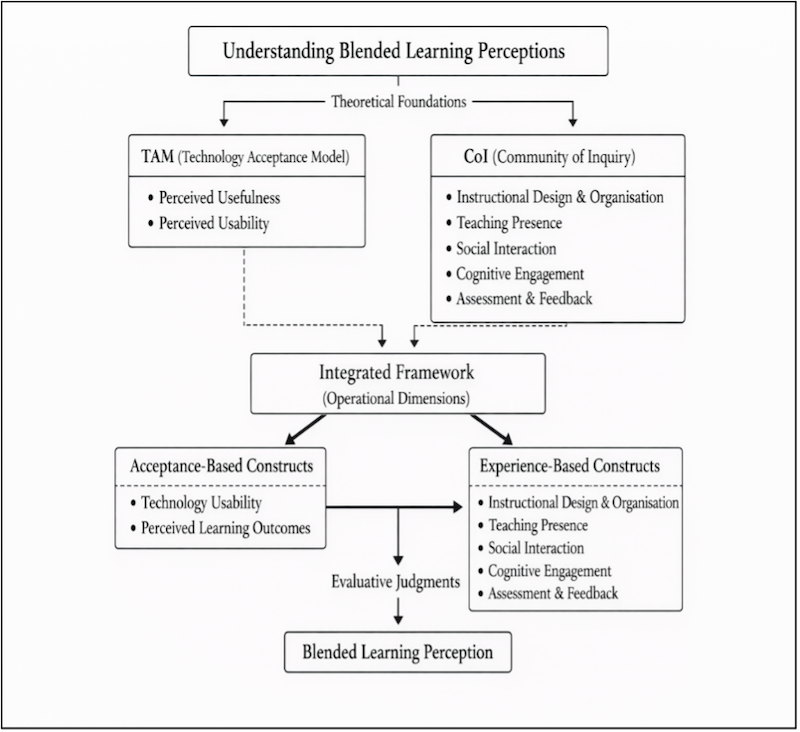
Students’ perceptions of blended learning are widely recognised as multidimensional, encompassing both pedagogical and technological dimensions, including instructional design, interaction, teacher support, engagement, assessment, usability, and perceived learning effectiveness (Boelens et al., 2017; Jiang et al., 2024; Rasheed et al., 2020; Sareen & Mandal, 2024). However, prior studies vary in how these dimensions were operationalised, often privileging either technological or pedagogical aspects, which limits conceptual coherence and comparability. To address this, the present study adopts an integrative framework drawing on the CoI framework and the TAM, conceptualising perceptions as shaped by both experience-based dimensions (e.g., instructional design, teaching presence, interaction, cognitive engagement, and feedback) and acceptance-based evaluations (e.g., technology usability and perceived learning outcomes). As illustrated in Figure 1, this framework provides a theoretically grounded basis for organising construct domains and informing the development of the perception scale.
In the Indian higher education context, the adoption of blended learning has expanded rapidly; however, its implementation remains shaped by variations in access, learning environments, and academic backgrounds (Adhya & Panda, 2022; Government of India, 2020). Existing research has predominantly focused on undergraduate populations or discipline-specific settings, with comparatively limited attention given to postgraduate learners, whose engagement with blended learning may be influenced by more specialised academic demands and prior experiences. Within this context, examining how perceptions vary across student-related variables is particularly important. Factors such as gender and academic stream have been associated with differences in learning preferences and engagement patterns, while residence and family type may reflect variations in home learning environments (Kundu, 2022). Similarly, semester level and prior blended learning experience may influence familiarity with blended learning practices, and access-related variables such as internet availability and device used determine how students engage with online components. Despite their potential relevance, these variables have largely been examined in isolation, resulting in a fragmented understanding of how different learner characteristics relate to perceptions of blended learning. In addition, many studies rely on single-dimension or descriptive measures, limiting their ability to capture the complexity of students’ experiences. There is, therefore, a lack of comprehensive, scale-based quantitative research that simultaneously examines the multidimensional structure of perception and its variation across demographic, academic, and access-related variables in the Indian postgraduate context. This study addresses these gaps by adopting a theoretically grounded, multidimensional approach to investigating postgraduate students’ perceptions of blended learning, providing context-sensitive empirical insights into how blended learning is experienced across diverse learner groups.
This study adopted a quantitative, cross-sectional survey design to examine postgraduate students’ perceptions of blended learning in a higher education context. The design enabled the systematic assessment of overall perception levels and comparisons across selected variables.
The study was conducted in a public university in eastern India. The sample comprised 313 postgraduate students drawn from three academic streams: Language (N = 49), Science (N = 218), and Social Science (N = 46). The sample included 156 male and 157 female students, with representation from both urban and rural backgrounds. Participants were eligible if they were enrolled in a postgraduate programme and had prior exposure to blended learning environments. Data were collected during the 2024-2025 academic session. A non-probability convenience sampling approach was employed, with participants recruited through voluntary response to an online questionnaire. Details of the participants are presented in Table 1.
Table 1: Demographic and Socio-Economic Characteristics of Participants (N = 313)
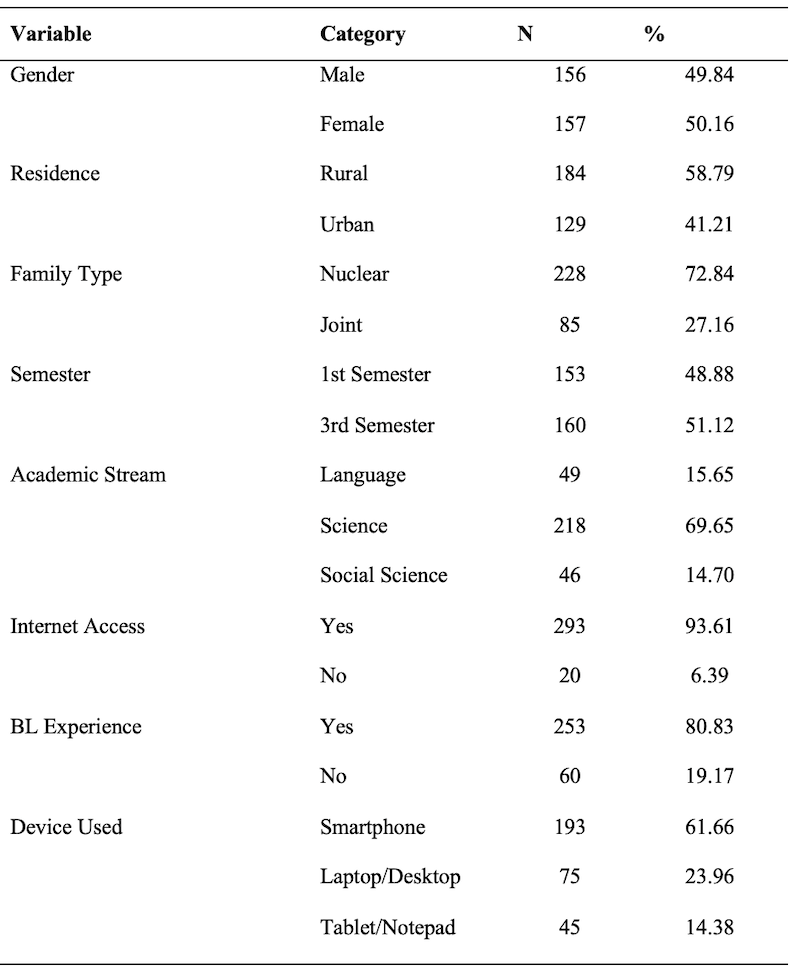
Note: Percentages might not total exactly 100 due to rounding. BL = Blended Learning.
Data were collected using an instrument — the Blended Learning Perception Scale (BLPS) — developed by the authors for the purpose of this study, comprising 21 items across seven theoretically grounded dimensions: instructional design and organisation (IDO), teaching presence (TP), social interaction (SI), technology usability (TU), cognitive engagement (CE), assessment and feedback (AF), and perceived learning outcomes (PLO) (Appendix A). The scale was developed based on prior literature aligned with the TAM and the CoI framework, and guided by the conceptual framework presented in Figure 1. Responses were recorded on a three-point Likert scale (Agree, Neutral, Disagree), which was adopted to capture overall perceptual tendencies while reducing response ambiguity and cognitive load, particularly in large-scale survey contexts (Revilla et al., 2014).
The BLPS was pilot-tested with 80 postgraduate students not included in the main sample. Internal consistency reliability was assessed using Cronbach’s alpha, and dimension-wise reliability coefficients were also computed. The results of these analyses are reported in the ‘Results’ section (Table 2). Construct validity was examined using Exploratory Factor Analysis (EFA) with Principal Axis Factoring and Promax rotation, given the theoretical interrelatedness of the constructs. The suitability of the data for factor analysis was assessed using the Kaiser-Meyer-Olkin (KMO) measure of sampling adequacy and Bartlett’s test of sphericity. Factor extraction was guided by Eigenvalues greater than one and inspection of the scree plot. The resulting factor structure and inter-factor relationships are also presented in the ‘Results’ section (Tables 3-5).
Data were collected using a structured online questionnaire administered via Google Forms. Participants were informed of the purpose of the study prior to participation, and completion of the questionnaire was voluntary. Data collection was conducted during March-April 2025. A total of 400 questionnaires were distributed, yielding 323 responses (response rate ≈ 80.75%). After screening for completeness and response consistency (e.g., removal of incomplete or invalid entries), 313 responses were retained for final analysis. All items were positively worded and scored consistently, with higher scores indicating more favourable perceptions of blended learning.
The study adhered to established ethical standards for educational research. Participants were informed about the purpose of the study, assured of anonymity and confidentiality, and participation was entirely voluntary. Completion of the questionnaire was considered as informed consent, and no personally identifiable information was collected. All ethical procedures for this study were reviewed and approved by the Research Advisory Committee, Raiganj University, India.
Data were analysed using descriptive and inferential statistical techniques aligned with the research questions. Descriptive statistics (mean and standard deviation) were computed to examine the overall level of students’ perceptions of blended learning. Independent samples t-tests were conducted to assess differences in perception across binary variables, including gender, residence, family type, semester, internet access, and prior blended learning experience. One-way analysis of variance (ANOVA) was used to examine differences across variables with more than two categories, namely academic stream (course type) and device used. Effect size indices (Cohen’s d and eta squared, η²) were calculated alongside significance testing to evaluate the magnitude of differences. Prior to inferential analysis, assumptions of normality and homogeneity of variance were assessed and found to be satisfactory, supporting the use of parametric tests. In addition, multiple regression analysis was conducted to examine the extent to which the identified dimensions of blended learning predict overall perception. The results of these analyses are presented in the ‘Results’ section (Tables 6-10).
To examine the reliability of the BLPS, Cronbach’s alpha coefficients were computed for each dimension and for the overall scale. As shown in Table 2, the BLPS demonstrated satisfactory to good internal consistency across all dimensions.
Table 2: Reliability Statistics for the BLPS
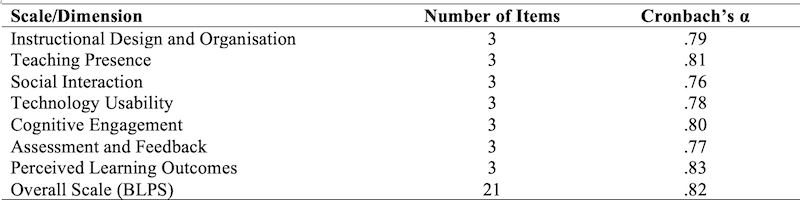
Note: Cronbach’s alpha values above .70 indicate acceptable internal consistency, while values above .80 indicate good reliability.
Prior to factor extraction, the suitability of the data for EFA was assessed using the Kaiser-Meyer-Olkin (KMO) measure and Bartlett’s test of sphericity. As reported in Table 3, both indicators confirmed the appropriateness of conducting factor analysis.
Table 3: KMO Measure and Bartlett’s Test of Sphericity for BLPS

Note: A KMO value above .80 indicates meritorious sampling adequacy. A significant Bartlett’s test (p < .05) indicates that the correlation matrix is suitable for factor analysis.
EFA using Promax rotation was conducted to examine the underlying structure of the BLPS. As illustrated in Table 4, a clear seven-factor solution emerged, corresponding to the theoretically proposed dimensions.
Table 4: Pattern Matrix for the BLPS Using Promax Rotation
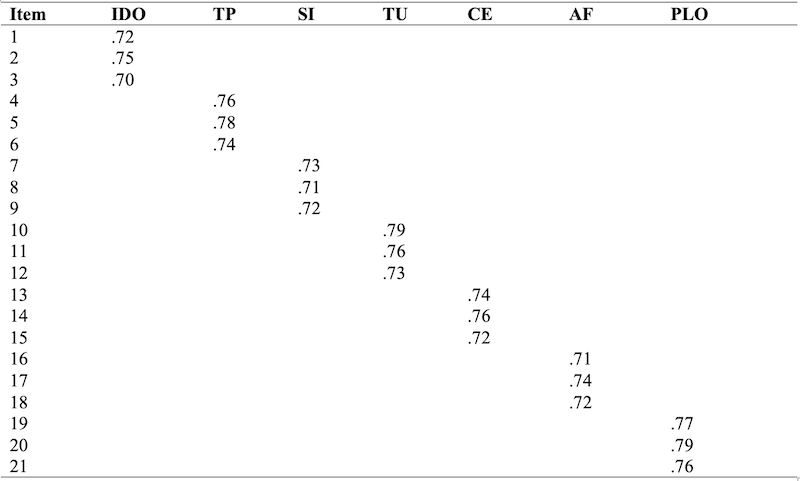
Note: Only factor loadings ≥ .40 are displayed. Promax (oblique) rotation was used.
To examine the relationships among the identified dimensions, inter-factor correlations were computed. As presented in Table 5, the correlations among factors were positive and moderate in magnitude.
Table 5: Inter-Factor Correlation Matrix for the BLPS
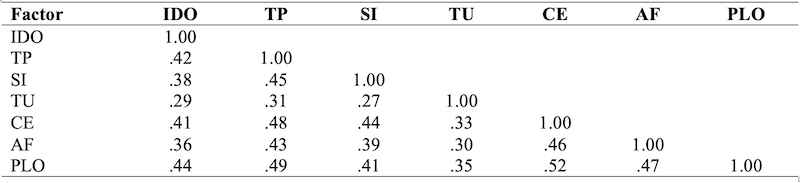
The results in Table 5 indicate that while the dimensions are meaningfully related (r = .27 to .52), they remain sufficiently distinct. This pattern supports the use of oblique (Promax) rotation and suggests that the constructs collectively contribute to an overall perception of blended learning while maintaining conceptual independence.
To examine the overall level of postgraduate students’ perceptions of blended learning, descriptive statistics were computed across the total scale and its constituent dimensions (Table 6).
Table 6: Descriptive Statistics of BLPS Scores (Dimension-wise and Total)
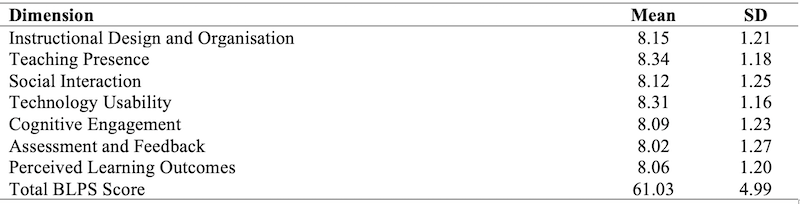
The results in Table 6 show that all dimensions exhibit comparable mean values, with Teaching Presence (M = 8.34, SD = 1.18) and Technology Usability (M = 8.31, SD = 1.16) scoring slightly higher than other domains, while Assessment and Feedback (M = 8.02, SD = 1.27) recorded the lowest mean. The total BLPS score (M = 61.03, SD = 4.99) indicates a moderate overall level of perception. The relatively low standard deviations across dimensions suggest limited dispersion, reflecting a consistent pattern of responses among participants. To further interpret the distribution of perceptions, total scores were categorised into low, moderate, and high levels. As shown in Table 7, the majority of students fell within the moderate category.
Table 7: Distribution of Postgraduate Students’ Perception Levels Toward Blended Learning

The distribution presented in Table 7 indicates that 68.89% of students demonstrated a moderate level of perception, while smaller proportions fell into the high (15.97%) and low (15.33%) categories. This pattern suggests that although blended learning is generally perceived positively, it has not yet achieved a strongly favourable evaluation among most of the students. The concentration of responses within the moderate range, combined with low variability, points to a stabilised but not fully optimised perception of blended learning experiences within the study context.
Preliminary screening indicated that the distribution of perception scores approximated normality, with skewness and kurtosis values within acceptable limits (±1), and no extreme outliers were detected. Assumptions of homogeneity of variance were satisfied for group comparisons. For the regression analysis, additional assumptions were examined, including linearity, independence of errors, homoscedasticity, and absence of multicollinearity. Diagnostic indicators (e.g., variance inflation factors within acceptable limits, VIF < 2; Durbin-Watson ≈ 2.0) suggested that these assumptions were not violated. These results supported the use of parametric statistical techniques, including independent samples t-tests, one-way ANOVA, and multiple regression analysis.
The results in Table 8 indicate that mean perception scores were comparable across all groups, with p-values exceeding .05 in each case. The observed mean differences were minimal, and corresponding effect sizes were trivial (d < 0.20), suggesting negligible practical differences between the groups. Taken together, these findings indicate that students’ perceptions of blended learning were consistent across gender, residence, family type, semester, level of internet access, and prior blended learning experience. The combination of non-significant statistical results and very small effect sizes supports the interpretation of homogeneity in perception, rather than meaningful variation attributable to these variables.
Table 8: Independent Samples t-test Results for Differences in Perception Across Demographic Variables
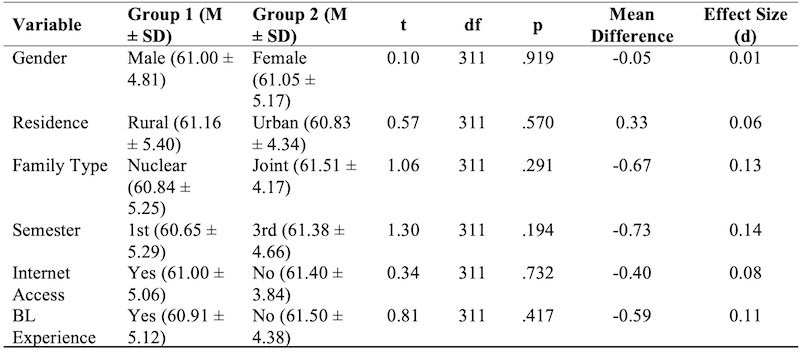
Note: M = Mean; SD = Standard Deviation; df = degrees of freedom; d = Cohen’s d (effect size). All p-values are non-significant (p > .05). Effect sizes below 0.20 indicate trivial differences.
To examine variation in perception across academic stream and device usage, descriptive statistics were computed. As shown in Table 9, mean scores across course types and device categories were broadly comparable.
Table 9: Descriptive Statistics of Perception Scores by Course Type and Device Used

Note: M = Mean; SD = Standard Deviation. Minor differences in mean scores across groups are observed.
The results in Table 9 indicate that students across all academic streams reported similar levels of perception, with only minor variations in mean scores. Likewise, perception scores were comparable across device categories (smartphone, laptop/desktop, and tablet), suggesting limited variation in perceptions across technological access conditions. To test whether these observed differences were statistically significant, one-way ANOVA was conducted. The results are presented in Table 10.
The ANOVA results in Table 10 show no statistically significant differences in perception across course types (F = 1.53, p .05) or device categories (F = 0.04, p > .05). The corresponding effect sizes were negligible (η² ≤ .01), indicating that the observed differences are not practically meaningful. Taken together, these findings suggest that students’ perceptions of blended learning did not vary significantly across academic streams or device types within the study context.
Table 10: One-Way ANOVA Results for Differences in Perception by Course Type and Device Used
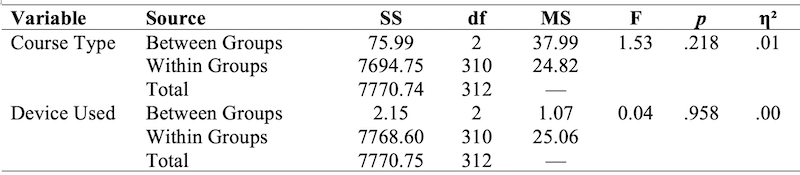
Note: SS = Sum of Squares; MS = Mean Square; df = degrees of freedom; η² = eta squared (effect size). All results are non-significant (p > .05). Effect sizes indicate negligible practical differences.
To examine the extent to which different dimensions of blended learning predict overall perception, a multiple linear regression analysis was conducted. The total BLPS score was entered as the dependent variable, and the seven dimensions were entered as predictors.
As shown in Table 11, the regression model explained 50% of the variance in students’ overall perceptions of blended learning (R² = .50). The adjusted R² (.49) indicates that the model provides a strong and stable explanation of perception scores.
Table 11: Model Summary for Multiple Regression Analysis

The ANOVA results in Table 12 indicate that the regression model is statistically significant (F = 44.87, p < .001), suggesting that the set of predictors collectively contributes to explaining variations in students’ perceptions.
Table 12: ANOVA for Regression Model

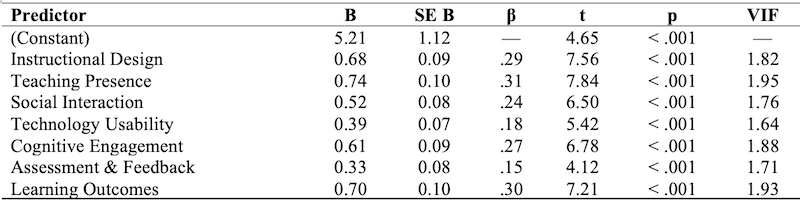
The results presented in Table 13 indicate that all seven dimensions significantly predict overall perceptions of blended learning (p < .001). Among these, teaching presence (β = .31), perceived learning outcomes (β = .30), and instructional design (β = .29) emerged as the strongest predictors. Cognitive engagement and social interaction also contributed meaningfully, while technology usability and assessment and feedback showed comparatively smaller but still significant effects. Variance inflation factor (VIF) values ranged from 1.64 to 1.95, indicating no multicollinearity concerns.
Table 13: Regression Coefficients for BLPS Dimensions
The findings demonstrate that postgraduate students reported a moderate level of perception towards blended learning (M = 61.03, SD = 4.99), with 68.89% of participants falling within the moderate category. This distribution indicates that while blended learning was generally accepted, it was not perceived as strongly effective by the majority of students. The relatively low variability suggests that this moderate perception was not incidental but reflected a stable evaluative pattern across the sample. From the perspective of the TAM and its extensions, this pattern might indicate partial alignment between perceived usefulness and actual learning experience (Davis, 1989; Kundu et al., 2022). Rather than reflecting full acceptance, students’ responses suggest a tempered evaluation shaped by both enabling and constraining aspects of blended learning environments, consistent with research showing that positive attitudes do not always translate into fully effective learning experiences (Hrastinski, 2019; Kundu, 2022; Rasheed et al., 2020). The multidimensional structure of the BLPS, supported by EFA, indicates that students’ perceptions were distributed across interconnected domains. The observed moderate inter-factor correlations (r = .27-.52) suggest that these domains operated in relation to one another rather than independently. This pattern is consistent with prior research that conceptualises blended learning as a multidimensional construct integrating pedagogical, technological, and interactional components (Boelens et al., 2017). Within the CoI model (Garrison et al., 2000), this finding suggests that teaching presence, social interaction, and cognitive engagement might jointly shape students’ evaluative responses, rather than functioning as isolated influences.
A key finding of this study is the absence of statistically significant differences across demographic, academic, and access-related variables. This indicates that students’ perceptions of blended learning were remarkably consistent across diverse learner groups. Given the heterogeneity of the sample, this consistency suggests that differences in gender, residence, academic stream, and access conditions did not meaningfully differentiate students’ evaluative responses. Rather than reflecting group-specific experiences, perceptions appear to be shaped by the shared characteristics of the blended learning environment itself. This pattern is consistent with prior research suggesting that, in technology-mediated learning contexts, students’ evaluative responses are often influenced more by instructional design and interaction quality than by individual background characteristics (Jiang et al., 2024; Sareen & Mandal, 2024). Within the present study, the absence of statistically significant differences across demographic and access-related variables suggests that variation in perception may be more closely associated with common instructional and experiential conditions than with student-specific factors.
The findings indicate that access-related variables such as internet availability and device used did not significantly influence students’ perceptions, suggesting that, within this sample, basic technological access did not function as a key differentiating factor. This pattern is consistent with emerging research indicating that, as digital access becomes more widespread in higher education, variations in students’ perceptions are less strongly associated with access conditions and more closely linked to pedagogical and experiential factors (Rasheed et al., 2020; Sareen & Mandal, 2024). At the same time, the moderate level of perception observed in this study aligns with prior work suggesting that the effectiveness of blended learning depends substantially on instructional design, quality of interaction, and learner engagement (Boelens et al., 2017; Hrastinski, 2019; Kundu et al., 2020). The present findings extend this understanding by indicating that such moderate evaluations may persist even when access-related differences are not statistically evident, pointing to the importance of factors beyond technological provision. The multidimensional structure of the BLPS further supports this interpretation, indicating that students’ perceptions are organised across multiple interrelated domains. This is consistent with theoretically grounded perspectives such as the CoI model, which emphasise the interplay between teaching presence, social interaction, and cognitive engagement in shaping meaningful learning experiences. The observed inter-factor relationships in this study reinforce the view that blended learning operates as an integrated pedagogical system, where instructional, interactional, and engagement-related components collectively contribute to students’ evaluative perceptions.
Building on the descriptive and inferential findings, the regression analysis provides deeper insight into the factors shaping students’ perceptions. The model explained a substantial proportion of variance in perception (R² ≈ .50), indicating that the identified dimensions collectively offer a strong explanatory framework. Among the predictors, teaching presence, perceived learning outcomes, and instructional design emerged as the strongest contributors, while cognitive engagement and social interaction also showed meaningful effects. In contrast, technology usability and assessment-related factors demonstrated comparatively smaller, though still significant, contributions. These findings extend the descriptive results by indicating that students’ perceptions are not uniformly associated with all dimensions, but appear to be more strongly linked to pedagogical and outcome-oriented factors. This pattern is consistent with prior research suggesting that the effectiveness of blended learning is shaped more by instructional design and interaction quality than by technological features (Hrastinski, 2019; Garrison & Vaughan, 2008; Rasheed et al., 2020). This suggests that the perceived effectiveness of blended learning is driven more by how learning is designed and facilitated than by technological features alone.
The regression findings provide insights into the complementary roles of the CoI framework and the TAM in explaining blended learning perceptions. Constructs related to teaching presence and interaction emerged as significant predictors, highlighting the importance of experiential dimensions of learning. In parallel, the contribution of perceived learning outcomes reflects the relevance of evaluative judgments associated with perceived usefulness. Taken together, the findings suggest that these frameworks can be understood as addressing different but related aspects of perception: CoI-oriented constructs capture experiential processes, whereas TAM-related constructs reflect evaluative orientations. Rather than operating independently, the results indicate a complementary relationship between these domains. Accordingly, the study contributes to theory by suggesting an integrated perspective in which experience-based processes and acceptance-based evaluations jointly inform students’ perceptions of blended learning.
The findings indicate that improving blended learning requires attention not only to access but also to the quality of instructional and interactional design. Given that perceptions did not vary significantly across student groups, improvements in these areas are likely to benefit a broad range of learners. The regression results further suggest that institutional efforts should prioritise strengthening teaching presence, improving instructional design, and enhancing perceived learning outcomes, as these factors exert the strongest influence on students’ perceptions. While technological infrastructure remains important, it may not be sufficient to improve students’ experiences in the absence of strong pedagogical design.
For higher education institutions, this implies a need to:
This study is based on data from a single institution, which may limit generalisability. The cross-sectional design also restricts causal interpretation. While the BLPS demonstrated satisfactory psychometric properties, further validation using confirmatory approaches is recommended. Future research may extend these findings by:
In addition, future studies could build on the regression findings by examining potential mediating or moderating relationships among key dimensions, providing a more nuanced understanding of how blended learning experiences are structured.
This study examined postgraduate students’ perceptions of blended learning in an Indian higher education context. The findings indicate that perceptions are moderate, suggesting general acceptance alongside scope for improvement in perceived effectiveness. Perceptions were broadly consistent across demographic, academic, and access-related groups, indicating limited variation within the sample. The results support a multidimensional view of perception, with factor analysis identifying interconnected domains related to instructional design, interaction, engagement, and learning outcomes. Regression findings further suggest that these dimensions contribute unevenly, with instructional design and teaching-related factors showing comparatively stronger associations with overall perception than technology-related aspects. This highlights the importance of pedagogical design and facilitation in shaping how blended learning is evaluated by students. By developing and applying the BLPS, the study offers a structured approach to capturing these dimensions. While the findings are context-specific, they underscore the value of addressing both pedagogical and technological aspects when evaluating and enhancing blended learning environments.
Acknowledgement: This study was conducted as part of the PhD research work of Prasenjit Das under the supervision of Pranab Barman, Department of Education, Raiganj University, India. The authors acknowledge all participants for their respective contributions.
Conflict of Interest: The authors declare that there is no conflict of interest.
Funding: No external funding was received for this study.
Data Availability Statement: The data supporting the findings of this study are available from the corresponding author upon reasonable request.
Adhya, D.H., & Panda, S. (2026). An integrative systematic review analysis of research on technology-enabled self-regulated learning and personalised learning. Smart Learning Environments, 13(1), 1-26. https://doi.org/10.1186/s40561-025-00428-8
Adhya, D., & Panda, S. (2022). Teacher educators’ attitude towards technology-enabled learning and its incorporation into teaching-learning during and post-pandemic. Educational Media International, 59(2), 131-149. https://doi.org/10.1080/09523987.2022.2101204
Almaiah, M.A., Al-Khasawneh, A., & Althunibat, A. (2020). Exploring the critical challenges and factors influencing the e-learning system usage during COVID-19 pandemic. Education and Information Technologies, 25, 5261-5280. https://doi.org/10.1007/s10639-020-10219-y
Boelens, R., de Wever, B., & Voet, M. (2017). Four key challenges to the design of blended learning: A systematic literature review. Educational Research Review, 22, 1-18. https://doi.org/10.1016/j.edurev.2017.06.001
Davis, F.D. (1989). Perceived usefulness, perceived ease of use, and user acceptance of information technology. MIS Quarterly, 13(3), 319-340. https://doi.org/10.2307/249008
Garrison, D.R., Anderson, T., & Archer, W. (2000). Critical inquiry in a text-based environment: Computer conferencing in higher education. The Internet and Higher Education, 2(2-3), 87-105. https://doi.org/10.1016/S1096-7516(00)00016-6
Garrison, D.R., & Vaughan, N.D. (2008). Blended learning in higher education: Framework, principles, and guidelines. Jossey-Bass.
Government of India. (2020). National education policy 2020. Ministry of Education. https://www.education.gov.in/sites/upload_files/mhrd/files/NEP_Final_English_0.pdf
Graham, C.R. (2006). Blended learning systems: Definition, current trends, and future directions. In C.J. Bonk & C.R. Graham (Eds.), The handbook of blended learning (pp. 3-21). Pfeiffer.
Hrastinski, S. (2019). What do we mean by blended learning? Tech Trends, 63(5), 564-569. https://doi.org/10.1007/s11528-019-00375-5
Jiang, Q., Zhang, Y., Wei, W., & Gu, C. (2024). Evaluating technological and instructional factors influencing the acceptance of AIGC-assisted design courses. Computers and Education Artificial Intelligence, 7, 100287. https://doi.org/10.1016/j.caeai.2024.100287
Kundu, A. (2022). Effect of teachers’ self-efficacy and self-concept on their perceived ease of ICT use [Doctoral Dissertation, Bankura University]. http://hdl.handle.net/10603/458136
Kundu, A., (2018). Blended learning in Indian elementary education: Problems and prospects. Journal of Online Learning Research, 4(2), 199-227. https://www.learntechlib.org/primary/p/180971/
Kundu, A., & Bej, T. (2021). COVID-19 response: Students’ readiness for shifting classes online. Corporate Governance, 21(6), 1250-1270. https://doi.org/10.1108/CG-09-2020-0377
Kundu, A., Bej, T. & Rice, M. (2020). Time to engage: Implementing math and literacy blended learning routines in an Indian elementary classroom. Education and Information Technologies, 26, 1201-1220. https://doi.org/10.1007/s10639-020-10306-0
Kundu, A., Dey, K.N., & Bej, T. (2022). Subject-self affecting on teachers' perceived ICT usability: A proposition for TAM3+. International Journal of Distance Education Technologies, 20(1), 1-24. http://doi.org/10.4018/IJDET.295980
Mustafa, M.Y., Tlili, A., Lampropoulos, G., Huang, R., Jandrić, P., Zhao, J., Salha, S., Xu, L., Panda, S. Kinshuk, Lopez‑Pernas, S., & Saqr, M. (2025). A systematic review of literature reviews on Artificial Intelligence in Education (AIED): A road map to a future research agenda. Smart Learning Environments, 11(59). https://doi.org/10.1186/s40561-024-00350-5
Rasheed, R.A., Kamsin, A., & Abdullah, N.A. (2020). Challenges in the online component of blended learning: A systematic review. Computers & Education, 144, 103701. https://doi.org/10.1016/j.compedu.2019.103701
Revilla, M., Saris, W., & Krosnick, J.A. (2014). Choosing the number of categories in agree-disagree scales. Sociological Methods & Research, 43(1), 73-97. https://doi.org/10.1177/0049124113509605
Sareen, S., & Mandal, S. (2024). Challenges of blended learning in higher education across Global North and South: A systematic and integrative literature review. Social Sciences & Humanities Open, 10, 101011. https://doi.org/10.1016/j.ssaho.2024.101011
Tlili, A., Shehata, B., Salha, S., Bozkurt, A., Mishra, S, Panda, S., Huang, R., & Altinay, F. (2024). A 60 years analysis of blended learning: Path towards clarity or obscurity in distance learning? In S. Panda, S. Mishra & P. Misra (Eds.) (2024). Case studies on blended learning in higher education: Policy, planning, and quality assurance. Springer. https://link.springer.com/book/9789819793877
Vaughan, N. (2014). Student engagement and blended learning: Making the assessment connection. Education Sciences, 4(4), 247-264. https://doi.org/10.3390/educsci4040247
Zawacki-Richter, O., Marín, V.I., Bond, M., & Gouverneur, F. (2019). Systematic review of research on artificial intelligence applications in higher education. International Journal of Educational Technology in Higher Education, 16(1), 1-27. https://doi.org/10.1186/s41239-019-0171-0
Author Notes
Prasenjit Das is a PhD scholar at Raiganj University, West Bengal, India. His research focuses on higher education students’ perceptions of blended learning. He has published 15 peer-reviewed research articles and contributed seven chapters to edited volumes in the field of education. Additionally, he has presented 12 research papers at various conferences and seminars. He is the author of a textbook titled Inclusive education. His academic interests include Educational Technology. Email: pdas1534@gmail.com (https://orcid.org/0000-0003-0243-4710)
Dr. Pranab Barman is an Assistant Professor of the Department of Education at Raiganj University, West Bengal, India. His research has been published in over 40 peer-reviewed national and international journals, and he has delivered several presentations at national and international conferences and seminars. He has also edited several books and authored textbooks entitled Learning resource and classroom management and Educational sociology. Email: pbarmanskbu@gmail.com (https://orcid.org/0000-0002-3783-0097)
Dr. Arnab Kundu is a researcher specialising in educational technology. He earned his PhD from Bankura University and has postdoctoral research experience at the Tata Institute of Social Sciences, Mumbai, India. His research focuses on pedagogical challenges in under-resourced educational contexts. He has authored 36 research papers published exclusively in SCOPUS-indexed international journals, including 15 in Q1-ranked from reputable publishers such as Springer, Sage, Taylor & Francis, IGI Global, Emerald, and Inderscience. Email: arnab.kundu@ierp.org.in (https://orcid.org/0000-0002-2291-5741)
Cite as: Das, P., Barman, P., & Kundu, A. (2026). Students’ perceptions of blended learning in higher education: A multidimensional analysis. Journal of Learning for Development, 13(2), 230-245.
Blended Learning Perception Scale (BLPS)
A. Instructional Design and Organisation
1. The structure of blended learning activities is clearly organised.
2. Online and face-to-face components are effectively integrated.
3. Learning objectives are clearly communicated across learning modes.
B. Teaching Presence
4. Instructors provide clear guidance in blended learning activities.
5. Instructors effectively facilitate both online and offline learning.
6. Instructors provide timely and meaningful academic support.
C. Social Interaction
7. Blended learning promotes meaningful interaction with peers.
8. I feel a sense of connection with other learners in blended classes.
9. Collaborative activities enhance my learning experience.
D. Technology Usability
10. The digital tools used in blended learning are easy to access.
11. I can use online learning platforms without difficulty.
12. Technical issues rarely disrupt my learning experience.
E. Cognitive Engagement
13. Blended learning encourages me to think critically about course content.
14. I actively engage with learning tasks in blended environments.
15. Blended learning motivates me to participate in learning activities.
F. Assessment and Feedback
16. Assessment methods are well aligned with learning objectives.
17. Feedback provided supports my learning effectively.
18. Evaluation methods accurately reflect my understanding.
G. Perceived Learning Outcomes
19. Blended learning enhances my understanding of course content.
20. It helps me learn at my own pace and convenience.
21. Blended learning improves my overall academic performance.