Saban Bon, Tive Sorn and Vannak Sao
2026 VOL. 13, No. 2
Abstract: Self-Directed Learning (SDL) with technology plays a significant role in preparing secondary school students to become lifelong learners in today's technological world. Yet, less research has been conducted to investigate this construct among this group of students. This study, therefore, aimed to investigate the levels of secondary school students’ SDL with technology, their perceptions of the roles of technology in their SDL, and the factors influencing it. A survey questionnaire was adopted to collect the data from 238 students, followed by semi-structured interviews with 12 students studying at a public secondary school in Cambodia. The study found that although students had positive perceptions of the role of technology in their SDL, particularly in terms of flexibility in learning, offering various learning resources, and enhancing cross-cultural knowledge, the level of students’ SDL with technology was not very high. The study yielded four main factors influencing this: a reliable internet connection, classroom experience with technology integration, knowledge of educational technology that could enable their SDL, and supporting technological devices. The findings of this study could provide an overall view of factors contributing to the promotion of SDL with technology among Cambodian secondary school students.
Keywords: self-directed learning, self-directed learning with technology, factors influencing self-directed learning with technology
Self-directed learning (SDL), necessitating students to independently explore and determine their learning objectives and strategies while integrating diverse learning opportunities and resources throughout their educational journey, has become a cornerstone of lifelong learning. SDL enables personalised and adaptable learning, and, thus, students, as self-directed learners, actively discover and customise their personal learning processes and outcomes (Aulakh et al., 2025; Knowles, 1975; Netasit et al., 2025; Shouchao et al., 2026; Zhao et al., 2024). This is highly significant for lifelong learners who continue to learn beyond the school setting. In Cambodia, to prepare students for a constantly changing world, fostering lifelong learners through SDL has become the main agenda in education policies (e.g., the Ministry of Education, Youth and Sport [MoEYS], 2004, 2019, 2021, 2024).
In this digital age, technology has become an important component of teaching and learning. For instance, with technology students can develop their intercultural knowledge (Bon & Inpin, 2024), which is essential for students in today’s world of mobility, migration, and globalisation (Bon, 2022). However, Shouchao et al. (2026) noted that there is ongoing discussion in academia over the effectiveness of digital technology in supporting students' SDL. In addition, students’ perception of technology could determine their behaviour in adopting technology, but little is known about how Cambodian students actually utilise these tools in their SDL and the factors associated with their SDL using technology. Therefore, this study aimed to investigate three main variables: secondary school students’ perceptions of technology in their SDL learning, the levels of their SDL with technology, and the factors influencing their SDL using technology.
This study is based on Knowles’ (1975) conceptualisation of SDL as a cognitive process, wherein individuals independently or with limited assistance from others engage in activities such as identifying their learning needs, setting their learning goals, selecting learning resources, implementing suitable learning strategies, and evaluating the outcomes of their learning endeavours.
While extensive research (Curran et al., 2019; Lee, 2017; Mohammadi, 2024; Nasri et al., 2020; Rashid & Asghar, 2016; Sumuer, 2018; van Woezik et al., 2019) has investigated SDL at the university level, the research conducted at the secondary education level remains scant, in particular concerning the integration of SDL with technology. Furthermore, students’ perceptions of the roles of technology in their SDL could determine their behaviour in using technological tools in their SDL. Yet, this has not been explored in the novel context of Cambodia at the secondary education levels. Therefore, the study aims to fill this gap by providing empirical evidence from a less developed context.
Self-directed learning (SDL) has become a prominent concept in the field of adult education since the 1970s (Lee, 2017; Loeng et al., 2020; Saks & Leijen, 2014; Voskamp et al., 2022). Parker and Roessger (2020) asserted that the background of SDL could be traced to the influential works of Knowles (1975), while its formalisation as a conceptual framework occurred in the 1970s under the guidance of Tough (1979). SDL presents a contrasting perspective on learning compared to traditional content-centred approaches, in which the teacher is considered to hold all the knowledge and the learner's experience is less important (Loeng et al., 2020; Robinson & Persky, 2020).
There have been some debates in the literature concerning the differences between SDL and self-regulated learning (SRL). As mentioned, SDL has been recognised as a significant concept in adult education since the 1970s. In contrast, SRL, a relatively newer concept, has its roots in educational psychology and cognitive psychology (Saks & Leijen, 2014). These two learning modes differ based on the learners’ responsibility (Boroughani et al., 2023). In SDL, students are accountable for the entire learning process (Voskamp et al., 2022), while SRL does not necessitate learners specifying their learning objectives, as they are determined by the instructor (Robinson & Persky, 2020). This could explain why the concept has been a topic of discussion in the field of adult education. Adults are expected to demonstrate greater initiative and assume more responsibility than children (Chukwunemerem, 2023).
The advent of contemporary mobile learning technologies presents students with the prospect of assuming control over the learning process, both within the confines of the classroom and beyond (Gokcearslan, 2017; Jaleel & Om, 2017). Students’ SDL is enhanced by utilising online technologies, viz. Wiki spaces, Moodle, Google Docs, and Facebook, which serve as the primary learning platforms (Sze-Yeng & Hussain, 2010); these enable them to acquire knowledge as and when required (Song & Bonk, 2016). Research has revealed that SDL exerts a substantial influence on the enduring societal requirements of our forthcoming labour force and our perception of the learning process (Timothy et al., 2010). Since SDL with technology is critically significant for students in the digital era, identifying the factors associated with it could offer insightful guidelines on how to promote SDL with technology among students.
Various factors could contribute to SDL with technology. Students’ competence in managing their learning needs and space, and accessing and making use of learning resources, could be one factor. The students’ abilities to independently guide their learning and effectively utilise available learning and accessible technology can significantly influence their overall learning effectiveness (Geng et al., 2019). In addition, students’ perception of the roles of technology in their learning could be another factor. The existing literature indicated that students' perception of the roles of technology in enhancing their learning was a crucial factor (Peart et al., 2017; Popovici & Mironov, 2015). Teaching practice could be another factor influencing students’ SDL with technology. Teachers are significant social actors who can affect students' SDL with technology for learning outside of the classroom (Lai et al., 2017). Students often need assistance, particularly when it comes to planning and reviewing SDL, and seek guidance on how to effectively utilise digital technologies for educational purposes (Morris & Rohs, 2023). Teachers can provide such assistance and guidance to support students’ SDL with technology. Although the existing literature indicates some factors influencing students’ SDL with technology, the factors associated with this construct could vary in different contexts, thereby suggesting the need for a study to be conducted in a novel setting.
The current study aimed to investigate Cambodian secondary school students’ level of SDL with technology, their perceptions of the roles of technology in their SDL, and the factors influencing it.
To attain the mentioned objectives, the study addressed the following questions:
This study employed a mixed-method case study design. The current study involved two designs, namely convergent and explanatory sequential. In the convergent design, the data from a survey and semi-structured interviews were integrated to examine the students’ SDL with technology. In the explanatory sequential design, an interview was also employed to explore the factors influencing their SDL with technology. In the interview, students were also invited to share their perspectives on the role of technology in their SDL.
Two hundred thirty-eight (238) students studying at a public secondary school located in Takeo Province, the Kingdom of Cambodia, were selected using a snowball sampling technique to obtain quantitative data through the survey questionnaire. Among the 238 students who completed the survey questionnaire concerning the level of SDL with technology, 133 (55.9%) were females, and the other 105 (44.1%) were males, and all 238 participants came from six distinct grades: Grade 7 (48), Grade 8 (62), Grade 9 (25), Grade 10 (35), Grade 11 (32), and Grade 12 (36). Twelve (N = 12) students were selected through stratified sampling to be interviewed about the factors influencing the level of SDL with technology. The stratified sampling was adopted to select a gender and grade level balance.
The survey was employed to investigate levels of SDL with technology. A face-to-face interview was adopted to explore the factors influencing SDL with technology. The survey was developed by Timothy et al. (2010). The survey consisted of six items measuring two aspects, viz. self-management and intentional learning, with a 6-point Likert scale (1 = not at all to 6 = all the time). Since most students encountered difficulties understanding the English language, the research team translated the survey questionnaires into the participants’ mother tongue (Khmer). Thus, Cronbach’s alpha was also included to test the reliability of the data. Cronbach’s alpha is the most popular method employed to examine this reliability (Hinton et al., 2014). Accordingly, the value of Cronbach’s alpha was .90 for Self-Management and .83 for Intentional Learning, which indicated high reliability (Hinton et al., 2014).
The researchers developed semi-structured interview questions. As mentioned, semi-structured interviews were utilised to collect data regarding the factors influencing students’ SDL with technology. The interviews were also conducted in the participants' and researchers’ native language (Khmer). The semi-structured interview questions were reviewed by the research committee for content validity. Creswell and Creswell (2018) proposed that during an interview, researchers could document information through various methods, including handwritten notes or audio or video recordings. In this study, both handwritten notes and audio recordings were utilised. Three researchers transcribed and translated the recorded data into English. Guest et al. (2012) claimed that validity was more essential than reliability in qualitative research, since qualitative studies seldom repeat their results and unstructured data-gathering does not yield consistent outcomes across participants or time. To ensure validity, we adopted a prolonged time period in the field and peer debriefing as suggested by Creswell & Creswell (2018).
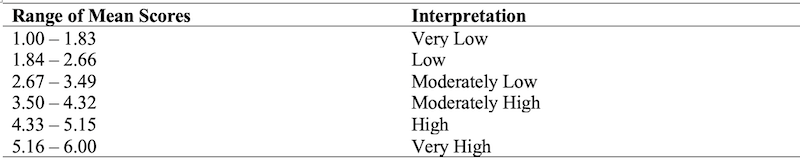
The Statistical Package for the Social Sciences 20 (SPSS 20) was adopted to analyse the data obtained from the survey questionnaires regarding the levels of secondary school students’ SDL with technology. Statistics, including Frequency Count, Percentage (%), Mean (M), and Standard Deviation (SD), were used to report the findings. The key interpretation concerning the levels of SDL with technology divided the 6-point Likert Scales (1-6) into six equal intervals (each ≈ 0.83 units wide), ranging from very low to very high, as seen in Table 1.
Table 1: Key Interpretation of the Levels of Students’ Self-Directed Learning with Technology
Coding was utilised to analyse the data from the interviews. The process of coding involves breaking down text or visual data into smaller categories, searching for evidence in different databases and ultimately assigning a label to each code (Creswell, 2012). Creswell and Creswell (2018) advised researchers to utilise computer software or manual coding; however, hand coding is time-consuming, even for multiple coders working together. Therefore, the researchers utilised the computer software MAXQDA to store the qualitative data gathered from the interviews and facilitate the coding process.
The researchers received approval for data collection from the school principals. All student participants were informed about the purpose of the research, and they were also informed that they could refuse to participate in the research if they wished to. In addition, to preserve confidentiality, the participants’ pseudonyms (Students A, B, C, etc.) were used to report the qualitative findings.
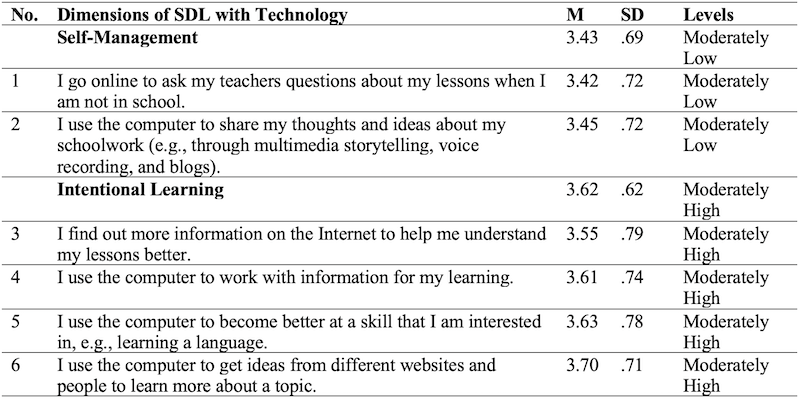
The first objective of the study was to examine the levels of students’ SDL with technology. As seen in Table 2, all participants (N = 238) rated their level of SDL with technology in Self-Management (M = 3.43; SD = .69). The results revealed that the level of students’ SDL with technology in this component was moderately low. Likewise, the M score of the two items were also similar to each other (M = 3.42 and 3.45). The students also rated the M score in Intentional Learning moderately high (M = 3.62; SD = .62). The M scores of the three items of intentional learning included Item 3 (M = 3.55; SD = .79), Item 4 (M = 3.61; SD = .74), Item 5 (M = 3.63; SD = .78), and Item 6 (M = 3.70; SD = .71).
Table 2: The Levels of Students’ Self-Directed Learning with Technology
In the interview, students were also invited to report how often they engaged in their SDL with technology, “How often do you engage in self-directed learning with technology?” The frequency was categorised as never, rarely, sometimes, often, and always. The result was comparable to the one found in the survey questionnaires. That is, among 12 students, only one (8.33%) reported that he always engaged in SDL with technology, and five (41.67%) reported that they often engaged in SDL with technology. The rest reported that they never, rarely, or only sometimes engaged in this learning construct.
This section describes the second purpose of the study, which was to investigate the students’ perceptions of the roles of technology in their SDL. Students' perceptions of the roles of technology could determine their SDL with technology. Three main themes concerning the advantages that technology offered to SDL were found, namely flexibility in learning, offering various learning sources, and enhancing cross-cultural knowledge.
Flexibility in Learning
Nine students cited the usefulness of technology in SDL in terms of flexibility in learning. That is, with technology, they could learn their school subjects or other things they wished to know at any time and from any place. For example, when asked to share their perceptions of the role of technology in their SDL, Student L responded, “For me, technology is very important for self-directed learning [SDL] because I can learn it whenever I have free time and wherever I feel comfortable learning”. To the same question, Student L replied, “With technology, I can choose my available time to explore more. For example, I can learn an English language subject at night”.
Offering Various Learning Resources
It is commonly acknowledged that with the advancement of technology, learners now have access to a wide range of learning resources to support their educational needs. Seven students accepted that technology made their SDL more convenient, as it provided them with various learning resources. For instance, Student D from Grade 8 said, “Technology is important for my self-directed learning [SDL] because it can help me search for lessons and many documents easily and at any time I want”. Likewise, Student K from Grade 12 shared a comparable perspective: “There are websites where I can search for documents and lessons easily”.
Enhancing Cross-Cultural Knowledge
The advent of digital technology has also allowed learners to learn about the different cultures of different countries around the globe. At least five students acknowledged that technology could provide them with the opportunity to gain cross-cultural knowledge. For example, Student H from Grade 10 remarked, “Because of technology, I can also learn anything I want to know, such as different cultures, different types of foods, and so on”. Similarly, Student I from Grade 11 said, “I also learn about the various cultures and languages of different countries around the world on websites and YouTube…”.
The third purpose of the study was to identify the factors influencing students’ SDL with technology. Twelve students were invited to be interviewed. Four main themes were generated from the data coding, namely, reliable internet connection, classroom experience with technology integration, knowledge of useful technology, and supporting technological devices.
Reliable Internet Connection
While technology has certainly made it more convenient for students to engage in their SDL, a reliable internet connection is essential for accessing valuable video lessons. Seven students reported experiencing difficulties while attempting to play a video lesson on Facebook and YouTube due to a subpar internet connection. For instance, when asked what the factors were that enhanced their SDL with technology, Student E from Grade 9 replied, “A Good internet connection is very important”. She added that, “Sometimes, I find it difficult to play videos on Facebook or YouTube because the internet connection at my home is not good”. Student J from Grade 11 also remarked, “I usually have a problem with the internet connection on my phone. It is very slow, which makes it difficult to watch video lessons”.
Experience in the Classroom with Technology Integration
Experience in the classroom with technology integration served as a positive factor influencing students’ SDL with technology. At least four students acknowledged that they often searched for lessons on the internet and social media when they were at home, because their teachers often introduced and used technology in teaching and learning. Student E from Grade 9 said, “My teacher recommended Facebook pages such as the Ministry of Education, Youth and Sports [MoEY] and E-School Cambodia that post video lessons”. Student G from Grade 10 also remarked, “I often try to find more video lessons on social media such as Facebook and TikTok that other teachers post.” He added that, “I know it from my teachers who introduced it in class”.
Knowledge of Useful Technology
Lack of knowledge regarding what types of technology could assist the SDL was the other negative factor influencing students’ SDL with technology. Two students, Student D from Grade 8 and Student B from Grade 7, reported that they did not know what websites or other types of technology were useful for SDL, so they rarely engaged in their SDL with technology. For example, Student D responded, “I use Facebook and Telegram every day to chat with my friends. However, I rarely use them for my self-directed learning [SDL] because I do not know what kinds of Facebook pages or websites can help my self-directed learning [SDL]”. Likewise, Student B responded, “I don’t search for the lesson I want to learn very often. After all, I don’t know many websites that can help me find what I want to learn”.
Supporting Technological Devices
Technological devices are of utmost significance in facilitating students’ SDL with technology in the modern world. The lack of supporting technological devices is a negative factor influencing students’ SDL with technology. In this study, although acknowledging that technology played a crucial role in his SDL, Student A from Grade 7 admitted, “I never searched for websites for learning or asked my teacher when I was not at school because I don’t have a smartphone”.
The study found a significant discrepancy between students' perceptions and actual practice, despite the fact that SDL is crucial for students' lifelong learning. Their SDL with technology was still low, notwithstanding their positive perceptions of technology in terms of learning flexibility, providing a variety of learning materials, and improving cross-cultural understanding. In addition, while the previous study by Hu et al. (2024) indicated that blended learning platforms promoted students' SDL in higher education, the current study found that the availability and accessibility of technology alone did not guarantee the use of technology for purposeful learning among secondary school students. The original contributions of the current study suggested that ‘knowledge of useful technology’ is another critical determinant of secondary school students’ SDL development. In addition to knowledge of useful digital tools and a dependable internet connection, the current study identified other associated factors, including prior classroom experience with technology integration and supportive technology equipment. This finding is in accordance with the previous study, which indicated that students’ SDL with and without technology was strongly correlated with classroom environment (Labonté & Smith, 2022). In particular, digital technology-supported teaching can promote SDL development (Shouchao et al., 2026). Likewise, another study (Morris & Rohs, 2023) suggested that students frequently needed assistance, particularly with the planning and evaluating parts of SDL, as well as direction on how to use digital devices for learning.
The current finding could build on the scant literature on SDL learning with technology in less developed contexts. The study identified the context-specific factors influencing SDL with technology, namely infrastructure (internet access/supporting devices), pedagogy (classroom with technology integration), and digital literacy (knowledge of useful tools). This finding also builds on a new dimension to Knowles' (1975) framework, in that SDL in developing contexts is associated with not only internal but also external support. The study by Woon and Tee (2025) also suggested that when learners were just beginning their SDL journey, external structures were crucial in offering the resources and direction required to support SDL. Since the current study found that the lack of knowledge of useful technology is a primary hindrance, MoEYS should promote SDL literacy in the national curriculum beyond availability and accessibility. Furthermore, teachers should use technology to support students' SDL and model SDL habits rather than utilising it only to deliver material. Finally, parents should be aware of the significance of home support, such as technological devices and internet access, for enhancing their children's SDL.
The study was subject to some limitations, suggesting the need for further investigation. Future studies may employ a bigger sample size, including different types of schools, and use observational methods. The prospective research should also aim to explore the strategies utilised by teachers to enhance SDL with technology. Finally, investigating the influence of students’ characteristics, such as gender and age group, on SDL with technology could be another interesting topic for further investigation
Acknowledgement: The authors would like to express their gratitude to the editor and anonymous reviewers for their valuable feedback, which greatly contributed to the improvement of this research work. They also gratefully thank the school principals who allowed data collection and the student participants who participated in this study.
Aulakh, J., Wahab, H., Richards, C., Bidaisee, S., & Ramdass, P.V.A.K. (2025). Self-directed learning versus traditional didactic learning in undergraduate medical education: A systemic review and meta-analysis. BMC Medical Education, 25(1), 70. https://doi.org/10.1186/s12909-024-06449-0
Bon, S. (2022). Developing Cambodian secondary school students’ intercultural competence: Strategies and challenges. Issues in Educational Research, 32(3), 887-905. https://www.iier.org.au/iier32/bon-abs.html
Bon, S., & Inpin, B. (2024). Roles of two PD modes in technology integration for EFL classes: Training and professional learning communities. Issues in Educational Research, 34(1), 1-18. https://www.iier.org.au/iier34/bon-abs.html
Boroughani, T., Xodabande, I., & Karimpour, S. (2023). Self-regulated learning with mobile devices for university students: Exploring the impacts on academic vocabulary development. Discover Education, 2(1), 5. https://doi.org/10.1007/s44217-023-00028-z
Chukwunemerem, O. (2023). Lessons from self-directed learning activities and helping university students think critically. Journal of Education and Learning, 12(2), Article 2. https://doi.org/10.5539/jel.v12n2p79
Creswell, J.W. (2012). Qualitative inquiry and research design: Choosing among five approaches (3rd ed.). SAage Publications, Inc.
Creswell, J.W., & Creswell, J.D. (2018). Research design: Qualitative, quantitative, and mixed methods approaches (5th ed.). Sage Publications, Inc.
Curran, V., Gustafson, D. L., Simmons, K., Lannon, H., Wang, C., Garmsiri, M., Fleet, L., & Wetsch, L. (2019). Adult learners’ perceptions of self-directed learning and digital technology usage in continuing professional education: An update for the digital age. Journal of Adult and Continuing Education, 25(1), 74-93. https://doi.org/10.1177/1477971419827318
Geng, S., Law, K.M.Y., & Niu, B. (2019). Investigating self-directed learning and technology readiness in blending learning environment. International Journal of Educational Technology in Higher Education, 16(1), 17. https://doi.org/10.1186/s41239-019-0147-0
Gokcearslan, S. (2017). Perspectives of students on acceptance of tablets and self-directed learning with technology. Contemporary Educational Technology, 8(1), Article 1. https://dergipark.org.tr/en/pub/cet/issue/29517/316725
Guest, G., MacQueen, K.M., & Namey, E.E. (2012). Applied thematic analysis. Sage Publications, Inc. https://doi.org/10.4135/9781483384436
Hinton, P.R., McMurray, I., & Brownlow, C. (2014). SPSS explained (2nd ed.). Routledge. https://doi.org/10.4324/9781315797298
Hu, L., Li, S., & Zhou, L. (2024). Effect of Tronclass combined with team-based learning on nursing students’ self-directed learning and academic performance: A pretest-posttest study. BMC Medical Education, 24(1), 752. https://doi.org/10.1186/s12909-024-05741-3
Jaleel, S., & Anuroofa, O.M. (2017). A study on the relationship between self directed learning and achievement in information technology of students at secondary level. Universal Journal of Educational Research, 5(10), 1849-1852. https://eric.ed.gov/?id=EJ1170184
Knowles, M.S. (1975). Self-directed learning: A guide for learners and teachers. Follett Publishing Company.
Labonté, C., & Smith, V.R. (2022). Learning through technology in middle school classrooms: Students’ perceptions of their self-directed and collaborative learning with and without technology. Education and Information Technologies, 27(5), 6317-6332. https://doi.org/10.1007/s10639-021-10885-6
Lai, C., Li, X., & Wang, Q. (2017). Students’ perceptions of teacher impact on their self-directed language learning with technology beyond the classroom: Cases of Hong Kong and U.S. Educational Technology Research and Development, 65(4), 1105-1133. https://doi.org/10.1007/s11423-017-9523-4
Lee, C., Yeung, A.S., & Ip, T. (2017). University English language learners’ readiness to use computer technology for self-directed learning. System, 67, 99-110. https://doi.org/10.1016/j.system.2017.05.001
Loeng, S. (2020). Self-directed learning: A core concept in adult education. Education Research International, 2020(1), 3816132. https://doi.org/10.1155/2020/3816132
MoEYS (Ministry of Education, Youth and Sport), the Kingdom of Cambodia. 2024). Education strategic plan 2024-2028. MoEYS.
MoEYS (Ministry of Education, Youth and Sport), the Kingdom of Cambodia. (2021). Cambodia secondary education blueprint 2030. MoEYS.
MoEYS (Ministry of Education, Youth and Sport), the Kingdom of Cambodia. (2019). Education strategic plan 2019-2023. MoEYS.
MoEYS (Ministry of Education, Youth and Sport), the Kingdom of Cambodia. (2004). Policy and strategies on Information and Communication Technology (ICT) in education in Cambodia. MoEYS.
Mohammadi, M. (2024). Digital information literacy, self-directed learning, and personal knowledge management in critical readers: Application of IDC theory. Research and Practice in Technology Enhanced Learning, 19, 004-004. https://doi.org/10.58459/rptel.2024.19004
Morris, T.H., & Rohs, M. (2023). The potential for digital technology to support self-directed learning in formal education of children: A scoping review. Interactive Learning Environments, 31(4), 1974-1987. https://doi.org/10.1080/10494820.2020.1870501
Nasri, N.M., Halim, L., & Abd Talib, M.A. (2020). Self-directed learning curriculum: students’ perspectives of university learning experiences. Malaysian Journal of Learning and Instruction, 17(2), 227-251. https://e-journal.uum.edu.my/index.php/mjli/article/view/mjli2020.17.2.8
Netasit, A., Intasuk, B., Teanprapakun, P., Fongkanta, P., & Buakanok, F.S. (2025). Self-directed learning development through blended learning in English opportunity expansion schools. Journal of Education and Learning, 14(6), 222-232. https://ccsenet.org/journal/index.php/jel/article/view/0/51893
Parker, D.A., & Roessger, K.M. (2020). Self-directed learning and retrieval practice: Building a bridge through functional contextualism. International Journal of Lifelong Education, 39(2), 205-218. https://doi.org/10.1080/02601370.2020.1743375
Peart, D.J., Rumbold, P.L.S., Keane, K.M., & Allin, L. (2017). Student use and perception of technology enhanced learning in a mass lecture knowledge-rich domain first year undergraduate module. International Journal of Educational Technology in Higher Education, 14(1), 40. https://doi.org/10.1186/s41239-017-0078-6
Popovici, A., & Mironov, C. (2015). Students’ perception on using elearning technologies. Procedia — Social and Behavioral Sciences, 180, 1514-1519. https://doi.org/10.1016/j.sbspro.2015.02.300
Rashid, T., & Asghar, H.M. (2016). Technology use, self-directed learning, student engagement and academic performance: Examining the interrelations. Computers in Human Behavior, 63, 604-612. https://doi.org/10.1016/j.chb.2016.05.084
Robinson, J.D., & Persky, A.M. (2020). Developing self-directed learners. American Journal of Pharmaceutical Education, 84(3). https://doi.org/10.5688/ajpe847512
Saks, K., & Leijen, Ä. (2014). Distinguishing self-directed and self-regulated learning and measuring them in the e-learning context. Procedia — Social and Behavioral Sciences, 112, 190-198. https://doi.org/10.1016/j.sbspro.2014.01.1155
Shouchao, G., Ningjie, X., & Zhenguo, X. (2026). Understanding how generative AI cultivates self-directed learning capabilities: A perspective based on digital technology evolution. Turkish Online Journal of Educational Technology — TOJET, 25(1), 157-169. https://eric.ed.gov/?id=EJ1497769
Song, D., & Bonk, C.J. (2016). Motivational factors in self-directed informal learning from online learning resources. Cogent Education, 3(1), 1205838. https://doi.org/10.1080/2331186X.2016.1205838
Sumuer, E. (2018). Factors related to college students’ self-directed learning with technology. Australasian Journal of Educational Technology, 34(4), Article 4. https://doi.org/10.14742/ajet.3142
Sze-yeng, F., & Hussain, R.M.R. (2010). Self-directed learning in a socioconstructivist learning environment. Procedia — Social and Behavioral Sciences, 9, 1913-1917. https://doi.org/10.1016/j.sbspro.2010.12.423
Timothy, T., Seng Chee, T., Chwee Beng, L., Ching Sing, C., Joyce Hwee Ling, K., Wen Li, C., & Horn Mun, C. (2010). The self-directed learning with technology scale (SDLTS) for young students: An initial development and validation. Computers & Education, 55(4), 1764-1771. https://doi.org/10.1016/j.compedu.2010.08.001
Tough, A. (1979). The adult’s learning projects: A fresh approach to theory and practice in adult learning (2nd ed.). Pfeiffer & Co.
van Woezik, T., Reuzel, R., & Koksma, J. (2019). Exploring open space: A self-directed learning approach for higher education. Cogent Education, 6(1), 1615766. https://doi.org/10.1080/2331186X.2019.1615766
Voskamp, A., Kuiper, E., & Volman, M. (2022). Teaching practices for self-directed and self-regulated learning: Case studies in Dutch innovative secondary schools. Educational Studies, 48(6), 772-789. https://doi.org/10.1080/03055698.2020.1814699
Woon, C.P., & Tee, M.Y. (2025). Navigating self-directed learning: Interaction between internal and external structures in different self-directed learning contexts. On the Horizon, 33(3), 378-395. https://doi.org/10.1108/OTH-12-2024-0089
Zhao, R., Zhuang, Y., Xie, Z., & Yu, P.L.H. (2024). Facilitating self-directed language learning in real-life scene description tasks with automated evaluation. Computers & Education, 219, 105106. https://doi.org/10.1016/j.compedu.2024.105106
Author Notes
Saban Bon earned his PhD in English for Professional Development from Mae Fah Luang University, Thailand, and his Master of Education in Educational Administration and Leadership from the Royal University of Phnom Penh, Cambodia. He is an officer at the Human Resource Department at the Ministry of Education, Youth and Sport, an associate editor with the Cambodian Education Forum (CEF; https://cefcambodia.com/), and an editor with the Cambodian Journal of Educational and Social Sciences (CJESS; https://ejournal. educationalfields.com/index.php/CJESS). His research interests include intercultural studies, teaching and learning with technology, linguistic analysis, and course book evaluation. Email: sabanbon50@gmail.com (https://orcid.org/0000-0002-8443-5145)
Tive Sorn graduated with a Masters of Education from the Royal University of Phnom Penh, Cambodia. He is a government English teacher at Sok An Kvav High School. His research interests include teaching and learning with technology, learning motivation, and educational leadership. Email: sorntive9@gmail.com (https://orcid.org/0009-0009-2787-4385)
Vannak Sao holds a Masters of Education from the Royal University of Phnom Penh. Currently, he is a PhD candidate in educational management and leadership at the National Institute of Education, Cambodia. He is a government English teacher at Prek Leap High School. He is a reviewer for the Cambodian Education Forum (CEF; https://cefcambodia.com/). His research interests are teacher professional development, lifelong learning, student motivation, technology integration, and TPACK. Email: vannaksao281@gmail.com (https://orcid.org/0009-0004-5714-0810)
Cite as: Bon, S., Sorn, T., & Sao, V. (2026). Secondary school students' self-directed learning with technology: Levels, perceptions, and influencing factors. Journal of Learning for Development, 13(2), 246-257.