Berrin Cefa, Olaf Zawacki-Richter and Aras Bozkurt
2025 VOL. 12, No. 2
Abstract: This article presents a comprehensive review of the Journal of Learning for Development (JL4D) over its first decade (2014-2024), employing bibliometric, content, and citation analyses to explore the Journal’s scholarly contributions, thematic evolution, and global impact. The findings reveal a steady increase in research output, a diversification of authorship across 55 countries, and a growing trend toward collaborative and cross-regional scholarship, particularly in response to the Covid-19 pandemic. Content analysis confirms the Journal’s sustained focus on equitable access to education, highlighting key themes such as Open Educational Resources (OER), capacity building, digital literacy, and pedagogical innovation. Citation metrics demonstrate the Journal’s expanding academic influence, with top-cited works addressing Education 4.0, social justice in open education, and teacher professional development. Beyond numerical indicators, JL4D’s true strength lies in its role as an inclusive platform bridging research, practice, and policy to support learning for development. As it enters its second decade, JL4D is well-positioned to deepen its academic impact while nurturing interdisciplinary collaborations that advance sustainable educational futures.
Keywords: open education, bibliometric analysis, content analysis, citation analysis, scholarly communication, educational development, academic publishing
The Journal of Learning for Development (JL4D) was founded on the principle that education serves as a critical catalyst for development, reflecting the Commonwealth of Learning’s (COL) overarching vision that education is central to fostering societal advancement. COL, established in 1987 by Commonwealth Heads of Government, is the only intergovernmental organisation dedicated exclusively to advancing open and distance learning worldwide (Mays, 2023). As highlighted by COL and cited in Mays (2023), Open and Distance Learning (ODL) provides flexible education designed to reduce barriers related to cost, background, personal circumstances, or accessibility. Teaching and learning have the essential role in achieving sustainable development outcomes as echoed by Education for all: Global monitoring report (2013). The 2024 SDG Progress Report (UN DESA, 2024) illustrates global education disparities: Sub-Saharan Africa experiences the largest educational gaps, including severe teacher shortages and inadequate infrastructure; Oceania (excluding Australia and New Zealand) faces the largest digital divide; India accounts for one-third of all child marriages — all highlighting the acute need for inclusive and accessible educational strategies.
Within this context, the inaugural foreword to JL4D (Kanwar, 2013) emphasised the urgent need for a global platform that bridges research innovation, and practice to promote equitable learning opportunities and support broader development goals. As Tait (2016) noted, JL4D was launched not as an addition to all other ODL journals but as an innovation in learning that aimed to contribute to social and economic development. The relevance of this vision became particularly evident during the Covid-19 pandemic, when technology-enabled learning solutions, such as MOOCs, played a crucial role in maintaining educational continuity amidst global disruption (Kanwar & Daniel, 2020). The impact of global disruptions is deeper and more intense in developing country contexts (Makoe & Olcott, 2021) and ODL becomes even more important in providing educational access to growing populations, as Tait (2018) indicated, describing the contribution of ODL in bringing access to university education to the masses and marginalised or excluded groups.
Since its inception, JL4D has steadily expanded its reach, attracting contributions from scholars across diverse regions and contexts and giving voice to regions' learning for development. In the wake of the pandemic, the Journal has further strengthened its role as a platform for cross-regional dialogue, fostering collaboration among early career researchers, independent scholars, and established academics worldwide. To situate JL4D within the broader landscape of open, distance, and digital education (ODDE), it is useful to examine the thematic directions and content patterns of other leading journals in the field. This approach helps illuminate those whose voices are represented and what kind of knowledge is prioritised within global discourses.
Across longitudinal reviews, a consistent pattern emerges: research in open, distance and educational technology journals privileges micro-level concerns while giving comparatively scant attention to institutional, cross-national or policy issues. Analyses of five flagship distance-education titles for 2000-2008 showed that nearly all the work clustered around instructional design, learner traits and interaction (Zawacki-Richter, 2009), a dominance largely replicated in a 2000-2015 follow-up of IRRODL (Zawacki-Richter et al., 2017) and in a four-decade scan of Computers & Education (Zawacki-Richter & Latchem, 2018).
Complementary studies of BJET and JETHE trace thematic drift—from early multimedia and ICT use to contemporary emphases on mobile, collaborative and AI-mediated learning—yet still situate most inquiry at the learner and classroom levels (Bond et al., 2019; Marín et al., 2018; Bond, 2024).
Regional journals exhibit the same tilt. Content analysis of TOJDE (2000-2015) found educational technology and learner characteristics far outpacing macro topics such as policy or governance (Aydin et al., 2020). Meanwhile, a mixed-methods audit of Open Praxis (2023-2024) identified three clusters—openness (macro), technology-enabled practice (meso) and human-AI symbiosis (micro)—with the strongest representation, again, at the course level, though multi-authorship is rising (Bozkurt et al., 2025).
Taken together, these studies demonstrate the power of longitudinal journal analytics to illuminate thematic trajectories, methodological shifts and collaboration patterns—and, crucially, to expose whose voices and research questions remain peripheral in the evolving knowledge landscape.
Across ODDE publishing, equity, diversity, and inclusivity remain aspirational rather than achieved. Early evidence showed a heavy concentration of authorship in five countries—the United States, Canada, the United Kingdom, Australia, and China—accounting for over 80% of the articles (Zawacki‐Richter, 2009), a Western skew echoed a decade later (Zawacki‐Richter & Latchem, 2018). Although BJET now reports 79% of recent papers had at least one non-UK author, representation from Africa (4%), South America (2%), and the Middle East (7%) remains marginal (Bond et al., 2019). Similar asymmetries surface elsewhere: ETHE has shifted from Spanish to English while enlarging its global readership (Marín et al., 2018); TOJDE draws work from 67 countries but one-third originates in Türkiye, with India, Pakistan, and Malaysia dominating the remainder (Aydin et al., 2020). Reviews of Open Praxis underline the continuing underrepresentation of Global-South scholars (Bozkurt et al., 2025), prompting calls to extend “openness” to equitable participation (Bozkurt & Gil-Jaurena, 2023). Likewise, only 8.2% of first authors in IJETHE hail from the Global South (Bond, 2024).
Recognising these gaps is particularly critical for a journal such as JL4D, which explicitly positions itself as a platform for research that advances development goals. The present analysis thus offers a timely benchmark for assessing JL4D’s role in promoting global knowledge equity and supporting a more inclusive and diverse academic discourse.
Scholarly content analyses offer critical insights into the development of academic fields, revealing methodological trends, thematic priorities, and authorship patterns. Such analyses not only map the intellectual trajectories of journals but also help to identify systemic gaps in representation and participation. To investigate the development and scholarly contributions of JL4D, the researchers of this study employed a multi-method approach combining bibliometric analysis, computer-assisted content analysis, and citation analysis across a ten-year publication span. Identifying the topics, trends, and themes is fundamental to mapping research landscapes (Lee et al., 2004), particularly when working with extensive textual corpora (Krippendorff, 2013). In this context, computer-mediated content analysis and text-mining tools enable us to delve deeper into the large body of texts and are also commonly used in the field of ODDE research (e.g., Bond, 2024; Bozkurt & Zawacki-Richter, 2021; Zawacki-Richter, 2009), offering the capacity to surface trends and patterns across large datasets.
The study integrates two complementary analytic strands. First, a bibliometric survey charts JL4D’s intellectual terrain by tracing the geographic origins of contributions, document types, and patterns of authorship. This mapping highlights leading contributors and reveals collaboration trends across the Journal’s community. Second, a computer-assisted content analysis employs Leximancer to uncover the corpus’s latent conceptual structure. Leximancer automatically detects concepts and clusters them into themes by analysing word frequencies and co-occurrences, then visualises their semantic proximity, allowing themes to surface inductively from the data (Smith & Humphreys, 2006). Together, the bibliometric and computer-assisted content analysis outputs offer a multidimensional view of how knowledge is produced and interconnected within JL4D.
In this study, the analysis was conducted on the abstracts and titles of all publications except editorials and book reviews, covering issues from Volume 1 (2014) through Volume 11 (2024). The citation analysis complemented these approaches by evaluating the Journal’s scholarly influence through citation patterns. Although citation metrics offer valuable insights, they are not without limitations; notably, they often fail to capture the qualitative motivations underpinning citation behaviour (e.g., Cronin, 2005; Nicolaisen, 2007). A high citation count does not necessarily reflect the quality of a work, as various factors beyond scholarly merit can influence citations (Garfield, 1980). However, respecting all concerns inherent to citation traditions in science, citation analysis still reflects how scholarly work circulates, indicating the impact and integration of research within the discipline (Zawacki-Richter & Anderson, 2011). For our citation analysis, we extracted citation data from Harzing’s Publish or Perish Software (2025, Version 8.17.4863.9118) to determine the most cited articles published in JL4D based on a Google Scholar search conducted on January 26, 2025.
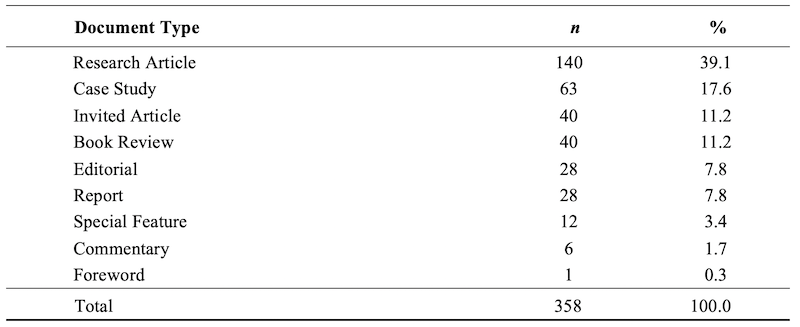
A systematic data curation process preceded the analysis to ensure the integrity and completeness of the study corpus. JL4D is an open-access journal and publishes three issues every year using different sections that include: a) an editorial, b) invited articles, c) research articles, d) case studies, e) reports from the field, f) a commentary, and g) book reviews (Table 1). Only the editorials and book reviews are not subject to the peer-review process, while all other content, including invited papers, undergoes peer review (Mishra, 2019).
The dataset for this study was manually compiled from the Journal’s website, encompassing the entire publication period between 2014 and 2024. For earlier volumes where metadata were incomplete, missing details—such as authors’ countries of affiliation—were manually retrieved through supplemental web searches. The final dataset comprised 358 publications, systematically categorised by document type, publication year, volume, issue, authorship demographics, and subject focus. Prior to analysis, all textual data were preprocessed to standardise formatting and ensure analytical consistency.
Table 1: Document Types Published in JL4D (2014-2024)
Despite offering a decade-long panorama of JL4D’s scholarly evolution, this review has several limitations to report. First, although the dataset encompasses 358 documents, some metadata—particularly authors’ countries of affiliation—had to be verified manually. This careful cross-checking reduced missing-data problems noted in earlier work (Bond, 2018), yet the process still admits possible human error, especially for authors who listed themselves as independent researchers. Second, the citation metrics were drawn from Google Scholar via Harzing’s Publish or Perish, a source that, while wide-ranging, is susceptible to indexing inconsistencies and cannot distinguish whether citations are supportive, critical, or neutral. Finally, the study could not examine gender representation because author declarations did not include gender metadata. Given evidence of enduring gender imbalances in educational-technology publishing—e.g., 61.4% of first authors in TOJDE were male (Aydin et al., 2020)—and broader findings of implicit bias (Meibauer et al., 2024; Bond, 2024), this omission is a significant limitation. We, therefore, urge journals to collect and report inclusive gender metadata—moving beyond binary categories—to enable fuller equity, diversity, and inclusion analyses in future research.
The results of this study are presented based on three analytical dimensions: contributions, citations, and content analysis.
As Kanwar (2013) stated in her Foreword, the Journal was intended to be a space for publishing research that highlights innovation in learning and its role in development. With applied research in development contexts, JL4D emphasises interventions that drive social and economic change, particularly in promoting equity and addressing issues such as poverty and unemployment. In this context, an analysis of contributions over the past ten years—including the types of publications, geographical representation, and authorship patterns (single vs. multiple authors)—provides valuable insights into the evolving research landscape of the Journal.
Over its ten-year journey, JL4D has published a total of 358 items across various categories (Figure 1). Notably, the number of research articles has increased substantially compared to the Journal’s first five years, as previously reviewed by Mishra (2019). This growth is especially evident from the onset of the Covid-19 pandemic onward, reflecting an intensified global interest in educational innovation during periods of disruption (Figure 1).
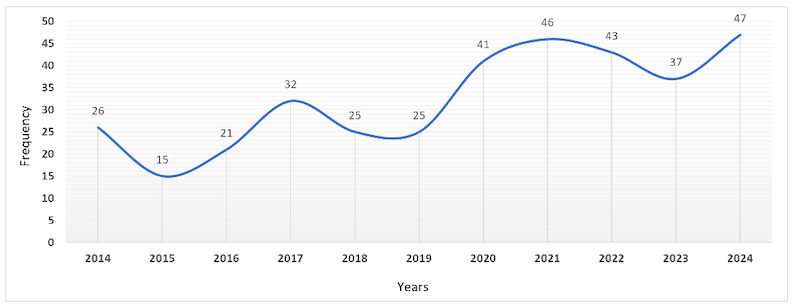
This might be well due to the need for an academic platform where those from diverse backgrounds can reflect on their explorations during the crisis. The pandemic intensified the scope and severity of already existent crises (Bozkurt et al., 2020). As the content analysis below highlighted as well, the pandemic disproportionately impacted African nations, exacerbating pre-existing challenges such as slow economic growth, poverty, a shortage of advanced skills necessary for emerging economies and escalating demand for higher education (Makoe & Olcott, 2021).
Geography: Contributions by Country
From its inception, JL4D aspired to create a collaborative scholarly space, encouraging contributions from both emerging and established researchers across diverse regional contexts (Kanwar, 2013). The vision remains evident in the Journal’s inclusive approach, which recognises that development is not a uniform process but one shaped by regional needs, economic conditions, and socio-economic realities. Therefore, the authors of this paper think it crucial to see the geographical analysis of contributions from various vantage points to picture the unique contribution of JL4D to the scholarly field.
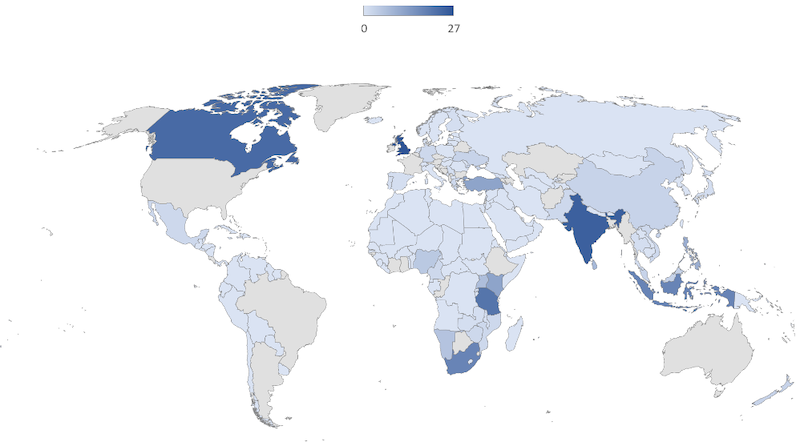
Figure 2 demonstrates the contributions from various countries. To ensure accurate country representation, the foreword/editorials and book reviews were excluded (n = 289). In addition, five entries were omitted due to untraceable affiliation information, typically because the authors self-identified as independent researchers. The final dataset comprised 284 articles, representing 55 countries over the ten-year span.
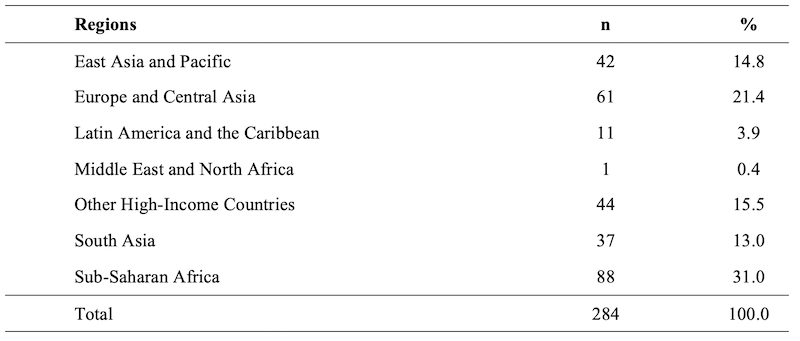
Considering the scope and aim of JL4D, we also reviewed the distribution of contributions based on the World Bank’s regional classification system (World Bank, 2025) in Table 2. This regional approach provides a meaningful framework for understanding the Journal’s global reach. Unlike traditional geographical groupings, which often focus solely on continents, the World Bank’s seven-region model acknowledges the socio-economic and developmental similarities shared by countries within these broader categories. Using this classification resonates with the Journal’s mission to highlight the role of education for development, “not only in terms of economic growth but also improvement in human welfare, quality of life and social well-being” (Kanwar, 2013, para. 3).
Sub-Saharan Africa provided the largest share of submissions (see Table 2), illustrating the Journal’s strong traction across that region. Europe, Central Asia and other high-income economies together accounted for 37% of the papers, signalling substantial engagement from the Global North. East Asia-Pacific and South Asia also featured prominently, albeit at lower levels. By contrast, Latin America and the Caribbean were scarcely represented, and contributions from the Middle East and North Africa were minimal—gaps that point to a need for proactive, region-specific outreach and collaboration initiatives.
Table 2: Contributions According to Regions (Our World in Data, 2023)
To have a more comparative view with the first five years of the Journal, Table 3 also presents the distribution of contributions from Commonwealth countries and non-Commonwealth countries.
Table 3: Contributions from Commonwealth and Non-Commonwealth Countries (adapted from Mishra, 2019)

Over the ten-year period, JL4D has continued to attract contributions from both Commonwealth and non-Commonwealth countries. Compared to the first five years, when Commonwealth countries formed a significant majority at 62.2% (Mishra, 2019), the latest data suggest an increasing presence of non-Commonwealth contributors to 49.1%. This shift highlights the Journal’s expanding international reach and its growing role as a diverse and inclusive platform for disseminating research at the intersection of learning and development.
Figure 3 presents the full list of countries that have contributed to the Journal over the past decade. The top ten contributing countries according to the country of the first authors are, respectively, the UK (n = 27), India (n = 25), Canada (n = 23), Tanzania (n = 21), Indonesia (n = 18), South Africa (n = 18), Kenya, Türkiye and the USA (n = 12), the Philippines (n = 10), and Sri Lanka (n = 8). When we apply the Pareto Principle (Juran, 1975), it is also important to note that, unlike the situation in other journals (see Bond et al., 2019; Bozkurt et al., 2025; Bozkurt & Gil-Jaurena, 2023; Zawacki‐Richter et al., 2009; Zawacki‐Richter & Latchem, 2018), most of the contributing countries are from the Global South. The orange line, climbing steeply early and leveling off with a long tail, illustrates the cumulative percentage of publications contributed by each county. This highlights both the concentration of contributions among a few countries and the broader global representation across many others. This distribution aligns with the Journal’s mission to nurture globally diverse scholarship, yet it also highlights a concentration in a handful of regions—pointing to opportunities for strategic outreach to under-represented countries (Kanwar, 2013).
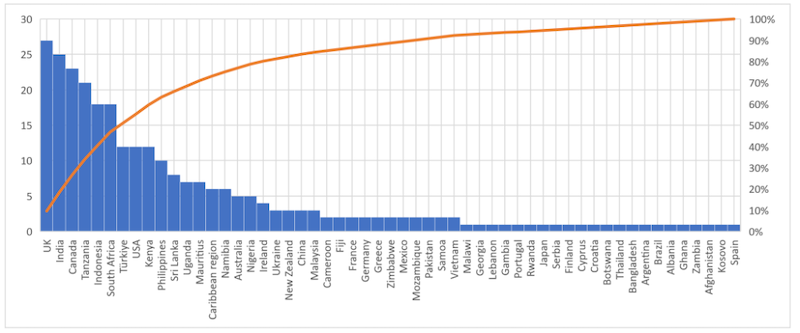
In particular, the inclusion of South Africa, Indonesia, India, Tanzania, Kenya, Türkiye, the Philippines and Sri Lanka among the top contributors suggests a significant voice from developing and emerging economies as well as densely populated countries. Table 4 shows the most contributing institutions according to the first authors’ affiliations.
Table 4: Institutional Distribution of First Author Contributions (n > 2)
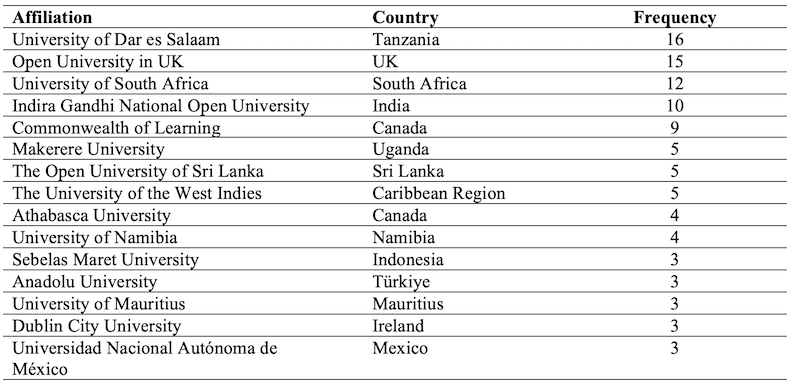
The leading contributing university was the University of Dar es Salaam, and six of the papers came from the same first author (see Table 8 in the section below, Contribution by Citation: Citation Analysis). Notably, many of these countries are home to large-scale open universities, which appear to play a critical role in their research output. For instance, the Open University in the UK (OUUK) accounted for most of the contributions. South Africa’s University of South Africa (UNISA) enrolled roughly one third of the country’s university student population. India’s Indira Gandhi National Open University (IGNOU) served over three million learners. Canada’s Athabasca University is a leading institution in distance education globally. These institutions extend access to education in underserved contexts.
This observed pattern, where developing countries with large open universities actively contribute to the discourse, slightly challenges the narrative that innovation and leadership in ODDE are confined to the Global North. As discussed by Bozkurt et al. (2019) and stressed by Kanwar et al. (2010), the flow of knowledge production has largely moved in one direction, from North to South. Yet, the prominence of institutions like UNISA and IGNOU within JL4D signals more engagement. As Wiley et al. (2014) argue, localisation and adaptation to cultural contexts are essential to contribute to development outcomes. The traditionally underrepresented in global academic discourse found representation in JL4D.
Authorship Pattern (Single vs Multiple)
An analysis of authorship patterns over the past decade reveals a notable shift toward increased collaboration, particularly since the onset of the Covid-19 pandemic in 2020 (see Table 5). Although collaborative authorship was already relatively well-established in JL4D’s early years (Mishra, 2019), the pandemic period appears to have accelerated this trend.
Table 5: Authorship Analysis by Year (Single, Two, Three and More)
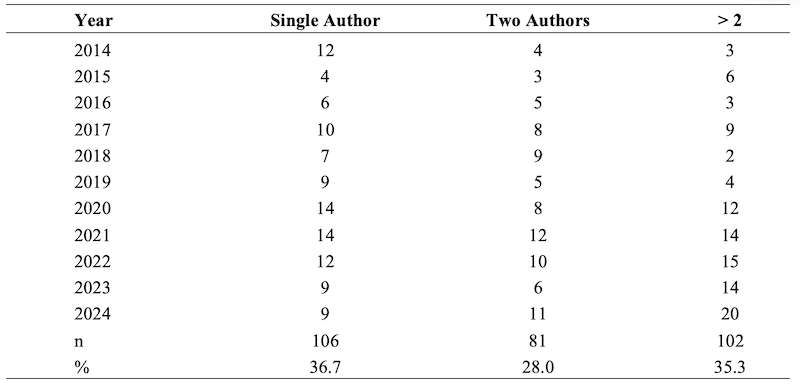
Between 2014 and 2018, the majority of published papers were authored by single individuals (n = 40; 43.96%). Nevertheless, the cumulative percentage of multi-authored papers (those authored by two or more individuals) exceeded that of single-authored papers, a pattern that Mishra (2019) interpreted as an encouraging indicator of early-stage scholarly collaboration within the Journal (p. 163).
This trajectory toward greater collaboration was further highlighted by the emergence of highly collaborative articles. Nine publications during the review period involved teams of more than five authors, reflecting more complex, multi-institutional, and sometimes cross-regional research endeavours (Table 6).
Table 6: Articles Published by a Team of More than Five Authors
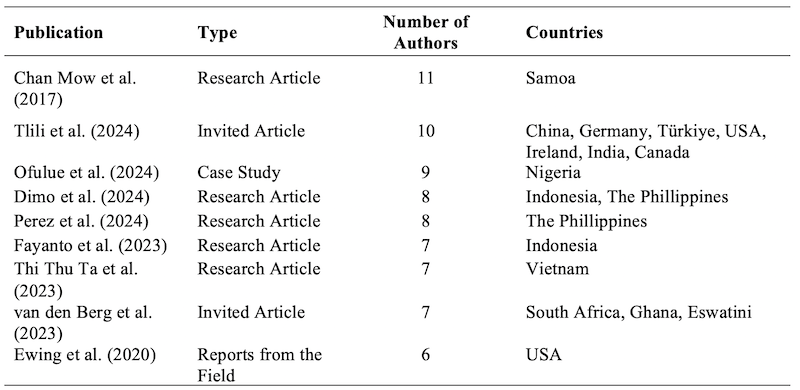
Table 6 presents noteworthy scholarly contributions by a collaborative team of more than five authors. Some publications reflect international collaborations, with contributors from multiple countries (e.g., Tlili et al., 2024), while others involve researchers from the same country or institution (e.g., Chan Mow et al., 2017). This distribution highlights the diverse nature of scholarly teamwork, spanning both multi-institutional and single-institutional studies across different regions. Although the overall number of highly collaborative publications remained relatively modest across the decade, a notable surge was observed in the last two years, during which seven such papers were published. This recent increase suggests a growing trend toward more complex and cooperative scholarly endeavours within the field of educational technologies.
From 2014 to 2024, JL4D published 262 articles that attracted a total of 3,338 Google Scholar citations—an average of 12.74 citations per paper (Table 7). The Journal’s h-index of 30 indicates that at least 30 articles have each been cited 30 times or more, while a g-index of 51 demonstrates that its most-cited work exerts an even broader influence. Together, these metrics attest to JL4D’s growing scholarly reach and its capacity to generate research that other academics consistently build upon.
Table 7: Journal Citation Metrics

Analysing the most cited articles, themes related to open education, digital learning, and pedagogical innovations emerged as central to JL4D’s scholarly influence. Notable contributions included Salmon’s (2019) exploration of “Creating education 4.0”, which led with 271 citations, and Lambert’s (2018) discussion on open education’s social justice framework, cited 248 times. Other high-impact articles addressed topics such as learning challenges during Covid-19, technology-enhanced teacher training, and the evolving role of MOOCs in education. Collectively, these influential articles highlight JL4D’s pivotal role in shaping scholarly discourse around open and distance learning, particularly in advancing global education equity and driving digital transformation initiatives.
Table 8: 20 Top-Cited Articles
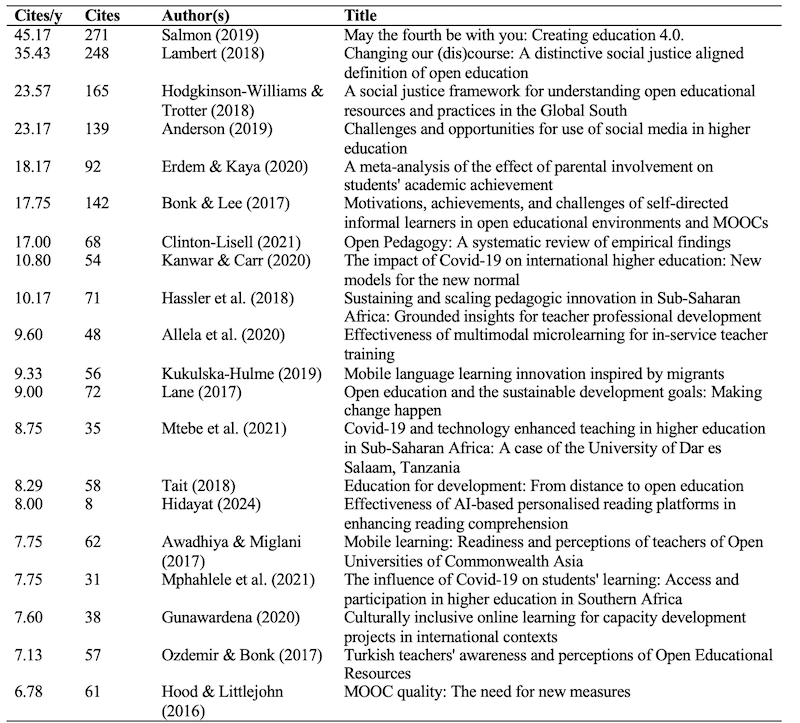
The top cited articles focus on open education, Covid-19, capacity development and innovative teaching and learning practices.
Overall Scope of the Journal (2014-2024)
An overall analysis with the text-mining tool Leximancer™ was run with titles and abstracts of all research articles, case studies, invited articles, reports, special features, and commentaries (n = 289). Editorials, book reviews, and forewords were excluded from the analysis to maintain focus on peer-reviewed scholarly contributions.
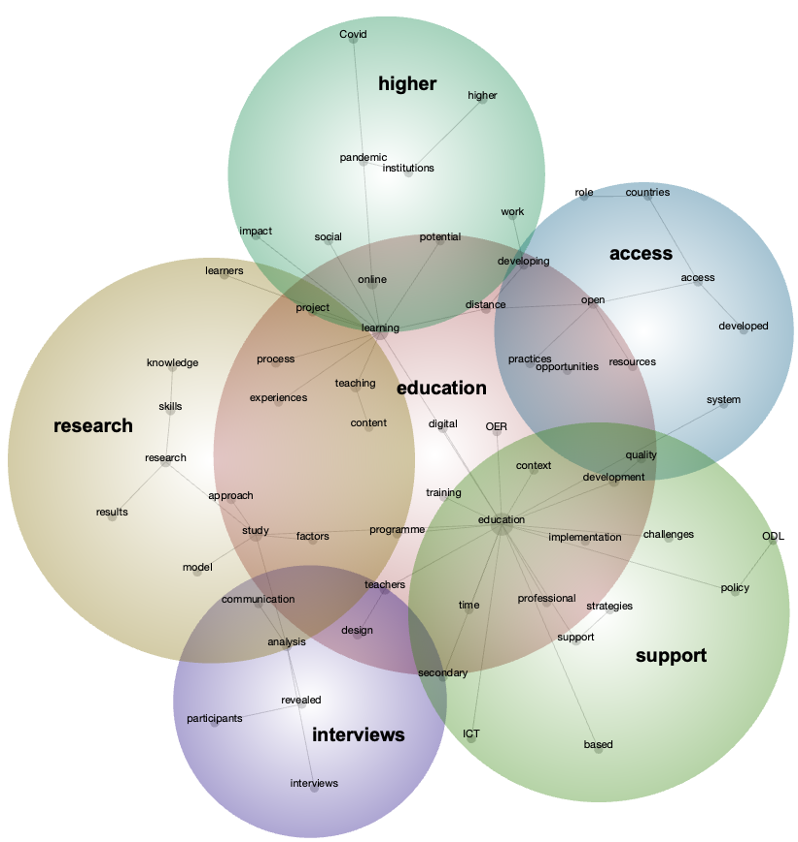
The concept map depicted in Figure 4 shows the overall thematic scope of the Journal for the whole timespan from 2014 to 2024 with six main thematic areas. In line with the Journal’s thematic aim and scope, JL4D publishes research focusing on access to learning opportunities for development in Commonwealth counties and beyond. Emphasis is placed on open and distance learning (ODL) and support systems, practices and policies in higher education settings.
As Mishra (2019) notes, “the historical focus of COL [The Commonwealth of Learning] as the sponsoring agency of the journal may influence its content largely towards open education and distance learning” (p. 167). The concept map corroborates this observation, positioning education as the central thematic hub that connects related areas such as open education, online learning, digital technologies, and the promotion of access to learning opportunities (see concept path learning – distance – open – access – countries/developed; also: digital – education – OER).
Research published in JL4D is often qualitative (see research - study - analysis - interviews) and descriptive focusing on practical cases and experiences (see learning – project – experiences).
A substantial portion of the last decade has, of course, been marked by a global disruption, the Covid-19 pandemic (see learning – online – pandemic- institutions – higher). This is also reflected in numerous publications in the light of the pandemic, which are addressed in more detail in the following analysis covering the period from 2019 to 2024.
In all, over its first decade, JL4D has coherently foregrounded open and distance learning as the linchpin of equitable development, with Leximancer analysis confirming “learning” as the hub linking openness, digital technologies, and access across Commonwealth and global contexts. Predominantly qualitative, practice-oriented studies—especially those charting pandemic-triggered shifts to online provision—signal the Journal’s agility in documenting real-world challenges. This sustained thematic clarity, combined with timely engagement with disruptive events, positions JL4D as a critical venue for scholarship that not only maps but actively shapes the evolving landscape of learning for development.
Addressing Challenges and Needs for Development (2014-2018)
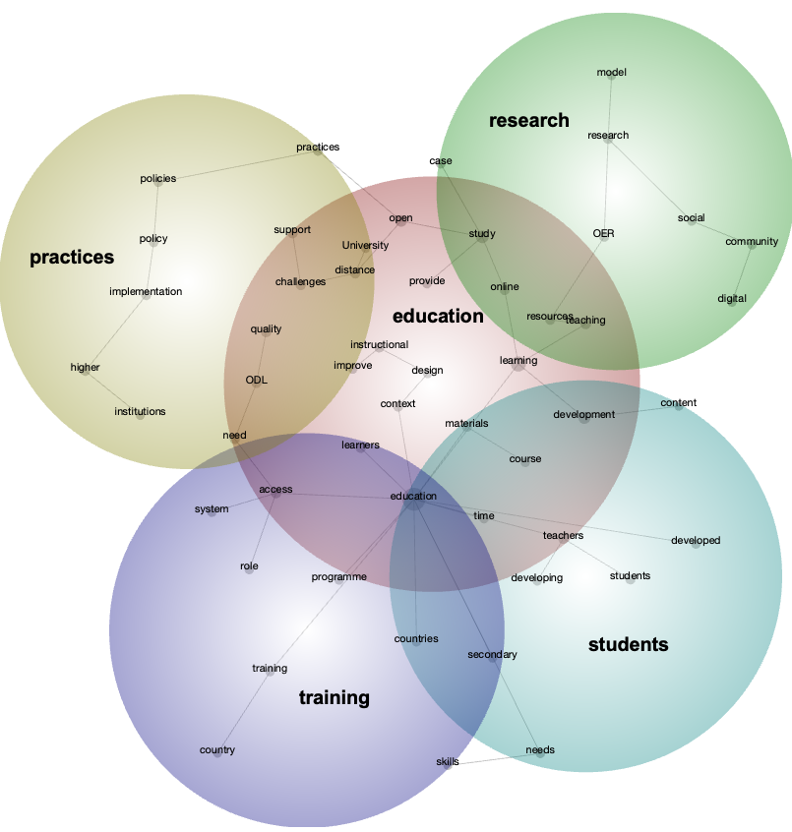
Topics and themes covered in the first five years (2014-2018) included education (100% relative count, 271 mentions in the corpus), research (14%), students (11%), practices (9%), and training (8%) (see Figure 5).
The central theme of education is linked to the instructional design and the development of learning materials for online study with particular attention to Open Educational Resources (OER) and research on their impact (see concept path education - materials - learning - teaching - resources - OER - research).
The development of learning materials on the micro level of teaching and learning is related to the concept of openness and open educational practices on the level of educational institutions. The concept of open is closely connected to distance teaching universities (see distance - University) and links education with the thematic region of practices, which deals with the practices and policies for the implementation of open and distance learning in higher education institutions (see open - practices - policies - implementation - higher - institutions).
In terms of practices, authors also investigated challenges that open and distance institutions face in the Global South to provide sufficient support for their learners and faculty members (see open - distance / university - distance - challenges - support). Surveying teachers at Indian open universities, for instance, Awadhiya and Miglani (2016) identified critical barriers to mobile learning adoption in Indian open universities, notably the lack of instructional design support and technological infrastructure.
Providing access to higher education opportunities at scale also comes with issues and the need for quality assurance that were another focus of many articles during this period (see education - access - need - ODL - quality). For example, in a comparative case study of quality assurance programmes at three open universities in Southeast Asia, Darojat et al. (2015) explored quality assurance in learner support services.
Capacity building, professional development and training programmes are seen as key to address such challenges to increase the quality of open and distance learning. Research articles dealt with the design, implementation and evaluation of training programmes in various countries (see education - programme - training - country). For example, Butcher et al. (2014) described the development of a teacher training curriculum in Guyana as part of an ICT professional development strategy, while Wolfenden et al. (2017) evaluated a large-scale MOOC adaptation initiative aimed at enhancing teacher training in India.
Responses to the Covid-19 Pandemic (2019-2024)
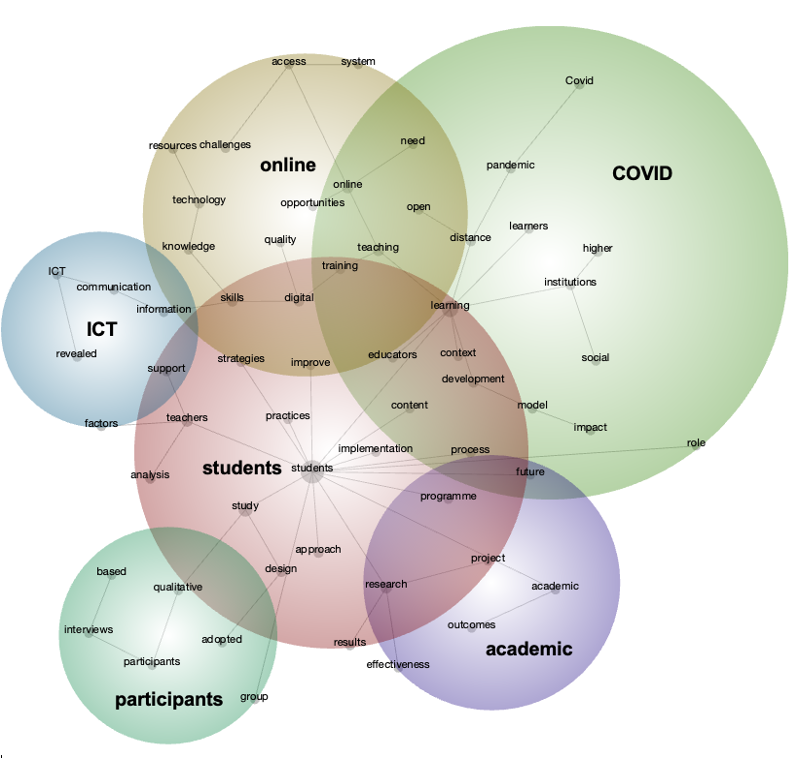
The concept maps for the time from 2019 to 2024 show six thematic regions (see Figure 6) with students (100% relative count, 703 mentions) and their online (17%) learning during the COVID (11%) pandemic at the centre using information and communication technologies (ICT, 5%; see concept path student - learning - distance - pandemic - Covid). Much of the scholarship during this period adopted qualitative methodologies to explore students’ learning environments, experiences, and perceptions through interviews and focus group discussions (see students - study - qualitative - participants - interviews). This learner-centred focus is further emphasised by Panda (2023), who highlighted the Journal's commitment to foregrounding student experiences during the pandemic.
Specific studies exemplify this shift. For example, Biccard et al. (2023) analysed written reflections from 336 students at the University of South Africa regarding their experiences with emergency online examinations. Krismanto et al. (2024) examined the transition of teacher education programmes in Indonesia from face-to-face to online formats, with particular emphasis on collaborative learning practices among teachers.
Other studies have also focused on the learning environment of students and the support provided by the social environment. For example, the study by San Jose et al. (2022) explored the roles and responsibilities of mothers as teachers of elementary grade children in the Philippines based on qualitative interviews, considering their reflections in becoming mother-teachers, and the benefits and complications in teaching their own children at home.
On the other hand, many articles also dealt with the challenges that the teachers and faculty members faced and the required resources, skills and knowledge for digital teaching (see teaching - training - digital - skills - information - communication - ICT; also: digital - skills - knowledge - technology - resources). Karunanayaka and Weerakoon (2020), from the Open University of Sri Lanka, reported on the implementation and evaluation of the Commonwealth Digital Education Leadership Training in the Action (C-DELTA) programme with 41 teachers and their schools in Sri Lanka. Despite many challenges such as inadequate ICT infrastructure, they found the teachers who participated in the intervention improved the digital literacy of the teachers (and their students).
In light of the experiences of emergency remote teaching on the macro educational systems level in Nigeria, Ofulue et al. (2024) presented a study to identify research gaps and priorities in open and distance learning to build more resilient and innovative systems. They surveyed over 300 practitioners and interviewed 26 distance education experts from Nigerian higher education institutions to reach a consensus on key research areas. Student support stood out as a critical factor in research and practice. This work is an important step towards the development of a contextualised research agenda.
Over the past decade, the Journal of Learning for Development (JL4D) has established itself as a vital platform advancing the discourse on education for development through open, distance, and digital learning. This review—encompassing bibliometric, content, and citation analyses—reveals the Journal’s growing influence, thematic depth, and expanding global reach. As the literature affirms, the Global North is leading the research publication representation. In such a context, JL4D creates space for more voices through “reports from the field” and “case study” sections from the Global South.
JL4D has demonstrated a steady increase in scholarly contributions, particularly in peer-reviewed research articles, alongside a notable rise in collaborative and cross-regional scholarship, especially following the Covid-19 pandemic. The geographic distribution of contributions, spanning 55 countries, reflects the Journal’s commitment to inclusivity and its success in expanding beyond its original Commonwealth-centric focus.
Content analysis reaffirms JL4D’s foundational commitment to fostering equitable access to education (Kanwar, 2013), with key themes centring on Open Educational Resources (OER), capacity building, digital literacy, and pedagogical innovation. During the pandemic years, the Journal served as a responsive academic forum, addressing urgent educational challenges and disseminating research that informed resilient teaching and learning practices worldwide.
Citation data further attest to the Journal’s growing scholarly impact. Top-cited articles have contributed to discussions on Education 4.0, social justice in open education, and teacher professional development. While citation metrics underscore the academic relevance of JL4D’s published work, the Journal’s true strength lies in its consistent role as a collaborative space for sharing contextually grounded, practice-oriented insights.
In alignment with its founding vision, JL4D continues to bridge research, practice, and policy by amplifying underrepresented voices and supporting scholarship that addresses critical development needs. In the face of converging global disruptions, such as climate emergencies, armed conflicts and the rapid proliferation of generative Artificial Intelligence, education systems are under unprecedented pressure. Academic journals are not merely repositories of knowledge anymore but they have become active sites of intellectual leadership. Recent initiatives highlight this collaborative momentum. Bozkurt et al. (2025), in a manifesto co-authored by more than 45 scholars across the globe, articulate a shared vision for education and call for prioritisation of equity and inclusion over efficiency. Similarly, Xiao et al. (2025) critiqued the prevailing emphasis on measurable efficiency and call for remembering the deeper purposes of education. Kanwar (in Johnson & Cefa, 2024) keeps emphasising how open and distance education harness the continuum of education especially in regions affected by inequality and climate instability. These responses are not just symbolic but also strategic, asserting academic agency against market-driven narratives. In this context, JL4D’s role extends beyond publications – it will presumably be more critical to lead pedagogical stances and mirror the cases in the praxis. As it enters its second decade, the Journal is well-positioned not only to deepen its academic impact but also to nurture interdisciplinary collaborations that advance learning for sustainable development on a global scale.
Allela, M.A., Ogange, B.O., Junaid, M.I., & Charles, P.B. (2020). Effectiveness of multimodal microlearning for in-service teacher training. Journal of Learning for Development, 7(3), 384-398. https://doi.org/10.56059/jl4d.v7i3.387
Anderson, T. (2019). Challenges and opportunities for use of social media in higher education. Journal of Learning for Development, 6(1). https://doi.org/10.56059/jl4d.v6i1.327
Awadhiya, A.K., & Miglani, A. (2016). Mobile learning: Challenges for teachers of Indian open universities. Journal of Learning for Development, 3(2). https://doi.org/10.56059/jl4d.v3i2.145
Aydin, C.H., Zawacki-Richter, O., & Bozkurt, A. (2020). A review and content analysis of the Turkish Online Journal of Distance Education publications between 2000 and 2015. EDEN Conference Proceedings, 1, 217–225. https://doi.org/10.38069/edenconf-2020-ac0020
Biccard, P., Mudau, P.K., & van den Berg, G. (2023). Student perceptions of online examinations as an emergency measure during Covid-19. Journal of Learning for Development, 10(2), 222-235. https://doi.org/10.56059/jl4d.v10i2.672
Bond, M. (2024). The International Journal of Educational Technology in higher education: Content and authorship analysis 2010-2024. International Journal of Educational Technology in Higher Education, 21(1), 60. https://doi.org/10.1186/s41239-024-00492-z
Bond, M. (2018). Helping doctoral students crack the publication code: An evaluation and content analysis of the Australasian Journal of Educational Technology. Australasian Journal of Educational Technology. https://doi.org/10.14742/ajet.4363
Bond, M., Zawacki‐Richter, O., & Nichols, M. (2019). Revisiting five decades of educational technology research: A content and authorship analysis of the British Journal of Educational Technology. British Journal of Educational Technology, 50(1), 12-63. https://doi.org/10.1111/bjet.12730
Bonk, C.J., & Lee, M.M. (2017). Motivations, achievements, and challenges of self-directed informal learners in open educational environments and MOOCs. Journal of Learning for Development, 4(1). https://doi.org/10.56059/jl4d.v4i1.195
Bozkurt, A., Jung, I., Xiao, J., Vladimirschi, V., Schuwer, R., Egorov, G., Lambert, S.R., Al-Freih, M., Pete, J., Olcott, Jr. D., Rodes, V., Aranciaga, I., Bali, M., Alvarez, A.V., Roberts, J., Pazurek, A., Raffaghelli, J.E., Panagiotou, N., Coëtlogon, P. de, … Paskevicius, M. (2020). A global outlook to the interruption of education due to COVID-19 pandemic: Navigating in a time of uncertainty and crisis. Asian Journal of Distance Education, 15(1), 1-126. https://doi.org/10.5281/ZENODO.3878572
Bozkurt, A., & Gil-Jaurena, I. (2023). Shaping the future by looking at the past of openness in education and open praxis: Rising on the shoulders of giants. Open Praxis, 15(1), 1-7. https://doi.org/10.55982/openpraxis.15.1.558
Bozkurt, A., Koseoglu, S., & Singh, L. (2019). An analysis of peer reviewed publications on openness in education in half a century: Trends and patterns in the open hemisphere. Australasian Journal of Educational Technology, 35(4). https://doi.org/10.14742/ajet.4252
Bozkurt, A., & Zawacki-Richter, O. (2021). Trends and patterns in distance education (2014-2019): A synthesis of scholarly publications and a visualization of the intellectual landscape. The International Review of Research in Open and Distributed Learning, 22(2), 19-45. https://doi.org/10.19173/irrodl.v22i2.5381
Bozkurt, A., Uçar, H., & Koçdar, S. (2025). Mapping minds in motion: A scholarly voyage and evaluation of research trends and patterns in Open Praxis. Open Praxis, 17(1), 1-8. https://doi.org/10.55982/openpraxis.17.1.896
Bozkurt, A., Xiao, J., Farrow, R., Bai, J. Y. H., Nerantzi, C., Moore, S., … Asino, T. I. (2024). the manifesto for teaching and learning in a time of generative AI: A critical collective stance to better navigate the future. Open Praxis, 16(4), 487-513. https://doi.org/10.55982/openpraxis.16.4.777
Butcher, N., Moore, A., & Hoosen, S. (2014). Harnessing OER to develop teachers: The Guyana experience. Journal of Learning for Development, 1(2). https://doi.org/10.56059/jl4d.v1i2.2
Chan Mow, I.T., Temese, E., Mose, M. N., Patu, T., Mauai, E., Sinclair, I., Lafaele, F., Namulauulu, J., Tanielu, M., Wong Soon, A., & Chan, V. (2017). An evaluation of the usefulness and ease of use of the Aptus within the Samoan education context. Journal of Learning for Development, 4(3). https://doi.org/10.56059/jl4d.v4i3.192
Clinton-Lisell, V. (2021). Open pedagogy: A systematic review of empirical findings. Journal of Learning for Development, 8(2), 255–268. https://doi.org/10.56059/jl4d.v8i2.511
Cronin, B. (2005). The hand of science: Academic writing and its rewards. Scarecrow Press.
Darojat, O., Nilson, M., & Kaufman, D. (2015). Quality assurance in Asian open and distance learning: Policies and implementation. Journal of Learning for Development, 2(2). https://doi.org/10.56059/jl4d.v2i2.105
Dimo, S., Abalayan, J.D., Celestial, E., Achas, M., Majarucon, N.J., Tolentino, R., Setiawan, E., & Lobo, J. (2024). Students’ technological readiness and online learning self-efficacy in physical education. Journal of Learning for Development, 11(3), 463-477. https://doi.org/10.56059/jl4d.v11i3.1124
Erdem, C., & Kaya, M. (2020). A meta-analysis of the effect of parental involvement on students’ academic achievement. Journal of Learning for Development, 7(3), 367-383. https://doi.org/10.56059/jl4d.v7i3.417
Ewing, H., Chickering, M., Burner, L., Keating, S.A., Berland, A., & Frank, E. (2020). Notes from the field: “Nurses International” uses OER to support nurse educators. Journal of Learning for Development, 7(3), 459–466. https://doi.org/10.56059/jl4d.v7i3.425
Fayanto, S., Ulfa, S., Praherdhiono, H., Shinta, N.D., Takda, A., Sahara, L., & Balulu, N. (2023). Design of exo physics book based on mobile application as a means of literacy learning media for remote areas in Indonesia. Journal of Learning for Development, 10(3), 411-426. https://doi.org/10.56059/jl4d.v10i3.846
Garfield, E. (1980). Citation indexing. Journal of Information Science, 2(1), 47-47. https://doi.org/10.1177/016555158000200109
GEM Report UNESCO. (2013). Education for all global monitoring report 2013/4: Teaching and learning: Achieving quality for all. GEM Report. UNESCO. https://doi.org/10.54676/CMSE2898
Gunawardena, C.N. (2020). Culturally inclusive online learning for capacity development projects in international contexts. Journal of Learning for Development, 7(1), 5-30. https://doi.org/10.56059/jl4d.v7i1.403
Harzing’s Publish or Perish Software (Version 8.17.4863.9118). (2025). [Computer software].
Hassler, B., Hennessy, S., & Hofmann, R. (2018). Sustaining and scaling pedagogic innovation in Sub-Saharan Africa: Grounded insights for teacher professional development. Journal of Learning for Development, 5(1). https://doi.org/10.56059/jl4d.v5i1.264
Hidayat, M.T. (2024). Effectiveness of AI-based personalised reading platforms in enhancing reading comprehension. Journal of Learning for Development, 11(1), 115-125. https://doi.org/10.56059/jl4d.v11i1.955
Hodgkinson-Williams, C.A., & Trotter, H. (2018). A social justice framework for understanding open educational resources and practices in the Global South. Journal of Learning for Development, 5(3). https://doi.org/10.56059/jl4d.v5i3.312
Hood, N., & Littlejohn, A. (2016). MOOC quality: The need for new measures. Journal of Learning for Development, 3(3). https://doi.org/10.56059/jl4d.v3i3.165
Johnson, K., & Cefa, B. (2024). Oral histories and engaged perspectives: In conversation with Asha Kanwar. Journal of Open, Distance, and Digital Education, 1(2), 1-10. https://doi.org/10.25619/CHFC1F44
Juran, J.M. (1975). The non-Pareto principle: Mea culpa. Quality Progress, 8(5), 8-9.
Kanwar, A. (2013). Foreword. Journal of Learning for Development, 1(1). https://doi.org/10.56059/jl4d.v1i1.37
Kanwar, A., & Carr, A. (2020). The Impact of Covid-19 on international higher education: New models for the new normal. Journal of Learning for Development, 7(3), 326-333. https://doi.org/10.56059/jl4d.v7i3.467
Kanwar, A., & Daniel, J. (2020, May). Report to Com monwealth education ministers: From response to resilience. Commonwealth of Learning. https://eric.ed.gov/?redir=http%3a%2f%2foasis.col.org%2fbitstream%2fhandle%2f11599%2f3592%2f2020_Kanwar_Report_to_Commonwealth_Education_Ministers__.pdf%3fsequence%3d5%26isAllowed%3dy _
Kanwar, A., Kodhandaraman, B., & Umar, A. (2010). Toward sustainable Open Education Resources: A perspective from the Global South. American Journal of Distance Education, 24(2), 65-80. https://doi.org/10.1080/08923641003696588
Karunanayaka, S.P., & Weerakoon, W.M.S. (2020). Fostering digital education among teachers and learners in Sri Lankan schools. Journal of Learning for Development, 7(1), 61-77. https://doi.org/10.56059/jl4d.v7i1.390
Krippendorff, K. (2018). Content analysis: An introduction to its methodology. Sage Publications.
Krismanto, W., Syawaluddin, A., Sayidiman., & Irfan, M. (2024). Teacher participation in online collaborative learning: Does it improve their teaching competency? Journal of Learning for Development, 11(2), 220–236. https://doi.org/10.56059/jl4d.v11i2.1141
Kukulska-Hulme, A. (2019). Mobile language learning innovation inspired by migrants. Journal of Learning for Development, 6(2). https://doi.org/10.56059/jl4d.v6i2.349
Lambert, S.R. (2018). Changing our (dis)course: A distinctive social justice aligned definition of open education. Journal of Learning for Development, 5(3). https://doi.org/10.56059/jl4d.v5i3.290
Lane, A. (2017). Open education and the sustainable development goals: Making change happen. Journal of Learning for Development, 4(3). https://doi.org/10.56059/jl4d.v4i3.266
Lee, Y., Driscoll, M.P., & Nelson, D.W. (2004). The past, present, and future of research in Distance Education: Results of a content analysis. American Journal of Distance Education, 18(4), 225-241. https://doi.org/10.1207/s15389286ajde1804_4
Makoe, M., & Olcott, D. (2021). Leadership for development: Re-shaping higher education futures and sustainability in Africa. Journal of Learning for Development, 8(3), 487-500. https://doi.org/10.56059/jl4d.v8i3.569
Marín, V.I., Duart, J.M., Galvis, A.H., & Zawacki-Richter, O. (2018). Thematic analysis of the International Journal of Educational Technology in Higher Education (ETHE) between 2004 and 2017. International Journal of Educational Technology in Higher Education, 15(1), 8, s41239-018-0089-y. https://doi.org/10.1186/s41239-018-0089-y
Mays, T. (2023). Challenges and opportunities for open, distance, and digital education in the Global South. In O. Zawacki-Richter, & I. Jung (Eds.), Handbook of open, distance and digital education (pp. 321–336). Springer Nature Singapore. https://doi.org/10.1007/978-981-19-2080-6_20
Meibauer, G., Phull, K., Alejandro, A., & Ciflikli, G. (2024). Alternative metrics, traditional problems? Assessing gender dynamics in the altmetrics of political science. European Political Science, 23(2), 179–198. https://doi.org/10.1057/s41304-023-00431-y
Mishra, S. (2019). Early years of the Journal of Learning for Development: A combination of bibliometrics and thematic analysis. Journal of Learning for Development, 6(2). https://doi.org/10.56059/jl4d.v6i2.331
Mphahlele, R., Seeletso, M., Muleya, G., & Simui, F. (2021). Influence of Covid-19 on students’ learning: Access and participation in higher education in Southern Africa. Journal of Learning for Development, 8(3), 501–515. https://doi.org/10.56059/jl4d.v8i3.515
Mtebe, J.S., Fulgence, K., & Gallagher, M. (2021). COVID-19 and technology enhanced teaching in higher education in Sub-Saharan Africa: A case of the University of Dar es Salaam, Tanzania. Journal of Learning for Development, 8(2), 383-397. https://doi.org/10.56059/jl4d.v8i2.483
Nicolaisen, J. (2007). Citation analysis. Annual Review of Information Science and Technology, 41(1), 609-641. https://doi.org/10.1002/aris.2007.1440410120
Ofulue, C., Opateye, J., Awolumate, S., Olakulehin, F.K., Adesina, A., Yabo, A.M., Ugoala, B., Oluyide, O., & Ojedeji., S. (2024). Developing a research agenda for resilient systems and innovative practices in ODeL: Findings from a national study. Journal of Learning for Development, 11(2), 323–348. https://doi.org/10.56059/jl4d.v11i2.1045
Our World in Data – processed by Our World in Data. (2023). World regions according to WB [dataset]. Our World in Data, “Regions” [original data]. World regions according to the World Bank. https://ourworldindata.org/grapher/world-regions-according-to-the-world-bank
Ozdemir, O., & Bonk, C. (2017). Turkish teachers’ awareness and perceptions of Open Educational Resources. Journal of Learning for Development, 4(3). https://doi.org/10.56059/jl4d.v4i3.224
Panda, S. (2023). Editorial: Learners as focus in ‘Learning for Development’ (L4D). Journal of Learning for Development, 10(3), i-iv. https://doi.org/10.56059/jl4d.v10i3.1259
Perez, C., Alvarez, J.J., Carbungco, A., Due, J., Ochoa, C.M., Celis, M.L., & Lobo, J. (2024). Relationship between online game addiction and mental well-being of high-school students during the Covid-19 pandemic: Implications for learning and development. Journal of Learning for Development, 11(2), 289-303. https://doi.org/10.56059/jl4d.v11i2.1101
Salmon, G. (2019). May the fourth be with you: Creating Education 4.0. Journal of Learning for Development, 6(2). https://doi.org/10.56059/jl4d.v6i2.352
San Jose, A., Concepcion, M.G.R., & San Jose, B. (2022). Mothers as teachers: The new role of mothers in the new normal. Journal of Learning for Development, 9(2), 351-362. https://doi.org/10.56059/jl4d.v9i2.566
Smith, A.E., & Humphreys, M.S. (2006). Evaluation of unsupervised semantic mapping of natural language with Leximancer concept mapping. Behavior Research Methods, 38(2), 262-279. https://doi.org/10.3758/BF03192778
Tait, A.W. (2018). Education for development: From distance to open education. Journal of Learning for Development, 5(2). https://doi.org/10.56059/jl4d.v5i2.294
Tait, A.W. (2016). From the emeritus editor…. Journal of Learning for Development, 3(2), 3-6. https://doi.org/10.56059/jl4d.v3i2.151
Thi Thu Ta, H., Thai Le, H., Nguyen, C.H., Quy Nguyen, T., Thi Tuyet Pham, N., Thi Pham, H., & Thi Trinh, N. (2023). Students’ perception of quality assurance in higher education in Vietnam: Empirical evidence and implications for face-to-face and alternative modes of learning. Journal of Learning for Development, 10(1), 91-108. https://doi.org/10.56059/jl4d.v10i1.737
Tlili, A., Agyemang Adarkwah, M., Lo, C.K., Bozkurt, A., Burgos, D., Bonk, C.J., Costello, E., Mishra, S., Stracke, C. M., & Huang, R. (2024). Taming the monster: How can open education promote the effective and safe use of generative AI in education? Journal of Learning for Development, 11(3), 398-413. https://doi.org/10.56059/jl4d.v11i3.1657
UN DESA. (2024, June). The sustainable development goals report 2024. https://unstats.un.org/sdgs/report/2024/
Wiley, D., Bliss, T.J., & McEwen, M. (2014). Open Educational Resources: A review of the literature. In J.M. Spector, M.D. Merrill, J. Elen, & M.J. Bishop (Eds.), Handbook of research on educational communications and technology (pp. 781-789). Springer New York. https://doi.org/10.1007/978-1-4614-3185-5_63
Wolfenden, F., Cross, S., & Henry, F. (2017). MOOC adaptation and translation to improve equity in participation. Journal of Learning for Development, 4(2). https://doi.org/10.56059/jl4d.v4i2.209
World Bank. (2025). Poverty and inequality platform methodology handbook. Edition 2025-06. https://datanalytics.worldbank.org/PIP-Methodology/lineupestimates.html#regionsandcountries
van den Berg, G., Mudau, P.K., Maphosa, C., Amponsah, S., Manditereza, B., Van Der Merwe, J., & Mongwe, S. (2023). Critical reflection by mature students as co-developers of an open educational resource in foregrounding their learning. Journal of Learning for Development, 10(3), 316–332. https://doi.org/10.56059/jl4d.v10i3.1081
Xiao, J., Bozkurt, A., Nichols, M., Pazurek, A., Stracke, C.M., Bai, J.Y.H., Farrow, R., Mulligan, D., Nerantzi, C., Sharma, R.C., Singh, L., Frumin, I., Swindell, A., Honeychurch, S., Bond, M., Dron, J., Moore, S., Leng, J., Van Tryon, P.J.S., … Themeli, C. (2025). Venturing into the unknown: Critical insights into grey areas and pioneering future directions in educational generative AI research. TechTrends. https://doi.org/10.1007/s11528-025-01060-6
Zawacki-Richter, O. (2009). Research areas in distance education: A delphi study. The International Review of Research in Open and Distributed Learning, 10(3). https://doi.org/10.19173/irrodl.v10i3.674
Zawacki-Richter, O., Alturki, U., & Aldraiweesh, A. (2017). Review and content analysis of The International Review of Research in Open and Distance/Distributed Learning (2000–2015). The International Review of Research in Open and Distributed Learning, 18(2). https://doi.org/10.19173/irrodl.v18i2.2806
Zawacki-Richter, O., & Anderson, T. (2011). The geography of distance education—Bibliographic characteristics of a journal network. Distance Education, 32(3), 441-456. https://doi.org/10.1080/01587919.2011.610287
Zawacki-Richter, O., & Latchem, C. (2018). Exploring four decades of research in Computers & Education. Computers & Education, 122, 136-152. https://doi.org/10.1016/j.compedu.2018.04.001
Author Notes
Berrin Cefa is a Research Associate and PhD candidate in Educational Sciences at Carl von Ossietzky University of Oldenburg, Germany. She coordinates the Center for Open Education Research (COER) and conducts research on the digitalisation of higher education, with a focus on student support ecosystems, dropout, retention, and qualitative and systematic review methodologies. Berrin holds an MSc in Curriculum and Instruction and has professional experience in English instruction, curriculum development, and educational technology integration in Turkish higher education. Email: berrin.cefa@uni-oldenburg.de (https://orcid.org/0000-0002-8306-8574)
Olaf Zawacki-Richter is Professor of Educational Technology and Learning Transfer at Carl von Ossietzky University of Oldenburg, Germany. Until recently, he served as Dean of the Faculty of Education and Social Sciences. He directs both the Center for Open Education Research (COER) and the Center for Lifelong Learning (C3L). With over 25 years of experience in open, distance, and digital education, he has authored more than 150 journal articles and edited reference works, including the Handbook of Open, Distance, and Digital Education (ODDE) (open access). In 2024, with an international editorial team of COER, he launched the Journal of Open, Distance, and Digital Education (JODDE). Email: olaf.zawacki.richter@uni-oldenburg.de (https://orcid.org/0000-0003-1482-8303)
Aras Bozkurt is a researcher and faculty member at Anadolu University, Türkiye. With an MA and PhD degrees in distance education, Dr. Bozkurt's work focuses on empirical studies in areas such as distance education, online learning, networked learning, and educational technology. He applies critical theories like connectivism, rhizomatic learning, and heutagogy to his research. Dr. Bozkurt is also interested in emerging research paradigms, including social network analysis, sentiment analysis, and data mining. Dr. Bozkurt's studies also cover the integration of artificial intelligence technologies into educational processes in the axis of human-machine interaction.
His dedication to advancing the field is reflected in his editorial roles as the Editor-in-Chief of Open Praxis and the Asian Journal of Distance Education, as well as his roles as an associate editor for prestigious journals like Higher Education Research and Development, Online Learning, eLearn Magazine, and Computer Applications in Engineering Education. Email: arasbozkurt@gmail.com (https://orcid.org/0000-0002-4520-642X)
Cite as: Cefa, B., Zawacki-Richter, O., & Bozkurt, A. (2025). From foundations to futures: Mapping ten years of scholarly growth in the Journal of Learning for Development to bridge research, practice, and policy. Journal of Learning for Development, 12(2), 235-258.