Jane-Frances Agbu, Jako Olivier, Basheerhamad Shadrach and Ashish Kumar Awadhiya
2025 VOL. 12, No. 3
Abstract: Graduate employability remains a crucial measure in assessing higher education institutions (HEIs), yet a gap exists between the skills imparted by HEIs and evolving job market demands. In India, despite a youthful and English-speaking workforce with substantial global potential, HEIs, particularly State Open Universities (SOUs), experience challenges due to limited resources, weak industry collaboration, and outdated curricula. Addressing this, the Commonwealth of Learning (COL) initiated a project targeting employability practices in 17 Indian SOUs. Using an adapted Institutional Employability Readiness Scorecard, this mixed-methods study assessed the employability readiness of SOUs. The results indicated partial achievement of employability readiness. Strengths included the effective delivery of essential skills, while weaknesses related to limited career events and industry mentorship opportunities. Best-performance practices emphasised functional skills and interdisciplinary exploration. Poor practices involved brokerage and entrepreneurial activities. A 6-C Strategy is proposed: fostering Collaboration, enhancing Classroom Technology, updating Curriculum, building Capacity and Awareness, strengthening Connectivity with students, and ensuring Compliance with policies.
Keywords: graduate employability, higher education institutions, state open universities, employability readiness
One of the key roles of higher education institutions is to empower their graduates with relevant employability skills so that they can attain meaningful employment and grow in their chosen career path. However, the employability landscape is complex. The skills needed for employability depend on many factors, such as job type, the industrial sector, and career stage. This makes it difficult to create one universally relevant definition or list of employability skills. Mohee (2019) observed that employability is better understood as a living term that is subject to change. This fluidity of the term can be triggered by two factors — social context and social change. Thus, the argument is that the attributes, competencies, and skills that constitute employability could vary from region to region as well as the needs emanating from societal, cultural, and technological advancement. Therefore, we cannot think about employability without considering these shifts. This article links with previous research on the promotion of graduate employability at the university level (Amarathunga et al., 2024; George & Baskar, 2024; Gupta & Mahajan, 2024; Jung et al., 2024).
Graduate employability is defined as “a set of achievements – skills, understandings and personal attributes – that makes graduates more likely to gain employment and be successful in their chosen occupations, which benefits themselves, the workforce, the community and the economy” (Yorke, 2006, p. 8). Employability skills involve profession-specific skills and transferable skills (often referred to as soft skills). An important emphasis is that employability should be transferrable across sectors and adaptable to the ever-changing technological landscape.
In the context of emerging complexities in the world of work and the challenges of graduate unemployment arising from the mismatch between degrees and the skills required to respond, adapt, and thrive in an ever-changing work environment, questions have been raised about what strategies higher education institutions have put in place to address graduate employability. These days, higher education institutions are constantly under pressure to demonstrate that they are producing value, and that they have the right processes in place to do so (Agbu, 2022). Olivier (2023) corroborated that higher education institutions find themselves at a crossroads in an ever-evolving higher education landscape where the nature of knowledge and the job market are shaped by technological advances, particularly the rise of generative artificial intelligence (AI). The relevance of courses, the soaring cost of qualifications, and the pressing need to enhance employability have become important points of discussion. A global report shows that 44% of workers’ skills will be disrupted in the next five years (World Economic Forum, 2023); and half of today’s young generation will reach adulthood without the necessary skills to thrive (The Learning Generation, 2016).
India stands at a critical juncture, poised to leverage its demographic dividend — a unique opportunity where the working-age population outnumbers dependents. With over 65% of the population under the age of 35 and a median age projected to remain below 30 until 2030, India is one of the youngest nations globally (India Today, 2024; S&P Global, 2024). However, according to the India Skills Report (2023), nearly half of employers in India report difficulties in finding job-ready talent due to a lack of specific skills.
In Section 2.7 of the Ahmedabad Declaration (2023) by the State Open University Vice Chancellors in India, stakeholders assert that “we commit to responding to continuous skilling, upskilling, and reskilling of individuals to meet the demands of the future of work by creating courses with involvement from the industry and the marketplace, especially for the marginalised groups through flexible pathways, internships, workplace-learning and other apprenticeship opportunities to enhance skills and employability”. This affirms India’s commitment towards enhanced graduate employability and, specifically, the utilisation of open and distance learning towards this objective.
Responding to the need for articulated processes for innovative implementation of graduate employability processes, the Commonwealth of Learning, in collaboration with the Commonwealth Educational Media Centre for Asia, initiated a project towards resilience for graduate employability in 17 Indian State Open Universities (SOUs). This study provides findings from the employability readiness assessment of pilot institutions.
Despite initiatives like Skill India and the provisions in the National Education Policy (NEP) 2020, a significant number of graduates remain unemployed or underemployed due to a skills mismatch. Outdated curricula and minimal industry collaboration are some of the factors that exacerbate these issues. Engaging with graduate employability issues and processes provides an opportunity for universities to show value for money, be responsive to the needs of the job market, and foster students who are adaptable and ready for the changing world of work. An institutional employability readiness survey is an important starting point for institutions proposing to enhance their processes, providing critical insights into how well a university is preparing students for the job market.
The study aimed to:
The following research questions guided this research:
This study originates from the paradigm that inculcating relevant employability skills is the core responsibility of higher education institutions, which leads to the development of the knowledge society, contributing to economic growth. This study considers graduate employability practices as an integral part of higher education and narrows them down to the selected open and distance learning (ODL) institutions.
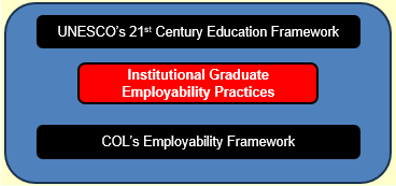
UNESCO’s framework of 21st-century education (Delors et al., 1996) asserts that education institutions should impart holistic education to their students to make them global citizens, able to thrive in their careers and contribute to their country's socio-economic growth. This framework entails the following four pillars:
COL’s employability model recommends an institutional employability framework through which higher education institutions can foster the holistic development of the graduates and equip them with domain-specific, practical, employability and entrepreneurship skills. The four-stage employability assessment scorecard helps HEIs to assess their graduate employability practices and further improve on them.
In India, HEIs implement many graduate employability practices. However, these practices have not been assessed in a systematic manner. In the case of ODL institutions, there is no such study to explore the existing institutional graduate employability processes. The conceptual framework of this study considers UNESCO’s 21st-century education framework and deploys COL’s employability framework to the study of institutional graduate employability practices of SOUs in India. The following figure depicts the conceptual framework for this study.
According to the Centre for Monitoring Indian Economy (CMIE, 2023), the unemployment rate among graduates stood at 17.2% in 2023, while the India Skills Report (2023) highlights that only 50.3% of Indian youth were considered employable. This gap reveals the disconnect between academic output and industry requirements, further aggravated by automation, digitalisation and changing job roles.
In a study by the COL (2025) on graduate employability and emerging skills in India, several factors were seen to affect the employability challenges in India. These factors include an inadequate focus on internships or hands-on training — many graduates pursue degrees that are misaligned with industry demands, leading to an oversupply in fields like the humanities and a shortage in technical or vocational skills — and inadequate career counselling and industry-academia collaboration.
Studies that explored employability readiness affirmed that ODL institutions should collaborate with industry partners to ensure that course content remains relevant to market needs (Tymon, 2013); and that learners require advanced self-management, adaptability, and digital communication skills to succeed in remote work environments (Andrews & Higson, 2008). Research highlights that employability readiness depends on both technical skills (job-specific competencies) and soft skills (communication, teamwork, and problem-solving) (Andrews & Higson, 2008). Employers increasingly demand graduates who possess a balance of these skills.
With the rise of automation and artificial intelligence, digital literacy is now a crucial component of employability readiness. Reports from the World Economic Forum (2020) stress the need for adaptability and continuous learning to remain competitive in the job market. Strategies to enhance institutional readiness include embedding employability in curricula by making career development courses mandatory (Clements & Kamau, 2018), incorporating problem-based and project-based learning (Savery, 2015) and introducing micro-credentials for industry-specific skills (Oliver, 2019). Faculty development processes include providing professional development programmes on industry trends (Knight, 2011); encouraging faculty-industry collaborations for real-world insights (Bridgstock, 2009); and recognising and rewarding employability-focused teaching (Pervaiz et al., 2024).
A purposive sampling method was adopted to select the 17 respondents for this study. The participants were nominated as the key representatives for this project at the 17 Indian SOUs. The following were the pilot institutions: Babasaheb Ambedkar Open University, Ahmedabad, Gujarat; Dr B.R. Ambedkar Open University, Hyderabad, Telangana; Jagat Guru Nanak Dev Punjab State Open University, Patiala, Punjab; Jharkhand State Open University, Ranchi, Jharkhand; Karnataka State Open University, Mysuru, Karnataka; Krishna Kanta Handiqui State Open University, Guwahati, Assam; M.P. Bhoj Open University, Bhopal, Madhya Pradesh; Nalanda Open University, Nalanda, Bihar; Netaji Subhas Open University, Kolkata, West Bengal; Odisha State Open University, Bhubaneswar, Odisha; Pandit Sundarlal Sharma Open University, Bilaspur, Chhattisgarh; Sreenarayanaguru Open University, Kollam, Kerala; Tamil Nadu Open University, Chennai, Tamil Nadu; U.P. Rajarshi Tandon Open University, Prayagraj, Uttar Pradesh; Uttarakhand Open University, Haldwani, Uttarakhand; Vardhman Mahaveer Open University, Kota, Rajasthan, and Yashwantrao Chavan Maharashtra Open University, Nasik, Maharashtra.
This study employed a descriptive exploratory research design. It followed a mixed-method approach by using qualitative and quantitative techniques. The questionnaire was developed using qualitative techniques and critical review by experts.
The adapted version of COL’s Institutional Employability Readiness Scorecard (Mohee, 2019) was utilised for this study. The scorecard assesses how well an institution is developing the employability of its students year by year, over the course of their journey. The scorecard highlights four strategic areas commonly used to develop employability among university students as follows: (1) Career Awareness, (2) Focused Career and Skill Development, (3) Practical Skill and Career Experience and (4/5) Transitional Skills. The scorecard asks universities to assess employability readiness within 25 criteria. The criteria consider tools, services, and resources known to enhance or develop the employability of students. The total score is then used to determine the strengths and weaknesses of an institution in terms of learners’ employability development, utilising a four-point-Likert scale. When used regularly, through annual evaluation, the scorecard can help institutions note improvements, zero in on urgent areas for improvement and help further develop programming and resources.
In its unaltered form, the following rubric was used to assess an institution’s score in the following range:
The COL’s preliminary criteria are intentionally broad in scope and language because there are no ‘one size-fits-all’ resources or initiatives that make sense for all universities. Instead, the scorecard was designed to help guide teams towards a phased approach to employability rather than to prescribe specific interventions or initiatives.
The COL employability readiness scorecard was adapted for this study. Accordingly, the stages (phased approach) were retained as per the COL’s Institutional Employability Scorecard Template. Internal criteria were developed as per the Indian context as well as COL’s Toolkit for Key Employability Indicators for National Qualification Agencies (Mohee & Putty-Rogbeer, 2020). However, this study adopted scoring of the parameters based on a five-point Likert scale as per the suggestions from the content experts during the face and content validation of the instrument, a deviation from the COL four-point scale. Additionally, the rubric to assess the institutional employability score was customised as follows: Employability Not Met = 0-49% 2.5>; Employability Partially Met = 50-69%, 2.5-3.4; Employability Fully Met = 70–100%, 3.5<.
The following documents were considered during the development of the questions so as to align the questions to the Indian context: National Education Policy (NEP), 2020 (the latest education policy in India); National Policy for Skill Development and Entrepreneurship, 2015 (released by the Ministry of Skill Development and Entrepreneurship (MSDE) of India, this policy endeavours to develop a systematic approach for skill development and entrepreneurship among Indian youth); and the Ahmadabad Declaration, 2023 (this document was signed by all the SOUs and adopted for progressive activities towards the growth of the ODL system in India and student support services).
This draft questionnaire was subjected to multiple face and content validation by three experts to ensure its alignment with the objectives of the study. The updated questionnaire was sent to an independent critical reviewer and was subsequently finalised. These review processes involved the refinement of double-barrelled questions, and language standardisation.
The final questionnaire contained two sections. The first section included open-ended questions related to capturing data on the profile of the university. The second section of the questionnaire contained four subsections, covering 25 focus areas. These focus areas contained a total of 92 questions.
The final questionnaire, which was hosted on LimeSurvey was administered to the participants. The link to the online survey questionnaire was sent to the representatives of the 17 pilot institutions. Since the questionnaire was comprehensive and needed inputs for four stages covering diverse areas of institutional graduate employability practices, the participants were provided adequate time to complete it. The participants responded to all the questions, and no outliers were found. This indicates that the participants were able to comprehend the questionnaire and responded accordingly.
A descriptive method was employed for the analysis. The scorecard measured the perception of the SOUs representatives in terms of Institutional Graduate Practices on a five-point scale. Based upon their perception, employability readiness was interpreted.
The participants were informed about the anonymity and confidentiality of their personal data, including the use of data for research purposes only. The personal information of the participants and participating SOUs was kept confidential during the reporting of the research.
This study proposed three research questions, from the four driving this research, to ascertain the extent of employability readiness of participating institutions, strengths, weaknesses, emerging commonalities, and recommendations. Tables 1 and 2 below provide insight into research question 1: To what extent do SOUs in India effectively implement employability processes for learners? This is determined by their scores on the stage-wise scorecard and overall mean.
Table 1: Employability Readiness of Indian SOUs: Stage-Wise Scorecard and Overall Mean
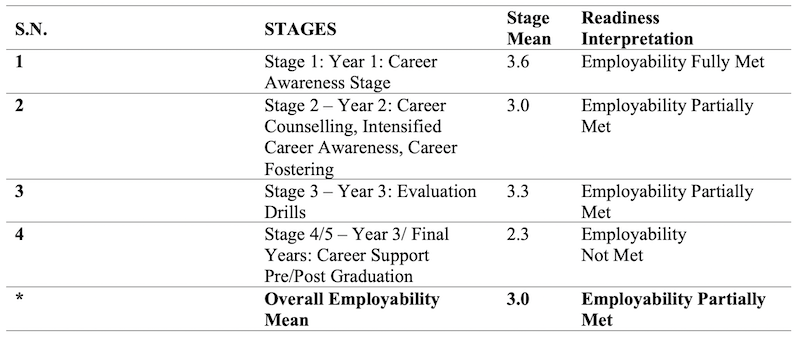
The result of Table 1 outlines the employability readiness scores of the four stages of institutions’ journey for graduate employability. Each stage is evaluated based on a mean score that indicates the degree to which employability requirements were met. For Stage 1: Year 1 – (Career Awareness), the mean score was found to be 3.6. Thus, this stage was categorised as ‘Employability Fully Met’. This score indicates that the participating universities (17 SOUs in India) effectively provided opportunities for career awareness at the foundation stage of enrolment. Though the score of 3.6 seems satisfactory, it is just at the threshold of the interval range (of 3.5 and above), and thus leaves room for improvement. For Stage 2 – (Career Counselling, Intensified Career Awareness, Career Fostering), the mean employability score was found to be 3.0 and thus categorised as ‘Employability Partially Met’. This stage focuses on processes for career paths and counselling. The score indicates that the participating institutions were partially able to implement these requirements.
For Stage 3 – (Evaluation Drills), the mean employability score was found to be 3.3, and thus categorised as ‘Employability Partially Met’. This stage emphasises instilling the students with practical employability skills to make them successful in their chosen careers. The score at this stage indicated that the participating institutions were partially able to implement the graduate employability processes. For the last Stage, 4/5 – (Career Support Pre/Post Graduation), the mean employability score was found to be 2.3, therefore categorising this stage as ‘Employability Not Met’. This is the final stage of the graduate employability process, which emphasises extending institutional support to students before and after graduation, including transition to employment. The finding here reflects that significant work is still required to support learners’ transition and resilience in the world of work. Additionally, the last section of Table 1 indicates an overall mean score of 3.0, an indication that employability processes in the 17 pilot institutions were ‘Partially Met’. In Table 2, the criteria for each of the focus areas are further determined.
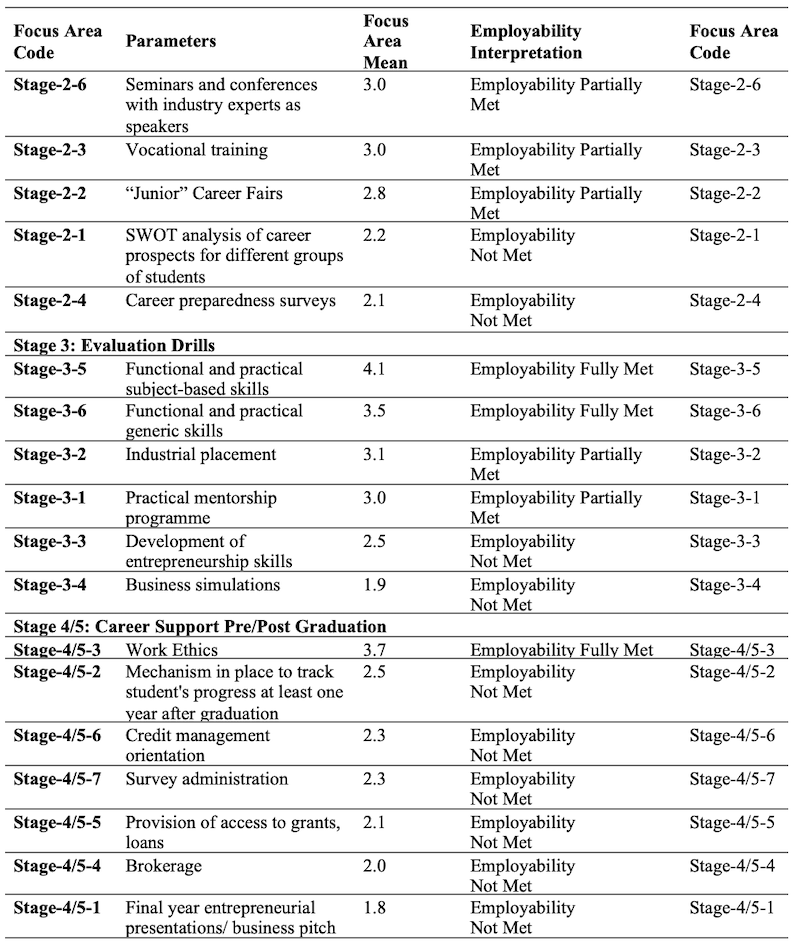
Table 2: Focus Area-Wise Scorecard for the Stages
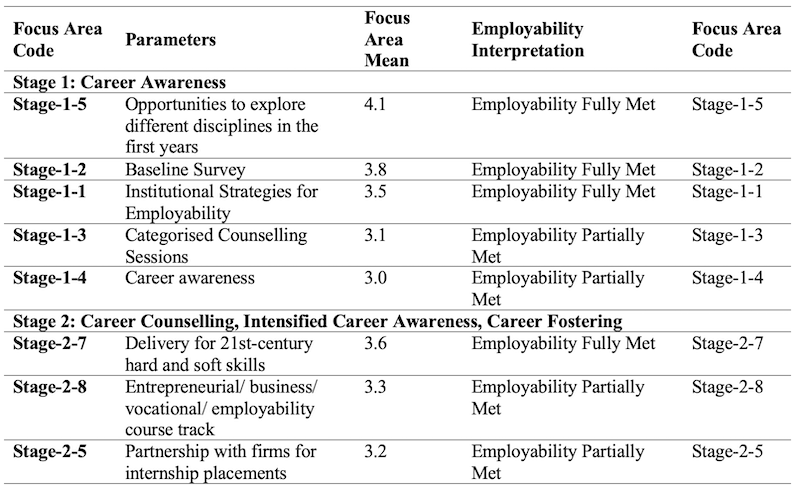
In Table 2 the findings show that for Stage 1, the highest scores were recorded for “opportunities to explore different disciplines in the first years, baseline survey and institutional strategies for employability”, while provisions for counselling sessions and career awareness appeared to be only partially met.
Outlining findings of the employability readiness scores of the eight focus areas of Stage 2 in terms of the mean and corresponding employability readiness categorisation, one focus area with ‘Employability Fully Met’ (delivery for 21st-century hard and soft skills) was recorded. Four focus areas with ‘Employability Partially Met’ included entrepreneurial/business/ vocational/employability course tracks; partnership with firms for internship placements; seminars and conferences with industry experts as speakers and vocational training. However, three focus areas reflecting ‘Employability Partially Met’ were “Junior” Career Fairs, seminars and conferences with industry experts as speakers and career preparedness surveys.
For the six focus areas of Stage 3, it was observed that participating institutions obtained ‘Employability Fully Met’ in two areas: functional and practical subject-based skills and functional and practical generic skills, while the following two areas were partially met: industrial placement and practical mentorship programmes. The section on “development of entrepreneurship skills and business simulations”, were not met.
In Stage 4, participating institutions recorded ‘Employability Fully Met’ in just one out of the seven sub-sections. This was on work ethics. The following sub-sections were recorded: ‘Employability Not Met’ — mechanism in place to track students’ progress at least one year after graduation; credit management orientation; survey administration; provision of access to grants, loans; provision of access to grants, loans; and brokerage and final year entrepreneurial presentations/business pitch.
Providing insight on the second research question, Figure 2 depicts cumulative strength, and a strengths weaknesses, opportunities and threats (SWOT) analysis for graduate employability at the 17 pilot institutions.
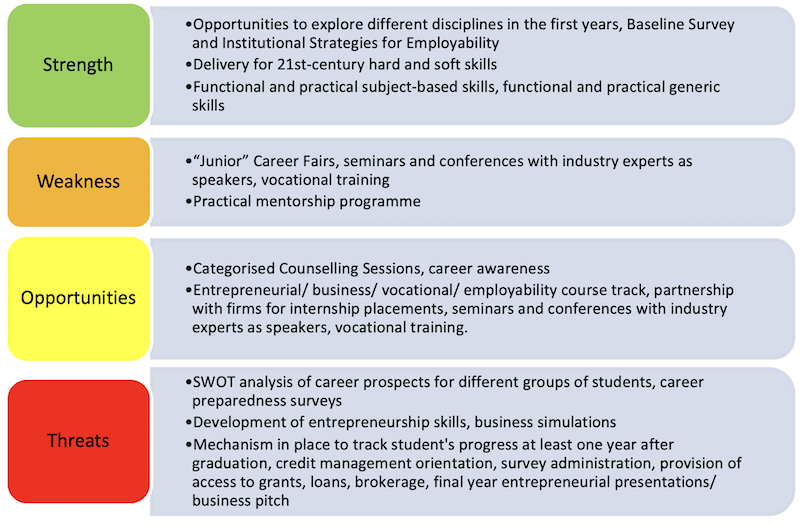
In Figure 2, we observed that the participating institutions were effective in the following graduate employability processes: opportunities to explore different disciplines in the first years, baseline survey for employability, delivery of 21st-century hard and soft skills, and functional and practical subject/generic based skills. Weaknesses were observed in the provisions for career fairs, seminars and conferences with industry experts as speakers, vocational training and practical mentorship programmes. Opportunities presented themselves in the following areas: categorised counselling sessions, career awareness, entrepreneurial/business/vocational/ employability course tracks, partnerships with firms for internship placements, and vocational training. Threats to effective graduate employability processes were identified as being precipitated by inadequate access to grants, loans, brokerage; inadequate guidelines for final year entrepreneurial presentations/business pitch; SWOT analysis of career prospects for different groups of students; and poor mechanisms in place to track students' progress at least one year after graduation.
In Table 3, we provide insight on the third research question: What are the emerging commonalities of graduate employability processes in the pilot institutions?
Table 3: Emerging Commonalities of Graduate Employability Processes in the 17 India SOUs
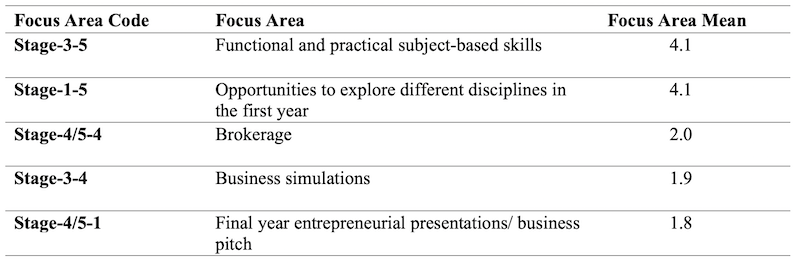
Based on the analysis of the employability scores of focus areas in all four stages, the provision of functional and practical based skills, as well as opportunities to explore different disciplines in the first year of study, emerged as the common best-performance practices of graduate employability in the 17 Indian SOUs. However, the poor-performance graduate employability practices included brokerage, business simulation and final-year entrepreneurial presentations/business pitch. This indicates a significant gap in those processes and a need for improvement.
This study assessed the employability readiness of 17 Indian SOUs. It raised four research questions which provided insight on the status of graduate employability processes, the strengths, weaknesses, opportunities and threats, the emerging commonalities and recommendations for resilience in this regard.
Our findings show that employability processes in the 17 pilot institutions were Partially Met. The SWOT analysis revealed strengths for the delivery of 21st-century hard and soft skills while significant weaknesses were observed in the provisions for career fairs, seminars and collaborations with industries, including mentorship programmes. Opportunities presented themselves in the following areas: categorised counselling sessions, career awareness, and partnership with industries, while the threat to effective graduate employability processes included inadequate access to grants, loans, brokerage and poor mechanisms for tracking students’ progress after graduation. Commonalities that emerged as best-performance practices for graduate employability in the 17 Indian SOUs were provisions for functional and practical-based skills as well as opportunities to explore different disciplines in the first year of study. However, the poor-performance graduate employability practices included issues bordering on brokerage, business simulation and final-year entrepreneurial presentations/business pitch.
The possible reasons for poor performance in brokerage, business simulation and final-year entrepreneurial presentations/business pitch might have included inadequate policy provisions, business simulation tools and entrepreneurship facilitation. Additionally, inadequate provisions for work-integrated learning, business plan development and incubation centres further exacerbated this. The solution could include management intervention through the integration of these provisions in institutional policies. The SOUs may need to allocate dedicated funds for these activities. Linkages with industries, sponsors, government agencies, and alumni could also help generate funds for these activities. Additionally, the SOUs might need to conduct monitoring and evaluation to coordinate the effective implementation of these practices.
In line with our findings, research buttresses that comprehensive career support, encompassing both pre- and post-graduation initiatives, significantly enhances graduate employability. Early engagement in career planning during university studies has been linked to higher employment rates and a greater likelihood of securing graduate-level positions (Cobb, 2024).
This study concludes by affirming that the 17 Indian SOUs already have processes for graduate employability in place. These processes need to be further strengthened and objectively monitored for broader impact and resilience. This study is of significant relevance because it cumulatively assessed graduate employability readiness in the 17 Indian SOUs. No other study has achieved this. This provides prospects for collaborations and communities of practice, including replication of findings.
This study concludes with 6-C strategy recommendations and matrix: fostering Collaboration, enhancing Classroom Technology, updating Curriculum, building Capacity and Awareness, strengthening Connectivity with students, and ensuring Compliance with policies. Studies confirmed the need for enhanced collaboration between universities, industry, and government for employability and innovation (Etzkowitz & Leydesdorff, 2000); integration of AI and digital technologies in classroom settings to develop future-ready graduates (Jisc, 2020); incorporation of micro-credentials to keep curricula relevant (Oliver, 2019) and provision of tools for institutions to build internal capacity to enhance employability outcomes (Mohee & Putty-Rogbeer, 2020).
It is hoped that these actions will assist the SOUs in planning and executing their employability integration activities. Broadly, insights from this study contribute to resilience for the graduate employability process for ODL and beyond and enhance skilling for future-ready-graduates.
Agbu, J.O. (2022). Connecting quality assurance and employability for a future-ready workforce. Commonwealth of Learning. https://www.col.org/news/connecting-quality-assurance-and-employability-for-a-future-ready-workforce
Ahmedabad Declaration. (2023). Ahmedabad Declaration by the State Open University Vice Chancellors of India August 2023. Commonwealth of Learning. https://www.col.org/wp-content/uploads/2024/02/Ahmedabad-Declaration-FINAL.pdf
Amarathunga, B., Khatibi, A., Talib, Z.M., Azam, S.F., & Tham, J. (2024). Graduate employability skills, trending avenues and research gaps: A systematic literature review and bibliometric analysis. Asian Education and Development Studies, 13(4), 320-339. https://doi.org/10.1108/AEDS-04-2024-0085
Andrews, J., & Higson, H. (2008). Graduate employability, ‘soft skills’ vs. ‘hard’ business knowledge: A European study. Higher Education in Europe, 33(4), 411-422. https://doi.org/10.1080/03797720802522627
Bridgstock, R. (2009). The graduate attributes we’ve overlooked: Enhancing graduate employability through career management skills. Higher Education Research & Development, 28(1), 31-44. https://doi.org/10.1080/07294360802444347
Centre for Monitoring Indian Economy. (2023). Economic outlook. https://economicoutlook.cmie.com/
Clements, M., & Kamau, C. (2018). The career coaching toolkit. Routledge.
Cobb, F. (2024). Employability through the student lifecycle: Encouraging early career planning. Higher Education Professional. https://heprofessional.co.uk/edition/employability-through-the-student-lifecycle-encouraging-early-career-planning
Commonwealth of Learning. (2025). Graduate employability and emerging skills in India. https://oasis.col.org/server/api/core/bitstreams/79fe59bf-58a1-461a-8470-138b0ca897e4/content
Delors, J., Carneiro, R., Chung, F., Geremek, B., Gorham, W., Kornhauser, A., Manley, M., Quero, M.P., Savane, M-A., Singh, K., Stavenhagen, R., Won, M., & Nanzhao, S.Z. (1996). Learning: The treasure within (Report to UNESCO of the International Commission on Education for the Twenty-first Century). UNESCO. https://unesdoc.unesco.org/ark:/48223/pf0000109590
Etzkowitz, H., & Leydesdorff, L. (2000). The dynamics of innovation: From National Systems and “Mode 2” to a Triple Helix of university–industry–government relations. Research Policy, 29(2), 109–123.
George, A.S., & Baskar, T. (2024). The diminishing returns of higher education in India: Examining degree inflation and employability. Partners Universal Innovative Research Publication, 2(2), 135-153.
Government of India. (2015). National policy for skill development and entrepreneurship 2015. Ministry of Skill Development and Entrepreneurship. https://www.msde.gov.in/
Gupta, P., & Mahajan, R. (2024). Investigating stakeholder perceptions of graduate employability. Higher Education, Skills and Work-Based Learning, 14(1), 109-129.
India Skills Report. (2023). Roadmap to India’s skills & talent economy 2030. https://do3n1uzkew47z.cloudfront.net/siteassets/pdf/ISR_Report_2023.pdf
India Today. (2024). India’s economic projections. https://www.indiatoday.in/business/economy
Jisc. (2020). AI in tertiary education: Preparing students for the future. https://www.jisc.ac.uk/reports/ai-in-tertiary-education
Jung, J., Wang, Y., & Sanchez Barrioluengo, M. (2024). A scoping review on graduate employability in an era of ‘Technological Unemployment’. Higher Education Research & Development, 43(3), 542-562.
Knight, P. (2011). Assessment, learning and employability. McGraw-Hill Education.
Mohee, R. (2019). A guide to integrating employability in higher education institutions: The Commonwealth of Learning’s employability model. https://oasis.col.org/server/api/core/bitstreams/a99f092e-5261-412b-8592-fa2f1395570c/content
Mohee, R., & Putty-Rogbeer, K. (2020). A toolkit for key employability indicators for national qualification agencies. Commonwealth of Learning.
National Education Policy. (2020). National education policy 2020. Ministry of Human Resource Development, Government of India. https://www.education.gov.in/sites/upload_files/mhrd/files/NEP_Final_English_0.pdf
Oliver, B. (2019). Making micro-credentials work for learners, employers and providers. Deakin University.
Olivier, J. (2023). The complexity of graduate employability for ODL. Commonwealth of Learning. https://www.col.org/news/the-complexity-of-graduate-employability-for-odl/
Pervaiz, A., Muhammad, M., Aniqa, A., & Muhammad, N.K. (2024). The interdisciplinary curriculum alignment to enhance graduates' employability and universities’ sustainability. The International Journal of Management Education, 22(3). https://doi.org/10.1016/j.ijme.2024.100861
Savery, J.R. (2015). Overview of problem-based learning: Definitions and distinctions. Interdisciplinary Journal of Problem-Based Learning, 1(1), 9-20. https://doi.org/10.7771/1541-5015.1002
S&P Global. (2024). India’s market and economic trends 2024. https://www.spglobal.com/en/research-insights/
The Learning Generation. (2016). Investing in education for a changing world. International Commission on Financing Global Education Opportunities. https://report.educationcommission.org/wp-content/uploads/2016/09/Learning_Generation_Full_Report.pdf
Tymon, A. (2013). The student perspective on employability. Studies in Higher Education, 38(6), 841-856. https://doi.org/10.1080/03075079.2011.604408
World Economic Forum. (2023). The future of jobs report 2023. https://www.weforum.org/publications/the-future-of-jobs-report-2023/
World Economic Forum. (2020). The future of jobs report 2020. https://www.weforum.org/reports/the-future-of-jobs-report-2020
Yorke, M. (2006). Employability in higher education: What it is – what it is not. The Higher Education Academy.
Author Notes
Jane-Frances Agbu is Adviser, Higher Education at the Commonwealth of Learning, Vancouver, working with regional, national and institutional stakeholders on ODL strategy, OER, quality assurance, employability and partnerships. She formerly served at the National Open University of Nigeria as Dean of Faculty, Study Centre Director, Head of department including OER. She was International Council for Open and Distance Education (ICDE) Chair in Open Educational Resources and a former board member of Open Education Global (OEG). She has authored several publications, including presentations on open and distance learning, OER, learner wellbeing and skills for work. Email: agbujane2005@yahoo.com (https://orcid.org/0000-0001-5852-397X)
Jako Olivier is an Adviser, Higher Education at the Commonwealth of Learning in Vancouver, Canada, where he works with ministries and universities on open, distance and technology-based solutions. Previously, he was the UNESCO Chair on Multimodal Learning and Open Educational Resources (OER) and a professor at North-West University in South Africa. He is rated as an established researcher by the National Research Foundation of South Africa and has published over 70 peer-reviewed articles and book chapters, and has edited nine books. His current research and advocacy relate to open and distance learning, micro-credentials, self-directed learning, OER, localisation, and blended learning. Email: jolivier@col.org (https://orcid.org/0000-0002-5860-6027)
Basheerhamad Shadrach is Director of the Commonwealth Educational Media Centre for Asia (CEMCA), COL’s centre, overseeing programmes to expand quality learning and skills development across the region. He serves on the Global Steering Committee of the Global Partnership on Artificial Intelligence (GPAI) and is an Alumni Ambassador for Loughborough University, UK. Since 1986, he has led ICT4D and lifelong-learning initiatives in 40+ countries, holding senior posts with the British Council, Transparency International, OneWorld International and telecentre.org Foundation, plus roles with IDRC, the Gates Foundation and the Web Foundation’s A4AI. Email: bshadrach@col.org (https://orcid.org/0009-0006-7063-3518)
Awadhiya Ashish Kuma is Assistant Director (Training and Development) at the Centre for Online Education (COE), Indira Gandhi National Open University (IGNOU), New Delhi. He completed his PhD in Graduate Employability Skills and holds a master’s degree in Distance Education (Gold Medalist). He has five years of industry experience in training and quality assurance. His areas of interest include online learning, e-content development, blended learning and MOOCs. His area of expertise also includes Graduate Employability and Skill Development, Capacity Building and Training. Email: akawadhiya@ignou.ac.in (https://orcid.org/0000-0003-4676-5861)
Cite as: Agbu, J-F., Olivier, J., Shadrach, B., & Kuma, A.A. (2025). Bridging the job skills gap in India: Assessing graduate readiness at Indian open universities Journal of Learning for Development, 12(3), 531-545.