Genimon Vadakkemulanjanal Joseph, Dawn Jose, Jith Rajan, Sujata Shankaran, Divya Vijay and V. Navya
2026 VOL. 13, No. 1
Abstract: Sustainable development ensures global progress without compromising future generations' opportunities. UN Sustainable Development Goals aim to integrate Green Technology and AI applications among business and management professionals. This descriptive study examines management graduates' attitudes toward sustainability, Green-Technology Integration (GTI), and institutional support for AI in education to foster sustainable business practices. The study is based on the intelligent Socio-Technical Systems (iSTS) framework. A structured questionnaire collected responses from 389 management students in Kerala, India via stratified participation. The data was coded, anonymised and analysed statistically. Findings highlight the role of curriculum design, faculty expertise, and institutional initiatives in shaping sustainability awareness. Significant correlations exist between graduates’ perceptions of GTI (mean = 4.14), sustainability in education, AI’s role, institutional support, and curriculum support (r = 0.651, p < 0.01), emphasising AI’s role in sustainability education. The study advocates for AI-driven training and courses to enhance graduates' eco-friendly innovation capabilities, offering insights for academic leaders, policymakers, researchers and environmental advocates.
Keywords: green technology integration, sustainability, AI tools, sustainable business, management education
The sustainable utilisation of non-renewable resources in the context of national development and sustainable growth is a global discussion topic (Noor et al., 2024). The concept of sustainability in business has evolved significantly over the past centuries from peripheral environmental concerns to a core strategic imperative. The sustainable concept gained momentum in the 1960s with the growth of environmental science and business concerns (Benn et al., 2014). Early management education emphasised efficiency and profit, with sustainability emerging in the 1980s and 1990s (Weybrecht, 2021). UN-led PRME in 2007 accelerated integration (PRME, 2024). Sustainability education now stresses interdisciplinary approaches, ethics, circular economy models and addresses emerging challenges from AI and green technologies (Hoffman, 2018; Holst, 2023; Vinuesa et al., 2019). Green Technology Integration (GTI) into management education faces challenges such as limited faculty expertise, resource constraints and weak industry alignment (Christou et al., 2024; Li et al., 2023). Indian management education shows uneven sustainability integration, often limited to theoretical approaches (Sharma, 2023; Bhaskar & Gupta, 2024). In the Kerala state, despite strong education indicators sustainability adoption remains uneven due to resource limitations (Chathukulam & Tharamangalam, 2021; Joseph & Thomas, 2021).
The research frameworks like the modified Socio-Technical Systems (iSTS) theory offer promise for examining AI-green tech interactions but their application in sustainability education remains underexplored in non-Western contexts (Akinsemolu & Onyeaka, 2025; Xu & Gao, 2024). In terms of application there is limited evidence on how curricula can practically incorporate AI tools (e.g., ChatGPT, Grok, or Gemini) for personalised sustainability learning (Sigurjonsson & Wendt, 2025). These profound gaps are unaddressed and they hinder progress toward SDGs 4 and 12. This descriptive study addresses these gaps by inspecting the attitudes of management graduates in the State of Kerala, India, toward integrating green technology and AI tools for sustainable business practices. It concentrated on the perceptions of management graduates regarding sustainability, the role of AI in fostering sustainability and the support provided by their educational institutions for sustainable practices. The theoretical frame of the study was adopted from the modified version of the traditional Socio-Technical Systems (STS) Theory of Trist and Bamforth (1951) and extended as the iSTS framework to incorporate AI and digital transformation (Xu & Gao, 2024).
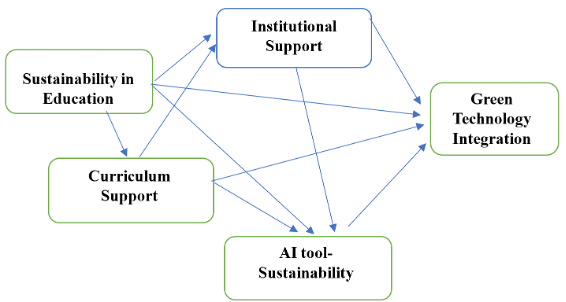
The present research context was management education in Kerala, India, a region with strong educational indicators but uneven sustainability adoption due to resource limitations and weak industry alignment. It explored graduates' attitudes amid global SDGs, focusing on integrating green technology and AI amid evolving business sustainability trends as post-1960s environmental movements and UN PRME initiatives. Key variables included: GTI as the outcome/dependent variable; mediators like AI in sustainability, curriculum support, and institutional support; and sustainability in education as an interrelated construct, with AI training as a moderator—all measured via a five-point Likert scale questionnaire.This study applied the iSTS framework in an Indian context and offers policy insights for AI-driven training and curriculum reforms to support SDG-aligned education and sustainable business innovation in India
AI-based sustainable business practices reduce environmental impact while enhancing long-term profitability and competitive advantage (Mair & Smith, 2022; Zhironkin & Abu-Abed, 2024). As industries adopt green technologies and AI solutions, managers must align with evolving sustainability trends. Effective use of AI requires a human-centred AI approach grounded in sociotechnical thinking (Xu & Gao, 2024). Therefore, management education must provide relevant training and exposure to sustainable practices (Singh et al., 2025). This descriptive study examines Kerala management graduates’ attitudes towards GTI focusing on sustainability perceptions, AI’s role and institutional support.
The theoretical frame of the study was adopted from the modified version of the traditional Socio-Technical Systems (STS) Theory of Trist and Bamforth (1951). STS theory has been extended as the intelligent sociotechnical systems (iSTS) framework to address AI integration (Sovacool & Hess, 2017; Xu & Gao, 2024). The iSTS framework incorporates digital transformation, including AI, automation, big data, and sustainability. It enables analysis of interactions among technology, people, institutions, sustainability and business practices within complex contemporary systems (Nair et al., 2024; Xu & Gao, 2024).
GTI emphasises adopting environmentally friendly technologies in business operations to reduce carbon footprints, improve energy efficiency and support sustainable development (Saqib et al., 2024). GTI stems from Green Technology Innovation (GTIn), which includes research, development, invention and training. These technologies mitigate climate change, reduce pollution, promote eco-friendly practices and balance economic growth with environmental protection (Saqib et al., 2024; Weybrecht, 2021). Businesses adopting green technologies report improved efficiency, reduced environmental impact and stronger brand reputation (Chen et al., 2024). Employee knowledge, resources and readiness are critical for this adoption (Ercantan & Eyupoglu, 2022). However, despite strategic emphasis, many HEIs lack comprehensive operational policies for training their students for GTI (Christou et al., 2024). GTI requires transforming the entire educational environment, not just curricula (Reche et al., 2020). Major barriers include limited academic time, faculty expertise, weak institutional support, and low industry demand (Li et al., 2023).
Sustainability incorporation integrates environmental, social, human and economic dimensions across organisations, governments and education (Joseph et al., 2022; Sharma, 2023; Zhang, 2024). In education, it prepares students to address environmental challenges and support sustainable economic growth (Bhaskar & Gupta, 2024; Sharma, 2023). A holistic approach embeds sustainability across curricula and campus operations (Holst, 2023). Management education needs to focus on sustainability concepts and practical applications of circular economy, waste-to-energy systems and green technologies leading to interdisciplinary learning and sustainability awareness (Jebba et al., 2024; Joseph et al., 2023; Karjanto, 2023a; Karjanto, 2023b). Managers’ expertise in waste-to-energy and resource optimisation is vital for sustainability (Kalak, 2023; Karim et al., 2025). Real-world applications strengthen the engagement and understanding of the students (Vargas-Merino et al., 2024; Weybrecht, 2021).
AI enables personalised learning, real-time case studies and simulations in management education to enhance understanding of sustainability practices (Shakeel & Wendt, 2025; Sigurjonsson & Wendt, 2025). AI applications streamline operations, lower carbon footprints and reduce inefficiencies (Chen et al., 2024; Hasan et al., 2024). AI-driven simulations and virtual cases improve sustainability learning and support distance education (Ai & Chung, 2025; Mende et al., 2024; Vinuesa et al., 2019). Students can use AI to analyse datasets for waste reduction, optimise supply chains and minimise energy and material usage (Adewale et al., 2024; Kulkov et al., 2023). AI also reduces administrative costs and supports data-driven sustainability decisions, underscoring the need for curricular integration with institutional support (Appio et al., 2024; Ta et al., 2024).
An AI-integrated curriculum in tune with industrial requirements is a critical success factor for business schools in the AI era (Huang, 2025; Southworth et al., 2023). Integration of AI tools and sustainability is accelerating as industries recognise AI’s potential in addressing global challenges (Ejjami, 2024; Rosak-Szyrocka et al., 2023; Singh et al., 2025). Effective integration depends on faculty expertise, enthusiasm, curriculum-embedded AI applications and experiential learning through case studies, projects and internships (Leal Filho et al., 2024; Senior et al., 2025). Institutional leadership, supportive policies, interdisciplinary collaboration and access to AI and sustainability resources are essential for building resilient, future-ready education systems (Liu & Curtin, 2025; Zönnchen et al., 2024).The literature review underscores critical gaps in integrating green technology and AI tools into management education, particularly in non-Western contexts like India. The theoretical focus dominates amid barriers such as faculty limitations and weak institutional alignment (e.g., Li et al., 2023; Sharma, 2023). Drawing on the iSTS framework (Xu & Gao, 2024), it reveals how AI can mediate sustainability outcomes through human-centred approaches. These insights directly inform the research objectives of the study.
The research problem was formulated as: “How are management graduates' attitudes toward Green Technology Integration and their perceptions of AI tools for sustainable business practices influenced by management curricula and institutional support?” To address this, the following research objectives were pursued:
The research objectives identified for this research were tested by formulating the research hypothesis. The following null hypotheses for testing the objectives were formulated as:
H0-1: There is no significant difference between the perception of the management graduates on GTI, sustainability in education, AI tools use, curriculum and institutional support for sustainable business practices with respect to their demographic factors .
H0-2: There is no significant relation between the perception of the management graduates on GTI, sustainability in education, AI tools use, curriculum and institutional support for sustainable business practices.
H0-3: There is no mediation effect on GTI and sustainability in education through the management graduates’ perception on AI tools use, curriculum and institutional support for sustainable business practices.
Based on the research reviews and the theoretical frame, the hypothesised relationships for the research model were formulated. Figure 1 depicts GTI as the outcome variable, mediated by AI, curriculum, and institutional support, moderated by AI training.
This study focused on undergraduate and postgraduate management students (BBA, MBA, and commerce specialisations) enrolled in universities across the state of Kerala, India. Students from non-business disciplines were excluded. The population was stratified across six universities, and data were collected through a structured Google Form questionnaire using voluntary sampling, with mandatory fields to avoid incomplete responses. Instruments were adapted from established scales, including the New Ecological Paradigm (Dunlap et al., 2000), and validated through expert review, a pilot study (n = 80), and scale dimensionality is affirmed with the Principal Component Analysis. Final responses from 389 students were analysed using descriptive statistics, t-tests, ANOVA, correlation, regression, and mediation analysis, adhering to ethical standards.
This study on the Management Graduates' attitudes for Sustainable Business Practices is framed based on the extensive research conducted on sustainability concerns and AI integration. The preliminary field studies were conducted among the management graduates enrolled in the different universities of the state of Kerala. Further studies were conducted among the management graduates through focus group interviews and in-depth field interactions to frame the research problem. Based on these preliminary studies this descriptive research design was identified along with an extensive review of the literature.
The study used the statistical tests ANOVA, t-test, correlation, regression, and mediation for getting inference from the quantitative data collected through the structured questionnaire. The study used the iSTS theoretical framework to extend STS with respect to the concerns of AI integration. The data was tested for its skewness and kurtosis to find whether it fell under the limits of parametric distribution. The relevant ethical concerns were addressed in this research and anonymity and consent was ensured for each respondent.
The tool for the structured sample survey was adopted from the relevant studies and New Ecological Paradigm (NEP) for the Sustainability Awareness Index, and assessment rubrics for proficiency (Dunlap et al., 2000). The tools adopted for this study were tested for face validity and content validity with an expert in the field. The pilot study with 80 samples from the population was conducted and upon analysis it affirmed the reliability of the instruments. The tool items further affirmed the dimensions when extracted with principal component analysis for reducing the dimensions, and the Varimax with Kaiser Normalisation provided the five components which were included in the tools. Principal Component Analysis resulted with factor loadings that ranged from 0.68 to 0.85.
The digital form of the questionnaire was expressed in statement format as, ‘I follow sustainable business practices like saving energy and using energy-efficient equipment’, with five-point Likert scale responses as: 1 = Strongly Disagree, 5 = Strongly Agree. All question items were set as mandatory fields for the respondents. The questionnaire consisted of 23 items to measure the constructs. The responses from the 389 management students were collected with the final tools and were coded, anonymised and the code of ethical research were adhered at all stages of the research.
Data collection was done through the Google Form and primary analysis and data coding was done with MS Excel. The statistical analysis of correlation, ANOVA and regression was done with IBM SPSS v26.0. The Process Macro v4.2 add-on to SPSS by Andrew F. Hayes, PhD was used for the mediation analysis.
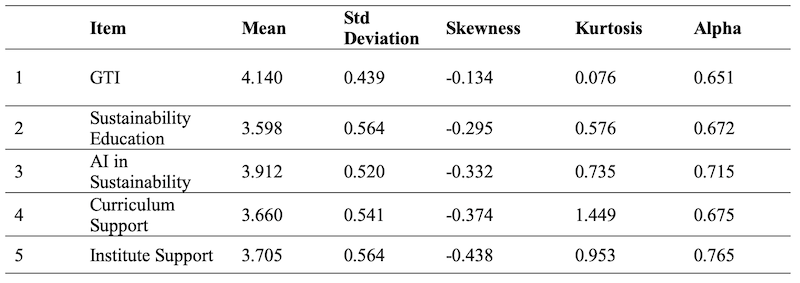
The sample consisted of 389 management graduates from six universities in the state of Kerala with 55.8% being female graduates. The management graduates had a major specialisation in marketing (32.6 %), HR (18.8%), finance (36.2%) and other specialisations (12.4%). All the management graduates expressed their interest in AI tools and its usage, while 24.5% were regularly undergoing systematic certification or training on AI tool usage, and 75.1% were interested in and wished to go on to systematic training on AI tool usage for managerial function and sustainability practices. The detailed descriptive statistics of the variables under study is given in Table 1. The reliability of each variable was under the accepted limit when tested with Cronbach's alpha. The skewness and kurtosis of the items indicated that the data was normally distributed and parametric tests were used for the analysis (Hair et al., 2006).
The perception of the management students on GTI was rather high (mean = 4.14, SD = 0.439) on a Likert scale where the maximum was 5 (Table 1). The responses of the graduates on GTI with respect to their locality as rural (mean 4.13) and urban (mean 4.14) fall in a similar range. All other variables were rated higher than normal and the deviation limit of the responses were minimal, which indicates the homogeneous perception of the management graduate population under study. The Cronbach’s alpha value of the items of each variable was under the acceptance level.
Table 1: Descriptive Statistics and Reliability
Hypothesis Testing
The null hypotheses formulated as, H0-1: There is no significant difference between the perception of the management graduates on GTI, sustainability in education, AI tools use, curriculum and institutional support for sustainable business practices with respect to their demographic factors. This was tested with one-way ANOVA. The probability value of the one-way ANOVA shows that the p-value (p > 0.05) was not in the acceptance range and therefore we fail to reject the null hypothesis (H0-1). And, thereby we affirm that there was no significant difference reported among the respondents with reference to their gender, specialisation, location of their institution, training received on AI tools, etc. on their perception on GTI, sustainability in education, AI tools use, curriculum and institutional support for sustainable business practices. Urban (mean = 4.14) and rural (mean = 4.13) GTI perceptions showed no significant difference (p > 0.05), supporting data connectivity’s role in uniform awareness.
The results show a strong positive perception of GTI among management graduates in Kerala, with a mean score of 4.14 on a five-point scale, indicating high agreement on its importance for sustainable business practices. This aligns with global trends of increased environmental awareness driven by social media and education (Chen et al., 2024; Saqib et al., 2024). Perceptions were uniform across gender, specialisation, institution location, and AI training status, as reflected in non-significant ANOVA results (p > 0.05). This homogeneity suggests that digital connectivity and widespread SDG awareness have reduced traditional divides (Joseph & Thomas, 2021).
The second null hypothesis (H0-2) was tested with the Pearson correlation using IBM SPSS v26.0. The correlation matrix is given in Table 2.
Table 2: Correlation Analysis
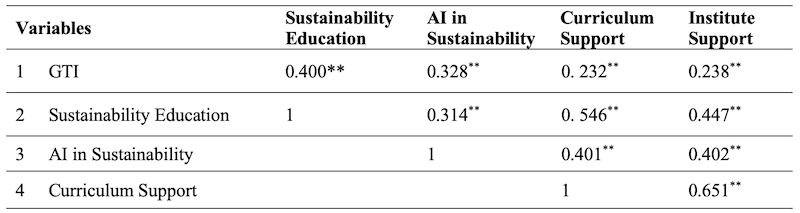
**Pearson Correlation is significant at the 0.01 level (2-tailed); N = 389.
The Pearson correlation analyses of the variables done at the 0.01 level, 2-tailed for the 389 responses, show that the correlation between them was positive and significant (p < 0.05). Based on the Pearson correlation analysis, it is affirmed that there was significant correlation between the variables and thereby the second null hypothesis (H0-2) is rejected. It is affirmed that there was a significant relation between the perception of the management graduates on GTI, sustainability in education, AI tools use, curriculum and institutional support for sustainable business practices.
The correlation analysis shows that management students’ attitude towards GTI was moderately related to sustainability in education (r = 0.400) and AI in sustainability (r = 0.328), but weakly related to curriculum support and institutional support. This indicates a gap between students’ awareness and institutional implementation. The strong correlation between curriculum and institutional support (r = 0.651) highlights their interdependence and the need for better integration to convert positive perceptions into practical skills.
The sustainability practices of the institution were positively related to the curriculum structure of the institute. It is to be noted that the correlation strength of the GTI with curriculum and institution support was considerably less. So, more concern needs to be shown for the curriculum modification to adapt AI tools for sustainability and the institutional support for the GTI should be improved in the practical aspect.
The second objective tested the third null hypothesis. It was done through the regression analysis and mediation test with Process Macro v4.2 by Andrew F. Hayes, PhD with moderating and mediating variable model 5. The H0-3 states that “There is no mediation effect on GTI and sustainability in education through the management graduates’ perception on AI tools use, curriculum and institutional support for sustainable business practices”. The direct path was significant (p < 0.05) and positive. The linear regression was significant (r = 0.457, R2 = 0.209, F = 25.312 (4,384), p = 0.000) and the ANOVA was also significant, p < 0.05. So, the third hypothesis, H0-3 is rejected and it is affirmed that a significant positive mediation effect existed on GTI and sustainability in education through the management graduates’ perception on AI tools use, curriculum and institutional support for sustainable business practices. The model summary of the analysis is provided in Table 3.
Table 3: Model Summary of the Sequential Mediation Analysis with Green Technology Integration as Outcome Variable*

*Direct path: GTI to Sustainability Education
*Indirect path for the model: through the AI in sustainability, curriculum support, institute support with moderator variable as the AI tool-based training. Indirect effect coefficients with 95% CI
The mediation analysis indicates the direct path of perception on the GTI was related with sustainability in the education process and was significant (β = 0.3528, se = 0.0550, t = 6.4160, p = 0.0000). The indirect effect was β = 0.1618, se = 0.0435, 95% CI [0.0819, 0.253]. The mediatory path through the AI in sustainability, curriculum support, institute support was significant. The management students’ exposure to the AI tool-based training had significant moderator power on the direct path of their perception on the GTI with sustainability in education process. The total effect of the model was also significant (R = 0.6206, R2 = 0.3851, F = 60.1278 (4,384), p = 0.000)
The mediation analysis confirms that AI in sustainability, curriculum support and institutional support significantly mediated the relationship between GTI and sustainability in education with a direct effect. The moderating role of AI-based training enhanced this path. It indicated that the exposure to tools like simulations or AI-based analytics amplified graduates' ability to apply green technologies. These results can be interpreted as evidence that while Kerala’s management education fosters high-level awareness (mean = 3.95; Weybrecht, 2021), the practical barriers in curriculum and infrastructure hinder deeper engagement which potentially limits the realisation of SDGs 4 and 12.
This study extends the intelligent iSTS framework by empirically demonstrating AI's mediating role in sustainability education within a developing context (Sovacool & Hess, 2017; Xu & Gao, 2024). By integrating students’ perceptions (graduates' attitudes) with technical elements (AI tools and green technologies) and institutional realms (curriculum and support) these findings advance sociotechnical theory beyond Western applications. It highlights how digital transformation can mediate sustainability outcomes in resource-constrained environments like Kerala. The mediation effects validated the iSTS emphasis on interactions between technology, people and institutions. It thereby contributes to the literature on Human-Centred AI (HCAI) by showing how AI training moderates awareness-to-practice transitions (Goralski & Tan, 2020; van Wynsberghe, 2021; Vettriselvan & Ramya, 2025). The non-significant demographic influences challenge assumptions in certain earlier studies (e.g., Ercantan & Eyupoglu, 2022). It also suggests that in digitally well-connected localities the sociotechnical factors dominate individual variables and, thus, refine models for global sustainability research. This highlights how digital connectivity makes awareness uniform despite resource gaps, extending iSTS theory to show AI's mediating role in human-centred sustainability transitions. This could pave the way for future theoretical developments as hybrid frameworks combine iSTS with behavioural theories like the New Ecological Paradigm (Dunlap et al., 2000) to predict long-term attitude shifts.
The results offer actionable insights for academic leaders, administrators, educators and policymakers to enhance sustainability in management education. The high GTI perception of the graduates (mean = 4.14) indicates an opportunity to leverage graduates' enthusiasm through curriculum reforms by adopting AI-driven modules (using tools like ChatGPT or Grok for personalised sustainability simulations) to strengthen weaker correlations with support variables (Sajja et al., 2024; Southworth et al., 2023). Institutions can prioritise faculty development and resource allocation. The strong interdependence between curriculum and institutional support (r = 0.651) implies that holistic approaches could increase mediation effects and foster eco-innovation.
These findings advocate for regulatory frameworks promoting AI adoption in education. It suggests affordable AI training programmes or regulations to align curricula with SDGs (Leal Filho et al., 2024). It urges curriculum development with AI modules, faculty training, and industry partnerships for internships (e.g., waste-to-energy to boost eco-innovation and reduce carbon footprints). In the state of Kerala, the higher education initiatives could include partnerships with industry for internships in waste-to-energy or circular economy practices to reduce the practical gaps identified (Kalak, 2023; Karim et al., 2025). Businesses could use these insights to refine their campus recruitment strategies to preferred graduates with the AI-sustainability skills to reduce operational inefficiencies and carbon footprints (Ametepey et al., 2024; Hasan et al., 2024). Applying these implications could cultivate a sustainability-conscious workforce which can produce long-term economic and environmental benefits in India and similar contexts.
This cross-sectional study was limited by its duration of only three months and being limited to the responses of the students and teachers of just the management stream. Multi-region (rural-urban, India vs. West) replication could use stratified sampling to enhance global generalisability. Longitudinal or mixed-methods studies might be conducted to address these gaps of this cross-sectional study. We suggest exploring rural-urban digital disparities in future research, since the management institutions under study were affiliated with universities and the curricula were defined by them. So, less flexibility was available for individual institutions with respect to incorporating the Sustainability Goals. Future studies could replicate this in urban vs. rural in Third World and Western contexts to test cultural influences.
Adewale, B.A., Ene, V.O., Ogunbayo, B.F., & Aigbavboa, C.O. (2024). A systematic review of the applications of AI in a sustainable building’s lifecycle. Buildings, 14(7), Article 2137. https://doi.org/10.3390/buildings14072137
Ai, C.T., & Chung, N.H.T. (2025). Exploring impactful research fronts of the digital educational ecosystem: A bibliometric analysis. Journal of Learning for Development, 12(1), 108-125. https://doi.org/10.56059/jl4d.v12i1.1642
Akinsemolu, A.A., & Onyeaka, H. (2025). The role of green education in achieving the sustainable development goals: A review. Renewable and Sustainable Energy Reviews, 210, Article 115239. https://doi.org/10.1016/j.rser.2024.115239
Ametepey, S., Aigbavboa, C., Thwala, W., & Addy, H. (2024). The impact of AI in sustainable development goal implementation: A delphi study. Sustainability,16(9). https://doi.org/10.3390/su16093858
Appio, F., Platania, F., & Hernandez, C. (2024). Pairing AI and sustainability: Envisioning entrepreneurial initiatives for virtuous twin paths. IEEE Transactions on Engineering Management, 71, 11669-11686. https://doi.org/10.1109/TEM.2024.3428913
Benn, S., Dunphy, D., & Griffiths, A. (2014). Organizational change for corporate sustainability (3rd ed.). Routledge. https://doi.org/10.4324/9781315819181
Bhaskar, P., & Gupta, P.K.K. (2024). Delving into educators’ perspectives on ChatGPT in management education: A qualitative exploration. Interactive Technology and Smart Education, 21(4). https://doi.org/10.1108/itse-08-2023-0169
Chathukulam, J., & Tharamangalam, J. (2021). The Kerala model in the time of COVID19: Rethinking state, society and democracy. World Development, 137, 105207. https://doi.org/10.1016/j.worlddev.2020.105207
Chen, C., Shahbaz, P., & Haq, S.U. (2025). Transforming students’ green behavior through environmental education: The impact of institutional practices and policies. Frontiers in Psychology, 15, Article 1499781. https://doi.org/10.3389/fpsyg.2024.1499781
Chen, W., Men, Y., Fuster, N., Osorio, C., & Juan, A.A. (2024). Artificial intelligence in logistics optimization with sustainable criteria: A review. Sustainability, 16(21), 9145. https://doi.org/10.3390/su16219145
Christou, O., Manou, D., Armenia, S., Franco, E., Blouchoutzi, A., & Papathanasiou, J. (2024). Fostering a whole-institution approach to sustainability through systems thinking: An analysis of the state-of-the-art in sustainability integration in higher education institutions. Sustainability, 16(6). https://doi.org/10.3390/su16062508
Dunlap, R.E., van Liere, K.D., Mertig, A.G., & Jones, R.E. (2000). New trends in measuring environmental attitudes: measuring endorsement of the new ecological paradigm: A revised NEP scale. Journal of Social Issues, 56(3), 425-442. https://doi.org/10.1111/0022-4537.00176
Ejjami, R. (2024). The future of learning: AI-based curriculum development. International Journal For Multidisciplinary Research, 6(4). https://doi.org/10.36948/ijfmr.2024.v06i04.24441
Ercantan, O., & Eyupoglu, S. (2022). How do green human resource management practices encourage employees to engage in green behavior? Perceptions of university students as prospective employees. Sustainability, 14(3), 1718. https://doi.org/10.3390/su14031718
Goralski, M., & Tan, T. (2020). Artificial intelligence and sustainable development. The International Journal of Management Education, 18(1). https://doi.org/10.1016/j.ijme.2019.100330
Hair, J.F., Black, W.C., Babin, B.J., Anderson, R.E., & Tatham, R.L. (2006). Multivariate data analysis (6th ed.). Prentice Hall.
Hasan, M.R., Islam, M.Z., Sumon, M.F.I., Osiujjaman, M., Debnath, P., & Pant, L. (2024). Integrating artificial intelligence and predictive analytics in supply chain management to minimize carbon footprint and enhance business growth in the USA. Journal of Business and Management Studies, 6(4), 195-212. https://doi.org/10.32996/jbms.2024.6.4.17
Hoffman, A.J. (2018). The next phase of business sustainability. Stanford Social Innovation Review, 16(2), 34-39. https://doi.org/10.48558/2REK-AA64
Holst, J. (2023). Towards coherence on sustainability in education: A systematic review of whole institution approaches. Sustainability Science, 18(2), 1015-1030. https://doi.org/10.1007/s11625-022-01226-8
Huang, A. (2025). Emotions, AI, and coaching pedagogy for the evolution of sustainability education. In Breakthroughs in Sustainable Business Education (pp. 72-89). Routledge.
Jebba, M.M., bin Nordin, M.S., & Isa, M.U. (2024). Integration Of green energy technologies into automobile technology education curriculum in tertiary institutions in Nigeria: Challenges And prospects. Migration Letters, 21(S5), 412-419. https://doi.org/10.59670/ml.v21iS5.7722
Joseph, G.V., & Thomas, K.A. (2021). Integration of technology initiatives with educational neuroscience and its impact on technology readiness to technology adoption by HSS Teachers, Kerala. Neuro-Systemic Applications in Learning, 423-444. https://doi.org/10.1007/978-3-030-72400-9_21
Joseph, G.V., & Thomas M, A., Thomas, H., & Thomas M, A. (2022). Sustainable green connected systems through integrated organic waste management eco-model for the green clean campus. ECS Transactions, 107(1), 10423. https://doi.org/10.1149/10701.10423ecst
Joseph, G.V., Varghese, S., Thomas, M.A., Athira, P., Joseph, J., John, T., & Prasad, M. (2023, December). Enhancing Industry 5.0 resilience among management professionals through technical competency and organisational leadership. In 2023 IEEE Technology & Engineering Management Conference-Asia Pacific (TEMSCON-ASPAC) (pp. 1-8). IEEE. https://doi.org/10.1109/temscon-aspac59527.2023.10531436
Kalak, T. (2023). Potential use of industrial biomass waste as a sustainable energy source in the future. Energies, 16(4), 1783. https://doi.org/10.3390/en16041783
Karim, R., Waaje, A., Roshid, M.M., & Yeamin, M.B. (2025). Turning the waste into wealth: Progressing toward global sustainability through the circular economy in waste management. In Sustainable waste management in the tourism and hospitality sectors (pp. 507-552). IGI Global Scientific Publishing. https://doi.org/10.4018/979-8-3693-6110-8.ch019
Karjanto, N. (2023a). Mathematical modeling for sustainability: How can it promote sustainable learning in mathematics education? arXiv preprint, arXiv:2307.13663.
Karjanto, N. (2023b). Teaching mathematical modeling for sustainability: Enhancing interdisciplinary skills in students. arXiv preprint, arXiv:2312.02165.
Kulkov, I., Kulkova, J., Rohrbeck, R., Menvielle, L., Kaartemo, V., & Makkonen, H. (2023). Artificial intelligence-driven sustainable development: Examining organisational, technical, and processing approaches to achieving global goals. Sustainable Development, 32(3). https://doi.org/10.1002/sd.2773
Leal Filho, W., Ribeiro, P.C.C., Mazutti, J., Lange Salvia, A., Bonato Marcolin, C., Lima Silva Borsatto, J.M., ... & Viera Trevisan, L. (2024). Using artificial intelligence to implement the UN sustainable development goals at higher education institutions. International Journal of Sustainable Development & World Ecology, 32(6), 1-20. https://doi.org/10.1080/13504509.2024.2327584
Li, H., Khattak, S., Lu, X., & Khan, A. (2023). Greening the way forward: A qualitative assessment of green technology integration and prospects in a Chinese technical and vocational institute. Sustainability, 15(6). https://doi.org/10.3390/su15065187
Liu, Y., & Curtin, J. (2025). Sustainability in higher education: Integrating leadership, policy, and teaching practices for a brighter future. In Higher education and quality assurance practices (pp. 123-158). IGI Global Scientific Publishing. https://doi.org/10.4018/979-8-3693-6765-0.ch005
Mair, J., & Smith, A. (2022). Events and sustainability: Why making events more sustainable is not enough. In Events and sustainability (pp. 1-17). Routledge. https://doi.org/10.4324/9781003314295-1
Mende, M., Borah, A., Scott, M.L., Bolton, L.E., & Lee, L. (2024). People, peace, prosperity, and the planet: A journey toward sustainable development in consumer research. Journal of Consumer Research, 51(1), 91-103. https://doi.org/10.1093/jcr/ucad068
Nair, S., Kumar, A.A., Chacko, E., & Simon, S. (2024). Synergizing humanity and technology: A human-machine collaboration for business sustainability in Industry 5.0. In Anticipating future business trends: Navigating Artificial Intelligence innovations: Volume 1 (pp. 105-115). Cham: Springer Nature . https://doi.org/10.1007/978-3-031-63569-4_10
Noor, M., Khan, D., Khan, A., & Rasheed, N. (2024). The impact of renewable and non-renewable energy on sustainable development in South Asia. Environment, Development and Sustainability, 26(6), 14621-14638. https://doi.org/10.1007/s10668-023-03210-3
Principles for Responsible Management Education. (2024). 2024 PRME annual report. United Nations Global Compact. https://www.unprme.org/resources/2024-prme-annual-report
Reche, A., Júnior, O., Estorilio, C., & Rudek, M. (2020). Integrated product development process and green supply chain management: Contributions, limitations and applications. Journal of Cleaner Production, 249. https://doi.org/10.1016/j.jclepro.2019.119429
Rosak-Szyrocka, J., Żywiołek, J., Nayyar, A., & Naved, M. (Eds.). (2023). The role of sustainability and Artificial Intelligence in education improvement. CRC Press. https://doi.org/10.1201/9781003425779
Sajja, R., Sermet, Y., Cikmaz, M., Cwiertny, D., & Demir, I. (2024). Artificial intelligence-enabled intelligent assistant for personalized and adaptive learning in higher education. Information, 15(10), 596. https://doi.org/10.3390/info15100596
Saqib, N., Usman, M., Ozturk, I., & Sharif, A. (2024). Harnessing the synergistic impacts of environmental innovations, financial development, green growth, and ecological footprint through the lens of SDGs policies for countries exhibiting high ecological footprints. Energy Policy, 184, 113863. https://doi.org/10.1016/j.enpol.2023.113863
Senior, D.D., Singh, G., & Verma, J. (2025). Institutional reform in education: Aligning curriculum with sustainable infrastructure development. Journal of Infrastructure, Policy and Development, 9(1), 10467. https://doi.org/10.24294/jipd10467
Shakeel, S. (2025). InsurTech and Sustainable Finance: Exploring AI-Driven Solutions for Financial Forecasting. DOI:10.13140/RG.2.2.29515.91680
Sharma, S. (2023). Towards sustainable education: Integrating environmental and social responsibility into the crriculum. International Scientific Journal for Research, 5(5), 1-10.
Sigurjonsson, T.O., & Wendt, S. (2025). The role of Artificial Intelligence in supporting sustainability in the food industry: Insights from Iceland. Scholarly Research and Practice, 51.
Singh, T.M., Reddy, C.K.K., Murthy, B.R., Nag, A., & Doss, S. (2025). AI and education: Bridging the gap to personalized, efficient, and accessible learning. In Internet of behavior-based computational intelligence for smart education systems (pp. 131-160). IGI Global. https://doi.org/10.4018/979-8-3693-8151-9.ch005
Southworth, J., Migliaccio, K., Glover, J., Reed, D., McCarty, C., Brendemuhl, J., & Thomas, A. (2023). Developing a model for AI across the curriculum: Transforming the higher education landscape via innovation in AI literacy. Computers and Education: Artificial Intelligence, 4, 100127. https://doi.org/10.1016/j.caeai.2023.100127
Sovacool, B.K., & Hess, D.J. (2017). Ordering theories: Typologies and conceptual frameworks for sociotechnical change. Social Studies of Science, 47(5), 703-750. https://doi.org/10.1177/0306312717709363
Ta, M., Wendt, S., & Sigurjonsson, T. (2024). Applying Artificial Intelligence to promote sustainability. Sustainability, 16(12). https://doi.org/10.3390/su16124879
Trist, E.L., & Bamforth, K.W. (1951). Some social and psychological consequences of the longwall method of coal-getting: An examination of the psychological situation and defences of a work group in relation to the social structure and technological content of the work system. Human Relations, 4(1), 3-38. https://doi.org/10.1177/001872675100400101
van Wynsberghe, A. (2021). Sustainable AI: AI for sustainability and the sustainability of AI. AI and Ethics, 1, 213-218. https://doi.org/10.1007/s43681-021-00043-6
Vargas-Merino, J.A., Rios-Lama, C.A., & Panez-Bendezu, M.H. (2024). Critical implications of education for sustainable development in HEIs: A systematic review through the lens of the business science literature. The International Journal of Management Education, 22(1), 100904. https://doi.org/10.1016/j.ijme.2023.100904
Vettriselvan, R., & Ramya, R. (2025). Sustainable curriculum design and development: A comprehensive approach. In Smart education and sustainable learning environments in smart cities (pp. 471-486). IGI Global. https://doi.org/10.4018/979-8-3693-7723-9.ch027
Vinuesa, R., Azizpour, H., Leite, I., Balaam, M., Dignum, V., Domisch, S., Felländer, A., Langhans, S., Tegmark, M., & Nerini, F. (2019). The role of artificial intelligence in achieving the Sustainable Development Goals. Nature Communications, 11. https://doi.org/10.1038/s41467-019-14108-y
Weybrecht, G. (2021). How management education is engaging students in the sustainable development goals. International Journal of Sustainability in Higher Education, 22(6), 1302-1315. https://doi.org/10.1108/ijshe-10-2020-0419
Xu, W., & Gao, Z. (2024). An Intelligent Sociotechnical Systems (iSTS) framework: Enabling a Hierarchical Human-Centered AI (hHCAI) approach. arXiv preprint, arXiv:2401.03223. https://doi.org/10.1109/tts.2024.3486254
Zhang, J.G. (2024, November). Developing curriculum for sustainability: Integrating environmental, social, and economic dimensions. In International Conference Actual economy: Local solutions for global challenges (pp. 321-324).
Zhironkin, S., & Abu-Abed, F. (2024). Review of the Transition to Energy 5.0 in the Context of Non-Renewable Energy Sustainable Development. Energies, 17(18), 4723. https://doi.org/10.3390/en17184723
Zönnchen, B., Böhm, C., & Socher, G. (2024). Bridging Disciplines in Higher Education: The Convergence of AI and Sustainability. 10th International Conference on Higher Education Advances (HEAd’24). https://doi.org/10.4995/head24.2024.17278
Author Notes
Dr Genimon Vadakkemulanjanal Joseph is a professor, academician, researcher and institution builder in Engineering and Management. He has 20 years of association with professional institutions and has published Scopus/WoS indexed researches related to educational technology, AI supported education transformation, sustainability, etc. His domain subjects are Human Resource Management, Financial Derivatives, Insurance and Risk Management, Training, Management Concepts and Learning, etc. He serves as the reviewer for the leading Scopus/WoS indexed journals. He has been actively involved in organisation building, recruitment and staffing functions, strategy formulation, advertisement and branding of institutions, ERP solutions, and technology implementation. Email: jinuachan@vjim.ac.in (https://orcid.org/0000-0001-6115-1097)
Dr Dawn Jose is a specialist in Management Studies, with a focus on Marketing from MG, University, India. He has 15 years of experience in university teaching. His research focuses on social media marketing, consumer behaviour, social commerce and emerging technologies. He has published and presented papers at various conferences and currently teaches at XIME-Kochi as the Assistant Professor of Management studies. Email: dawnjose@xime.org (https://orcid.org/0009-0006-9934-7160)
Dr Jith Rajan, a faculty member at LEAD College of Management, has published in ABDC-listed and Scopus journals, contributed book chapters, and presented papers at national and international conferences. He also serves as a distinguished FDP resource person, with expertise in marketing, consumer behavior, and automation's impact on the industry. Email: jith@lead.ac.in (https://orcid.org/0009-0008-0047-2266)
Dr Sujata Shankaran holds MCom, MBA and PhD degrees and is a UGC-NET in Management and Commerce, with 20 years of teaching experience. He is Deputy Director, Head of Academics, Placement at FIMS, with publications in Abhigyaan, Professional Banker, International Journal Research Explorer, and Marketing Mastermind. He presented at the 6th PAN-IIM Conference IIM-Bengaluru & Mgt Doctoral Colloquium at IIT Kharagpur. Email: sujatafims11@gmail.com (https://orcid.org/0009-0002-7898-4196)
Divya Vijay, a research scholar in Marketing at Rajagiri Business School, researches women's entrepreneurship. She holds an MBA in Finance and Marketing and has successfully managed a home-based business. Formerly with HLL Lifecare and Mettler Toledo, her work was accepted at ICBT, Jordan. Her research interests include women’s entrepreneurship and sustainability. Email: divya_vijay@rediffmail.com (https://orcid.org/0009-0007-2533-7311)
Dr V. Navya is a seasoned management consultant and academician with 20 years of experience. She is HOD at Chinmaya Institute of Technology, with expertise in finance, counselling, and entrepreneurship. A researcher and trainer, she actively contributes through publications, academic panels, and institutional development initiatives. Email: navya@chintech.ac.in (https://orcid.org/0009-0000-6266-6615)
Cite as: Joseph, G.V., Jose, D., Rajan, J., Shankaran, S., Vijay, D., & Navya, V. (2026). Management graduates' attitudes to green technology integration and AI Tools for sustainable business practices. Journal of Learning for Development, 13(1), 81-95.