Venkataraman Balaji, Betty Obura Ogange and Tony Mays
2025 VOL. 12, No. 2
Abstract: Artificial intelligence (AI) is rapidly transforming various sectors, including education. One of the most promising applications of AI in education is in the development and adaptation of Open Educational Resources (OER). COL’s Teacher-in the-Loop (TiL-AI) initiative empowers teachers and TVET trainers across the Commonwealth to leverage generative AI (GenAI) in adapting OER to fit national and local curricula, ensuring relevance and cultural resonance. Synergising the power of GenAI with the teacher’s role, we can improve the quality of AI-generated content and empower teachers with a deeper understanding of both AI and OER and their combined potential in education. This paper is based on Phase 1 of the project.
Keywords: artificial intelligence (AI), open educational resources (OER), human-in-the-loop
Artificial intelligence (AI) is rapidly transforming various sectors, and education is no exception (Baidoo-Anu & Owusu Ansha, 2023; Tlili et al., 2024). One of the most promising applications of AI in education is in the development and adaptation of Open Educational Resources (OER). OER are freely available educational materials that can be used, reused, and adapted by educators to suit their specific needs and contexts (for a detailed definition of OER and its implications, refer to the UNESCO Recommendation on OER – UNESCO, 2019). However, adapting OER to align with national curricula and diverse student needs can be a challenging task for teachers, particularly in developing countries where resources and support may be limited (Kılıçkaya & Kic-Drgas, 2021) and where open sharing of resources between teachers might need to be incentivised and supported (Wang et al., 2021).
This is where Teacher in the Loop AI (TiL-AI) comes in.
The Teacher in the Loop AI approach involves integrating human expertise, particularly that of teachers, into the AI-driven OER adaptation process. By leveraging the strengths of both AI and human intelligence, we can create more effective and relevant OER for learners in developing countries.
The Commonwealth of Learning (COL) is advancing its “Teacher-in-the-Loop AI” (TiL-AI) project, fully aligning with the UNESCO Consensus on AI in Education, which was first established in 2019 and evolved through subsequent global dialogues. The UNESCO Consensus emphasises harnessing AI to enhance educational equity and quality, advocating for human-centred approaches where technology supports — rather than supplants — teachers’ roles (Bozkurt & Sharma, 2023). Since 2019, this framework has matured, integrating lessons from AI’s rapid deployment in education, reinforcing the need for alignment with local contexts and national priorities (UNESCO, 2024). COL’s TiL-AI initiative embodies this vision by empowering teachers and TVET trainers across the Commonwealth to leverage generative AI (GenAI) in adapting OER to fit national and local curricula, ensuring relevance and cultural resonance while mitigating any risks (Aksoy & Kursun, 2024; Cooper, 2023).
At the heart of TiL-AI lies the "Human-in-the-Loop" AI model, where human oversight and collaboration are integral to AI’s effectiveness (Borup et al., 2025; Mosqueira-Rey et al., 2023). Picture a self-driving car: the AI navigates routine roads autonomously but a human operator intervenes during complex scenarios — like heavy fog or unexpected obstacles — ensuring safety and precision. Similarly, COL’s approach positions teachers as active partners, using GenAI to streamline OER adaptation while retaining control to tailor content to their students’ needs (Rajan & Cortinovis, 2024; Velaru, 2024). This echoes the UNESCO Consensus’s call to augment, not substitute, teachers’ presence, enhancing their expertise rather than diminishing it. Most critically, COL deploys AI to ensure OER aligns seamlessly with national curricula, bridging global resources with local educational goals and empowering educators as champions of this transformative process. This paper is based on Phase 1 of the project.
The process starts by identifying curriculum documents Ministries of Education make available on their websites to guide the work of teachers and existing OER at a subject level licensed with a CC license such as CC BY or CC BY-SA. These are then uploaded as key source documents into an offline large language module (LLM) or programmed into an online model, like GPT 3.5 or GPT 4o-Mini, to search only in selected OER repositories and to provide links to the resources used so that the licences can be identified.
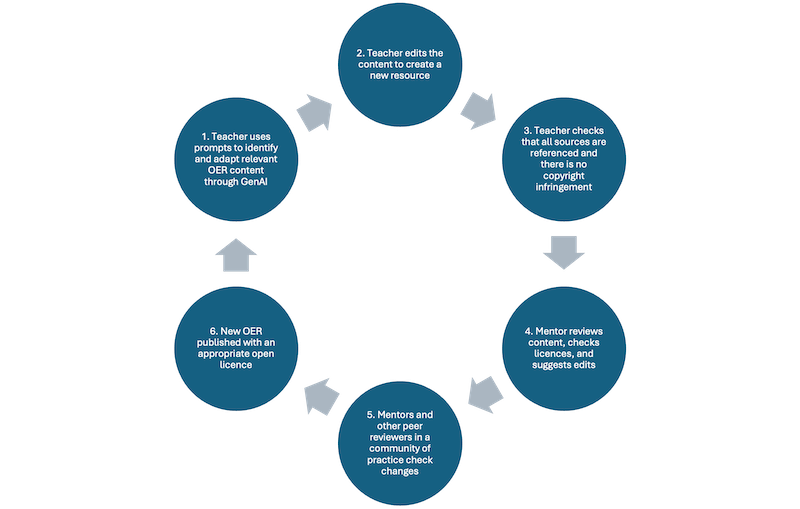
Figure 1 below illustrates the process of initial content generation and self-review, which is a critical part of the creation process (Zhou et al., 2025), and then the subsequent formal review by a subject expert mentor. This process ensures that it is human teachers who make the final determination of the quality of the content developed with GenAI support.
For Step 1, teachers would need to explore appropriate prompts for the GenAI, for example, ‘create a 45-minute lesson plan on addition of irregular fractions aligned with curriculum standard 6.1 including illustrative examples, practice exercises and an authentic assessment task’. They would also need to explore follow-on prompts to refine the outputs, for example, ‘adapt the assessment task for a learner with visual impairment and create an assessment rubric’. As familiarity with the tools grows, and as the tools themselves become more sophisticated, there will likely be a transition from sequential prompting to a truly more dialogic interaction (Rahimi, 2025).
For steps 3, 4 and 6, all stakeholders would need to be cognisant of OER licences and the compatibility thereof. For steps 4 and 5, all teachers and mentors would need to agree on a set of criteria for evaluating the new OER created with GenAI support. An OER evaluation tool might include the following criteria, for example:
The new resources created through this process can then also be shared under an appropriate licence consistent with the licences applied to the OER used as source materials. Once published, the new OER becomes a source document for other teachers.
COL has been actively promoting the use of GenAI in education, particularly in developing countries, using the model illustrated above. One notable example is a pilot project in India where secondary school educators are using GenAI with a human-in-the-loop approach to create context-specific OER for Grade 9 mathematics. This project, conducted in partnership with the regulatory boards and textbook societies, aims to equip teachers with advanced GenAI tools to personalise learning content and foster inclusive and adaptive education. Through this project, teachers are empowered to leverage GenAI to create customised learning materials that cater to the unique needs of their students.
Further exemplifying this approach, COL is implementing a co-creative mentoring model that utilises its GenAI-Powered OER adaptation tool in Ghana. This model provides a supportive environment where teacher mentors and pre-service teachers collaborate to develop subject-specific resources while simultaneously reinforcing gender-responsive pedagogical skills. By integrating GenAI tools into the mentoring process, COL is fostering a new generation of educators who are equipped to leverage GenAI for OER development and adaptation.
In the Pacific region, COL offers a hands-on, activity-based course to help teachers improve their digital skills and create OER. As a prior activity, using a COL online course on OER, participants learn how to develop teaching materials for their classrooms and share them as OER. This course empowers teachers to create curriculum-based OER, contributing to the growth of national and regional OER communities of practice. Over 800 teachers in the region have been trained in OER adaptation and use of GenAI.
Elsewhere, teachers from over 30 TVET institutions in Ghana, Jamaica, Kenya and Nigeria are collaborating to develop OER in Fashion Design and Science Laboratory Technology. The teachers have been mentored and guided on OER and GenAI, based on outcomes from a recent study investigating the needs and requirements for AI-integration in the TVET curriculum.
These activities highlight the potential of Teacher in the Loop AI in empowering teachers to adapt and create OER that are relevant to their students' needs and aligned with national curricula.
The ‘Teacher in the Loop AI’ approach can be further generalised to the co-creation of revised OER aligned to national curricula. GenAI tools can be used to analyse curriculum documents and locally accessible OER to generate initial drafts of new OER, such as lesson plans, activities, and assessments. Teachers can then review, refine, and adapt these drafts to ensure they are appropriate for their students and aligned with their teaching styles. All the activities take place in the online space using a platform that COL has leased from a social enterprise. Adaptation or co-creation of OER aligned to national curricula can be paired with a process of mentoring and peer review that leads to publication of the OER online. In the regional activity in the Pacific some 40 teachers created 357 lesson plans of which 100 received peer approvals. This happened in one week of workshop activities.
This collaborative approach allows teachers to leverage the efficiency of GenAI while maintaining control over the pedagogical aspects of OER development. By incorporating their subject matter expertise and understanding of their students' needs, teachers can ensure that the revised and co-created OER are effective and engaging.
Taking the ‘Teacher in the Loop AI’ approach a step further, we can envision teachers playing a crucial role in refining responses from advanced Large Language Models (LLMs) for OER development. LLMs have shown remarkable capabilities in generating human-quality text, which can be used to create various educational materials, including interactive textbooks and dynamic content. However, these models still require human oversight to ensure the accuracy, relevance, and appropriateness of the generated content.
Teachers can act as graders, evaluating the quality of content generated by LLMs from OER sources and providing feedback to improve the models' performance. This feedback loop could help LLMs learn to generate more effective and relevant content, tailored to specific learning objectives and student needs. This process not only enhances the quality of GenAI-generated content but also has significant implications for GenAI development and education more generally. By incorporating teacher feedback, LLMs can become more sophisticated and better equipped to generate content to support diverse learning needs, ultimately contributing to the democratisation of teaching and learning.
The careful selection of mentors to collaborate with the teachers to co-create and subsequently review and add licences to new OER related to national curricula could ensure that the OER created in this way reflects values, such as gender equity using peer mentoring, to build a foundation for equitable education provision and contribute to building a community of practice for professional excellence (Adu-Manu & Ogange, 2025).
Synergising the power of GenAI with the teacher’s role, we can improve the quality of GenAI- adapted OER and empower teachers with a deeper understanding of GenAI and its potential in education. Initial lessons suggest that the implementation of the Teacher-in-the-Loop AI strategy can promote skill development, result in higher quality OER, empower educators, provide the basis for a scalable framework, promote inclusive education practice and enhance sustained mentorship (Adu-Manu & Ogange, 2025). A more detailed analysis of the model and the lessons learned will be available on completion of the pilot project.
ACHIEVE. (2011). Rubrics for evaluation Open Education Resources (OER) objects. https://www.achieve.org/files/AchieveOERRubrics.pdf
Adu-Manu, K.S., & Ogange, B. (2025). A co-creative mentoring model for pre-service teachers in Ghana. Unpublished COL Consultant Report.
Aksoy, D.A., & Kursun, E. (2024). Behind the scenes: A critical perspective on genAI and open educational practices. Open Praxis, 16(3), 457-470. https://search.informit.org/doi/10.3316/informit.T2024100100012100759885702
Baidoo-Anu, D., & Owusu Ansah, L. (2023, January 25). Education in the era of generative Artificial Intelligence (AI): Understanding the potential benefits of ChatGPT in promoting teaching and learning. https://ssrn.com/abstract=4337484 or http://dx.doi.org/10.2139/ssrn.4337484
Borup, J., West, R.E., Lowenthal, P., & Archambault, L. (2025). A framework for establishing social presence through the combination of AI-generated text with human-created video. Open Praxis, 17(1), pp. 64-78. DOI: https://doi.org/10.55982/ openpraxis.17.1.769
Bozkurt, A., & Sharma, R.C. (2023). Generative AI and prompt engineering: The art of whispering to let the genie out of the algorithmic world. Asian Journal of Distance Education, 18(2). https://www.researchgate.net/profile/Aras-Bozkurt/publication/372650445_Generative_AI_and_Prompt_Engineering_The_Art_of_Whispering_to_Let_the_Genie_Out_of_the_Algorithmic_World/links/64c1af66c41fb852dd9d8ace/Generative-AI-and-Prompt-Engineering-The-Art-of-Whispering-to-Let-the-Genie-Out-of-the-Algorithmic-World.pdf
Cooper, G. (2023). Examining science education in ChatGPT: An exploratory study of Generative Artificial Intelligence. Journal of Science Education and Technology, 32, 444-452. https://doi.org/10.1007/s10956-023-10039-y
Kılıçkaya, F., & Kic-Drgas, J. (2021). Issues of context and design in OER (open educational resources). Educational Technology Research and Development 69, 401-405. https://doi.org/10.1007/s11423-020-09852-8
Mosqueira-Rey, E., Hernández-Pereira, E., Alonso-Ríos, D. et al. (2023). Human-in-the-loop machine learning: A state of the art. Artificial Intelligence Review 56, 3005-3054. https://doi.org/10.1007/s10462-022-10246-w
Rahimi, M. (2025). Synergising dialogic teaching with competencies-trained GenAI dialoguing for critical thinking and communication competencies. Journal of University Teaching and Learning Practice, 22(2), 1-22. https://doi.org/10.53761/vaa8h214
Rajan, R., & Cortinovis, R. (2024). Ethical integration in computer science education: Leveraging Open Educational Resources and generative Artificial Intelligence for enhanced learning. PPIG. https://www.researchgate.net/profile/Ranjidha-Rajan/publication/384809359_Ethical_Integration_in_Computer_Science_Education_Leveraging_Open_Educational_Resources_and_Generative_Artificial_Intelligence_for_Enhanced_Learning/links/678877fe43ffa93f52d8c761/Ethical-Integration-in-Computer-Science-Education-Leveraging-Open-Educational-Resources-and-Generative-Artificial-Intelligence-for-Enhanced-Learning.pdf
Tlili, A., Agyemang Adarkwah, M., Lo, C.K., Bozkurt, A., Burgos, D., Bonk, C.J., Costello, E., Mishra, S., Stracke, C.M., & Huang, R. (2024). Taming the monster: How can open education promote the effective and safe use of generative AI in education? Journal of Learning for Development, 11(3), 398-413. https://doi.org/10.56059/jl4d.v11i3.1657
UNESCO. (2024). Dubai Declaration on Open Educational Resources (OER): Digital public goods and emerging technologies for equitable and inclusive access to knowledge. UNESCO. https://unesdoc.unesco.org/ark:/48223/pf0000392271.locale=en
UNESCO. (2019). Recommendations of Open Educational Resources (OER). UNESCO. https://www.unesco.org/en/legal-affairs/recommendation-open-educational-resources-oer
University of Illinois. (2024). Open Educational Resources (OER): Evaluate OER. https://guides.library.illinois.edu/c.php?g=246992&p=1645967
Velaru, C.S. (2024). The impact of generative AI on content curation and content advancements in education and training. European Journal of Advances in Engineering and Technology, 11(4), 121-130. https://www.researchgate.net/profile/Chandra-Veluru-2/publication/384467366_The_Impact_of_Generative_AI_on_Content_Curation_and_Content_Advancements_in_Education_and_Training/links/66fb16349e6e82486ffc296f/The-Impact-of-Generative-AI-on-Content-Curation-and-Content-Advancements-in-Education-and-Training.pdf
Wang, J., Dineke E.H., & Tigelaar, W.A. (2021). Rural teachers’ sharing of digital educational resources: From motivation to behavior. Computers & Education, 161, 104055, https://doi.org/10.1016/j.compedu.2020.104055
Zhou, X., Li, Y., Chai, C.S., & Chiu, T.K.F. (2025). Defining, enhancing, and assessing artificial intelligence literacy and competency in K-12 education from a systematic review. Interactive Learning Environments. https://doi.org/10.1080/10494820.2025.2487538
Author Notes
Venkataraman Balaji is Special Adviser to the President at the Commonwealth of Learning. Email: vbalaji@col.org (https://orcid.org/0000-0001-6561-2399)
Betty Obura Ogange is Education Specialist: Teacher Education at the Commonwealth of Learning. Email: bogange@col.org (https://orcid.org/ 0000-0002-3133-7138)
Tony Mays is Director: Education at the Commonwealth of Learning. Email: tmays@col.org (https://orcid.org/ 0000-0003-3506-8497)
Cite as: Balaji, V., Ogange, B.O., & Mays, T. (2025). Teacher in the Loop AI (TiL-AI): A strategy for empowering educators in developing countries through OER adaptation. Journal of Learning for Development, 12(2), 439-445.