Shyamali Mondal and Manohar Kumar Das
2026 VOL. 13, No. 2
Abstract: Integration of Information and Communication Technology (ICT) in education and development of its competencies are crucial for quality learning and sustainable development in this digital age. This quantitative study investigated the factors influencing ICT skills acquisition among trainee teachers, using the TOEK (Technological infrastructure, Organisational support, Environmental influences, and Knowledge development) framework. Data were collected using validated scales from 202 randomly selected trainee teachers, from different institutions in Jharkhand state, India. Confirmatory Factor Analysis (CFA) and Structural Equation Modelling (SEM) were applied to analyse the relationships between latent variables. The results indicated poor model fit, leading to refinement of the measurement items. The revised model demonstrated improved fit (Chi-square, CFI, TLI, and RMSEA) indices. The findings also revealed that all four factors significantly influence ICT skills acquisition, with knowledge development emerging as the strongest predictor. The model explained 79.8% of the variance in ICT skill acquisition, highlighting the need for institutional and pedagogical support to enhance digital competencies among the future teachers.
Keywords: sustainable education, TOEK framework, ICT skills, teacher education
In the digital era, integrating information and communication technology (ICT) in every facet of education has become increasingly important. With the ever-evolving landscape of technology, educators are responsible for preparing the next generation to thrive in a digitally connected world. Tech-savvy aspiring teachers are leading this educational revolution, with developing ICT competencies amongst the students playing a pivotal role. Digitalised learning and advanced technologies have empowered learners with digital tools helping students in their self-directed learning, while teachers use these tools to improve their pedagogical skills and stay updated on new teaching methods (Elstad & Christophersen, 2017; Mondal & Das, 2024). The Commonwealth of Learning (COL) has been developing and supporting education and training institutions for sustainable policy-technology-capacity building to implement technology-enabled management and learning (Mishra & Panda, 2020). In India (the context of this study), the National Council of Educational Research and Training (NCERT) platforms, such as Digital Infrastructure for Knowledge Sharing (DIKSHA) and Study Webs of Active-learning for Young Aspiring Minds (SWAYAM), provide structured and interactive ICT training to enhance teachers’ digital skills.
The Technology-Organisation-Environment (TOE) framework has been extensively employed to examine the adoption of web 2.0 technologies in organisational settings (Oliveira et al., 2019; Tarofder et al., 2019; Tornatzky & Fleischer, 1990). Extending this framework by incorporating a knowledge factor enhances its exploratory scope. Accordingly, the present study adopts the Technology-Organisation-Environment-Knowledge (TOEK) framework to analyse the connections amongst the four variables, and their influence in developing ICT skills among trainee teachers. Trainee teachers are those training to be student-teachers or teacher-educators. Investing in their perception regarding the determinants of ICT skills acquisition seems necessary as their competencies shall affect those of their students in the near future.
By investigating the relationships between the TOEK factors and ICT competency, this study aimed to inform policy makers and teacher educators in designing targeted interventions to facilitate effective ICT integration in teaching and learning.
Several theoretical models have been widely used to explain the acquisition of ICT skills and adoption of technology among teachers. At the individual level, the Technology Acceptance Model (TAM) (Davis, 1989) identifies perceived usefulness and perceived ease of use as key determinants of technology adoption. Empirical evidence has consistently demonstrated that teachers who perceive ICT tools as useful and easy to use exhibit higher levels of engagement and ICT skills (Lubuva et al., 2022; Mukherjee & Singh, 2026; Zhang et al., 2022). Similarly, the Unified Theory of Acceptance and Use of Technology (UTAUT), proposed by Venkatesh et al. (2003), incorporates performance expectancy, effort expectancy, social influence, and facilitating conditions, thereby offering a comprehensive explanation of technology adoption within institutional settings. Complementing these models, the Technological Pedagogical Content Knowledge (TPACK) framework (Koehler & Mishra, 2009) emphasises the integration of technological, pedagogical, and content knowledge for effective ICT use, highlighting the need for teacher competency in meaningful technological integration (Deb, 2026; Petko et al., 2025; Tømte et al., 2015).
Previous studies also explored the role of teacher-related characteristics in ICT integration. Factors such as attitude, self-efficacy and perceived competence have been identified as strong predictors of ICT use (Hatlevik & Hatlevik, 2018; Røkenes & Krumsvik, 2014; Sang et al., 2011). Additionally, Pozas and Letzel (2023) found that pre-service teachers’ attitudes and teaching competence strongly influence their ICT usage. Further, positive attitude toward using advanced digital models of learning increases the likelihood of ICT in providing meaningful learning (Mukherjee, 2024; Yusuf & Balogun, 2011). Collectively, professional development, subject-specific factors, and perceived usefulness were emphasised as important factors influencing ICT integration and skills acquisition among trainee teachers (Li et al., 2019; Nunes et al., 2022). At a broader level, the Technology, Organisation, Environment (TOE) framework, proposed by Tornatzky and Fleischer (1990), provides a multi-dimensional perspective incorporating technological, organisational, and environmental factors influencing technology adoption (Bhattacharya & Wamba, 2015; Di & Xia, 2017). Building on this foundation, the present study adopts an extended Technology-Organisation-Environment-Knowledge (TOEK) framework, providing a comprehensive theoretical foundation for examining ICT skills development among trainee teachers. It was evident that a significant gap remains in understanding the combined and interactive influence of the four TOEK factors on acquisition of ICT skills among trainee teachers. Existing studies have largely relied on the traditional TOE framework without incorporating the Knowledge dimension therefore, it seemed necessary to adopt a holistic approach for understanding how these dimensions shape the digital competencies of pre-service educators. Furthermore, while the UNESCO ICT Competency Framework for Teachers (2018) establishes internationally benchmarked standards for digital competencies, organisational support, and professional learning, empirical validation with integrated, context specific models remain limited.
To address this gap, the present study extends the TOE framework by incorporating knowledge development as a crucial dimension and empirically aims to examine the structural relationships among these factors using CFA and SEM techniques. By focusing on trainee teachers within the Indian context and aligning with the priorities of the National Education Policy 2020, this study contributes a comprehensive data driven model that bridges the gap between global competency standards and their practical implementation in teacher education.
The study was conducted with the following research objectives in view:
RO1: To validate the measurement model of the TOEK framework constructs using Confirmatory Factor Analysis (CFA).
RO2: To assess the structural model fit and examine the relationships among the latent variables using Structural Equation Modeling (SEM).
RO3: To study the effect of technological infrastructure, organisational support, environmental influences, and knowledge development on the acquisition of ICT skills among trainee teachers.
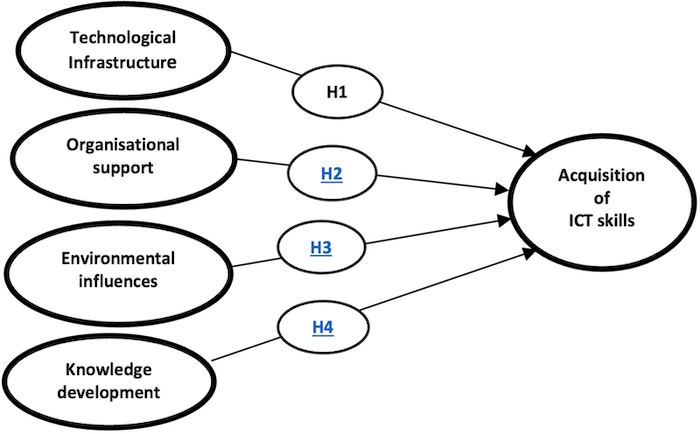
Based on the study objectives and the TOE framework proposed by Tornatzky and Fleischer (1990), an extended conceptual model (TOEK) was developed to examine the effects of contextual factors on ICT skills acquisition among trainee teachers. Conceptual frameworks are designed to represent the relationship among variables derived from research objectives and theoretical foundation (Maxwell, 2013; Creswell & Plano Clark, 2018). In the present study, the conceptual model served not only as a theoretical foundation but also as an analytical framework that guided the identification of latent construct and formulation of their hypothesised relationships. Accordingly, four hypotheses corresponding to each of the TOEK dimensions were formulated and empirically tested.
Technological infrastructure: Tech-infused infrastructure, like access to high-speed internet, software tools, and electronic devices, significantly enhances ICT abilities. Jo and Bang (2023), identified network quality, accessibility and responsiveness as primary determinants of technology adoption. Real-time internet access further facilitates interactive and personalised learning amongst learners. Hence the hypothesis was stated as:
H1: Technological infrastructure influences ICT skills acquisition among trainee teachers.
Organisational support: Culture, organisation, and institutional strategy are crucial factors when utilising technology in teaching and learning. An environment full of creativity, cooperation, and continuous learning efficiently promotes utilisation of technological innovations. This factor was advanced by Westerman et al. (2014), according to whom organisational agility and leadership play a crucial role in promoting digital transformation and developing ICT skills. Therefore, to examine its effect in the study’s context the hypothesis formulated was:
H2: Organisational support influences ICT skills acquisition among trainee teachers.
Environmental influences: The external environment, including regulatory frameworks, policy support, and socio-economic conditions, plays a crucial role in shaping the use of ICT in teaching and learning. Effective ICT integration depends on how organisations adapt to global changes and emerging opportunities. Research by Permadi and Fathussyaadah (2021) highlights that environmental support significantly affects online learning amongst students. Support from government, community, and organisations creates a favourable influence on digital learning. Considering this it was proposed that:
H3: Environmental influences affect ICT skills acquisition among trainee teachers.
Knowledge development: ICT facilitates knowledge creation, access, sharing, and dissemination. Teachers need continuous exposure to the latest technologies and best practices to strengthen their professional knowledge. Nonaka and Takeuchi (1995) highlighted the importance of knowledge production, sharing, and utilisation in promoting organisational innovation and competitiveness. Considering this, the present study included knowledge development and proposed:
H4: Knowledge development influences ICT skills acquisition among trainee teachers.
Based on the study objectives and the TOE framework proposed by Tornatzky and Fleischer (1990), an extended conceptual model (TOEK) was developed to examine the effects of contextual factors on ICT skills acquisition among trainee teachers. Conceptual frameworks are designed to represent the relationship among variables derived from research objectives and theoretical foundation (Maxwell, 2013; Creswell & Plano Clark, 2018). In the present study, the conceptual model served not only as a theoretical foundation but also as an analytical framework that guided the identification of latent construct and formulation of their hypothesised relationships. Accordingly, four hypotheses corresponding to each of the TOEK dimensions were formulated and empirically tested.
Based on the proposed hypotheses, a conceptual model was developed to examine how contextual factors collectively influence digital skill development (Figure 1). The model informs the research design, instrument development, and CFA- and SEM-based empirical analysis. The conceptual model served as the central framework guiding the entire study. In the methodology section, the four TOEK dimensions are treated as independent latent constructs and ICT skills acquisition as the dependent construct, measured through a structured Likert-scale instrument. In the results section, the model is empirically tested using CFA to validate the measurement structure, followed by SEM to examine the hypothesised relationships among the constructs. The discussion further interprets how each of the TOEK dimensions contributed to ICT skills acquisition, deriving practical implications for teacher education.
The study adopted a quantitative research approach to assess the factors influencing trainee teachers’ acquisition of ICT skills. Structural Equation Modelling (SEM) supported by Confirmatory Factor Analysis (CFA) was employed to investigate the relationship between the latent variables: technological infrastructure, organisational support, environmental influences, knowledge development, and ICT Skills while accounting for measurement error. This approach enabled a comprehensive understanding of the direct effects of the proposed factors influencing the ICT Skills development.
A sample of 202 trainee teachers (124 males and 78 females) were selected using simple random sampling from three government-aided teacher training colleges in the East Singhbhum district of the Kolhan Division, Jharkhand, India. The study was delimited to government-aided colleges within this region only. Participation was voluntary and informed consent was obtained from all respondents. In terms of pedagogical specialisation, 110 participants were from the social sciences, 29 from science, 36 from language studies, and 27 were from the humanities.
Data were collected through a self-constructed five-point Likert scale questionnaire, designed to measure the latent variables of technological infrastructure, organisational support, environmental influences, knowledge development, and ICT skills acquisition amongst the participants. At the preliminary stage, a 42-item measurement scale was prepared with responses ranging from Strongly Agree to Strongly Disagree. The measurement tool demonstrated excellent internal consistency, with a Cronbach’s alpha coefficient of 0.974. CFA and SEM were employed to validate the measurement and structural models, and to examine the relationships among the constructs. SPSS Version 22 and JAMOVI software for the social sciences were used for statistical analysis of the data. Further, multiple regression was performed on SPSS 22 software for hypotheses testing.
To address the first research objective, CFA was conducted to examine the reliability and validity of the TOEK framework constructs. Initially, 42 items were analysed, and items with factor loadings below 0.50 were removed to improve construct validity (Morse, 2022). The final model retained 24 items across five factors: technological infrastructure, organisational support, environmental influences, knowledge development and ICT skills acquisition.
As presented in Table 1, all retained items demonstrated satisfactory factor loadings (> 0.50), with the Average Variance Extracted (AVE) values exceeding the recommended threshold of 0.50, confirming construct validity. Further, construct reliability values ranged from 0.757 to 0.903, indicating adequate internal consistency (Hair et al., 2010).
Table 1: Construct Report Summary of Confirmatory Factor Analysis
|
Factor 1 |
Sl. No. |
Construct |
Items |
Factor Loading |
Reliability |
AVE > = 0.5 |
|
1 |
|
My institution provides sufficient technological resources to support remote work effectively. (T1) |
.633 |
0.799
|
0.510 |
|
|
2 |
Technological infrastructure including hardware, software and networking resources in my organisation are up-to-date. (T4) |
.657 |
||||
|
3 |
My organisation’s tech-infrastructure facilitates the implementation of ICT initiatives. (T5) |
.665 |
||||
|
4 |
Tech-infrastructure empowers me to reveal innovative approaches to work. (T6) |
.516 |
||||
|
5 |
Tech-infrastructure empowers the scalability to adopt adequately in rapid institutional expansion. (T8) |
.541 |
||||
|
Factor 2 |
1 |
|
There are separate ICT departments to provide guidance on technology related problems and doubts. (O2) |
.507 |
0.833
|
0.561 |
|
2 |
My organisation provides sufficient access to resources for ICT projects and initiatives. (O3) |
.714 |
||||
|
3 |
My organisation’s learning culture promotes for continuous learning in ICT-related competencies. (O4) |
.620 |
||||
|
4 |
My organisation invests in training programmes to help students develop requisite skills for utilising technology in learning. (O5) |
.614 |
||||
|
5 |
My institution promotes ICT-related practices through continuous learning. (O8) |
.557 |
||||
|
Factor 3 |
1 |
|
Changes such as transition from one technological process to another are an obvious key factor for innovation. (E1) |
.506 |
0.848 |
0.581 |
|
2 |
Societal side of technological progress forms a crucial part of keeping pace with the changing needs. (E2) |
.527 |
||||
|
3 |
An optimistic environmental support of the institution fosters adoption of innovation in technological field. (E5) |
.532 |
||||
|
4 |
Institution actively adapts only changes that pertain to regulatory requirements and management decisions. (E6) |
.625 |
||||
|
5 |
Institution upholds social norms regarding accessibility drive to ensure equal opportunity to ICT resources within the institution. (E7) |
.630 |
||||
|
Factor 4 |
1 |
|
Organisation offers learning programmes that give learners with tools to increase their ICT skills. (K1) |
.605 |
0.757 |
0.544 |
|
2 |
Participating in communities related to ICT Improves my knowledge in the field. (K3) |
.631 |
||||
|
3 |
Trainee teachers demonstrate high levels of digital literacy, showcasing their ability to effectively assess the online resources. (K8) |
.518 |
||||
|
Factor 5 |
1 |
ICT skills |
I seek out different ICT applications because I wish to enhance my proficiency in them. (I2) |
.598 |
0.903 |
0.672 |
|
2 |
I trust that taking advanced computer classes is a good idea for my future career opportunities. (I4) |
.511 |
||||
|
3 |
Group work on ICT projects with peers has laid foundation for my general skills and competency. (I7) |
.605 |
||||
|
4 |
Instructors give me positive feedbacks on my ICT assignments. (I8) |
.609 |
||||
|
5 |
My creativity in preparing lesson plans has increased multiple folds with the use of ICT. (I9) |
.717 |
||||
|
6 |
My critical thinking skills and leaning proficiency have increased with the use of ICT. (I10) |
.743 |
These findings confirm that the observed variables adequately represent the latent constructs of the TOEK framework and that the measurement model is suitable for further analysis.
To address the second research objective, SEM was employed to assess the model fit and examine the relationships among the latent constructs of the TOEK framework. With a sample size of 202, the prerequisite of performing SEM was satisfied (as per Hair et al., 2010, the sample to item ratio should be 5:1). Model fit was determined using indices such as normative Chi-square (χ²/df), Comparative Fit Index (CFI), Tucker-Lewis Index (TLI), and Root Mean Square Error of Approximation (RMSEA). The initial model showed moderate fit (χ²/df = 2.159, and RMSEA = 0 .075, CFI = 0.841, TLI = 0.831), indicating the requirement for model refinement. After removing the poorly performing items, the revised structural model demonstrated improved fit indices (χ²/df = 1.855, CFI = 0.925, TLI = 0.915, and RMSEA = 0.065), all within acceptable limits (Hair et al., 2010). These values (Table 2), imply that the model fits the data well and can be reliably used to examine the interrelationships among the variables being studied.
Table 2: Goodness-of-fit of the Structural Model
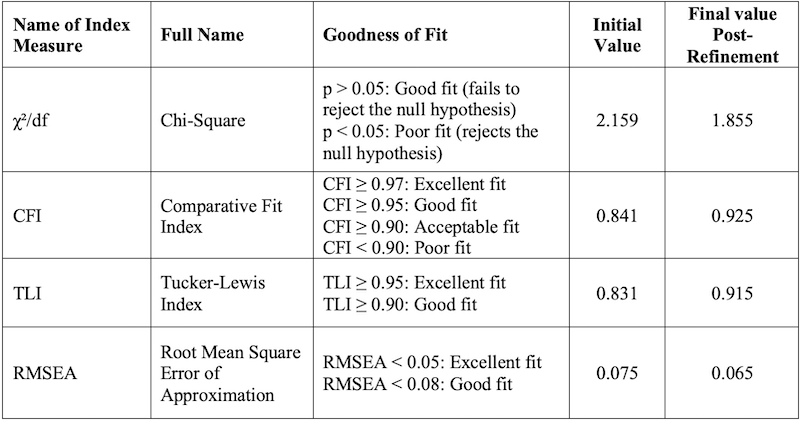
Note: Goodness of fit indices as per Hair et al. (2010)
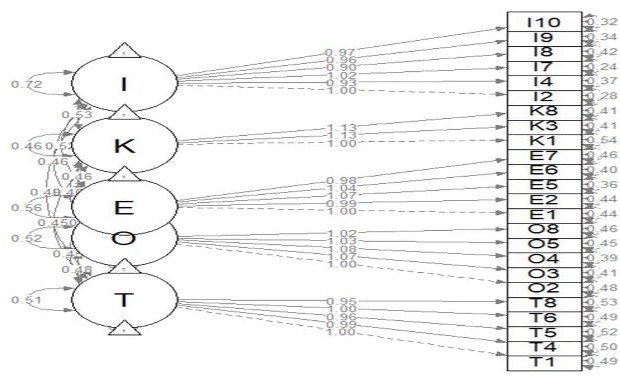
The revised CFA model, depicted in a path diagram (Figure 2), indicates satisfactory relationships between latent constructs, and observed variables, with all standardised factor loadings above acceptable limits and reduced error terms. The latent variables — technological infrastructure (T), organisational support (O), environmental influences (E), knowledge development (K), and ICT skills acquisition (I) are depicted in circles on the left side, while their observed indicators are depicted in rectangular boxes on the right. This validated model was subsequently used for hypotheses testing.
To address the third research objective, the validated structural model was used to examine the influence of the TOEK factors on ICT skills acquisition among trainee teachers. Multiple regression was performed, where findings showed that the overall model was statistically significant (F = 194.45, p < 0.001), with the set of predictors explaining 79.8% of variance in ICT skills acquisition (R2 = 0.798), thus showing adequate explanatory power of the independent variables towards the dependent constructs. The result of the regression analysis is presented in Figure 3.
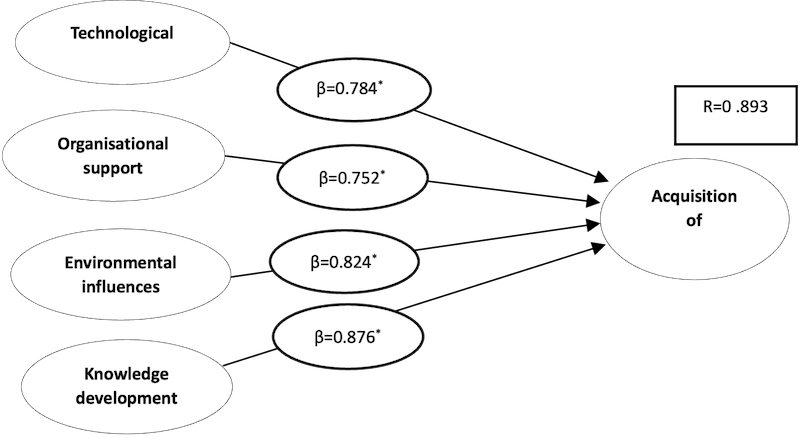
Note: *P = 0.000. significant at 95% level
All hypothesised relationships were found to be significant, where technological infrastructure positively influenced ICT skills acquisition (β = 0.784, p < 0.001), supporting H1. Organisational support also demonstrated a significant positive influence (β = 0.752, p < 0.001), supporting H2. Similarly, environmental influences significantly predicted ICT skills acquisition (β = 0.824, p < 0.001), supporting H3, while knowledge development emerged as the strongest predictor influence (β = 0.876, p < 0.001), thereby supporting H4.
Therefore, the findings confirm that the TOEK framework is a valid and reliable model for understanding ICT skills acquisition among trainee teachers. The CFA results showed that the retained items adequately represented the five constructs, namely technological infrastructure, organisational support, environmental influences, knowledge development, and ICT skills acquisition, with satisfactory reliability and validity values. The structural model assessment further demonstrated acceptable model fit indices, indicating that the proposed framework fits the data well and can effectively explain the relationships between the variables. This means that the framework is scientifically suitable for examining how different institutional and learning related factors contribute towards development of ICT skills among teachers. The regression findings further revealed that all four factors significantly influenced ICT skills acquisition, explaining nearly 80% of the variance in trainee teachers’ ICT competency. This indicates that effective ICT integration in teacher education requires not only technological resources but also supportive learning environments and opportunities for practical digital engagement.
The findings of this study document that ICT skills acquisition among trainee teachers is influenced by a combination of technological, organisational, environmental, and knowledge-related factors rather than by access to technology alone. The validated TOEK framework was consistent with prior SEM-based educational technology research (Davis, 1989; Tornatzky & Fleischer, 1990), indicating that ICT competency development in teacher education is a multidimensional process where institutional support, digital learning opportunities, and practical exposure to technology collectively shape trainee teachers’ readiness to integrate ICT into teaching and learning practices.
Technological infrastructure was found to significantly influence ICT skills acquisition, indicating that trainee teachers develop better technological competencies when institutions provide reliable internet connectivity, updated digital devices, and access to ICT resources during classroom activities (Guerreo, 2023; Mukherjee & Singh, 2026). However, infrastructure alone does not ensure competency development unless accompanied by pedagogically relevant learning opportunities and institutional support mechanisms (Mondal & Das, 2025; Mirzajani et al., 2016; Pozas & Letzel, 2023; Sang et al., 2010). Organisational support also contributed significantly, highlighting the importance of institutional encouragement, mentoring, and collaborative learning environments. The findings suggest that trainee teachers become more confident in using ICT when teacher educators provide guidance, technical support, and opportunities to practise technology-integrated teaching strategies (Mtebe, 2020). This indicates that institutional leaders should create supportive professional learning environments where trainee teachers can continuously develop and practise ICT-related pedagogical skills (Day et al., 2012; Zhang et al., 2022).
Environmental influences were also found to positively affect ICT skills acquisition, indicating that technology-oriented academic environments and supportive digital ecosystems foster greater ICT readiness and technology adoption (Chan et al., 2025; Chen et al., 2024). Among all the predictors, knowledge development exerted the strongest influence, suggesting that trainee teachers develop ICT competency more effectively when they actively engage in hands-on learning such as preparing multimedia lesson plans, conducting online assessments, participating in collaborative digital activities, and using technology during teaching practice sessions (Kumar & Sri, 2023). This implies that teacher education institutions should integrate practical ICT training across pedagogy courses rather than limiting ICT learning to theoretical instruction or isolated workshops (Jo & Bang, 2023; Kumar, 2026; Luik & Taimalu, 2021). These experiences may help trainee teachers promote the 21st century skills like critical thinking, and collaboration and active learner engagement in technology-enabled classrooms (Bitegeko et al. 2024; Deb, 2026).
The study contributes theoretically by empirically validating the extended TOE framework through the inclusion of knowledge development as an additional dimension, strengthening its explanatory power in teacher education contexts. Practically, the findings suggest that teacher education institutions should adopt integrated ICT strategies that strengthen infrastructure, organisational support, digital learning culture, and professional training opportunities. Embedding ICT oriented learning within teacher education curricula, while strengthening administrative support through adequate resources, and continuous encouragement, might significantly improve trainee teachers’ digital preparedness and confidence (Falloon, 2020; Hamilton et al., 2020; Oliveira et al., 2019). Aligning with established frameworks such as UNESCO’s ICT Competency Framework for teachers and India’s National Education Policy 2020 (para 24.3), such initiatives may further emphasise equitable and meaningful integration of technology in education (Mishra et al., 2025).
Despite increasing ICT availability, challenges related to poor internet connectivity, limited confidence, inadequate digital preparedness, uneven institutional support, and digital illiteracy continue to restrict effective classroom integration of technology, particularly in rural and resource-constrained areas (Esfijani & Zamani, 2020; Mukherjee, 2024; Niyibizi, 2026; Vandegrift, 2022). Additionally, the limited pedagogical integration of emerging AI tools, such as Chatbots and Gemini may constrain the development of advanced digital competencies in teacher education (Sigurjonsson & Wendt, 2025). Therefore, strengthening inclusive digital infrastructure, institutional collaboration, continuous professional development, and ICT competency frameworks remain essential for achieving equitable and sustainable technology-enabled education aligned with Sustainable Development Goal 4.
This study indicates that ICT competency is shaped by the combined influence of technological, institutional, environmental, and knowledge related factors, rather than by isolated variables alone. By incorporating knowledge development into the traditional TOE framework, the findings of the study provide a more comprehensive perspective on ICT skill formation, among training teachers. The strong explanatory power of the model further supports the applicability of the TOEK framework in understanding ICT skills acquisition in contemporary educational settings. The findings suggest that teacher education programmes should prioritise structured ICT training and continuous knowledge development. Institutions need to strengthen technological infrastructure and provide sustained organisational support. The TOEK framework also offers a useful model for researchers and policy makers to design and evaluate ICT integration strategies.
While the study provides important insights, further research might adopt longitudinal designs to examine how ICT skills evolve over time with continuous exposure and practise. Researchers need to examine additional factors such as self-efficacy, motivation and attitudes towards technology to better understand how and why ICT skills are developed among different types of learners. Further, testing the effectiveness of teaching interventions like AI-based tools, animation, or digital storytelling would be a good approach towards assessing the improvement of ICT skills among teachers. Lastly, research could investigate the role of policies and institutional leadership in strengthening ICT integration in teacher education.
Bhattacharya, M., & Wamba, S. (2015). A conceptual framework of RFID adoption in retail using TOE framework. International Journal of Technology Diffusion, 6(1), 1-32. https://doi.org/10.4018/ijtd.2015010101
Bitegeko, R.M., Lawrent, G., & Cosmas, J. (2024). Applying the UNESCO ICT competency framework to evaluate digital competencies among undergraduate students in teacher education in Tanzania. Educational Technology Quarterly, 2024(3), 298-318. https://doi.org/10.55056/etq.769
Chan, R., Tan, M., & Verma, A. (2025). The relationship between teacher digital literacy and the use of technology in learning. International Journal of Educational Narratives, 3(2), 133-142. https://doi.org/10.70177/ijen.v2i4.12663
Chen, W., Men, Y., Fuster, N., Osorio, C., & Juan, A.A. (2024). Artificial intelligence in logistics optimization with sustainable criteria: A review. Sustainability, 16(21), 9145. https://doi.org/10.3390/su16219145
Creswell, J.W., & Plano Clark, V.L. (2018). Designing and conducting mixed methods research (3rd ed.). Sage Publications.
Davis, F.D. (1989). Perceived usefulness, Perceived ease of use, and user acceptance of information technology. MIS Quarterly, 13(3), 319-340. https://doi.org/10.2307/249008
Day, A., Paquet, S., Scott, N., & Hambley, L. (2012). Perceived information and communication technology (ICT) demands on employee outcomes: The moderating effect of organizational ICT support. Journal of Occupational Health Psychology, 17(4), 473-491. https://doi.org/10.1037/a0029837?urlappend=%3Futm_source%3Dresearchgate.net%26utm_medium%3Darticle
Deb, J.P. (2026). Technological Pedagogical Content Knowledge (TPACK) framework in pre-service teacher education: A comprehensive review of two decades of research (2006-2026). International Journal of Emerging Voices in Education, 2(2), 1-22. https://doi.org/10.59828/ijeve.v2i2.31
Di, W., & Xia, J. (2017). Study on the key factors for enterprises adopting XBRL technology based on TOE framework. ICCESSH, 124,739-746. https://doi.org/10.2991/iccessh-17.2017.178
Elstad, E., & Christophersen, K. (2017). Perceptions of digital competency among student teachers: Contributing to the development of student teachers’ instructional self-efficacy in technology-rich classrooms. Education Sciences, 7(1), 1-15. https://doi.org/10.3390/educsci7010027
Esfijani, A., & Zamani, B.E. (2020). Factors influencing teachers’ utilisation of ICT: The role of in-service training courses and access. Research in Learning Technology, 28, 1-16. https://doi.org/10.25304/rlt.v28.2313
Falloon, G. (2020). From digital literacy to digital competence: The teacher digital competency (TDC) framework. Educational Technology Research and Development, 68, 2449-2472. https://doi.org/10.1007/s11423-020-09767-4
Guerreo, J. (2023). Drivers and barriers to adopting ICT: Mexican EFL primary school teachers’ perceptions. Open Journal for Information Technology, 6(1), 33-46. https://doi.org/10.32591/coas. ojit.0601.03033g
Hair, J., Anderson, R., Babin, B., & Black, W. (2010). Multivariate data analysis (7th ed.). Prentice Hall.
Hamilton, L.S., Kaufman, J.H., & Diliberti, M. (2020). Teaching and leading through a pandemic: Key findings from the American Educator Panels Spring 2020 COVID-19 Surveys. Insights from the American Educator Panels. Research Report. RR-A168-2. RAND Corporation. https://doi.org/10.7249/RRA168-2
Hatlevik, I., & Hatlevik, O. (2018). Examining the relationship between teachers’ ICT self-efficacy for educational purposes, collegial collaboration, lack of facilitation and the use of ICT in teaching practice. Frontiers in Psychology, 9, 1-8. https://doi.org/10.3389/fpsyg.2018.00935
Jo, H., & Bang, Y. (2023). Analyzing ChatGPT adoption drivers with the TOEK framework. Scientific Reports, 13(1), 1-17. https://doi.org/10.1038/s41598-023-49710-0
Koehler, M.J., & Mishra, P. (2009). What is technological pedagogical content knowledge (TPACK)? Contemporary Issues in Technology and Teacher Education, 9(1), 60-70. https://www.scirp.org/reference/referencespapers?referenceid=1565932
Kumar, A. (2026). ICT-Integrated learning: Rethinking knowledge, skills and competencies. International Journal of Advanced Research in Science, Communication and Technology, 6(7), 294-309. https://doi.org/10.48175/IJARSCT-32227
Kumar, R.V., & Sri, P.M. (2023). Perceived ICT competencies of female student teachers in relation to selected variables. MIER Journal of Educational Studies, Trends & Practices, 13(2), 250-274. https://doi.org/10.52634/mier/2023/v13/i2/2425
Li, S., Yamaguchi, S., Sukhbaatar, J., & Takada, J. (2019). The influence of teachers’ professional development activities on the factors promoting ICT integration in primary schools in Mongolia. Education Sciences, 9(2), 1-18. https://doi.org/10.3390/educsci9020078
Lubuva, E.E., Ndibalema, P., & Mbwambo, E. (2022). Assessment of tutors’ level of ICT competencies in teaching in teacher education in Tanzania. Journal of Learning for Development, 9(3), 436-454. https://doi.org/10.56059/jl4d.v9i3.705
Luik, P., & Taimalu, M. (2021). Predicting the intention to use technology in education among student teachers: A path analysis. Education Sciences, 11(9), 1-14. https://doi.org/10.3390/educsci11090564
Maxwell, J.A. (2013). Qualitative research design: An interactive approach (3rd ed.). Sage Publications.
Ministry of Education, Government of India. (2020). National education policy. https://www.education.gov.in/sites/upload_files/mhrd/files/NEP_Final_English_0.pdf
Mirzajani, H., Mahmud, R., Ayub, A., & Wong, S. (2016). Teachers’ acceptance of ICT and its integration in the classroom. Quality Assurance in Education, 24(1), 26-40. https://doi.org/10.1108/qae-06-2014-0025
Mishra, S., & Panda, S. (Eds.) (2020). Technology-enabled learning: Policy, pedagogy and practices. The Commonwealth of Learning. https://oasis.col.org/handle/11599/3655
Mishra, S., Jha, N.K., & Bhagat, K.K. (2025). Review and validation of the benchmarking of technology-enabled learning. Journal of Learning for Development, 12(3), 450-468. https://doi.org/10.56059/jl4d.v12i3.2410
Mondal, S., & Das, M.K. (2025). Tech-infused learning: Exploring the relation between technology adoption and knowledge acquisition in self-paced online learning among higher education learners. MIER Journal of Educational Studies Trends and Practices, 15(1), 177-192. https://doi.org/10.52634/mier/2025/v15/i1/2862
Mondal, S., & Das, M.K. (2024). Examining the impact of social media platforms on the professional development of educators. The Online Journal of Distance Education and e-Learning, 12(2), 70-74. https://tojdel.net/journals/tojdel/articles/v12i02/v12i02-03.pdf
Morse, D. (2022). Re: Factor loading slightly less than 0.5 any reference to justify the item? https://www.researchgate.net/post/Factor_loading_slightly_less_than_05_any_reference_to_justify_the_item/6262f35dc9121b6eb8576123/citation/download
Mtebe, J.S. (2020). Applying UNESCO ICT Competency Framework to evaluate teachers' ICT competence levels in Tanzania. In Handbook of research on innovative pedagogies and best practices in teacher education (350-366). IGI Global. https://www.igiglobal.com/viewtitle.aspx?titleid=231167
Mukherjee, A. (2024). Teacher-educators' perspectives towards blended learning: A step towards futuristic trend in education. IISRR: International Journal of Research, 10 (2), 37-48. https://scholar.google.com/citations?view_op=view_citation&hl=en&user=JLA1wI0AAAAJ&citation_for_view=JLA1wI0AAAAJ:W7OEmFMy1HYC
Mukherjee, A., & Singh, S. (2026). Leveraging AI chatbots for self-directed learning: A study of practices and drivers to adoption among college students. Turkish Online Journal of Distance Education, 27(1), 70-81. https://doi.org/10.17718/tojde.1632775
National Council of Educational Research and Training. (2022). Guidelines for 50 hours of continuous professional development for teachers, head teachers and teacher educators. https://.nic.in/pdf/Guidelines50HoursCpd.pdf
Niyibizi, O. (2026). Collaborative learning through technology: Secondary school mathematics teachers’ perspectives on digital professional communities. Journal of Learning for Development, 13(1), 96-107. https://doi.org/10.56059/jl4d.v13i1.2416
Nonaka, I., & Takeuchi, H. (1995). The knowledge-creating company: How Japanese companies create the dynamics of innovation. Oxford University Press.
Nunes, A., Limpo, T., & Castro, S. (2022). Predictors of Portuguese teachers’ use of information and communication technologies in literacy classes. Frontiers in Psychology, 13, 1-8. https://doi.org/10.3389/fpsyg.2022.1006713
Oliveira, T., Martins, R., Sarker, S., Thomas, M., & Popovič, A. (2019). Understanding SaaS adoption: The moderating impact of the environment context. International Journal of Information Management, 49, 1-12. https://doi.org/10.1016/j.ijinfomgt.2019.02.009
Permadi, I., & Fathussyaadah, E. (2021). Technology, organization, and environment factors in the adoption of online learning. The 3rd International Conference on Education and Social Science Research (ICESRE 2020), 1-17. https://papers.ssrn.com/sol3/papers.cfm?abstract_id=3865852
Petko, D., Mishra, P., & Koehler, M.J. (2025). TPACK in context: An updated model. Computers and Education Open, 8, 1-5. https://doi.org/10.1016/j.caeo.2025.100244
Pozas, M., & Letzel, V. (2023). “Do you think you have what it takes?” — Exploring predictors of pre-service teachers’ prospective ICT use. Technology Knowledge and Learning, 28(2), 823-841. https://doi.org/10.1007/s10758-021-09551-0
Røkenes, F.M., & Krumsvik, R.J. (2014). Development of student teachers’ digital competence in teacher education: A literature review. Nordic Journal of Digital Literacy, 9(4), 250-280. https://doi.org/10.18261/ISSN1891-943X-2014-04-03
Sang, G., Valcke, M., van Braak, J., & Tondeur, J. (2010). Student teachers’ thinking processes and ICT integration: Predictors of prospective teaching behaviors with educational technology. Computers & Education, 54(1), 103-112. https://doi.org/10.1016/j.compedu.2009.07.010
Sang, G., Valcke, M., Braak, J., Tondeur, J., & Zhu, C. (2011). Predicting ICT integration into classroom teaching in Chinese primary schools: Exploring the complex interplay of teacher-related variables. Journal of Computer Assisted Learning, 27(2), 160-172. https://doi.org/10.1111/j.1365-2729.2010.00383.x
Sigurjonsson, T.O., & Wendt, S. (2025). The role of Artificial Intelligence in supporting sustainability in the food industry: Insights from Iceland. Scholarly Research and Practice, 51.
Tarofder, A.K., Jawabri, A., Haque, A., & Sherief, S.R. (2019). Validating technology-organization-environment (TOE) framework in web 2.0 adoption in supply chain management. Industrial Engineering and Management Systems, 18(3), 482-494. https://doi.org/10.7232/iems.2019.18.3.482
Tømte, C., Enochsson, A-B., Buskqvist, U., & Kårstein, A. (2015). Educating online student teachers to master professional digital competence: The TPACK-framework goes online. Computers & Education, 84, 26-35. https://doi.org/10.1016/j.compedu.2015.01.005
Tornatzky, L., & Fleischer, M. (1990). The process of technology innovation. Lexington Books.
UNESCO. (2018). UNESCO ICT Competency Framework for Teachers: Version 3. UNESCO.
Vandegrift, T. (2022). Post-exam videos for assessment in computing courses: See and hear students’ thinking. In SIGCSE 2022: Proceedings of the 53rd ACM Technical Symposium on Computer Science Education (Vol. 1, pp. 230-236). Association for Computing Machinery. https://doi.org/10.1145/3478431.3499273
Venkatesh, V., Morris, M.G., Davis, G.B., & Davis, F.D. (2003). User acceptance of information technology: Toward a unified view. MIS Quarterly: Management Information Systems, 27(3), 425-478. https://doi.org/10.2307/30036540
Westerman, G., Bonnet, D., & McAfee, A. (2014). Leading digital: Turning technology into business transformation. Harvard Business Review Press.
Yusuf, M.O., & Balogun, M.R. (2011). Student-teachers’ competence and attitude towards Information and Communication Technology: A case study in a Nigerian university. Contemporary Educational Technology, 2(1), 18-36. https://doi.org/10.30935/cedtech/6041
Zhang, Y., Adams, D., & Lee, K.C.S. (2022). The relationship between technology leadership and teacher ICT competency in higher education. Education and Information Technologies, 27, 10285-10307. https://doi.org/10.1007/s10639-022-11037-0
Author Notes
Shyamali Mondal is a Doctoral Research Fellow in the Department of Education at the Central University of Jharkhand, Ranchi, India. Her research focuses on the Effectiveness of Online Learning Models, with a particular focus on technology integration in education and digital pedagogies. She earned her Master of Arts (MA) in Education from Visva-Bharati, Shantiniketan, India, and qualified for the UGC Junior Research Fellowship (JRF) in Education. Her research interests include Educational Technology, ICT in Education, Teacher Education, and Higher Education. She has published research articles in both Web of Science indexed and other peer-reviewed journals, and has actively presented her work at international conferences and seminars in educational technology. Through her research, she seeks to contribute to the advancement of innovative teaching practices and technology-enhanced learning in educational settings. Email: mondalshamu2112@gmail.com (https://orcid.org/0000-0002-7478-7745)
Dr Manohar Kumar Das has a PhD in Education, has been working as an Assistant Professor since 2016 and currently works in the Department of Education, Central University of Jharkhand, India. He has taught in BEd, MEd, MA (Education), and PhD (Education) programmes, and his research areas include Educational Technology, ICT in Education, Information Security, and Educational Assessment. He has guided 30 MA dissertations in Education, and one PhD thesis has been awarded under his supervision. He has participated in 40 faculty development programmes, presented 40 papers and delivered 20 invited lectures at national and international conferences. He has contributed 20 research papers in national and international peer-reviewed journals and the Web of Science, and 15 chapters in edited books, as well as two books published in ICT for teacher education. Email: manohar.kdas@cuj.ac.in (https://orcid.org/0000-0002-8536-5935)
Cite as: Mondal, S., & Das, M.K. (2026). Factors influencing ICT skills among trainee teachers: A confirmatory analysis under the TOEK framework. Journal of Learning for Development, 13(2), 282-297.