I Gede Budi Mahendra and Billy Killis
2025 VOL. 12, No. 1
Abstract: Open and distance learning (ODL) often faces challenges in student motivation and engagement. This study aimed at examining the effectiveness of a virtual laboratory-assisted microlearning platform in enhancing student motivation and engagement. Using a quasi-experimental methodology, 52 students from higher education institutions in Indonesia were divided into two different groups: the experimental group, which received the virtual laboratory-assisted microlearning treatment, and the control group, which used a conventional microlearning platform. The study revealed that students who used the virtual laboratory-assisted microlearning platform showed significantly higher motivation and engagement in ODL than those who used the conventional platform. The platform was also found to be more effective in improving cognitive ability (N-Gain = 0.7243) and practical skills (N-Gain = 0.7130), showing both in the high category. The ANCOVA test confirmed that motivation and engagement significantly influenced academic success. These findings confirm that the integration of virtual laboratories in microlearning not only positively impacts student motivation and engagement but also contributes to increased student academic success in ODL, making it an effective alternative for teaching in the digital age.
Keywords: open and distance learning, microlearning, virtual laboratory, motivation, engagement
The higher education landscape has undergone considerable transformation in recent years, largely driven by the increasing need for flexible learning opportunities (Hashim et al., 2022; Žalėnienė & Pereira, 2021). Open and Distance Learning (ODL) has emerged as an important educational model, allowing learners to follow academic programmes without the constraint of physical presence (Lembani et al., 2020). The flexibility and accessibility of ODL make it particularly attractive to non-traditional learners, such as working professionals, individuals with family responsibilities, and those living in remote areas (Saidi et al., 2021; Maphosa & Bhebhe, 2020). Despite these advantages, ODL faces significant challenges in maintaining student motivation and engagement, factors that are critical to academic success and retention (Xu & Xu, 2020; Allam et al., 2020; Chiu et al., 2021). Unlike traditional classroom environments where students benefit from direct engagement with instructors and classmates, ODL environments often leave students feeling isolated and disconnected (Crow & Murray, 2020). In addition, research reveals that dropout rates in ODL programmes are typically higher than in traditional education, with student disengagement and lack of academic ability as major factors (Yates et al., 2020; Aldowah et al., 2020). Therefore, innovation is needed to sustain student motivation and engagement in ODL.
Microlearning, defined as the provision of content in concise and focused segments, has gained popularity as a method to address various challenges associated with ODL (Kohnke et al., 2024). By breaking down educational content into manageable segments, microlearning aligns with cognitive load theory, which states that humans process information more effectively if it is presented in smaller chunks. Microlearning has shown a positive impact on knowledge retention, and accommodates the diverse schedules of ODL students (Kossen & Ooi, 2021; Bothe et al., 2019). A study by Nikkhoo et al. (2023) found that microlearning enhances knowledge compared to traditional lectures. It promotes active learning and allows students to engage at their own pace and benefit from ODL environments. However, while microlearning offers many benefits, it also presents challenges, especially in terms of maintaining long-term engagement and motivation (Dennen et al., 2024; Lee, 2023; Fidan, 2023). The fast-paced, often asynchronous nature of microlearning can lead to isolation, as students miss the immediate feedback and interactive experiences found in traditional learning (Zhang & West, 2020; Gokli, 2022). This has led to the exploration of strategies to enhance microlearning in ODL.
Virtual labs present a promising solution to this challenge. Virtual labs offer an interactive and hands-on learning experience that can help alleviate the isolation often felt by ODL students (Hernández-de-Menéndez et al., 2019; Alnagrat Alnagrat et al., 2023). A virtual laboratory is a digital recreation of an actual laboratory setting, allowing students to conduct experiments, manipulate variables, and analyse results in a regulated setting (Hao et al., 2021; Jamshidi & Milanovic, 2022). This provides hands-on and interactive experiences that are often absent in ODL environments (Umenne & Hlalele, 2020). The integration of virtual labs in microlearning-based ODL is in line with constructivist learning theory, which highlights the importance of active learning and applying knowledge in a real-world context.
This study aimed to explore the impact of integrating virtual labs into microlearning in an ODL context of student motivation and engagement, and its contribution to academic success in microlearning in ODL programmes.
The research questions were as follows:
Microlearning is an educational strategy that delivers content in concise and targeted segments, designed to be learnt in a short period of time (Díaz Redondo et al., 2021). This approach is compatible with ODL, which ensures flexible and efficient delivery of materials. Microlearning offers compact resources such as videos, texts, infographics and interactive modules, allowing learners to learn at their own pace anytime and anywhere (Fitria, 2022). This strongly supports the ODL model, which prioritises learning independence and freedom in arranging the time and place of learning (Khine, 2019).
The main advantage of microlearning in an ODL context lies in its ability to improve information retention (Kossen & Ooi, 2021). Its short and varied format increases motivation (Sankaranarayanan et al., 2023; Garshasbi et al., 2021). Supported by digital technology, it offers flexibility and access at any time, extending learning beyond the traditional classroom.
In the context of ODL, microlearning has the potential to be an effective strategy to increase learner engagement and motivation, especially in the digital era that demands flexibility in access to learning (Lee, 2023). With the right approach, microlearning can not only provide short-term benefits in terms of learning retention but also support overall learner engagement (Allela et al., 2020). However, effective integration requires a structured, collaborative approach to ensure depth of understanding.
Microlearning is thriving in digital and distance learning but faces challenges in terms of cognitive, emotional and behavioural engagement (Lee et al., 2019). The short duration of microlearning limits the depth of content, hindering critical reflection and long-term cognitive engagement (Sankaranarayanan et al., 2023; Carless, 2019). In addition, the lack of social interaction in microlearning, which usually takes place independently, is also a significant challenge (Dolasinski & Reynolds, 2020). Students' emotional and behavioural engagement often decreases when there is no direct interaction with the facilitator or fellow students.
Motivation in microlearning is very important, and is divided into intrinsic and extrinsic types (Legault, 2020; Liu et al., 2020). Microlearning can inhibit intrinsic motivation when the material is irrelevant or too simple (Gherman et al., 2022), and short duration may reduce students' perception of long-term academic or professional benefits, thus weakening extrinsic motivation (Taylor & Hung, 2022; Nikkhoo et al., 2023).
A major challenge in microlearning is also related to learner boredom and fatigue (Fitria, 2022; Ghafar et al., 2023). Lack of variety in learning design and challenge could reduce motivation, while limited collaboration opportunities could increase feelings of isolation in self-directed learning (Lohman, 2024). While microlearning offers flexibility, it requires careful design strategies, including varied methods, relevant feedback and social interaction, to effectively increase engagement, motivation and achieve learning objectives (Fidan, 2023; Kossen & Ooi, 2021).
Virtual laboratories are an important innovation in digital education, especially in supporting microlearning in ODL programmes (Panda, 2022; Estriegana et al., 2019; Sazanita Isa et al., 2022; Çivril & Özkul, 2021). Virtual laboratories allow students to conduct experiments and practical exercises digitally, without the need to be in a physical laboratory (Hernández-de-Menéndez et al., 2019). In microlearning, virtual laboratories enhance cognitive engagement by offering an interactive and focused learning experience (Putri et al., 2021). Constructivist theory states that knowledge is more effective when learners are actively involved in the practical application of the concepts learnt (Zajda, 2021), and virtual laboratories provide a platform that supports this.
In ODL, virtual laboratories overcome geographical and infrastructural limitations, providing anytime, anywhere access to realistic and repeatable experiments for self-directed and immersive practice (Hernández-de-Menéndez et al., 2019; Kapilan et al., 2021). This flexibility also allows students to conduct as many experiments as needed, improving their understanding of the material through repetition and exploration.
Virtual laboratories also enhance student motivation by offering control and feedback, which increases intrinsic motivation (De Vries & May, 2019; Ryan & Deci, 2023). Students can set their own pace, with automated feedback reinforcing their experience (Estriegana et al., 2019). In addition, virtual laboratories increase extrinsic motivation by offering measurable results from experiments that are directly relevant to the learning material (Hao et al., 2021). Virtual laboratories present a highly efficient approach to improving the quality of education in the digital age by increasing accessibility, flexibility and engagement in microlearning and ODL, making learning more inclusive and interactive.
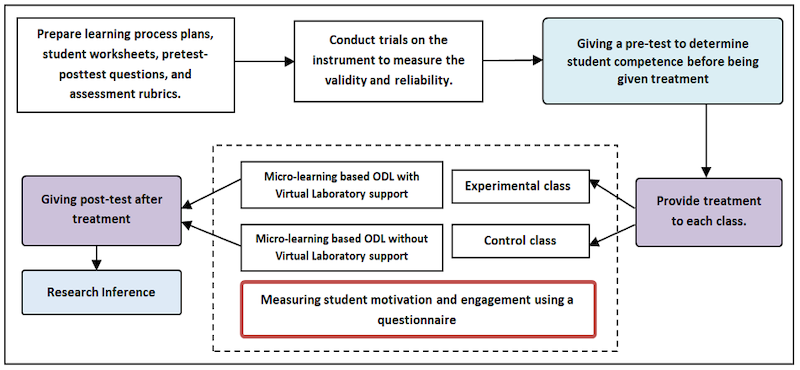
This study used a quasi-experimental method, which was chosen because it allowed the exploration of cause-and-effect relationships through a theoretical approach (Miller et al., 2020). The research utilised a non-equivalent control group design due to the constraints associated with conducting random sampling. In each class there was a distribution of students with low, medium, and high abilities, so that the distribution of student abilities was considered evenly distributed. In this research framework, two different class groups were formed—the experimental and the control classes. The experimental class received an intervention in the form of microlearning-based ODL with Virtual Laboratory support. The control class underwent microlearning-based ODL without Virtual Laboratory support. Before the treatment was given, all classes underwent a pretest to assess students' basic competence. During the treatment, questionnaires were administered to assess the level of student motivation and engagement in microlearning-based ODL. After the treatment, a final test was conducted on both classes to evaluate the academic success after the intervention.
The participants comprised students in their sixth semester from the Electrical Engineering Education Department at Universitas Negeri Manado, Indonesia in two classes. Participants in this study were assumed to have an equal level of knowledge. The sampling technique used was saturated sample (Suriani et al., 2023). This method is used when the entire research population is sampled. The experimental and control classes were selected through two separate draws. Class 2021B, with 24 students, was chosen as the experimental group, while class 2021A, with 28 students, was selected as the control group. So, the total number of research respondents was 52 students.
Data collection methods in this study were categorised into test and non-test methods. Test methods were employed to gather data on academic success, while non-test methods were used to assess the impact of virtual laboratories on student motivation and engagement in microlearning within the ODL framework. The test instruments used included a pretest, which was given before the treatment to measure initial ability, and a posttest, which was conducted after the treatment to evaluate the impact of the intervention that had been implemented. Non-test data was collected through questionnaires during the treatment. The stages of data collection are shown in Figure 1.
The study utilised both test and non-test instruments. The test instrument aimed to evaluate academic success via a pretest-posttest questionnaire conducted before and after the treatment. While non-test instruments in the form of questionnaires were used to gauge student motivation and engagement in microlearning-based ODL during the treatment. The pretest-posttest questions used were in the form of C2 and C4 cognitive level description questions and practical performance tests for AC circuit analysis material. The same questions and practical performance tests were used during the pretest and posttest. The items used were items that passed the validity test, both logical validity and empirical validity. The pretest was given before the treatment to assess students’ foundational skills, while the posttest was conducted afterwards to evaluate students’ cognitive abilities and practical skills after the intervention. Furthermore, the scores obtained were used to evaluate the effect of the treatment on student competence in each class. The questionnaire was used to assess the level of student motivation and engagement in microlearning-based ODL during the treatment. The questionnaire consisted of 44 questions. The student motivation questionnaire comprised measurements of learning goal orientation, task value, self-efficacy, and self-regulation, and consisted of 32 questions (Velayutham et al., 2011). In contrast, the student engagement questionnaire included measurements of behavioural engagement, cognitive engagement, emotional engagement, and social engagement, and consisted of 12 questions (Deng et al., 2020). This questionnaire had five response options ranging from "strongly disagree" to "strongly agree".
Data analysis was intended to analyse the impact of virtual laboratory integration into microlearning in the context of ODL on student motivation and engagement, as well as its contribution to student academic success. Data analysis techniques in this study used descriptive statistics and analysis of covariance. The analysis aims to describe the data of the research results. Inferential statistics, such as t-test, N-Gain and ANCOVA, were applied to the intervention on students' motivation and engagement in learning and their contribution to academic success. The analysis involved examining questionnaire responses to identify trends in student motivation and engagement during the intervention. Academic achievement was assessed using N-Gain, with data analysed through SPSS software.
This section presents the study's results, beginning with descriptive statistics, t-test, N-Gain, and covariate analysis. The data collected from the questionnaires and tests were organised in tables and graphs to clarify the patterns and distribution of the data. This description aims to provide insight into the level of motivation and engagement during the treatment. This section also provides an overview of the students' academic performance before and after the treatment in terms of both cognitive and practical skills. In addition, this descriptive analysis and t-test also served as a basis for identifying significant trends or changes that emerged during the intervention process, thus allowing the researcher to understand the impact of the virtual laboratory on students' motivation and engagement in micro-learning in ODL. The improvement of students' academic success in each group was tested using the N-Gain analysis method. Meanwhile, to ensure an optimal level of precision in an experiment, especially in controlling the influence of other variables that cannot be controlled directly, the ANCOVA analysis technique was used.
Table 1 presents an overview of the case processing involved in the experiment conducted for comparison purposes on the effectiveness of microlearning on students' motivation and engagement in ODL between the two groups. There were no missing cases, with the experimental group having 24 cases and the control group 28. This completeness reinforces the reliability and validity of the findings.
Table 1: Case Processing Summary

Table 2 presents the descriptive statistics for the two groups involved in the study. The results showed that the experimental group had a mean score of 187.00, illustrating their level of motivation and engagement, with a 95% confidence interval ranging from 185.39 to 188.61. While the mean score for students' motivation and engagement in the control group was 167.8929. The mean for the control group was markedly lower than that of the experimental group, with a 95% confidence interval for the mean spanning from 165.5536 to 170.2322.
Table 2: Descriptive Statistics

Table 3 shows the normality test results for both groups using the Kolmogorov-Smirnov and Shapiro-Wilk tests. P-values below 0.05 (*), after Lilliefors correction, indicate normal distribution, confirming the data's suitability for parametric analysis.
Table 3: Tests of Normality

* This is a lower bound of the true significance.
a. Lilliefors Significance Correction
Table 4 shows that the experimental group (n = 24) scored a mean of 187.00 (SD = 3.82), while the control group (n = 28) scored 167.89 (SD = 6.03). The independent samples t-test revealed a significant difference (t = 13.375, p < 0.001), and Levene's Test confirmed the unequal variances assumption.
Table 4: Group Statistics

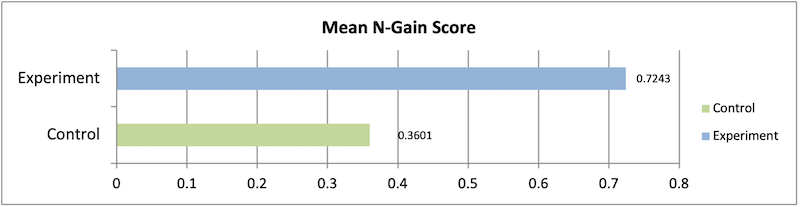
Table 5 presents the independent sample t-test results, showing differences in motivation and engagement between the experimental and control groups. Levene’s Test indicated significant variance (F = 4.340, p < .001). The t-test confirmed a significant mean difference (t = 13.375, df = 50, p < .001) of 19.10714, with a Std. Error of 1.42857 and a 95% confidence interval of 16.23778 to 21.97651. The results of the independent t-test showed that the mean difference was 19.10714 between the two groups, indicating that students who used the virtual laboratory-assisted microlearning platform had better motivation and engagement in ODL than those who did not.
Table 5: Independent Samples Test
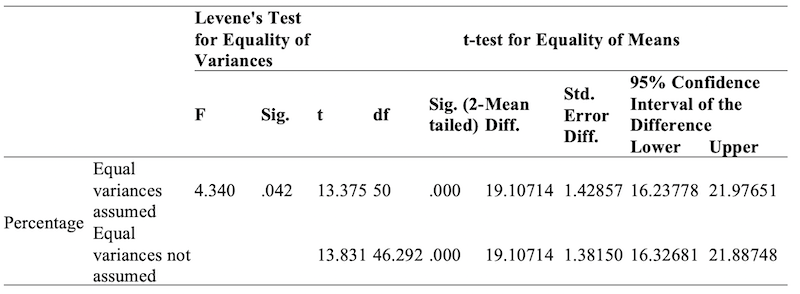
The increase in student academic success in each group was tested using the N-Gain analysis method. The academic success tested was the students’ cognitive ability in learning the material and the practical skills they demonstrated in the AC circuit analysis material. The first N-Gain analysis related to cognitive ability showed that the experimental group had a mean N-Gain score of 0.7243 (high category) compared to 0.4697 (medium category) for the control group. These results suggest that the virtual laboratory assisted microlearning platform was more effective in improving students’ cognitive ability compared to conventional microlearning platforms. The results of the N-Gain analysis of cognitive abilities in both groups are shown in Figure 2.
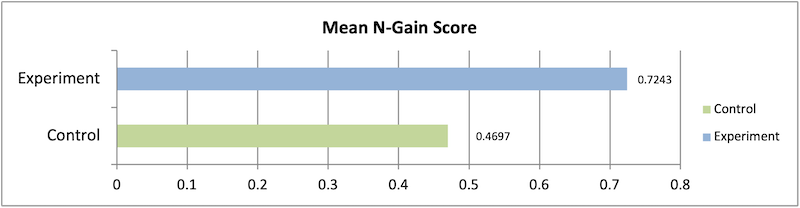
The second N-Gain analysis related to practical skills in the AC circuit analysis material. N-Gain analysis results showed that the experimental group had a mean N-Gain score of 0.7130 (high category), while the control group had a value of 0.3601 (medium category). This result shows that the virtual laboratory-assisted micro-learning platform was more effective in improving students' practical skills compared to the conventional micro-learning platform. The results of the N-Gain analysis of students' practical skills ability in both groups are shown in Figure 3.
To ensure an optimal level of precision in an experiment, especially in controlling the influence of other variables that cannot be directly controlled, the ANCOVA analysis technique was used. In this context, the covariate variables analysed included student motivation and engagement, while the dependent variables were academic achievement in the form of cognitive ability and practical skills. The ANCOVA technique allowed adjustment for the effects of these covariate variables, so that the analysis can more accurately measure the effect of the treatment on students' academic success. The results of the ANCOVA test are shown in Table 6.
Table 6: The Results of the ANCOVA Test
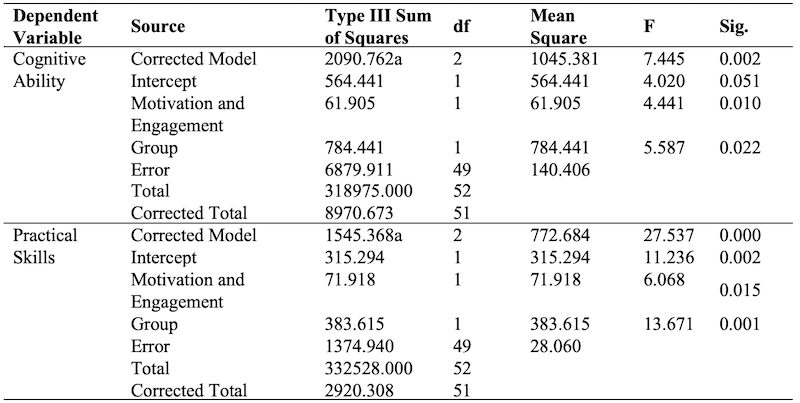
Cognitive Ability: a. R Squared = .233 (Adjusted R Squared = .202)
Practical Skills: a. R Squared = .529 (Adjusted R Squared = .510)
For Cognitive Ability, the results of ANCOVA analysis showed that the overall statistical model was significant (F = 7.445, p = 0.002), illustrating that the covariate variables (motivation and engagement) and treatment (group) together contributed to explaining the variance in cognitive ability. Motivation and engagement variables had a significant effect on cognitive ability (F = 4.441, p = 0.010). This suggests that students' level of motivation and engagement influence cognitive learning outcomes. Treatment has a significant effect on cognitive ability (F = 5.587, p = 0.022), which means there are differences in cognitive learning outcomes between groups given different treatments. The intercept results showed a p value close to significance (p = 0.051), indicating that the mean cognitive ability scores after controlling for covariates approached significant differences.
With regard to practical skills, the ANCOVA analysis results showed this statistical model was highly significant (F = 27.537, p = 0.000), indicating that motivation, engagement, and treatment together explained high variance in practical skills. The covariate variables had a significant effect on practical skills (F = 6.068, p = 0.015). This indicates that students' motivation and engagement positively influenced the mastery of practical skills. The treatment had a highly significant effect on practical skills (F = 13.671, p = 0.001), indicating that there was a significant difference in practical skills acquisition between the groups that received different treatments. Intercept results were significant (F = 11.236, p = 0.002), indicating a difference in the overall mean practical skills scores after considering covariates.
Based on the test results, student motivation and engagement consistently had a significant effect on success in both cognitive and practical skills. The treatment showed significant effects on both dependent variables, with a stronger effect on practical skills. This ANCOVA model shows that by controlling for the influence of motivation and engagement, the cause-and-effect relationship between treatment and academic success can be more clearly identified. These results provide empirical evidence that the treatment had an impact on academic success, as well as demonstrating the important role of student motivation and engagement in the learning process. In this case, the experimental group treated with microlearning assisted virtual laboratory demonstrated better results than the control group.
The dynamics of higher education are increasingly dominated by digital transformation, necessitating the adoption of microlearning based educational technologies and virtual laboratories (Diogo et al., 2023; Žalėnienė & Pereira, 2021; Alnagrat Alnagrat et al., 2023). In line with this transformation, the findings of the study showed that students who used a virtual laboratory-assisted microlearning platform had better motivation and engagement in ODL compared to those who did not use it. This is in line with previous research that has demonstrated the positive impact of these two approaches on enhancing learning quality, especially in ODL environments. Microlearning and virtual laboratories significantly contribute to increasing motivation, engagement, and conceptual understanding, all of which directly influence the improvement of students' academic performance (Skalka et al., 2021; John & Tan, 2022).
In ODL, students often face isolation and low engagement. Microlearning helps overcome time and attention constraints by offering flexible and concise content for better understanding (Susilana et al., 2022; Gherman et al., 2022). Furthermore, virtual labs enhance this by providing interactive simulations that replicate real-world experiments, overcoming traditional barriers in ODL (El Kharki et al., 2021; Hernández-de-Menéndez et al., 2019). In line with this transformation, the results showed that the virtual laboratory-assisted micro-learning platform proved more effective than the conventional platform in improving students' cognitive abilities (mean N-Gain score = 0.7243) and practical skills (mean N-Gain score = 0.7130), both of which are in the high category. These results are reinforced by previous research, where virtual laboratories have been shown to improve students' understanding of complex scientific concepts because students could see the direct impact of the experiments they conducted in the simulation (Reeves & Crippen, 2021).
The integration of microlearning and virtual labs in ODL also contributes to higher motivation and engagement by promoting active participation and reinforcing conceptual understanding through experiential learning (Gunawan et al., 2019). Based on the results of the ANCOVA test, student motivation and engagement consistently had a significant effect on students' academic success in both cognitive abilities and practical skills. These results provide empirical evidence that the treatment had an impact on academic success, as well as showing the important role of student motivation and engagement in the learning process. In this case, the experimental group treated with a virtual laboratory assisted by microlearning produced better results than the control group. Research also shows that the combination of microlearning and virtual laboratories has a stronger impact on student learning. A study by Truchly et al. (2022) found that integrating microlearning with virtual labs enhances student engagement. The interactive experience generated by virtual laboratories, coupled with the modular delivery of material through microlearning, encourages students to be more actively involved in the learning process (Hernández-de-Menéndez et al., 2019; Chiu et al., 2021; Lee, 2023).
In the context of ODL, this combination is very effective because it provides learning flexibility that is tailored to the needs of distance learners, while still providing learning quality that is equivalent to conventional education (Saidi et al., 2021). Students can learn theory through microlearning and then apply it directly in virtual experiments. Research by Çivril & Özkul (2021), Skalka et al. (2021), and De Vries and May (2019) found that the integration of practise-based learning with theory through virtual simulations helped students connect abstract concepts with real-world applications, which ultimately improves their conceptual understanding and learning outcomes.
The results of this study suggest that microlearning and virtual labs are particularly beneficial in the context of ODL, where students often face challenges related to motivation and engagement, and the lack of conventional in-person engagement has resulted in a diminished conceptual comprehension. These technologies address some of the key limitations of ODL by offering more interactivity, flexibility, and an increase in students’ personal motivation learning experiences (Kohnke et al., 2024; Bothe et al., 2019). Combining these approaches fosters flexible, interactive learning, and enhances deep understanding and academic success. Universities adopting them improve education quality and better prepare students for the digital job market (Rodríguez-Abitia et al., 2020; Gherman et al., 2022).
The findings from this study demonstrate that integrating microlearning and virtual laboratories in ODL has a positive impact on students’ motivation, engagement, and conceptual understanding, ultimately leading to improved academic outcomes. The combination of microlearning’s flexible content delivery and virtual labs’ hands-on experiences effectively enhances student motivation and engagement in ODL. This approach bridges theory and practice, providing personalised, interactive learning that promotes academic success. Adopting these technologies addresses key ODL challenges, offering students more engaging and impactful learning experiences.
This study has several limitations that are important to note. First, technology accessibility is still a barrier, especially for students in remote areas who may not have adequate devices or internet connections, thereby creating a digital divide. Second, virtual learning experiences are still unable to fully replace physical interactions in real laboratories, especially in disciplines that require manual and sensory skills. Third, current research focuses more on STEM fields, so the effectiveness of microlearning and virtual laboratories in other fields, such as the humanities or social sciences, is still underexplored. Finally, measurement of success often focuses on only academic outcomes, while the impact on the cultivation of non-technical competencies, including collaboration and critical thinking, have not been adequately acknowledged. Further research is needed to address these limitations and ensure wider and more balanced adoption of technology.
To optimise this technology, further research is essential. First, longitudinal studies are needed to assess the long-term impact of microlearning and virtual labs on academic outcomes and professional readiness. Cross-disciplinary research is also necessary to explore their use in non-STEM fields such as the social sciences and the arts. Qualitative studies on students' experiences could refine learning tools by addressing specific challenges. Additionally, integrating AI into virtual labs could create adaptive simulations with real-time feedback. Comparative studies between technology-based and traditional methods should provide evidence of their impact on learning quality. These studies could strengthen higher education’s flexibility, inclusivity, and relevance.
Aldowah, H., Al-Samarraie, H., Alzahrani, A.I., & Alalwan, N. (2020). Factors affecting student dropout in MOOCs: A cause and effect decision‐making model. Journal of Computing in Higher Education, 32(2), 429-454. https://doi.org/10.1007/s12528-019-09241-y
Allam, S.N.S., Hassan, M.S., Mohideen, R.S., Ramlan, A.F., & Kamal, R.M. (2020). Online distance learning readiness during Covid-19 outbreak among undergraduate students. International Journal of Academic Research in Business and Social Sciences, 10(5), Pages 642-657. https://doi.org/10.6007/IJARBSS/v10-i5/7236
Allela, M.A., Ogange, B.O., Junaid, M.I., & Charles, P.B. (2020). Effectiveness of multimodal microlearning for in-service teacher training. Journal of Learning for Development, 7(3), 384-398. https://doi.org/10.56059/jl4d.v7i3.387
Alnagrat Alnagrat, A.J., Che Ismail, R., & Syed Idrus, S.Z. (2023). The opportunities and challenges in virtual reality for virtual laboratories. Innovative Teaching and Learning Journal, 6(2), 73-89. https://doi.org/10.11113/itlj.v6.91
Bothe, M., Renz, J., Rohloff, T., & Meinel, C. (2019). From MOOCs to micro learning activities. 2019 IEEE Global Engineering Education Conference (EDUCON), 280–288. https://doi.org/10.1109/EDUCON.2019.8725043
Carless, D. (2019). Feedback loops and the longer-term: Towards feedback spirals. Assessment & Evaluation in Higher Education, 44(5), 705–714. https://doi.org/10.1080/02602938.2018.1531108
Chiu, T.K.F., Lin, T.-J., & Lonka, K. (2021). Motivating online learning: The challenges of COVID-19 and beyond. The Asia-Pacific Education Researcher, 30(3), 187-190. https://doi.org/10.1007/s40299-021-00566-w
Çivril, H., & Özkul, A.E. (2021). Investigation of the factors affecting open and distance education learners’ intentions to use a virtual laboratory. The International Review of Research in Open and Distributed Learning, 22(2), 143-165. https://doi.org/10.19173/irrodl.v22i2.5076
Crow, J., & Murray, J.-A. (2020). Online distance learning in biomedical sciences: Community, belonging and presence. In P. M. Rea (Ed.), Biomedical visualisation (Vol. 1235, pp. 165-178). Springer International Publishing. https://doi.org/10.1007/978-3-030-37639-0_10
De Vries, L.E., & May, M. (2019). Virtual laboratory simulation in the education of laboratory technicians–motivation and study intensity. Biochemistry and Molecular Biology Education, 47(3), 257–262. https://doi.org/10.1002/bmb.21221
Deng, R., Benckendorff, P., & Gannaway, D. (2020). Learner engagement in MOOCs: Scale development and validation. British Journal of Educational Technology, 51(1), 245–262. https://doi.org/10.1111/bjet.12810
Dennen, V.P., Arslan O., & Bong, J. (2024). Optional embedded microlearning challenges: Promoting self-directed learning and extension in a higher education course. Educational Technology & Society, 27(1). https://doi.org/10.30191/ETS.202401_27(1).SP04
Díaz Redondo, R.P., Caeiro Rodríguez, M., López Escobar, J.J., & Fernández Vilas, A. (2021). Integrating micro-learning content in traditional e-learning platforms. Multimedia Tools and Applications, 80(2), 3121-3151. https://doi.org/10.1007/s11042-020-09523-z
Diogo, R.A., Dos Santos, N., & Loures, E.F.R. (2023). Digital transformation of engineering education for smart education: A systematic literature review. In Reliability modeling in industry 4.0 (pp. 407-438). Elsevier. https://doi.org/10.1016/B978-0-323-99204-6.00002-9
Dolasinski, M.J., & Reynolds, J. (2020). Microlearning: A new learning model. Journal of Hospitality & Tourism Research, 44(3), 551–561. https://doi.org/10.1177/1096348020901579
El Kharki, K., Berrada, K., & Burgos, D. (2021). Design and implementation of a virtual laboratory for physics subjects in Moroccan universities. Sustainability, 13(7), 3711. https://doi.org/10.3390/su13073711
Estriegana, R., Medina-Merodio, J.-A., & Barchino, R. (2019). Student acceptance of virtual laboratory and practical work: An extension of the technology acceptance model. Computers & Education, 135, 1–14. https://doi.org/10.1016/j.compedu.2019.02.010
Fidan, M. (2023). The effects of microlearning-supported flipped classroom on pre-service teachers’ learning performance, motivation and engagement. Education and Information Technologies, 28(10), 12687–12714. https://doi.org/10.1007/s10639-023-11639-2
Fitria, T.N. (2022). Microlearning in teaching and learning process: A review. CENDEKIA: Jurnal Ilmu Sosial, Bahasa Dan Pendidikan, 2(4), 114–135. https://doi.org/10.55606/cendikia.v2i4.473
Garshasbi, S., Yecies, B., & Shen, J. (2021). Microlearning and computer-supported collaborative learning: An agenda towards a comprehensive online learning system. STEM Education, 1(4), 225. https://doi.org/10.3934/steme.2021016
Ghafar, Z.N., Abdullkarim, S.T., Mhamad, L.M., Kareem, R.A., Rasul, P.A., & Mahmud, T.I. (2023). Microlearning as a learning tool for teaching and learning in acquiring language: applications, advantages, and influences on the language. Canadian Journal of Educational and Social Studies, 3(2). https://doi.org/10.53103/cjess.v3i2.127
Gherman, O., Turcu, C.E., & Turcu, C.O. (2022). An approach to adaptive microlearning in higher education (Version 1). arXiv. https://doi.org/10.48550/ARXIV.2205.06337
Gokli, A.A. (2022). Teaching and communicating with millennial learners. In T. Catanzano (Ed.), Image-based teaching (pp. 15–31). Springer International Publishing. https://doi.org/10.1007/978-3-031-11890-6_2
Gunawan, G., Harjono, A., Hermansyah, H., & Herayanti, L. (2019). Guided inquiry model through virtual laboratory to enhance students’ science process skills on heat concept. Jurnal Cakrawala Pendidikan, 38(2), 259–268. https://doi.org/10.21831/cp.v38i2.23345
Hao, C., Zheng, A., Wang, Y., & Jiang, B. (2021). Experiment information system based on an online virtual laboratory. Future Internet, 13(2), 27. https://doi.org/10.3390/fi13020027
Hernández-de-Menéndez, M., Vallejo Guevara, A., & Morales-Menendez, R. (2019). Virtual reality laboratories: A review of experiences. International Journal on Interactive Design and Manufacturing (IJIDeM), 13(3), 947–966. https://doi.org/10.1007/s12008-019-00558-7
Jamshidi, R., & Milanovic, I. (2022). Building virtual laboratory with simulations. Computer Applications in Engineering Education, 30(2), 483–489. https://doi.org/10.1002/cae.22467
John, K., & Tan, D.A. (2022). Students’ academic performance and motivation in physics using a microlearning approach via cybergogy learning environment. Science International, 34(2), 157–170. https://www.researchgate.net/publication/360561820
Kapilan, N., Vidhya, P., & Gao, X.-Z. (2021). Virtual laboratory: A boon to the mechanical engineering education during Covid-19 pandemic. Higher Education for the Future, 8(1), 31–46. https://doi.org/10.1177/2347631120970757
Khine, M.S. (2019). Emerging trends in learning analytics: Leveraging the power of education data. BRILL. https://doi.org/10.1163/9789004399273
Kohnke, L., Foung, D., & Zou, D. (2024). Microlearning: A new normal for flexible teacher professional development in online and blended learning. Education and Information Technologies, 29(4), 4457–4480. https://doi.org/10.1007/s10639-023-11964-6
Kossen, C., & Ooi, C.-Y. (2021). Trialling micro-learning design to increase engagement in online courses. Asian Association of Open Universities Journal, 16(3), 299–310. https://doi.org/10.1108/AAOUJ-09-2021-0107
Lee, J., Song, H.-D., & Hong, A.J. (2019). Exploring factors, and indicators for measuring students’ sustainable engagement in e-learning. Sustainability, 11(4), 985. https://doi.org/10.3390/su11040985
Lee, Y.-M. (2023). Mobile microlearning: A systematic literature review and its implications. Interactive Learning Environments, 31(7), 4636–4651. https://doi.org/10.1080/10494820.2021.1977964
Legault, L. (2020). Intrinsic and extrinsic motivation. In V. Zeigler-Hill & T.K. Shackelford (Eds.), Encyclopedia of personality and individual differences (pp. 2416–2419). Springer International Publishing. https://doi.org/10.1007/978-3-319-24612-3_1139
Lembani, R., Gunter, A., Breines, M., & Dalu, M.T.B. (2020). The same course, different access: The digital divide between urban and rural distance education students in South Africa. Journal of Geography in Higher Education, 44(1), 70–84. https://doi.org/10.1080/03098265.2019.1694876
Liu, Y., Hau, K., Liu, H., Wu, J., Wang, X., & Zheng, X. (2020). Multiplicative effect of intrinsic and extrinsic motivation on academic performance: A longitudinal study of Chinese students. Journal of Personality, 88(3), 584–595. https://doi.org/10.1111/jopy.12512
Lohman, L. (2024). How can you deliver microlearning when learners don’t want it? Designing microlearning for socially oriented learners. Educational Technology & Society, 27(1). https://doi.org/10.30191/ETS.202401_27(1).SP03
Maphosa, C., & Bhebhe, S. (2020). Interrogating the concept ‘openness’ in open distance learning (ODL). European Journal of Open Education and E-Learning Studies, 5(2). https://doi.org/10.46827/ejoe.v5i2.3282
Miller, C. J., Smith, S.N., & Pugatch, M. (2020). Experimental and quasi-experimental designs in implementation research. Psychiatry Research, 283, 112452. https://doi.org/10.1016/j.psychres.2019.06.027
Mohamed Hashim, M.A., Tlemsani, I., & Matthews, R. (2022). Higher education strategy in digital transformation. Education and Information Technologies, 27(3), 3171–3195. https://doi.org/10.1007/s10639-021-10739-1
Nikkhoo, I., Ahmadi, Z., Akbari, M., Imannezhad, S., Ardekani, S.A., & Lashgari, H. (2023). Microlearning for today’s students: A rapid review of essentials and considerations. Medical Education Bulletin, 4(1), 673–685. https://doi.org/10.22034/meb.2022.355659.1066
Panda, S. (2022). Evolving learner support systems: From distance to digital education. In Handbook of open, distance and digital education (pp. 1–20). Springer Nature Singapore. https://doi.org/10.1007/978-981-19-0351-9_46-1
Putri, L.A., Permanasari, A., Winarno, N., & Ahmad, N.J. (2021). Enhancing students’ scientific literacy using virtual lab activity with inquiry-based learning. Journal of Science Learning, 4(2), 173–184. https://doi.org/10.17509/jsl.v4i2.27561
Reeves, S.M., & Crippen, K.J. (2021). Virtual laboratories in undergraduate science and engineering courses: A systematic review, 2009–2019. Journal of Science Education and Technology, 30(1), 16–30. https://doi.org/10.1007/s10956-020-09866-0
Rodríguez-Abitia, G., Martínez-Pérez, S., Ramirez-Montoya, M.S., & Lopez-Caudana, E. (2020). Digital gap in universities and challenges for quality education: A diagnostic study in Mexico and Spain. Sustainability, 12(21), 9069. https://doi.org/10.3390/su12219069
Ryan, R.M., & Deci, E.L. (2023). Self-determination theory. In F. Maggino (Ed.), Encyclopedia of quality of life and well-being research (pp. 6229–6235). Springer International Publishing. https://doi.org/10.1007/978-3-031-17299-1_2630
Saidi, R.M., Sharip, A.A., Abd Rahim, N.Z., Zulkifli, Z.A., & Md Zain, S.M. (2021). Evaluating students’ preferences of open and distance learning (ODL) tools. Procedia Computer Science, 179, 955–961. https://doi.org/10.1016/j.procs.2021.01.085
Sankaranarayanan, R., Leung, J., Abramenka-Lachheb, V., Seo, G., & Lachheb, A. (2023). Microlearning in diverse contexts: A bibliometric analysis. TechTrends, 67(2), 260–276. https://doi.org/10.1007/s11528-022-00794-x
Sazanita Isa, I., Abdullah, H., Kasim, N.M., Ismail, N.A., & Faiza, Z. (2022). Open distance learning simulation-based virtual laboratory experiences during COVID-19 pandemic. International Journal of Electrical and Computer Engineering (IJECE), 12(4), 4042. https://doi.org/10.11591/ijece.v12i4.pp4042-4053
Skalka, J., Drlik, M., Benko, L., Kapusta, J., Rodríguez Del Pino, J.C., Smyrnova-Trybulska, E., Stolinska, A., Svec, P., & Turcinek, P. (2021). Conceptual framework for programming skills development based on microlearning and automated source code evaluation in virtual learning environment. Sustainability, 13(6), 3293. https://doi.org/10.3390/su13063293
Suriani, N., Risnita, & Jailani, M.S. (2023). Konsep Populasi dan Sampling Serta Pemilihan Partisipan Ditinjau Dari Penelitian Ilmiah Pendidikan. Jurnal IHSAN : Jurnal Pendidikan Islam, 1(2), 24–36. https://doi.org/10.61104/ihsan.v1i2.55
Susilana, R., Dewi, L., Rullyana, G., Hadiapurwa, A., & Khaerunnisa, N. (2022). Can microlearning strategy assist students’ online learning? Jurnal Cakrawala Pendidikan, 41(2), 437–451. https://doi.org/10.21831/cp.v41i2.43387
Taylor, A., & Hung, W. (2022). The effects of microlearning: A scoping review. Educational Technology Research and Development, 70(2), 363–395. https://doi.org/10.1007/s11423-022-10084-1
Truchly, P., Zeman, T., & Podhradsky, P. (2022). Advanced online learning digital content for lecturing and learning. 2022 International Symposium ELMAR, 123–128. https://doi.org/10.1109/ELMAR55880.2022.9899794
Umenne, P., & Hlalele, S. (2020). Evaluation of the effectiveness of virtual laboratory’s for electronics in the open distance learning context. 2020 International Conference on Artificial Intelligence, Big Data, Computing and Data Communication Systems (icABCD), 1–5. https://doi.org/10.1109/icABCD49160.2020.9183831
Velayutham, S., Aldridge, J., & Fraser, B. (2011). Development and validation of an instrument to measure students’ motivation and self‐regulation in science learning. International Journal of Science Education, 33(15), 2159–2179. https://doi.org/10.1080/09500693.2010.541529
Xu, D., & Xu, Y. (2020). The ambivalence about distance learning in higher education: Challenges, opportunities, and policy implications. In L.W. Perna (Ed.), Higher education: Handbook of theory and research (Vol. 35, pp. 351–401). Springer International Publishing. https://doi.org/10.1007/978-3-030-31365-4_10
Yates, A., Brindley-Richards, W. & T. Thistoll. (2020). Student engagement in distance-based vocational education. Journal of Open, Flexible and Distance Learning, 24(1), 60-74. https://doi.org/10.3316/informit.195497153067486
Zajda, J. (2021). Constructivist learning theory and creating effective learning environments. In J. Zajda, Globalisation and education reforms (Vol. 25, pp. 35–50). Springer International Publishing. https://doi.org/10.1007/978-3-030-71575-5_3
Žalėnienė, I., & Pereira, P. (2021). Higher education for sustainability: A global perspective. Geography and Sustainability, 2(2), 99–106. https://doi.org/10.1016/j.geosus.2021.05.001
Zhang, J., & West, R.E. (2020). Designing microlearning instruction for professional development through a competency based approach. TechTrends, 64(2), 310–318. https://doi.org/10.1007/s11528-019-00449-4
Author Notes
I Gede Budi Mahendra is an Assistant Professor at the Department of Electrical Engineering Education, Universitas Negeri Manado. His research interests include Microlearning, TPACK, TVET, Instructional Design, and Electrical Engineering Education. In addition to his teaching duties, he is actively engaged in writing books and scientific articles. Email: igedebudimahendra@unima.ac.id (https://orcid.org/0009-0006-5225-3116)
Billy Killis is an Associate Professor at the Department of Electrical Engineering Education, Universitas Negeri Manado. The focus of his studies is Electrical Engineering Education, IT-based Learning, TVET, Philosophy of Education, and Management and Evaluation of Higher Education. He is active as a speaker in academic seminars both nationally and internationally. Email: billykillis@unima.ac.id (https://orcid.org/0009-0003-6472-549X)
Cite as: Mahendra, I.G.B., & Killis, B. (2025). Impact of virtual laboratory-assisted microlearning on students' motivation, engagement, and academic success. Journal of Learning for Development, 12(1), 1-16.