
Soumya Ranjan Das and Madhusudan J.V.
2026 VOL. 13, No. 1
Abstract: This paper presents a review on the use of technology in promoting teacher professional development in relation to its utilisation, benefits, challenges, and best practices. Lack of systematic analysis on these aspects within the literature prompted the need for this review. A systematic review technique was applied, and 47 studies published between 2010 and 2025 from various countries were selected from different databases for detailed analysis. These studies focused on in-service school professional development and higher education teachers. The findings highlight that teachers use digital tools, platforms and materials, such as smartphones, computers, laptops, Artificial Intelligence tools (like ChatGPT), Learning Management Systems, webinars, social media communities, Open Educational Resources, and multimedia for professional development. They found several benefits to the use of technology for their professional development, such as its flexibility, eliminating geographical boundaries, easy resource availability, time saving, extending professional networks, and improving digital skills. However, lack of digital devices, limited digital skills, poor internet connections, insufficient interaction, inadequate institutional support, concerns about AI accuracy, and plagiarism were found to be challenges. Best practices include receiving governmental and institutional support, designing user-friendly platforms, encouraging effective collaboration, considering participants' psychological factors, and conducting follow-up studies to gauge its effectiveness. The results of this systematic review should assist stakeholders in addressing these limitations and using technology more effectively.
Keywords: technology-enabled professional development, utilisation, benefits, challenges and best practices
Professional development (PD) is the process to improve teachers’ content knowledge and pedagogical expertise, both of which are critical in contributing to improving students' learning outcomes (Goldenberg et al., 2014). It is a strategy used by educational institutions to enhance teacher performance and the quality of education (Ventista & Brown, 2023). Integrating technology into teacher PD has become increasingly crucial due to the advancements of digital technologies and the developments in technology-enabled learning. The rapid advancements in technology provide a variety of digital teaching materials, resources, information and platforms for teachers that were previously challenging to achieve. Online courses, webinars, and workshops support teachers to engage in PD flexibly, accommodating their schedules and learning preferences (Darling-Hammond et al., 2017). The use of technologies, such as smartphones, computers, Artificial Intelligence (AI), Massive Open Online Courses (MOOCs), Open Educational Resources (OER), and social media play a vital role in teachers’ PD. Therefore, technology-enabled PD has emerged as a relevant approach for addressing teachers’ diverse personalised needs in developing specific areas of professional knowledge (Koehler & Mishra, 2009). It enables global collaboration, provides real-time feedback, and enhances teachers’ professional growth by improving teaching practices and, eventually, student achievement (Hennessy et al., 2022; Karunanayaka & Naidu, 2017). Some barriers, such as poor internet connectivity, the digital divide, lack of self-confidence, ethical concerns and overreliance on AI tools, can limit the effectiveness and opportunities of technology enabled-PD (Knapp, 2020; Mushayikwa, 2013; Resta et al., 2018). Despite its challenges, the use of technology plays a vital role in teacher PD due to its innovative strategies and techniques.
UNESCO’s ICT Competency Framework for Teachers (2011) indicates that ICT can enhance teacher PD, emphasising the need for teachers to become familiar with new challenges through ICT training. The Organisation for Economic Co-operation and Development (OECD) highlights that digital technologies transform teacher learning and development, which was demonstrated during the Covid-19 pandemic, when online learning alternatives increased their significance (Kalman et al., 2022; Lockee, 2021; Minea-Pic, 2020). The Commonwealth of Learning (COL) advocates for integrating various technologies, such as MOOCs, multimedia, social media, mobile, and AI tools to support flexible, personalised learning and sustainable teacher development in low-income countries (Traxler & Ogange, 2024). While these organisations’ reports highlight the importance of integrating technology into teacher PD, research also supports its significance in enabling personalised learning, remote access, and peer collaboration (Akayuure & Apawu, 2015; Major & Francis, 2020).
These global initiatives, framework and recommendations of UNESCO, OECD and COL encouraged national initiatives in technology for PD in India. Therefore, the Ministry of Education (2020) of the Government of India emphasised the need for technology in teacher PD in its National Education Policy of 2020. Accordingly, the National Council of Educational Research and Training (NCERT) recommended 50 hours of PD per year, by using the national online education portal SWAYAM (Study Webs of Active Learning for Young Aspiring Minds), and the online platform DIKSHA (Digital Infrastructure for Knowledge Sharing) for pervasive, standardised training. The policy also recommended different delivery methods, including workshops at various levels, suggested MOOCs for wider access and sharing experience among teachers. Considering the importance of technology-enabled PD, IGNOU (Indira Gandhi National Open University), India has been continuously trying to promote various steps including, “skilling and employability” and “technology-enabled blended learning” (Lakshmi et al., 2022, p. 10). The ground-level scenario shows that teachers in low-income countries and rural areas face several challenges, such as the high cost of ICT tools, the digital divide, low-speed internet, and lack of PD opportunities (Hennessy et al., 2022; Maher & Prescott, 2017; Traxler & Ogange, 2021).
Studies have reported some significant opportunities for enhancing teacher PD through the integration of technology, including global access to needs-based learning, flexible self-paced modes, professional collaboration, and access to updated teaching materials (Feldacker et al., 2017; Gallegos et al., 2021; Hennessy et al., 2022; Jurnal et al., 2023; Perkasa, 2023; Puripunyavanich, 2025; Traxler & Ogange, 2024). Studies also demonstrate that technology-enabled PD contributes to enhanced teachers’ engagement, professional competencies, teaching practices, and students’ learning outcomes (Jamal, 2023; Kavoshian et al., 2022; Lee et al., 2024; Nyaaba & Zhai, 2024; Puripunyavanich, 2025; Ventista & Brown, 2023).
Regardless of these stated benefits, some highlighted challenges affect the usefulness of technology-enabled PD, such as the digital divide, poor internet connectivity, inadequate digital literacy, lack of informal peer interaction, and its lengthy session duration (Alqarni, 2022; Knapp, 2020; Lander et al., 2020; Maher & Prescott, 2017; Marc et al., 2023; Mushayikwa, 2013; Resta et al., 2018; Sukarno & Sumarwati, 2020). Several best practices, including support from the concerned institution and the government, promoting peer interaction, and using user friendly platforms were reported in enhancing the effectiveness of technology-enabled PD (Alqarni, 2022; Meyer et al., 2023; Qian et al., 2018; Traxler & Ogange, 2024; Uzorka et al., 2023; Wenger, 1998).
However, the available studies are fragmented, focusing on these areas separately rather than collectively. Studies on the benefits and challenges of technology-enabled PD lack clarity in articulating best practices indicated in the empirical evidence. There is a scarcity of integrated synthesis covering all these aspects of technology enabled PD for a comprehensive insight. Therefore, a systematic review was essential to critically synthesise existing studies, identify consistent patterns and gaps, and consolidate empirically highlighted best practices for effective technology-enabled PD. Considering the significance of technology-enabled PD in relation to its policy and research background, this paper aims to synthesise existing studies on technology-enabled PD among in-service school and higher education teachers, with a focus on the use of technological tools, associated benefits, challenges and best practices.
The following research questions were formulated for this review study:
The study employed a systematic literature review (SLR) method in accordance with the PRISMA (Preferred Reporting Items for Systematic Reviews and Meta-Analysis) framework, encompassing the "search strategy, eligibility of the studies, data collection, and extraction" (Page et al., 2021, p. 4). A comprehensive literature search was conducted using various databases, including Google Scholar, Scopus, and Web of Science, to ensure widespread coverage of high-quality peer reviewed studies. The grey literature, including national and international policy documents, was selected for its systematic analysis.
The search for this review was conducted from February 2025 to April 2025 and covered the publication years from 2010 to 2025. Some keywords were used with appropriate Boolean operators (e.g., AND, OR, NOT) for a thorough retrieval of the studies with a refining search. The search was done by the primary author, and the articles were collaboratively reviewed by the co-author. The following keywords were used to search the studies: “Technology-enabled professional development" OR "Technology-integrated professional development” OR "Online professional development " OR "Virtual professional development "OR “Web-based professional development” OR “ICT integrated professional development” OR “Teacher training” AND “Usage” OR “Utilisation” OR “Adoption” OR “Application” AND “Advantages” OR “Benefits” OR “Merits” OR “Opportunities” OR "Positive impact” AND “Challenges” OR “Barriers” OR “limitations” OR “Issues” OR “Obstacles” OR “Problems” AND “Best practices” OR “Suggestions” OR “Recommendations” OR “Enhancements” AND “Teacher” OR “In-service school teacher” OR “Higher education teacher". Table 1 presents a complete summary of search strategies across the databases.
Table 1: Summary of Search Strategies Across the Databases
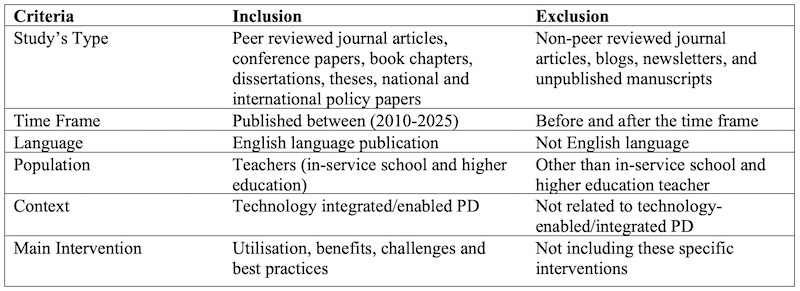
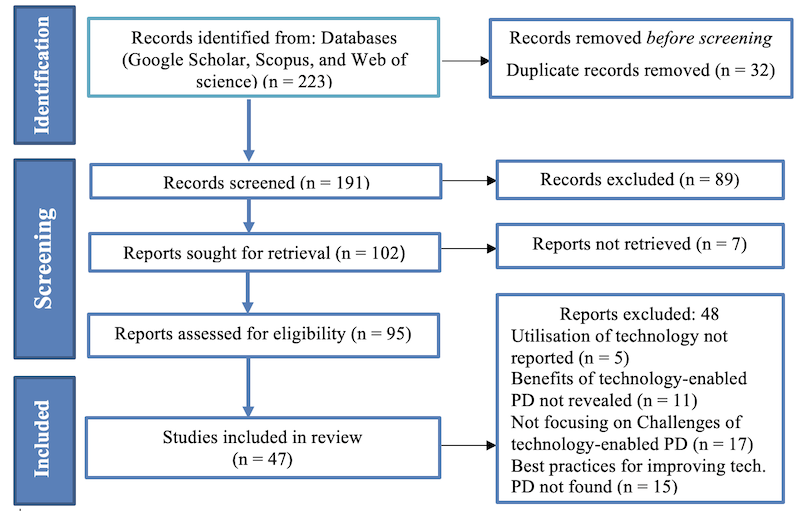
A total of 223 research papers were identified from an extensive search across the above mentioned databases according to their alignment with the research questions. From these studies, 47 in total (see Figure 1), which rigorously met the dimension of the research questions, were selected for analysis. Studies focusing on in-service school teachers and higher education teachers were included due to the common technological and pedagogical characteristics of technology-enabled PD across these educational levels. Table 2 records the inclusion and exclusion criteria for the studies.
Table 2: Inclusion and Exclusion Criteria for the Collected Studies
The data, including usage, benefits, challenges and best practices of technology-enabled PD were extracted from the selected studies. The overall process of this systematic review has been depicted in Figure 1. Thematic analysis was employed to analyse the extracted data (Hennessy et al., 2022). Through manual coding, themes related to the usage, benefits, challenges and best practices were identified. The findings have been interpreted in terms of the following themes and sub-themes.
Utilisation of Digital Devices
The most commonly used devices were smartphones, laptops, tablets, and desktops. Teachers employed these devices for various purposes, such as accessing, storing, and retrieving information, facilitating communication, professional collaboration, and content creation (Dahri et al., 2023; Jurnal et al., 2023; Puripunyavanich, 2025). Further, it was found that teachers had positive views on mobile-based learning, which were more engaging than traditional learning as it fulfilled their individual learning needs (Dahri et al., 2023; Peng, 2019). Teachers used mobile devices for browsing and utilising various applications that offer digital modules, quizzes, and puzzles related to the content and pedagogical knowledge in their field (Ahmed & Mohammad 2019).
Utilisation of Digital Resources and Platforms
Teachers engaged in various PD activities, including attending webinars, participating in online communities of practice, and utilising Web 2.0 platforms and social media for resource sharing, discussion, and community building (Adjapong et al., 2018; Bissessar, 2014; Fishman et al., 2013; Maher & Prescott, 2017; Prestridge, 2019). Hennessy et al. (2022) report that teachers frequently use videos, audios, OER, and digital presentations, with video resources being the most commonly used. Teachers create and upload new OER and apply these in their teaching practice, which further supported students’ engagement and learning outcomes (Hennessy et al., 2022; Karunanayaka & Naidu, 2017; Lee et al., 2024). MOOCs provide access to PD programmes from universities and organisations all over the world (Atapattu et al., 2019; Rodes et al., 2021).
Social Media and Professional Development
Social networking sites (SNSs) provided valuable platforms for teacher PD (Manca & Ranieri, 2015). Teachers use Facebook for PD, offering a collaborative and accessible opportunity at any time for sharing teaching experiences (Rutherford, 2010). Similarly, Telegram provides a supportive environment with active engagement and opportunities to explore new ideas and learning resources during the PD programme (Kavoshian et al., 2022).
Utilisation of Hardware, Software and Multimedia
Teachers used various software, hardware and multimedia tools, such as e-learning techniques, learning management systems (LMSs), Google Forms for assessment, audio-visual podcasts, blogs, e-books, research articles, reports and social networking platforms (Jena & Barad, 2023). Additionally, utilisation of educational television programmes as well as smart phones provides continuous updates related to content and pedagogical knowledge of teachers (Ahmed & Mohammad, 2019). Teachers also use AI for various purposes, including “fostering teaching skills, making learning personalised, generating quality resources, identifying knowledge gaps, and recognising their learning styles”, to grow professionally (Jamal, 2023, p. 140). They have positive attitudes towards integrating AI into their teaching practice (Lee et al., 2024). Most of the teachers opined that ChatGPT can be employed in language teaching (Kostikova et al., 2024).
Anytime, Anywhere Learning
Technology-enabled PD provides learning at any time and from any location, permitting participants to utilise self-paced learning experiences (Oddone, 2022; Powell & Bodur, 2019), and flexibility in receiving learning exposure from around the globe (Knapp, 2020). Participants benefit from global access to knowledge, resources, networking opportunities with professional groups and experts (Knapp, 2020). Therefore, this remote access provides personalised education, improving skills without being hindered by geographical location (Hennessy et al., 2022; Hu et al., 2021; Perkasa, 2023). The asynchronous mode of PD enables teachers to access materials, engage in discussion forums and complete assignments according to their available time (McNamara, 2010; Powell & Bodur, 2019).
Collaboration
Teachers effectively collaborate by sharing ideas, viewpoints, and feedback on their content, including those from different disciplines (Powell & Bodur, 2019). The literature highlights that teachers communicated effectively in technology-enabled PD programmes (Yıldırım et al., 2021). They used discussion forums, e-mail, Google Docs, Google Classroom, and Google Drive to collaborate with colleagues (Knapp, 2020; Puripunyavanich, 2025). Collaboration with experienced colleagues enhances teacher efficiency in applying technology to their teaching practice. After PD sessions, teachers continue collaboration outside the platform (Knapp, 2020; McNamara, 2010). Social networking sites support peer interactions, build communities of practice, and facilitate communication and collaboration, which are crucial for PD (Kavoshian et al., 2022).
Easy and Continuous Access to Resources
Teachers opined that, it was easy to access and benefit from the continuous availability of learning resources in technology-enabled PD (McNamara, 2010). It facilitated access to a diverse range of materials, such as video lectures and text-based resources, thereby encouraging participation in discussion forums (Lichy & Merle, 2020; Omondi et al., 2020). These materials support improving and updating their understanding on emerging content and pedagogical knowledge (Jena & Barad, 2023).
Quality of Materials in Technology-Enabled PD
Participants favoured online delivery of PD rather than face-to-face delivery, stating that their satisfaction with the courses and resources was helpful for their grade level (Yoon et al., 2020). The materials and instruction were found to be valuable, and teachers applied them in their classrooms (Powell & Bodur, 2019). Teachers observed changes in their methods after completing online PD (Jena & Barad, 2023). AI also helped teachers in generating materials according to their individual needs, which enhanced their engagement and proficiency (Jamal, 2023; Nyaaba & Zhai, 2024).
Saving Time
Technology-enabled PD allows teachers to access courses at a convenient time, unlike offline PD, and eliminates the need for travel and academic hindrances (Knapp, 2020; McNamara, 2010; Perkasa, 2023; Powell & Bodur, 2019). Teachers also save time by accessing ChatGPT to generate useful resources and materials (Kostikova et al., 2024).
Cultivating Cognitive Abilities and Digital Skills
The utilisation of digital platforms in technology-enabled PD, such as MOOC forums, webinars, and online workshops nurtured critical thinking and reflection among teachers. These platforms enhanced higher-order thinking and improved digital skills, empowering teachers to efficiently use digital devices and resources in their teaching practice. AI tools like ChatGPT assisted teachers to conduct research, improve their language skills and lesson planning, and generate educational resources, thereby supporting their PD (Lee et al., 2024; Nyaaba & Zhai, 2024).
Personalised Learning Experience
Personalised access to professional learning resources and tools are more effective than a one-size-fits-all PD programmes, because it addresses the individual needs of teachers (Nishimura, 2014; Oddone, 2022). This personalised learning experience helps teachers to effectively meet the diverse needs of their students (Jamal, 2023; Lee et al., 2024). English language teachers generated required textual materials, images and questions using ChatGPT, which made their learning more personalised (Kostikova et al., 2024). It analysed teachers’ performance data, which helped teachers identify areas of PD need (Jamal, 2023).
Lack of Technological Devices
Previous studies highlighted that a small percentage of teachers lacked the technological devices to access and participate in technology-enabled PD (Alqarni, 2022; Knapp, 2020; Mushayikwa, 2013; Resta et al., 2018). This created challenges in utilising the same opportunities that exist for technology-enabled PD. Therefore, a digital divide occurred in access between technology-enabled PD and non-technology enabled PD.
Internet Connectivity/Access
Inconsistent and low-bandwidth internet connectivity in rural areas created problems for teachers trying to access PD programmes. It affects downloading resources and attending synchronous sessions, which leads to frustration and disengagement among teachers (Alqarni, 2022; Knapp, 2020; Mushayikwa, 2013; Puripunyavanich, 2025; Resta et al., 2018; Sukarno & Sumarwati, 2020).
Lack of Social Interaction
Teachers faced challenges due to inadequate communication between instructors and limited social interaction among the participants in a PD platform. Such inadequate communication with instructors prevents teachers from receiving individualised feedback and clarification related to their learning. Additionally, the absence of social peer interaction, restrains participants’ opportunities to share their experiences, views, and ideas, which are important components of effective technology-enabled PD programmes (Alqarni, 2022; Knapp, 2020; Lander et al., 2020).
Recognition and Support of the PD Programme
A significant challenge reported by the teachers was the negation of administrative support and recognition for technology-enabled programmes for teacher service promotion. Such lack of acknowledgement was seen as a major obstacle by teachers, which subsequently affected the interest of teachers for technology-enabled PD (Alqarni, 2022; Knapp, 2020; Widodo & Riandi, 2013). Moreover, utilising advanced AI features poses important challenges for teachers’ PD because of its high cost.
Insufficiency of Expert Educators
The shortage of skilled educators contributed to dissatisfaction and disengagement among teachers who attended programmes. As a result, some teachers felt that webinars and other sessions were ineffective and uninteresting (Knapp, 2020). They stated the methods and presentation strategies of technology-enabled PD were not simple to understand. They lose interest and disengage with this methodology in the PD programme (Alqarni, 2022).
Self-Confidence
The lack of digital skills and experience in using the internet, digital devices and PD platforms, affected teachers’ self-confidence. These skills are prerequisite for effective participation in technology-enabled PD. Therefore, these factors lead to low self-confidence and motivation in teachers accessing technology-enabled PD (Alqarni, 2022; Knapp, 2020; Mushayikwa, 2013; Oddone, 2022; Widodo & Riandi, 2013). Further, teachers encounter difficulties in giving effective prompts to AI tools like ChatGPT to generate accurate and anticipated results (Kaplan-Rakowski et al., 2023; Marc et al., 2023; Nyaaba & Zhai, 2024).
Uncomfortable with Long Duration
Teachers faced several concerns related to the long duration of screen time, such as eye and neck pain (Alqarni, 2022). They felt discouraged while attending lengthy online webinars (Knapp, 2020). The frequent usage of PowerPoint to present large amounts of content can lead to disengagement among teachers.
Lack of Adequate Time
Teachers found academic workload as the most challenging factor in attending technology-enabled PD. They faced difficulties in maintaining their focus and understanding the session by the end of its scheduled time. Therefore, they lack dedicated time to invest in their PD (Alqarni, 2022; Knapp, 2020). Teachers opined that engaging in asynchronous technology-enabled PD during institutional working hours was insufficient, and they required additional time to completely comprehend the content (Oddone, 2022).
Ethical Challenges
AI helped teachers in generating learning content and pedagogical materials. Directly using these generated materials might create issues like inaccuracy, unreliability, plagiarism and bias in professional practice, which could also impact teachers’ professional ethics and autonomy (Goh & Mansor, 2023; Jamal, 2023; Kaplan-Rakowski et al., 2023; Marc et al., 2023; Nyaaba & Zhai, 2024). Overreliance on AI could make users overly dependent (Kaplan, 2024). Despite its ethical challenges, it can be used to generate ideas and make learning enjoyable for students (Dilzhan, 2024; Kaplan, 2024).
Government and Institution Initiatives
Awareness programmes and technical support should be started by the government to enhance teachers’ competencies in using technology for PD (Alqarni, 2022). Infrastructural resources, such as the availability of computers, a consistent electricity supply, high speed internet access and regulations for ICT use to support teacher PD should be provided by the government (Dharma et al., 2020; Traxler & Ogange, 2024). Specific courses on “ICT for teachers’ PD” should be provided to improve the aptitudes of teachers in using ICT for their PD. Dahri et al. (2023) proposed a mobile-based training programme to improve teachers’ PD and bridge the gap between traditional and technology-enabled PD. Keeping in mind the importance of AI in PD, Nyaaba & Zhai (2024) recommended that it would be very beneficial to introduce a course on “usage of various prompts to operate AI tools like ChatGPT” (p. 8). They also suggested that the cost of utilising the premium features of AI should be provided by higher education institutions to enhance the competencies of teacher educators. The ethical challenges could be reduced by verifying the generated responses of AI (Dilzhan, 2024).
Effective Collaboration and Easy Navigation
Meyer et al., (2023) highlighted the significance of collaboration in web-based PD to enhance teachers’ competencies. Group discussions, interaction with experts and collaboration should be strengthened. Additionally, organising collaborative work in smaller groups, sharing experiences and providing feedback could further support participants’ professional networks. Qian et al., (2018) noted the significance of user-friendly navigation on the PD platform, including online discussion forums, assessment features and the availability of materials. MOOC platforms should be redesigned for their smooth functioning at lower bandwidths to address the low internet speed in rural areas (Traxler & Ogange, 2021).
Strengthening Psychological Factors
The cultural, linguistic, and curricular background should be considered for the effectiveness of technology-enabled PD. Motivational techniques, such as interactive content and gamification, should be assimilated into PD programmes. The effectiveness of PD should be enhanced by making the content more practical and applicable to real teaching practice (Qian et al., 2018). PD courses on relevant topics like “critical digital literacy”, “e-content creation”, and “flipped learning pedagogy” should be provided on MOOC platforms (Traxler & Ogange, 2024, p. 49).
Follow-up Study for Evaluation of Technology-Enabled PD
Hennessy et al. (2022) suggested that there is a need to measure teachers’ professional need and motivation to better integrate technology into teacher PD. A follow-up study should be conducted by the PD provider or institution to find out the effect of technology-enabled PD on teachers’ professional practice (Dahri et al., 2023; Powell & Bodur, 2019).
The findings of this systematic review suggest that the effectiveness of technology-enabled PD was shaped by the interaction among institutional conditions, technological competencies and pedagogical design. Supporting the design of technology-enhanced learning (Koehler & Mishra, 2009), the review highlights that mere access to digital technologies does not ensure meaningful professional learning, rather, learning outcomes depend on how technologies are coordinated to support collaboration, reflection, and contextual relevance. The extensive use of digital devices, LMS, social media, MOOCs, OER and AI reflects self-paced, flexible, and community-based learning. These findings align with prior studies that emphasised these factors as key advantages of technology-enabled PD (Feldacker et al., 2017; Gallegos et al., 2021). While flexibility increases access and engagement, research on pedagogical design cautions that inadequate structure, limited facilitation, and weak social presence can affect learning depth and motivation (Lander et al., 2020; Wenger, 1998). The present review emphasises this context by showing that unstructured flexibility, and unskilled experts, particularly in long-duration PD, might lead to declining engagement. The review shows that the benefits of technology-enabled PD were significantly enhanced by teachers’ digital competencies, access to consistent infrastructure, and institutional support mechanisms. These findings align with research on the digital divide, where professional inequities arise in low resource or rural contexts (Lander et al., 2020; Maher & Prescott, 2017). The identified best practices, such as user-friendly platforms, needs-based technical training, interactive content, collaborative activities, institutional and governmental support, were consistent with prior studies on usability, organisational support, and communities of practice (Uzorka et al., 2023; Wenger,1998). The findings suggest that the effectiveness of technology-enabled PD depends on the dynamic interaction between pedagogical design, technological infrastructure, and institutional support.
The study highlights shared and level-specific implications for school and higher education teachers due to common technological characteristics and divergent professional needs. Across both levels policymakers and funding agencies should address infrastructural inequities by ensuring access to digital devices, a reliable electricity supply, and high-speed internet connectivity, particularly for resource-limited institutions. At the school level, technology-enabled PD should emphasise structured, curriculum-aligned programmes supported by skilled experts and collaborative learning activities, whereas in higher education settings, greater flexibility and discipline-specific design may be more applicable. Across both levels, PD designers should strengthen pedagogical foundations by integrating interactive tasks, peer collaboration, and content directly applicable to teaching practice, while maintaining a user-friendly platform to support teacher engagement. Institutional leaders play a critical role in establishing supportive regulatory frameworks, offering recognition, incentives, and promoting continuous digital-competency development across both levels. Finally, follow-up studies and systematic evaluations are necessary for continuous improvement and scalability of technology-enabled PD.
Longitudinal studies should be conducted to examine the continual impact of technology-enabled PD on teachers’ teaching practices and student outcomes. To address psychological challenges of teachers, further studies are desirable to explore teachers’ learning styles and local needs for effective PD. Comparative studies of synchronous and asynchronous PD modes are necessary to better understand participants’ accessibility, preference, applicability and associated challenges. Studies examining the impact of AI in teachers’ PD could provide significant insight into its effectiveness.
Adjapong, E.S., Emdin, C., & Levy, I. (2018). Virtual professional learning network: Exploring an educational twitter chat as professional development. Current Issues in Comparative Education, 20(2), 24-39. https://eric.ed.gov/?id=EJ1205701
Ahmed, K., & Mohammad, A. (2019). ICT: A contemporary mechanism of professional development of teachers. International Journal of Research and Analytical Reviews, 6(2), 558-560. https://www.researchgate.net/publication/340819564
Akayuure, P., & Apawu, J. (2015). Examining mathematical task and pedagogical usability of web contents authored by prospective mathematics teachers. International Journal of Research in Education and Science, 1(2), 101-10. https://files.eric.ed.gov/fulltext/EJ1105197.pdf
Alqarni, A.S. (2022). Challenges of using online professional development for teachers in Saudi Arabia. International Journal of Computer Science and Network Security, 22(3), 580-584. https://doi.org/10.22937/IJCSNS.2022.22.3.75
Atapattu, T., Thilakaratne, M., Vivian, R., & Falkner, K. (2019). Detecting cognitive engagement using word embeddings within an online teacher professional development community. Computers & Education, 140, Article 103594. https://doi.org/10.1016/j.compedu.2019.05.020
Bissessar, C.S. (2014). Facebook as an informal teacher professional development tool. Australian Journal of Teacher Education, 39(2), 121-135. https://doi.org/10.14221/ajte.2014v39n2.9
Dahri, N.A., Al-Rahmi, W.M., Almogren, A.S., Yahaya, N., Vighio, M.S., & Al-Maatuok, Q. (2023). Mobile-based training and certification framework for teachers' professional development. Sustainability, 15(5839), 1-22. https://doi.org/10.3390/su15075839
Darling-Hammond, L., Hyler, M.E., & Gardner, M. (2017). Effective teacher professional development. Learning Policy Institute. https://doi.org/10.54300/122.311
Dharma, W.R., Copriady, J., & Linda, R. (2020). The utilisation of ICT as pedagogical and professional competencies to support the professionalism of chemistry teachers. Indonesian Research Journal in Education, 4(2), 291-305. https://online-journal.unja.ac.id/index.php/irje/index
Dilzhan, B. (2024). Teaching English and Artificial Intelligence: EFL teachers’ perceptions and use of ChatGPT. [Master’s thesis, SDU University, Denmark]. https://doi.org/10.35542/osf.io/fwy92
Feldacker, C., Jacob, S., Chung, M.H., Nartker, A., & Kim, H.N. (2017). Experiences and perceptions of online continuing professional development among clinicians in sub-Saharan Africa. Human Resource for Health, 15, 89. https://doi.org/10.1186/s12960-017-0266-4
Fishman, B., Konstantopoulos, S., Kubitskey, B.W., Vath, R., Park, G., Johnson, H., & Edelson, D.C. (2013). Comparing the impact of online and face-to-face professional development in the context of curriculum implementation. Journal of Teacher Education, 64(5), 426-438. https://doi.org/10.1177/0022487113494413
Gallegos, P.J., Mistry, B., Freshwater, D., & Mullen, C. (2021).Continued professional development: A comparison of online vs. in-person workshops. Currents in Pharmacy Teaching and Learning, 13(7), 770-775. https://doi.org/10.1016/j.cptl.2021.03.019
Goh, K.M., & Mansor, M. (2023).Exploring the impact of Chat-GPT on teacher professional development: Opportunities, challenges, and implications. Asian Journal of Research in Education and Social Sciences, 5(4), 54-67. https://doi.org/10.55057/ajress.2023.5.4.6
Goldenberg, L.B., Culp, K.M., Clements, M., Pasquale, M., & Anderson, A. (2014). Online professional development for high-school biology teachers: Effects on teachers’ and students’ knowledge. Journal of Technology and Teacher Education, 22(3), 287-309. https://eric.ed.gov/?id=EJ1040804
Hennessy, S., D’Angelo, S., McIntyre, N., Koomar, S., Kreimeia, A., Cao, L., Brugha, M., & Zubairi, A. (2022). Technology use for teacher professional development in low- and middle-income countries: A systematic review. Computers and Education Open, 3, Article 100080. https://doi.org/10.1016/j.caeo.2022.100080
Hu, D., Yuan, B., Luo, J., & Wang, M. (2021).A review of empirical research on ICT applications in teacher professional development and teaching practice. Knowledge Management and E-Learning, 13(1), 1-20. https://doi.org/10.34105/j.kmel.2021.13.001
Jamal, A. (2023). The role of artificial intelligence (AI) in teacher education: Opportunities & challenges. International Journal of Research and Analytical Reviews, 10(1), 139-146. https://www.researchgate.net/publication/369384184
Jena, M.K., & Barad, S. (2023). Integrating technology on professional development of elementary school teachers in the 21st century. Journal of Educational Research and Review, 1(5), 22-28. http://dx.doi.org/10.61778/ijmrast.v1i5.27
Jurnal, U., Ikhwan, M., Fuadi, M., & Jannah, M. (2023).The utilisation of information technology for the professional development of Islamic education teachers in Indonesia. Progresiva, 12(2), 209-222. https://doi.org/10.22219/progresiva.v12i02.31169
Kalman, M., Kalender, B., & Cesur, B. (2022). Teacher learning and professional development during the COVID-19 pandemic: A descriptive study. Educational Research: Theory and Practice, 33(2), 1-22. http://files.eric.ed.gov/fulltext/EJ1352338.pdf
Kaplan-Rakowski, R., Hartwick, P., & Papin, K. (2023). Generative AI and teachers’ perspectives on its implementation in education. Journal of Interactive Learning Research, 34(2), 313-338. https://www.learntechlib.org/primary/p/222363/paper_222363.pdf
Kaplan, O. (2024). Thematic modelling of pre-service mathematics teachers’ reflections on ChatGPT use: Appraisals, ethical challenges and aspirations. Adiyaman University Journal of Educational Sciences, 14(1), 21-35. https://dergipark.org.tr/en/pub/adyuebd/issue/85728/1463794
Karunanayaka, S.P., & Naidu, S. (2017). Impact of integrating OER in teacher education at the Open University of Sri Lanka. In C. Hodgkinson-Williams, & P. Arinto (Eds.), Adoption and impact of OER in the Global South (1st ed.) (pp. 459-498). African Minds, International Development Research Centre & Research on OER. https://core.ac.uk/download/pdf/157769323.pdf
Kavoshian, S., Ketabi, S., Tavakoli, M., & Koehler, T. (2022). Mobile social network sites (MSNSS) for Iranian EFL teachers’ professional development. TechTrends, 66(3), 196-211. https://doi.org/10.1007/s11528-021-00652-2
Knapp, T. (2020). Teacher perception of technology influence on engagement in professional development. [Doctoral dissertation, Grand Canyon University]. ProQuest Dissertations Publishing. https://www.academia.edu/download/63669845/Knapp_Teri_Dissertation20200618-76075-109bpf7.pdf
Koehler, M.J., & Mishra, P. (2009). Technological pedagogical content knowledge: A framework for teacher knowledge. Teachers College Record, 111(6), 101-138. https://www.tcrecord.org/Content.asp?ContentId=15260
Kostikova, I., Holubnycha , L., Besarab , T., Moshynska, O., Moroz, T., & Shamaieva, I. (2024). ChatGPT for professional English course development. International Journal of Interactive Mobile Technologies, 18(2), 68–81. https://doi.org/10.3991/ijim.v18i02.46623
Lakshmi, P., Mythili, G., & Panda, S. (2022, September). A comparative study on training/professional development needs of university teachers on ODL pre-COVID and ongoing pandemic in India. [Paper presentation]. Tenth Pan-Commonwealth Forum on Open Learning, Canada. http://dx.doi.org/10.56059/pcf10.8780
Lander, N., Lewis, S., Nahavandi, D., Amsbury, K., & Barnett, L.M. (2020).Teacher perspectives of online continuing professional development in physical education. Sport, Education and Society, 27(4), 434-448. https://doi.org/10.1080/13573322.2020.1862785
Lee, Y., Davis, R.O., & Ryu, J. (2024). Korean in-service teachers' perceptions of implementing artificial intelligence (AI) education for teaching in schools and their AI teacher training programmes. Journal of Information Technology Education, 14(2), 214-219. https://doi.org/10.18178/ijiet.2024.14.2.2042
Lichy, J., & Merle, K. (2020). “Clicks & Tweets” in Continuing Professional Development (CPD)—A cross-cultural comparison of ICT usage. Management international, 24(5), 153-169. https://doi.org/10.7202/1075487ar
Lockee, B.B. (2021). Shifting digital, shifting context: (Re)considering teacher professional development for online and blended learning in the COVID-19 era. Educational Technology Research and Development, 69(1), 17-20. https://doi.org/10.1007/s11423-020-09836-8
Maher, D., & Prescott, A. (2017). Professional development for rural and remote teachers using video conferencing. Asia-Pacific Journal of Teacher Education, 45(5), 520-538. https://doi.org/10.1080/1359866X.2017.1296930
Major, L., & Francis, G.A. (2020). Technology-supported personalised learning: Rapid evidence review. EdTech Hub. https://doi.org/10.5281/ZENODO.3948175
Manca, S., & Ranieri, M. (2015). Implications of social network sites for teaching and learning. Where we are and where we want to go. Education and Information Technologies, 22(2), 605-622. https://doi.org/10.1007/s10639-015-9429-x
Marc, W., Gunasekara, A., Leigh, J., Ian, J., & Pechenkina, E. (2023). Generative AI and the future of education: Ragnar or reformation? A paradoxical perspective from management educators. The International Journal of Management Education, 21(2), Article 100790. https://doi.org/10.1016/j.ijme.2023.100790
McNamara, C. (2010). K-12 teacher participation in online professional development. [Doctoral dissertation, University of California]. UC San Diego Electronic Theses and Dissertations. https://escholarship.org/uc/item/1zd9k8z6
Meyer, A., Kleinknecht, M., & Richter, D. (2023). What makes online professional development effective? The effect of quality characteristics on teachers’ satisfaction and changes in their professional practice. Computers& Education, 200(3), Article 104805. https://doi.org/10.1016/j.compedu.2023.104805
Minea-Pic, A. (2020). Innovating teachers’ professional learning through digital technologies. OECD Education Working Paper No. 237. https://doi.org/10.1787/3329fae9-en
Ministry of Education, Government of India. (2020). National education policy, 43. https://www.education.gov.in/sites/upload_files/mhrd/files/NEP_Final_English_0.pdf
Mushayikwa, E. (2013). Teachers’ self-directed professional development: Science and mathematics teachers’ adoption of ICT as a professional development strategy. African Journal of Research in Mathematics, Science and Technology Education, 17(3), 275-86. https://doi.org/10.1080/10288457.2013.848540
National Council of Educational Research and Training. (2022). Guidelines for 50 hours of continuous professional development for teachers, head teachers and teacher educators. https://.nic.in/pdf/Guidelines50HoursCpd.pdf
Nishimura, T. (2014). Effective professional development of teachers: A guide to actualising inclusive schooling. International Journal of Whole Schooling, 10(1), 19-42. https://files.eric.ed.gov/fulltext/EJ1016781.pdf
Nyaaba, M., & Zhai, X. (2024). Generative AI professional development needs for teacher educators. Journal of AI, 8(1), 1-13. https://doi.org/10.61969/jai.1385915
Oddone, K. (2022). The nature of teachers’ professional learning through a personal learning network: Individual, social and digitally connected. Teaching and Teacher Education: Leadership and Professional Development, 1(100001). https://doi.org/10.1016/j.tatelp.2022.100001
Omondi, M.A., Barasa, P.P.L., & Omulando, C.A. (2020). Embedding ICT in English second language teacher professional development: Challenges and prospects for Kenya. Journal of Education Technology, 23(3), 68-80. http://www.issrjournals.org/links/papers.php?journal=ijisr&application=pdf&article=IJISR-14-224-08
Page, M.J., Mckenzie, J.E., Bossuyt, P.M., Boutron, I., Hoffmann, C., Mulrow, C.D., Shamseer, L., Tetzlaff, J.M., Akl, E.A., Brennan, S.E., Chou, R., Glanville, J., Grimshaw, J.M., Hrobjartsson, A., Lalu, M.M., Li, T., Loder, E.W., Mayo-Wilson, E., Mcdonald, S., … Moher, D. (2021). The PRISMA 2020 statement: An updated guideline for reporting systematic reviews and meta-analyses. The British Medical Journal, 372, n71. https://doi.org/10.1136/bmj.n71
Peng, D. (2019). Mobile-based teacher professional training: Influence factor of technology acceptance. In M. Chang, E. Popescu, Kinshuk, N-S. Chen, M. Jemni, R. Huang, J.M. Spector, & D.G. Sampson (Eds.), Foundations and trends in smart learning. International Conference on Smart Learning Environments. University of North Texas, Denton, TX, US (pp. 161-170.). Springer. https://doi.org/10.1007/978-981-13-6908-7_23
Perkasa, A.B. (2023). Teachers' attitudes towards webinars in professional development: A case study at secondary school in Indonesia. Journal of Educational Research and Review, 4(2), 200-208. https://doi.org/10.46843/jiecr.v4i2.559
Powell, C.G., & Bodur, Y. (2019). Teachers’ perceptions of an online professional development experience: Implications for a design and implementation framework. Teaching and Teacher Education, 77, 19-30. https://doi.org/10.1016/j.tate.2018.09.004
Prestridge, S. (2019).Categorising teachers’ use of social media for their professional learning: A self-generating professional learning paradigm. Computers& Education, 129, 143-158. https://doi.org/10.1016/j.compedu.2018.11.003
Puripunyavanich, M. (2025). Measuring the effectiveness of an online teacher training program for in-service secondary school teachers: Trainees’ reactions and learning. LEARN Journal: Language Education and Acquisition Research Network, 18(1), 816-857. https://doi.org/10.70730/YVSD7249
Qian, Y., Hambrusch, S., Yadav, A., &Gretter, S. (2018). Who needs what: Recommendations for designing effective online professional development for computer science teachers. Journal of Research on Technology in Education, 50(2), 164-181. https://doi.org/10.1080/15391523.2018.1433565
Resta, P., Laferriere, T., McLaughlin, R., & Kouraogo, A. (2018). Issues and challenges related to digital equity: An overview. In J. Voogt, G. Knezek, R. Christensen, & K.W. Lai (Eds.), Second handbook of information technology in primary and secondary education (pp. 987-1004). Springer. https://doi.org/10.1007/978-3-319-71054-9_67
Rodes, V., Porta, M., Garofalo, L., & Enriquez, C.R. (2021). Teacher education in the emergency: A MOOC-inspired teacher professional development strategy grounded in critical digital pedagogy and pedagogy of care. Journal of Interactive Media in Education, 2021(1), 1-14. https://doi.org/10.5334/jime.657
Rutherford, C. (2010). Facebook as a source of informal teacher professional development. In Education, 16(1), 60-74. https://doi.org/10.37119/ojs2010.v16i1.76
Sukarno, S., & Sumarwati, S. (2020). Participants’ perceptions of the effectiveness of online continuing professional development for principals in Central Java, Indonesia. International Journal of Instruction, 13(2), 477-492. https://doi.org/10.29333/iji.2020.13233
Traxler, J., & Ogange, B. (2024). Policies, pedagogies and technologies to complement MOOCs for teacher professional development. Commonwealth of Learning. http://hdl.handle.net/11599/5628
Traxler, J., & Ogange, B. (2021). Leveraging MOOCS for teacher development in low-income countries and disadvantaged regions. Commonwealth of Learning. https://doi.org/10.56059/11599/3980
United Nations Educational, Scientific and Cultural Organisation (2011). UNESCO ICT competency framework for teachers. https://iite.unesco.org/pics/publications/en/files/3214694.pdf
Uzorka, A., Namara, S. & Olaniyan, A.O. (2023). Modern technology adoption and professional development of lecturers. Education and Information Technology, 28, 14693-14719. https://doi.org/10.1007/s10639-023-11790-w
Ventista, O.M., Brown, C. (2023). Teachers’ professional learning and its impact on students’ learning outcomes: Findings from a systematic review. Social Science & Humanities Open, 8(1), 1-19. https://doi.org/10.1016/j.ssaho.2023.100565
Wenger, E. (1998). Communities of practice: Learning, meaning, and identity. Cambridge University Press. https://doi.org/10.1017/CBO9780511803932
Widodo, A., & Riandi. (2013). Dual-mode teacher professional development: Challenges and re-visioning future TPD in Indonesia. Teacher Development, 17(3), 380-392. https://doi.org/10.1080/13664530.2013.813757
Yıldırım, B., Akcan, A.T., & Ozden, E. (2021). Teachers’ perceptions and STEM teaching activities: Online teacher professional development. Journal of Baltic Science Education, 21(1), 84-107. https://doi.org/10.33225/jbse/22.21.84
Yoon, S.A., Miller, K., & Richman, T. (2020). Comparative study of high-quality professional development for high school biology in a face-to-face versus online delivery mode. Educational Technology & Society, 23(3), 68-80. https://www.jstor.org/stable/26926427
Author Notes
Soumya Ranjan Das is a doctoral research fellow in the Department of Education and Education Technology at the University of Hyderabad, Telangana, India. He also serves as a Lecturer in the Department of Education at Alaka Mahabidyalaya, Odisha, India. His research focuses on technology-enabled professional development of teachers. He earned his Master of Arts (MA) in Education from Ravenshaw University, Odisha, India, and qualified for the UGC Junior Research Fellowship (JRF) in Education. His research interests include educational technology, teacher education, and higher education. He has published four research articles in both Web of Science–indexed and other peer-reviewed journals, and has presented his work at international conferences in educational technology. Email: soumyaranjandas670@gmail.com (https://orcid.org/0000-0002-0668-1981)
Prof Madhusudan J.V. is the Head of the Department of Education and Education Technology at the University of Hyderabad, India. He previously served as Director of the Centre for Digital Learning, Training and Resources at the University of Hyderabad and has also worked at North-Eastern Hill University (NEHU), Meghalaya, India. He currently serves on the Research Advisory Council of Inter-University Centre for Teacher Education (IUCTE), Banaras Hindu University, and the Planning and Monitoring Board of National Institute of Educational Planning and Administration (NIEPA), New Delhi, India. He was also a member of the Educational Research and Innovations Committee (ERIC) at the National Council of Educational Research and Training (NCERT), India. Prof. Madhusudan has been actively associated with national educational bodies such as the National Institute of Open Schooling (NIOS), the National Council for Teacher Education (NCTE), and NCERT, as well as with several central and state universities across India, contributing to curriculum development and serving in academic advisory roles. Email: madhusudanjv@uohyd.ac.in (https://orcid.org/0000-0001-7546-4596)
Cite as: Das, S.R. & J.V., M. (2026). Technology-enabled professional development of teachers: A systematic review of utilisation, benefits, challenges, and best practices. Journal of Learning for Development, 13(1), 108-122.