Tetiana Hul, Natalia Matviichuk and Svitlana Hodzhal
2025 VOL. 12, No. 3
Abstract: Artificial intelligence (AI) is transforming education by enabling personalised learning, innovative teaching, and administrative efficiency, yet it also raises ethical, legal, and equity concerns. This study examines the integration of AI in education across European countries and Ukraine, analysing national strategies, policy documents, and practical implementation cases. Using a qualitative comparative methodology, the research explores similarities and differences in AI adoption, regulatory frameworks, teacher training, and challenges. The findings indicate that European countries benefit from coordinated policies, substantial public investment, and structured teacher development programmes, promoting ethical and equitable AI use across all educational levels. In contrast, Ukraine exhibits fragmented adoption driven primarily by individual educators and institutions, and constrained by limited funding, insufficient training, legislative gaps, and the impacts of the ongoing conflict. The study highlights the need for strengthened regulation, enhanced infrastructure, and professional support to maximise AI benefits while safeguarding ethical standards. The results inform policy, pedagogy, and future research on AI’s educational impact.
Keywords: artificial intelligence, training, education, education seeker, European Union, Ukraine
No sphere of society escapes significant transformation in the modern world. The defining characteristic of these changes is the integration of advanced technologies, which enables governments, institutions, and organisations to implement qualitative innovations and improve operational efficiency. Consequently, the further development of education is increasingly linked to the possibilities offered by artificial intelligence (AI) and other emerging technologies.
AI can be understood as a system of algorithms simulating aspects of human cognition (Shevchenko et al., 2023). Its application in education has the potential not only to enhance teaching and learning but also to transform traditional methods of knowledge acquisition and dissemination. The rapid advancement of AI and related information and communication technologies is reshaping educational paradigms, creating both new opportunities and challenges. AI offers personalised learning, efficient administration, and increased inclusivity, yet it also raises ethical concerns, questions of academic integrity, and issues regarding data security. Across Europe, countries are developing strategies and legal frameworks to regulate AI in education, whereas, in Ukraine, despite significant interest and early initiatives, adoption remains constrained by structural challenges and the ongoing effects of war.
The theoretical basis for this study draws on constructivist, cognitive, sociocultural, philosophical, and innovative approaches. The constructivist perspective emphasises the learner’s active engagement, highlighting the importance of AI in promoting adaptability, personalised learning, and rapid feedback. The cognitive approach underlines AI’s role in optimising learning processes through student performance analysis, interactive systems, and virtual or augmented reality programmes. Sociocultural perspectives allow the examination of social interaction and cultural context in learning, while an innovative approach focuses on the implementation of cutting-edge technologies, including AI, to support educational development.
This study examines published data on the use of AI technologies in learning and education across Europe to answer several research questions: 1. What are the practical aspects, advantages, and disadvantages of using AI technologies in the educational process? 2. How do European countries respond to challenges regarding the use of AI technologies in education and the learning process? 3. What is the state of application of AI in learning processes and education as a whole in Ukraine?
Research on AI in education spans more than seventy years, from early philosophical debates (Turing, 1950) and symbolic problem-solving programmes (Newell et al., 1959) to contemporary data-driven and generative systems. While the evidence base has expanded rapidly, several persistent gaps remain that limit both theory and practice.
Many studies document AI’s potential to enhance learner engagement, assessment, and personalisation (Seo et al., 2021; Gibson et al., in press; Zhang & Aslan, 2021). However, most designs are observational or exploratory, relying on self-reports or short-term outcomes. Few controlled trials isolate AI’s contribution to achievement, particularly in low-resource environments, such as Ukrainian schools, where bandwidth, devices, and trained staff are limited (Government of Ukraine, 2023; Mashlakovska, 2024).
European policy frameworks, such as, the EU Digital Education Action Plan (The European Commission, 2022), Council of Europe guidance (Standing Conference of Ministers of Education, 2023), and UNESCO–EU initiatives (UNESCO, 2023), emphasise transparency, accountability, and data protection. Yet classroom-level implementation is underexplored. Teachers often lack concrete strategies to apply fairness, bias mitigation, or explainability principles in everyday practice. This gap is especially acute in Ukraine, where institutional supports are weaker.
Surveys reveal both enthusiasm and unequal access. In Europe, regional differences persist despite national strategies (Duboust, 2024; Toome, 2023). In Ukraine, disparities are magnified by rural-urban divides, language barriers, and the disruption of war (Pokatilova, 2023; Shevchenko et al., 2023). Existing research rarely disaggregates outcomes by student subgroup, leaving equity effects poorly understood.
Although teacher readiness is repeatedly cited as a prerequisite for effective AI adoption (Gocen & Aydemir, 2021; Ayala-Pazmiño, 2023), the literature seldom specifies which forms of training shift classroom practice. Most initiatives remain at the level of workshops or awareness-raising, without empirical tests of practice-proximal coaching or credentialing models.
Global reviews overlook how AI can sustain learning during disruptions — blackouts, air-raid alerts, or large-scale displacement. Ukrainian educators have piloted AI for translation, offline learning, and rapid adaptation (Government of Ukraine, 2022), but systematic documentation and evaluation of such practices are scarce.
Taken together, prior studies have established the promise of AI but leave unanswered how it functions in constrained, crisis-affected, or under-resourced systems. These gaps define the contribution of the present study.
This study employed a qualitative comparative approach to examine the implementation of AI in education across Europe and Ukraine. Sources included European Commission documents, national AI strategies, surveys, and academic publications. The research combined several methodological techniques: a comparative analysis of EU and Ukrainian policies; synthesis and verification of secondary data from academic and institutional reports; and a systematic approach to identify relationships between AI adoption and national legislation. Additionally, prognostic methods were applied to anticipate future developments in AI integration within education.
The study drew on theoretical methods including comparative analysis, to assess the level of AI implementation across different countries; verification and synthesis, to validate information from open sources; and generalisation, to derive coherent conclusions. The systematic approach facilitated understanding of the interplay between AI applications and legislative frameworks, while prognostic analysis provided insights into potential future trends in AI use in education.
The use of AI in the field of education has both its advantages and disadvantages. First, AI in education was introduced for those processes that do not require detailed human work. In some places, the administrations of various educational institutions implemented the practice usе of chatbots, which can answer the most common questions related to the work of an educational institution or the studying that goes on within it.
Moreover, automation can be used not only by educational institutions but also by teachers and others. AI technologies are used to simplify the procedure for evaluating students, predicting success, supporting feedback, personalising the educational process (developing individual educational trajectories taking into account the interests of the student, learning conditions, etc.), and analysing the behaviour of students.
AI technologies come in a variety of variations: intelligent systems, mobile applications, web services, chatbots, etc. Such systems have a high level of automation, can help in the implementation of complex management decisions, process significant amounts of data, and generate statistical indicators and forecasts, etc.
The use of AI technologies allows all participants in the educational process to make it more interesting and engaging. The use of the analytical capabilities of AI and virtual reality technologies and the ability to process a significant array of data can also simplify and facilitate learning for learners with special educational needs, including in inclusive education.
Several negative factors arise from the inappropriate use of AI capabilities in the educational process. This could lead to violations of academic integrity and ethics in education, cause passivity among participants in the educational process, and decrease their ability to think critically—in the case of using AI developments in education without proper analytical work, not as an additional and auxiliary means, but as the basic core. The number of cases of detection by teachers and others of the hidden use of these methods by those seeking education to facilitate the performance of certain works (projects, scientific publications, qualification papers, etc.) has seen a manifold increase. At the same time, the practice of using AI also demonstrates that sometimes individual services used by education seekers to perform certain tasks “produce” a product with numerous errors and, in some cases, incomplete and fake information.
The use of AI by any participant in the educational process also requires the collection, processing, and storage of personal data, so issues of a legal nature, confidentiality, and protection of this information arise. Educators often face the question of the possibility of using AI in certain processes, because it is important to take into account the fact that AI does not possess the skills of social interaction, critical thinking, communication, etc.
The vast majority of government officials in various countries understand the irreversibility of digitalisation and digitisation processes for the further successful development of the state. Therefore, there are attempts at the level of individual educational institutions, countries, and associations to regulate these processes. At the same time, the general trend is the adoption by most countries of special documents at the state level, which should contribute to digitisation, and the introduction of AI technologies in all spheres, including education. Countries are gradually developing a legal framework for regulating the use of AI technologies and introducing financial support for the development of these industries.
Legislation in European countries regarding the use of AI technologies in the educational sphere generally varies. At the same time, the countries that are part of the European Union fulfil common requirements arising from the EU policy in this matter. In 2019, it was made a public recommendation of the Council on Artificial Intelligence, OECD/LEGAL/0449, and ethics guidelines for trustworthy AI, to regulate the use of AI technologies. In 2020, the European Commission approved the Digital Education Action Plan (2021-2027) (European Commission, 2022). Representatives of the European Commission noted that AI technologies and systems are constantly developing. Therefore, all participants in the educational process must have a basic understanding of AI to be able to positively, critically and ethically approach these technologies. The white paper on artificial intelligence: A European approach to excellence and trust (European Commission, 2020) became a significant document, which allows for determining the directions of the national policies of the European Union countries in the field of AI use. At the same time, in 2018, on the initiative of the European Commission, the Europe AI Alliance started its work. Today, the main task of the Europe AI Alliance is to introduce the best practices of AI, and help and support their developers. In addition, the EC also introduced the European AI Office as a centre of AI expertise and a basis for the operation of a common European AI management system.
The European Commission consistently conducts explanatory work on the use of AI technologies in training and education in EU countries, publishing recommendations, guidelines, plans, etc. The White Paper of the European Commission, published in 2020, indicates that AI in Europe should become an ecosystem of excellence and trust.
In 2021, the European Commission proposed a draft Law on Artificial Intelligence, after a process of negotiations with co-legislators. In June 2023, this law was adopted by the Parliament of the European Union. The European Commission also signed an agreement with UNESCO to accelerate the global implementation of UNESCO’s recommendations on the ethics of AI, Artificial intelligence: Partnership between UNESCO and the EU to speed up the implementation of ethical rules. (UNESCO, 2023). Such steps made it possible to allocate four million euros to the development of national legislation for those EU members that had less potential for development in this field.
At the same time, the Council of Europe Standing Conference of Ministers of Education Regulating Artificial Intelligence in Education of AI was also functioning. Members of the Permanent Conference emphasise the need to ensure transparency, accountability, responsibility, and high-quality pedagogy as the basis for regulating the use of AI technologies in training and education (Council of Europe Standing Conference of Ministers of Education, 2023.).
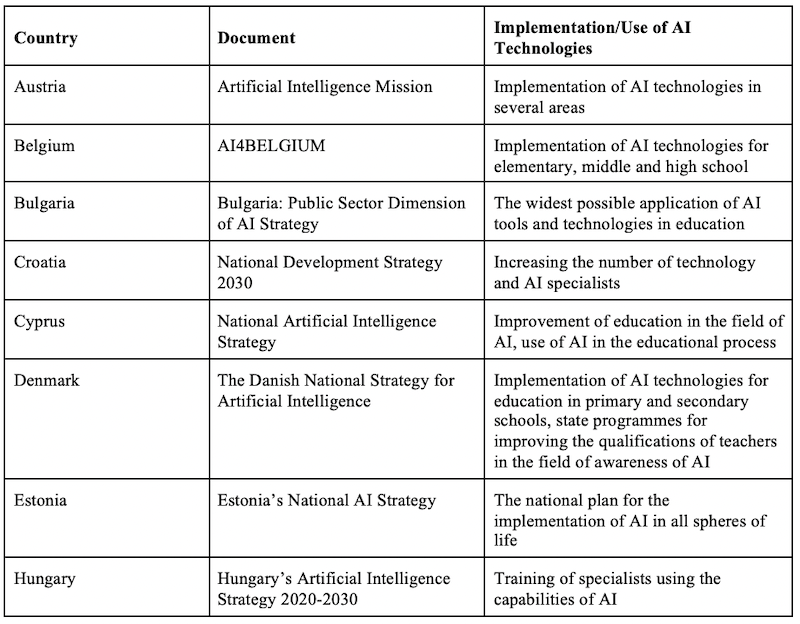
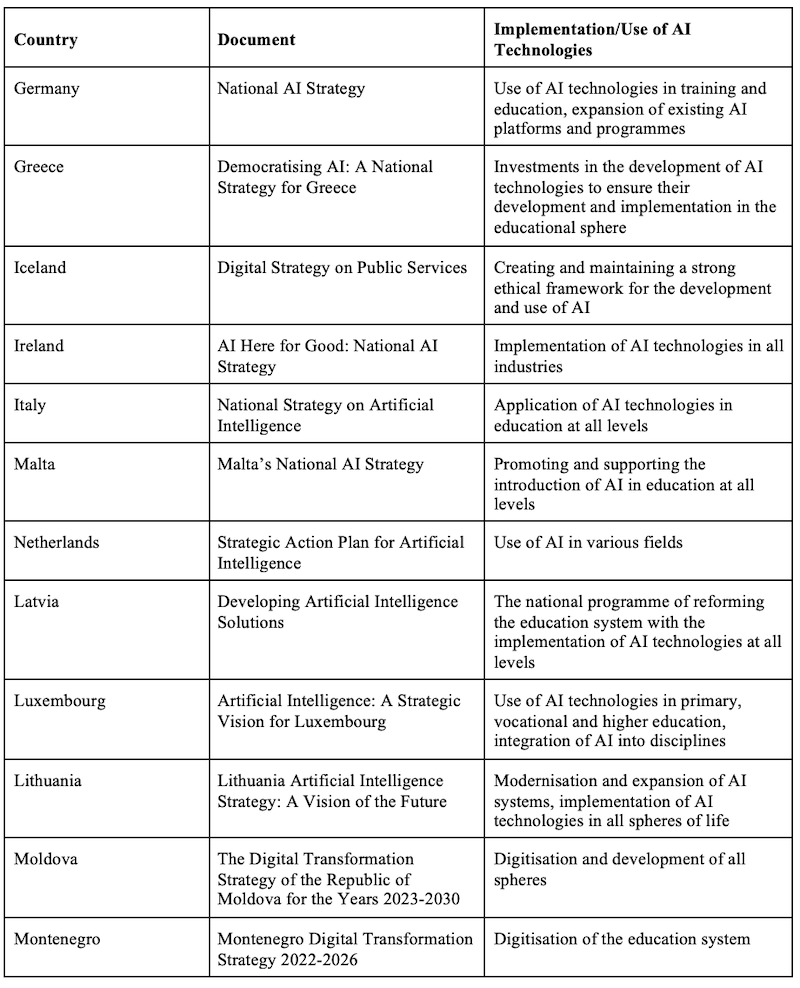
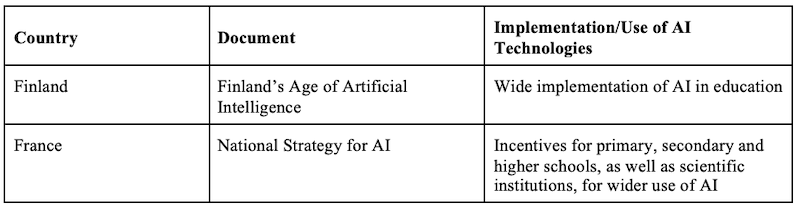
Currently, the legislation of European countries, independent of EU-wide regulations, regarding the use of AI technologies in education is still in the process of adoption and finalisation. A 2022 survey of the Council of Europe member states revealed that only four out of 23 countries had formal policies on AI in education (Council of Europe Standing Conference of Ministers of Education, 2023). Another survey from 2021 on the role of AI in K-12 education showed varying levels of interest: eight out of 18 countries reported moderate interest, five expressed significant interest, four showed minimal interest, and one considered it irrelevant (European Schoolnet, 2021). These findings suggest that, in some countries, leadership has limited understanding of AI’s role not only in education but also in broader societal and economic contexts. Overall, however, awareness of the importance of AI for national development, including in education, has been steadily increasing, as reflected in the growing number of formal policy documents and initiatives (Table 1).
Table 1: Regulatory Framework for the Use of AI in Education (European Countries)

A recent survey was conducted by GoStudent, a company engaged in educational technologies, in which the respondents were children aged 10-16, their parents, and teachers (from Austria, France, Germany, Great Britain, Italy and Spain). The majority of the respondents showed a significant interest in using AI in education and training (Duboust, 2024). Both students and their parents were unanimous in acknowledging the importance of studying and using AI and virtual and augmented reality. At the same time, the survey showed that access to using AI technologies in European countries was not equally distributed (the possibility of using personal computers, tablets, etc.). In addition, according to the data, only half of the surveyed teachers used digital applications, although the vast majority of educators also recognised their effectiveness.
In general, each European country has its own approaches to the application of AI technologies in education and training and is forced to respond to the challenges that arise. After the presentation of ChatGPT and the extraordinary popularity of the application among users throughout the world, the European University Association issued recommendations for universities on the use of ChatGPT and other AI technologies. The association stressed that attempts to ban the use of AI technologies in higher education are futile. The members of the association, on the contrary, recommended that European universities adapt their approaches to the use of AI technologies, for proper and ethical use (European University Association, 2023).
In 2021, according to the AI Index Report (Stanford University, 2021) in 27 European countries, there were 1,032 positions available for studying in the field of AI (mostly master's programmes). Recently, AI technologies have made significant progress in education as a whole.
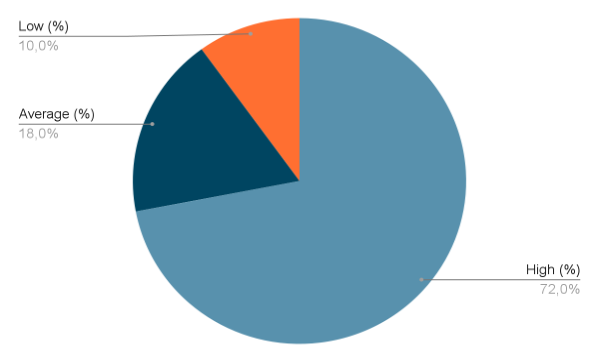
It should be emphasised that European countries generally have a positive attitude toward using AI technologies in education and training, although the level of implementation varies. Scandinavian countries and Great Britain show particularly significant adoption. For example, in Great Britain, public institutions have created a dedicated resource providing information on AI use in school education (GOV UK, 2024). In 2023, a study called Use of Artificial Intelligence in Education Delivery and Assessment (Felix, 2024) was conducted in the UK. Figure 1 illustrates the data obtained and the problem of excessive workload for British teachers, who devote most of their time to lesson planning and documentation (segment high %), which negatively affects the quality of education. In response, the government introduced funding to develop and provide free access to AI tools that assist teachers with lesson planning and other tasks. Overall, the active use of AI in education and training is steadily developing in Great Britain.
In Germany, the Standing Conference of the Ministers of Education and Cultural Affairs recommends the systematic use of AI in education to develop digital competencies among students (DMEXCO, 2024). Each German state can implement its own policies regarding AI in education, while the Federal Ministry of Education and Research provides financial support to centres that integrate AI in teaching and science. Since 2019, government-funded positions for AI educators have been created at technical universities in Darmstadt, Dresden, and Munich (The Decoder, 2022).
Austria also demonstrates strong government support for AI in education. The Austrian Society for Artificial Intelligence organises a national student AI competition, enabling students to present their AI projects (Austrian Society for Artificial Intelligence, 2023).
Bulgaria is developing AI technologies in education through public-private cooperation. In 2024, a draft memorandum between state bodies, academic institutions, and Intel was signed to involve teachers and students in AI development, training, and certification (Novinite.com – Sofia News Agency, 2023).
Estonia prioritises AI integration in education through teacher training programmes initiated by the Education and Youth Board (Toome, 2023). Similarly, the Netherlands launched the National Education Lab AI (NOLAI) in 2022, promoting AI adoption across primary, secondary, and special education (NOLAI National Education Lab AI, 2022).
In Italy, AI implementation focuses on both educational integration and retraining of specialists, supported by higher education programmes. Lithuania emphasises institutional policies and ethical guidelines for AI use in education to prevent misuse by students (Kučinskas, 2023).
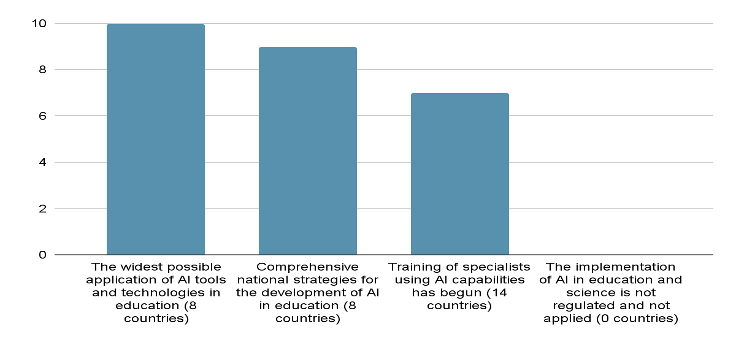
Overall, European countries actively implement AI in education, showing strong recognition at the state level of the importance of legal and regulatory frameworks to support its ethical and effective use (Figure 2).
According to the data on the international ranking of the use of AI in general, including in education, Ukraine, in 2023, was in the group of countries with the lowest indicators (Pokatilova, 2023). In general, Ukraine, like many other countries, was only studying the aspects related to the use of AI in the field of education. Legislative regulation of AI in education is becoming important, however, considering that Ukraine is currently in a full-scale war and the efforts of the state's leadership and lawmakers are aimed at overcoming military aggression and the challenges it causes. However, the process of incorporating AI technologies into the field of education has begun.
The Institute of Artificial Intelligence Problems of the Ministry of Education and Science of Ukraine and the National Academy of Sciences of Ukraine began their work in 1991. At the same time, before the start of the full-scale invasion by Russia of Ukraine, the Ministry of Education of Ukraine initiated the process of reforming the educational sphere. The Ministry has initiated digital transformations in the educational sphere of Ukraine since 2021. These processes became a logical continuation of the implementation of the Concept for the Development of Artificial Intelligence in Ukraine, which was approved by the order of the Cabinet of Ministers of Ukraine in 2020. The concept defined the principles, goals, and objectives of the development of AI technologies in Ukraine as one of the priority areas (Government of Ukraine, 2020).
The document indicated that the priority areas in which the tasks to implement the state policy for the development of artificial intelligence would be undertaken were: education and professional training, science, economy, cybersecurity, information security, defence, public administration, legal regulation and ethics and justice. This concept determined how some tasks should be done in separate educational spheres, such as: general secondary education (improvement of the educational and methodological base, organisation of courses for teaching staff on the work of AI, the spread of digital literacy among schoolchildren), higher education (creation of specialised educational programmes, integration of leading courses on the subject of AI in educational programmes, organisation, and provision of internships for teachers in institutions that develop and apply AI technologies, the establishment of international cooperation), improvement of qualifications and professional retraining of personnel in science (promoting the attraction of grant funding for scientific activities in the field of AI to stimulate the transition of Ukrainian scientists to effective models, standards, and formats of cooperation, stimulation of scientific research in the field of artificial intelligence), etc.
The Ministry of Education and Science of Ukraine presented the transformation programme of Ukrainian education, Education 4.0: Ukrainian Dawn, in 2022 (Government of Ukraine, 2022). The concept envisages combining the efforts of people and technologies to achieve new opportunities; the use of the latest technologies that do not replace the educator but complement the learning process, the digital transformation of education and science, and the harmonisation of Ukrainian and European educational spaces.
According to the results of a survey, an All-Ukrainian study of the use of AI in school education conducted in 2023 by the Projector Creative and Tech Institute and the Small Academy of Sciences of Ukraine with the support of the research company Factum Group, the most popular AI service (among teachers and students of Grades 8-11) became ChatGPT (Government of Ukraine, 2023). Analysis of the survey shows that the vast majority of teachers and students have experience using AI services. In most cases, the audience was satisfied with such an experience. Teachers noted that they used AI services to prepare for classes, create homework tests, and test students' knowledge and extracurricular work during classes. The teachers interviewed noted that the use of such new technologies could be beneficial for students. However, the use of AI also raised concerns for them because of the possible limitations of student development, the spread of plagiarism and unethical use.
An interesting question is, What is the source of teachers’ knowledge about AI technologies, and the possibilities of their use in training and education? Sixty-nine percent of the interviewed teachers learned about AI from social networks, 46% from educational materials (lectures, courses, etc.), 35% received information from friends or colleagues, 30% purposefully and independently searched for information about AI technologies, and 24% learned from the press.The analysed survey contains data on the use of AI in teachers' professional activities, which is illustrated in Figure 3.
Regarding the student audience, 91% of students knew about at least one AI service, and 78% used at least one AI service (in the previous six months before the time of the survey). The majority of students who had experience using AI had positive impressions (75%) and talked about the help provided by AI; 16% gave a neutral assessment, and 6% a negative one. According to a survey conducted in 2023 by the National Bank of Ukraine with the support of partners, 93.6% of educators wanted to receive more information about the possibilities of using AI technology in the educational process. However, 6% of respondents were not interested in this topic (Mashlakovska, 2024).
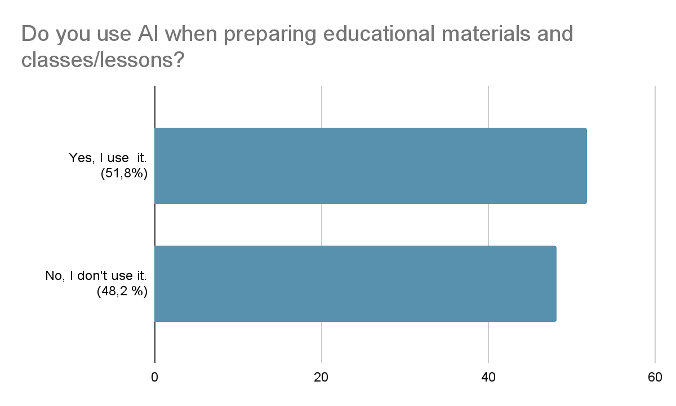
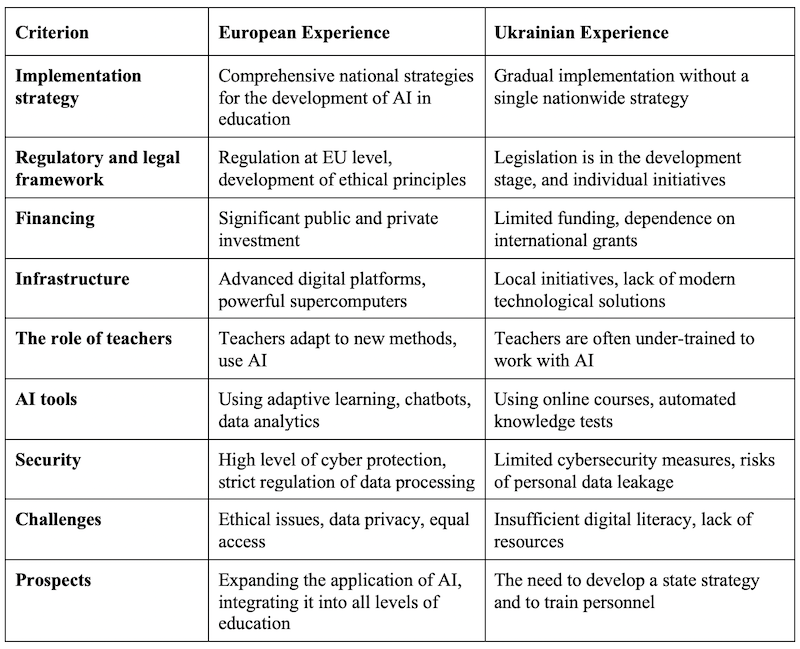
In general, the use of AI technologies in training and education in Ukraine, for the most part, depends on the administrative policies of educational institutions and the personal desire of educators to use AI in their work (there are a significant number of variations of this: the use of AI technologies in institutions of higher education when training specialists in the field of computer technologies, military training (training of military engineers, intelligence officers, UAV pilots, cybersecurity specialists, etc.), the use of AI technologies in the study of foreign languages or disciplines where the use of virtual simulations, laboratories, etc. is necessary; the use of AI in specialised educational institutions for the training and adaptation of persons with special needs, etc.). Therefore, generalised information on the use and impact of AI in the educational process in European countries and Ukraine is provided in Table 2.
Table 2: Comparative Analysis of the Impact of the Use, Implementation, and Regulation of AI in Educational and Training Processes in European Countries and Ukraine
The findings of this study confirm that AI technologies are increasingly integrated into education but the scope, modalities, and depth of the implementation differ significantly between European countries and Ukraine. These differences reflect not only technological capacity but also the broader socio-political, economic, and institutional contexts that shape educational policy and practice.
Consistent with previous research, the results highlight the dual nature of AI integration. On the one hand, AI provides opportunities to personalise learning, automate assessment, enhance accessibility for students with special educational needs, and foster adaptive educational environments (Gocen & Aydemir, 2021; Ayala-Pazmiño, 2023). On the other hand, rapid adoption raises challenges related to academic integrity, critical thinking, ethical use, and overdependence on automated systems. These findings align with international debates that stress the necessity of balancing innovation with pedagogy and ethics (Tlili et al., 2024).
The European case demonstrates a structured, policy-driven approach underpinned by robust investment and regulatory frameworks. EU-wide initiatives such as the White Paper on Artificial Intelligence, the Digital Education Action Plan, and the AI Act established principles of ethical, inclusive, and transparent use (European Commission, 2022; Council of Europe, 2023). Countries such as Austria, Estonia and Germany combine financial support with teacher training programmes, development of digital infrastructure, and targeted student engagement initiatives such as AI contests. These measures have accelerated adoption and fostered innovation. Nevertheless, surveys reveal uneven levels of teacher preparedness and access to AI resources, highlighting gaps that persist even in well-resourced systems (Duboust, 2024).
In contrast, Ukraine exhibits a more fragmented and less institutionalised trajectory. While awareness and positive attitudes toward AI are widespread among teachers and students (Government of Ukraine, 2023), the lack of a unified national strategy, insufficient funding, and limited teacher training constrain systemic adoption (Mashlakovska, 2024). Current AI use is often driven by individual initiatives or institutional policies, ranging from language learning applications to specialised professional and military training (Pokatilova, 2023; Shevchenko et al., 2023). Ethical concerns, including plagiarism and data privacy, are amplified by weak infrastructure and the absence of comprehensive regulation. At the same time, national strategies such as the Concept for the Development of Artificial Intelligence in Ukraine (Government of Ukraine, 2020) and the Education 4.0: Ukrainian Dawn programme (Government of Ukraine, 2022) indicate growing alignment with European practices and recognition of AI as a complementary rather than substitutive educational tool.
Across both contexts, three key issues emerge. First, the ethical and legal dimensions of AI, particularly regarding data protection and academic integrity, remain underdeveloped. Second, while AI enhances efficiency and personalisation, it cannot replace critical thinking, creativity, or social interaction, which are essential to holistic education. Third, successful integration requires balance: technological opportunities must be embedded in coherent pedagogical strategies rather than imposed as standalone solutions.
This study has several limitations. It relied on the analysis of policy documents, surveys, and reports, without direct observation of classroom practices, which may limit insight into day-to-day realities of AI use. Furthermore, given the rapid pace of AI development, some findings are at risk of becoming outdated soon. Future research should therefore employ longitudinal designs to examine how AI tools affect student outcomes, teacher roles, and motivation over time, as well as cross-cultural comparisons to identify context-specific best practices.
For Ukraine, the European experience offers valuable lessons. Our recommendations are to strengthen teacher training to build digital and pedagogical competence; develop clear ethical guidelines that address plagiarism, fairness, and data protection; invest in infrastructure to ensure equitable access; and foster international cooperation to share best practices and adapt them to local realities.
By adopting these measures, Ukraine can accelerate the responsible integration of AI into education. More broadly, the findings emphasise that AI should not be viewed as a replacement for educators but as a supportive tool that complements human interaction, enriches teaching practices, and promotes equitable access to high-quality education.
The use of AI technologies in education enhances personalisation, efficiency, and innovation, supporting adaptive learning, data-driven decision-making, and improved management. European experience demonstrates that clear legislation, funding, and teacher training contribute to effective AI implementation. In Ukraine, AI adoption in education is progressing but challenges such as limited resources, insufficient digital literacy, and the ongoing effects of military conflict remain. Ethical use, data privacy, and equitable access are crucial for maximising AI’s benefits. Therefore, it is recommended that Ukraine finalise legislation regulating AI in education, provide financial and infrastructural support for AI tools, train educators in AI applications, and promote awareness of its possibilities and ethical use. Ensuring access for all students, regardless of social or economic status, will be essential for achieving the full potential of AI in transforming education and aligning Ukrainian education with European standards.
Austrian Society for Artificial Intelligence. (2023). АІ student contest. https://www.asai.ac.at/en/bwki
Ayala-Pazmiño, M. (2023). Artificial Intelligence in education: Exploring the potential benefits and rsisks. 593 Digital Publisher CEIT, 8(3), 892-899. https://doi.org/10.33386/593dp.2023.3.1827
Council of Europe Standing Conference of Ministers of Education. (2023). Regulating artificial intelligence in education. https://rm.coe.int/regulating-artificial-intelligence-in-education-26th-session-council-o/1680ac9b7c
DMEXCO. (2024). AI in education: What does it mean for schools? https://dmexco.com/stories/newsstory-ai-in-education-what-does-it-mean-for-schools/
Duboust, O. (2024). European students want to learn with AI but many don’t have access in schools, survey finds. https://www.euronews.com/next/2024/03/05/european-students-want-to-learn-with-ai-but-many-dont-have-access-in-schools-survey-finds
European Commission. (2020). White paper: On artificial intelligence – A European approach to excellence and trust. COM 2020. https://commission.europa.eu/system/files/2020-02/commission-white-paper-artificial-intelligence-feb2020_en.pdf
European Schoolnet. (2021). Artificial Intelligence role in K12 education. http://www.eun.org/documents/411753/7316225/Artificial+Intelligence+Role+in+K12+Education+Report/0b9f5e20-62f7-4966-a58e-fdacc9199248
European University Association. (2023). Artificial intelligence tools and their responsible use in higher education learning and teaching. https://eua.eu/resources/publications/1059:artificial-intelligence-tools-and-their-responsible-use-in-higher-education-learning-and-teaching.html
Felix J. (2024). Use of artificial intelligence in education delivery and assessment. https://researchbriefings.files.parliament.uk/documents/POST-PN-0712/POST-PN-0712.pdf
Gibson, D. C., Kovanovic, V., Ifenthaler, D., Dexter, S., & Feng, S. (in press). Learning theories for artificial intelligence promoting learning processes. British Journal of Educational Technology. https://doi.org/10.1111/bjet.13341
Gocen, A., & Aydemir, F. (2021). Artificial Intelligence in education and schools. Sciendo. https://sciendo.com/article/10.2478/rem-2020-0003
GOV UK. (2024). The education hub. https://educationhub.blog.gov.uk/category/schools/
Government of Ukraine. (2023). All-Ukrainian study of the use of AI in school education. Ministry of Education and Science of Ukraine. https://mon.gov.ua/storage/app/media/news/2023/12/20/Vseukranske.doslidzhennya.vykorystannya.20.12.2023.pdf
Government of Ukraine. (2022). The program of the great transformation, education 4.0: Ukrainian dawn. https://www.kmu.gov.ua/news/ministr-osvity-i-nauky-ukrainy-prezentuvav-prohramu-velykoi-transformatsii-osvita-40-ukrainskyi-svitanok
Government of Ukraine. (2020). Approval of the concept for the development of Artificial Intelligence in Ukraine. Decree of the Cabinet of Ministers, No. 1556. https://www.kmu.gov.ua/npas/pro-shvalennya-koncepciyi-rozvitku-shtuchnogo-intelektu-v-ukrayini-s21220
Kučinskas, K. (2023). Instead of bans, Lithuanian universities look to incorporate AI-assisted learning. https://www.lrt.lt/en/news-in-english/19/2037106/instead-of-bans-lithuanian-universities-look-to-incorporate-ai-assisted-learning
Mashlakovska, Т. (2024). Artificial intelligence in education: Results of a survey of teachers. https://talan.bank.gov.ua/uploads/ekspertyza/files/shi-v-osviti-rezultati-opituvannia.pdf
Newell, A., Shaw, J.C., & Simon, H.A. (1959). Report on a general problem-solving program. In IFIP Congress, 256. 64.
Novinite.com – Sofia News Agency. (2023). Intel and Bulgaria forge alliance in AI education initiatives. https://www.novinite.com/articles/222563/Intel+and+Bulgaria+Forge+Alliance+in+AI+Education+Initiatives
Pokatilova, V. (2023). Artificial intelligence in education: How technology affects learning in Ukrainian schools. https://fakty.com.ua/ua/ukraine/suspilstvo/20231220-shtuchnyj-intelekt-v-osviti-yak-tehnologiya-vplyvaye-na-navchannya-v-ukrayinskyh-shkolah/
Radboud Universitei. (2022). NOLAI | National Education Lab AI. https://www.ru.nl/en/nolai
Seo, K., Tang, J., Roll, I., Fels, S., & Yoon, D. (2021). The impact of artificial intelligence on learner–instructor interaction in online learning. International Journal of Educational Technology in Higher Education, 18(54). https://doi.org/10.1186/s41239-021-00292-9
Shevchenko, A., Bokanovsky, S., & Bilokobylsky, O. (2023). Strategy for the development of artificial intelligence in Ukraine. CEUR Workshop Proceedings.
Stanford University. (2021). Artificial Intelligence Index. https://aiindex.stanford.edu/wp-content/uploads/2021/03/2021-AI-Index-Report-_Chapter-4.pdf
The Decoder. (2022, October 16). AI in Germany: Institutions and study programs. https://the-decoder.com/ai-in-germany-institutions-and-study-programs
The European Commission (2022, October 24). The Commission publishes guidelines to help teachers address misconceptions about Artificial Intelligence and promote its ethical use. https://ec.europa.eu/commission/presscorner/detail/en/ip_22_6338
Tlili, A., Adarkwah, M.A., Lo, C.K., Bozkurt, A., Burgos, D. Bonk, C.J., Costello, E., Mishra, S., Stracke, C.M., & Huang, R. (2024). Taming the monster: How can open education promote the effective and safe use of generative AI in education? Journal of Learning for Development, 11(3), 398-413
Toome, E. (2023). Empowering learners with AI in education — Education Estonia. Education Estonia. https://www.educationestonia.org/empowering-learners-with-ai-in-education/
Turing, A. (1950). I.—COMPUTING MACHINERY AND INTELLIGENCE. OUP Academic. https://academic.oup.com/mind/article/LIX/236/433/986238
UNESCO. (2023). Artificial intelligence: Partnership between UNESCO and the EU to speed up the implementation of ethical rules. https://www.unesco.org/en/articles/artificial-intelligence-partnership-between-unesco-and-eu-speed-implementation-ethical-rules
Zhang, K., & Begum Aslan, A. (2021). AI technologies for education: Recent research & future directions. OUCI. https://ouci.dntb.gov.ua/en/works/40LYzO34/
Author Notes
Tetiana Hul holds a master's degree in History and Archeology and English Philology. She is currently finishing her postgraduate studies in History and Archeology at the National University of Ostroh Academy, where she works as a teacher at the International Relations Department of the Educational and Scientific Institute of International Relations and National Security. Her research interests include the history of the 20th century, the study of the activities of Ukrainian historians who worked in education abroad, and the use of artificial intelligence in educational activities. Email: tetiana.yushchuk@oa.edu.ua (https://orcid.org/0009-0006-4654-9228)
Natalia Matviichuk is a candidate of historical sciences and a senior lecturer in the department of international relations at the National University of Ostroh Academy. Her scientific interests include international relations, in particular, the study of interaction in the field of education. She has a significant number of publications in scientific journals and considerable experience in teaching and working with both post-secondary and high school students. Email: natalia.matviichuk@oa.edu.ua (https://orcid.org/ 0000-0003-0011-3681)
Svitlana Hodzhal is a candidate of historical sciences and a senior lecturer in the department of history, named after Prof. M. P. Kovalskyi, at the National University of Ostroh Academy. Her scientific interests include research on the history of Ukraine and the world, in particular, the functioning of educational institutions in the territory of Ukraine during the 20th and 21st centuries. Email: svitlana.hodzhal@oa.edu.ua (https://orcid.org/0000-0002-2940-6325)
Cite as: Hul, T., Matviichuk, N., & Hodzhal, S. (2025). Integration of AI into learning and education: A comparative analysis of European and Ukrainian experiences. Journal of Learning for Development, 12(3), 599-614.