
Catharine Bleasdale and Alison Glover
2025 VOL. 12, No. 3
Abstract: Teachers’ professional identity is shaped by a range of factors. Active participation in professional learning opportunities is one such factor. The purpose of this case study is to bring teachers’ voice to the forefront and present the considered reflections of a small group of Zambian teachers, following their engagement with the Zambian Education School-Based Training (ZEST) programme. During the programme, teachers contributed to an online community of practice, where they shared classroom practice with their peers, and were interviewed about their professional learning experiences. Some also wrote reflections that explored the impact of their experiences on their professional teacher identity further. Consequently, the teacher’s voice is used extensively in this paper, and vignettes offer a snapshot of the positive impact of their professional learning experience on self-confidence, increased collaborative working, an increased appreciation for learner-centred approaches, and how they envisage themselves to be at a ‘pivot’ point on their teacher professional identity journeys.
Keywords: Community of Practice, classroom practice, teacher professional development, teacher professional identity, ZEST
This case study presents teachers’ perceptions in understanding the influence of their engagement in professional learning activities in shaping their Teacher Professional Identity (TPI). By positioning teachers’ voice at the forefront, this case study addresses a gap in current research, by delivering direct engagement with teachers’ reflections. Since 2017, the Zambian Education School-Based Training (ZEST) programme, funded by the Scottish Government and implemented by The Open University UK, in collaboration with World Vision Zambia and the Ministry of Education in Zambia, has enhanced the teaching skills of over 4,000 primary school teachers (Stutchbury, et al., 2023). Much has been reported on the principles of ZEST, and its reach and impact (Stutchbury et al., 2019; Stutchbury & Gallastegi, 2020). This case study offers complementary evidence of effective professional learning in Zambia, in which teachers were very much “active stakeholders” in their own development (Mitchell et al., 2024, p. 26). The contributing teachers’ voices are presented via vignettes that put their voices at the forefront of this case study. This paper is drawn from a wider study (the full dataset for this study is currently being analysed). This involved an online community of practice, research conversations and written reflections. To this end, the case study aims to explore the role of the professional learning activities offered by engagement with ZEST in shaping teacher professional identity. The depth of insight is presented by focusing on the reflections of five teachers.
Wenger (1998, p. 151) identifies identity as “a way of being in the world”, where individuals negotiate their desired persona within a particular context. Applying this idea to TPI, would suggest that individuals aim to become the teacher they want to be, within their school, district and country systems. When considering the idea of negotiating a desired persona, two influences can be identified: self and others. Teachers need to be comfortable with the ways that their context requires them to work to develop positively into the persona they desire to be. As such, TPI can be seen to be socially, culturally and personally constructed (Davey, 2013).
Teachers in Zambia sometimes work in challenging conditions; for example, large class sizes (and sometimes several classes attending school in shifts to accommodate the number of pupils); limited resources (materials and communication); and a fixed outcomes-based curriculum. An individual teacher may have little influence on any of these external factors but can develop their pedagogy to enhance learner progress within their context. Being able to feel comfortable with the way that they act as a teacher requires them to establish what aspects of the role are important and to ensure that they incorporate these into their practice. As such, they are aiming to behave as closely as possible to their “I-position” (Arvaja, 2016, p. 393), or the teacher persona they wish to portray.
Although each teacher will develop their individual TPI in their own way, they will do so through engagement with others. If the teaching community is considered a Community of Practice (CoP) as described by Lave and Wenger (1991), teachers will be influenced by other members of this hierarchical model as they aim to fit in and show they belong. Influences can be positive or negative, and they will shape an individual’s TPI in different ways depending on how closely they align with the teacher’s “I-position” (Arvaja, 2016, p. 393); even where it is highly desirable or necessary to act in a certain way, it will feel very uncomfortable if this does not align with their personal practice. Conversely, teachers are able to positively develop their TPI when they are working at a ‘pivot’ point, where they are comfortable with the balance between social and individual influences on their trajectory: the others and the self. This is unique for every teacher and can change with time, particularly through interaction with others within the community of practice in which they are engaged.
The Community of Practice (CoP) model is recognised for its informal evolution through a shared domain, core practices and interpersonal relationships. Individuals can belong to several CoPs simultaneously, including CoPs within CoPs, for example, working within a school, a district, a country. This study in effect created a new CoP for the teachers invited to reflect on the ZEST project. These teachers (domain) were brought together through their positive engagement with learner-centred teaching approaches (practice). Through the evaluative workshop and subsequent online communication, the group of teachers developed interpersonal relationships on which to build their own TPI whilst contributing to the further progress of the ZEST practices. Could engagement with like-minded teachers support and enhance individuals’ TPI in a particular trajectory that would also further the CoP activity to sustain a learner-centred approach to teaching? The Organisation for Economic Co-operation and Development (OECD) recognises that engaging teachers in a collective identity around a particular focus can be a positive way for individuals to identify and value themselves, as well as to communally share experience and tacit knowledge freely, to promote change or growth in the desired practice (Suarez & McGrath, 2022).
It is recognised that “school-based teacher development programmes are underpinned by the belief that knowledge about teaching is socially constructed in a particular cultural context” (Stutchbury et al., 2024, p. 238). The ZEST programme drew teachers from many primary schools together to share input designed to shape classroom practice. It provided participants with access to new ideas and opportunities to experiment with their own practice, collaborate with other teachers (both between schools and within schools) and with access to expert support from World Vision and Open University staff. Rogoff (2008) suggests that such an approach to change, where people work together through guided participation, can achieve “participatory appropriation” (Rogoff, 2008, p. 142), where individuals learn to act differently as a result of their engagement in the project.
A qualitative approach was adopted, with purposive sampling that gathered data from volunteers who had participated in ZEST workshops in Zambia. Ethical approval was received for the study and participants’ informed consent was gained before any data collection, with participants free to withdraw at any time during the study. The primary school teachers who participated in the workshops (N = 26) shared examples of their teaching practice with their workshop peers online; six participants completed research conversations, and five shared written reflections of their experiences, and the influence of the professional learning activities on their practice and TPI. This process allows for depth of experiences to be explored (Jain, 2021), with the context and situation of participants integral to their shared understanding (Gray, 2018; Hamilton & Corbett-Whittier, 2013; Stake, 2006). Different data sources (online reflections, research conversations and written reflections) were drawn upon, with triangulation of the findings evident (Bryman, 2006). Yet, at the same time, it is recognised that limiting the data collection to just the above methods could also limit the depth and breadth of the data collected.
It is also acknowledged that the small sample size does not represent the broader population of primary school teachers, thus, limiting the generalisability of the findings. Additionally, there is the possibility of bias, as the information shared by the participants may have been selected to align with their perception of the expected outcomes. By adopting thematic analysis, flexibility existed, with both inductive and deductive approaches used (Braun & Clarke, 2021; Jackson & Bazeley, 2019). The following results focus on the voice of the participants with direct extracts from the written reflections offering a snapshot in each vignette of how a community of practice can support teacher professional identity development.
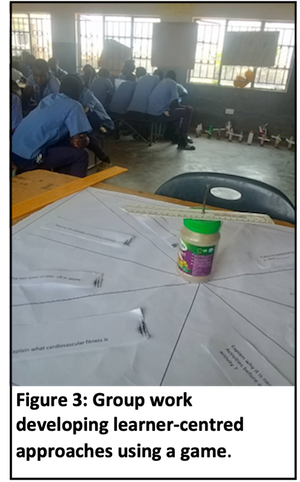
Both the online communications and research conversations provided detailed evidence of extensive engagement with the learner-centred ZEST approaches. Most participants recounted their classroom experiences where approaches such as group/pair work and using local resources had a positive impact on learner engagement and outcomes. In this instance, it is extracts from the written reflections that are presented with the teachers’ context included. These vignettes include thoughts on developing confidence and TPI, with significant moments in teachers’ professional learning journeys and practice offering examples of this. For example, as Anold and Patricia recount below, the confidence gained in understanding one’s learners is critical. The accompanying images (Figures 1 to 5) are examples from each teacher’s practice:
To start with, ZEST program acts as a lesson catalyst and it’s the field or a base of approaches. I have been using ZEST approaches to improve learning to be more learner-centred in my class and as a school at large. When I joined the workshop, I would say I felt more confident about using ZEST approaches effectively with my learners. This pool of approaches gives me much energy and confidence to understand and value that different children have different interests and personalities and may need different teaching approaches. With the use of ZEST approaches much of the classroom work is done by the learners. It embeds more confidence in me to know when and how to differentiate appropriately, using ZEST approaches which enables pupils to be taught effectively, so that all pupils are supported and challenged, whatever their level of ability. In addition, I also capitalise on the use of local resources that promotes hands on activities. While participating in the [online] group I found out that my level of confidence was increasing due to the knowledge, ideas, skills and the positive feedback received.
It was during one of the sessions where I was teaching dialogue to a grade 6 class. Since we didn't have enough books, I wrote the comprehension on a big chart then learners were able to see and read clearly this helped my dialogue session be unique. What I loved the most was how learners were able to use role play during their dialogue. This helped learners acquire the skill of reading because everyone was interested in reading what was displayed.

Incorporating the [learner-centred] approaches in every lesson I teach will help because it will be more of a child and less of a teacher. I will change as a teacher because I will be able to respect my learners as equal partners in their education. I would like to see a teacher in me who considers a child as the whole package and ensure that the learners are getting the right type of education using the right approaches to successful learning.
Key skills, such as reflection and time management, have come to the fore during engagement with ZEST professional learning, as reflected upon by Stanley:
I have found reflectiveness to be an essential ingredient to effective teaching. The latter principle has taught me to pose critiquing questions to myself so as to ascertain the impact of my teaching, the effectiveness of the methods employed and levels of learner participation. Being reflective has also attached me to the norm of seeking to establish the amount of resources invested in each particular lesson presented as well as time management. Through exposure to reflective teaching, I have come to learn that as a good teacher, one needs to embrace the principle of good time management because learner-centred lessons require effective use of time. I believe that the challenge can be navigated by effective planning of lessons which should include projection/ approximation of the time frame within which intended class tasks would be done. Selection of appropriate approaches that would not drag the lesson out of the set time limits should be an inevitable aspect in planning. [Using locally available materials] has played a significant role in shaping me into a change agent that sees teaching and learning materials in almost every object around. In other words, my commitment to being resourceful and the zeal to exploit teaching and learning materials in promoting learner-centred teaching cannot be over emphasised.
The teachers also noted how the impact of participating in the professional learning offered by ZEST has impacted their wider profession; Chalupata below discusses the influence of the community of practice within their own school as teachers work together during their Teacher Group Meetings (TGMs):
I was working with limited knowledge and ideas but ZEST has stimulated the spirit of working together as a team in TGMs both in planning and reflection meetings. The lecture method I was using in teaching could not give me chance to use group work method but ZEST has [helped me] learn more about strategies to use in delivering lessons using group work methods. There were few monitoring intervals but with ZEST I have been benefiting from peer monitoring where strengths and weaknesses are discussed amicably in each study cycle. On the issue of lesson planning, it was done individually but now with ZEST collaborative planning has taught me the importance of sharing ideas and challenges, hence there is an improvement in planning for effective teaching.

Some also reflected upon the future developments of their TPI, e.g., Mubita, an early career teacher, looked ahead to his future self:
In my future development as a teacher, I want to see myself as a mentor for new teachers, explore new teaching methods and advance my education. To continue developing my confidence in the learner-centred approaches I will make sure I embrace a growth mindset, setting up realistic expectations in trying to make sure I offer balanced activities to my learners and also to be providing constructive feedback to learners. To help me run a [good] learner-centred approach in my classroom, variety of teaching and learning materials are needed, such as the 21st century modern tools like computers as well as a strong connectivity (internet connection). This can be of help to me because in most cases learners don’t actively interact with computers for practical due to the lack of them. The change I would like to see in myself as a teacher, is that of a teacher who sees any available material as teaching/learning aid.

All the teachers’ reflections above illustrate instances of the influence of self and others as individuals negotiate their teaching persona (Pillen et al., 2013). For instance, their engagement with the online communications where they shared their own classroom practice, and gave and received feedback, contributed to developing teachers’ self-confidence. As Chalupata commented, the introduction of team planning and reflection, which also included peer observations, now promotes more effective learner experiences. The influence of those from within their CoP was prevalent (Lave & Wenger, 1991), as it was apparent that, through the guided participation of the ZEST professional learning programme, the teachers now act differently as a consequence of the collective identity generated during their involvement in these activities (Rogoff, 2008; Suarez & McGrath, 2022). For example, Anold considered improving self-confidence and valuing learners’ individuality more since engaging with the programme. Stanley reflected on the impact of a heightened appreciation for the incorporation of local materials and how this could be a route to more effective learner-centred activities; recognising the opportunity to be a ‘change agent’. Indications that these teachers are working at a ‘pivot’ point can also be determined. Patience considered how teachers are changing as a consequence of delivering learner-centred approaches — noting a more equitable partnership between the teacher and learners emerging. Mubita recognised the current ‘new’ status of teachers within the CoP, whilst considering how teachers see their role in future as developing into mentors, which illustrates the current ‘pivot’ point in their TPI journey.
The vignettes highlight the individual nature of Teacher Professional Identity development. Although there is little reference to each teacher’s current ‘pivot’, that is, their comfort within their current teaching context, it is clear that they shared a belief that belonging to the community of practice created by their involvement in ZEST has had a positive impact on their TPI development. This goes beyond their use of learner-centred strategies within classroom practice: reference to themselves as reflective teachers, collaborating with others, supporting and mentoring peers across the district, and the confidence-building impact of this involvement, show how impactful the CoP has been to them in their TPI development. These personal narratives of five individuals, who have reflected on their involvement in the ZEST professional development programme and their engagement with an online community of ZEST colleagues, demonstrates the possibility of achieving “participatory appropriation” (Rogoff, 2008, p. 142) by developing collective identity around a particular focus (Suarez & McGrath, 2022). This case study offers lessons for teachers and those responsible for professional learning in the Southern Africa region and beyond. By encouraging and engaging with teachers to reflect more openly their voice is prioritised. Such direct engagement by teachers provides further opportunity for sustainable growth, as teachers’ confidence improves and they feel more enabled.
Acknowledgements: This work was funded by the Scottish Government and was completed with the support of the Ministry of Education Officers in Zambia, and the implementation partner, World Vision Zambia. We would also like to acknowledge the following contributors:
Arvaja, M. (2016). Building teacher identity through the process of positioning. Teaching and Teacher Education, 59, 392-402. https://doi.org/10.1016/j.tate.2016.07.024
Braun, V., & Clarke, V. (2021). One size fits all? What counts as quality practice in (reflexive) thematic analysis? Qualitative Research in Psychology, 18(3), 328-352. https://doi.org/10.1080/14780887. 2020.1769238
Bryman, A. (2006). Integrating quantitative and qualitative research: How is it done? Qualitative Research, 6(1), 97-113. https://doi.org/10.1177/1468794106058877
Davey, R. (2013). The professional identity of teacher educators: Career on the cusp? Routledge.
Gray, D.E. (2018). Doing research in the real world (4th ed.). SAGE Publications Ltd.
Hamilton, L., & Corbett-Whittier, C. (2013). Using case study in education research. SAGE Publications Ltd.
Jackson, K., & Bazeley, P. (2019). Qualitative data Analysis with NVivo (3rd ed.). SAGE Publications Ltd.
Jain, H. (2021). Survey versus interviews: Comparing data collection tools for exploratory research. The Qualitative Report, 21(2), 541-554. https://doi.org/10.46743/2160-3715/2021.4492
Lave, J., & Wenger, E. (1991). Situated learning: Legitimate peripheral participation. Cambridge University Press.
Mitchell, R., Ayinselya, R.A., Barrett, A.M, Cortez Ochoa, A.A., David, O., Imaniriho, D., Nwako, Z.A., Reda, N.W. & Singh, M. (2024). Teacher professional development in Africa: A critical synthesis of research evidence. CIRE, Bristol. https://doi.org/10.5281/zenodo.10944685
Pillen, M.T, Den Brok, P.J. & Beijaard, D. (2013). Profiles and change in beginning teachers’ professional identity tensions. Teaching and Teacher Education, 34, 86-97. https://doi.org/10.1016/j.tate.2013.04.003
Rogoff, B. (2008). Observing sociocultural activity in three planes: Participatory appropriation, Guidance participation, and apprenticeship. In K. Hall, P. Murphy & J. Soler (Eds.), Pedagogy and practice: Culture and identities (pp. 58-74). SAGE Publications Ltd.
Stake, R.E. (2006). Multiple case study analysis. The Guildford Press.
Suarez, V., & McGrath, J. (2022). OECD Education Working Papers No. 267 — Teacher professional identity: How to develop and support it in times of change. https://dx.doi.org/10.1787/b19f5af7-en
Stutchbury, K., & Gallastegi, L. (2020). Zambian Education School-based Training (ZEST) Project: Cohort 2 Evaluation, April 2020. The Open University. https://doi.org/10.21954/ou.ro.00015329
Stutchbury, K., Gallastegi, L., Woodward, C., Biard, O., & Phiri, J. (2024). Teacher professional development @scale: Achieving quality and sustainability in Zambia. Journal of Learning for Development, 11(2), 237-252. https://doi.org/10.56059/jl4d.v11i2.1547
Stutchbury, K., Gallastegi, L., Woodward, C., & Phiri, J. (2023). Zambian education school-based training: Endline evaluation report. The Open University UK. https://oro.open.ac.uk/94372/1/ZEST%20Endline%20Report%20final_Nov_23.pdf
Stutchbury, K., Gallastegi, L., & Woodward, C. (2019). Supporting Open Practices with teachers in Zambia. Journal of Learning for Development, 6(3), 208-227. https://jl4d.org/index.php/ejl4d/article/view/367
Wenger, E. (1998). Communities of Practice: Learning, meaning and identity. Cambridge University Press.
Author Notes
Dr Catharine Bleasdale is a Curriculum Tutor in the Primary team of The Open University ITE Partnership PGCE programme in Wales. She has worked within the Teacher Education sector for over two decades and has a particular interest in teacher professional identity development. Email: catharine.bleasdale@open.ac.uk (https://orcid.org/0000-0002-5469-1252)
Dr Alison Glover is the Research Fellow for The Open University ITE Partnership PGCE programme in Wales. She has worked in outdoor education, the early years, and in the primary and secondary sectors in the UK and overseas. She has supported university education programmes, and undertaken many education-focused research projects. Email: alison.glover@open.ac.uk (https://orcid.org/0000-0002-9287-6661)
Cite as: Bleasdale, C., & Glover, A. (2025). Sustaining a Community of Practice to Support Development of Teacher Professional Identity: A Zambian Case Study. Journal of Learning for Development, 12(3), 615-623.