Tran Ai Cam and Nguyen Huu Thanh Chung
2025 VOL. 12, No. 1
Abstract: This study employs bibliometric methods to analyse impactful and emerging research topics in the digital education ecosystem, using Scopus data from 2019 to 2023. It introduces a new Impact Factor (IF) that considers productivity, growth rate, core papers, and citations to identify key research fronts. The top five areas identified were artificial intelligence, online learning, virtual reality, hybrid learning, and educational technology. The study offers a detailed overview of the evolving digital education landscape, emphasising significant contributors and global research distribution, and highlights the leading institutions and countries, especially from developing nations, making substantial contributions to each research front.
Keywords: research fronts, digital education ecosystem, impact factor, Clarivate analysis approach, bibliometric method
The digital educational ecosystem in higher education refers to the use of modern digital technologies to enhance teaching, learning, and research activities (Kummanee et al., 2020; Nguyen & Tuamsuk, 2022; Chinchua et al., 2022). It involves the integration of digital tools to activate students' research and innovation activities, improve teaching and learning, and increase efficiency. While this shift offers significant opportunities for transformation, it also presents challenges that require a deeper understanding of the evolving trends in research and innovation.
Despite the growing interest in digital education, there is a notable gap in the existing literature regarding a comprehensive analysis of the broader digital educational ecosystem. Most studies have focused on specific elements, such as artificial intelligence (Kaur et al., 2020), virtual reality (Rojas-Sánchez et al., 2023), online teaching (Bao et al., 2020), educational technology (Bedenlier et al., 2020), gamification (Kummanee et al., 2020; Chinchua et al., 2022), and digital literacy (Wang & He, 2022; Tan, 2024). However, there has been little effort to map the field holistically, capturing the overarching trends and emerging research fronts that shape this ecosystem. This leaves a significant gap in understanding how these disparate components interconnect and evolve as part of a dynamic digital ecosystem in higher education.
Moreover, while bibliometric analysis (Ellegaard & Wallin, 2015; Donthu et al., 2021) has been extensively applied to track trends in various academic fields, there is a lack of studies applying this method to systematically analyse the digital educational ecosystem in its entirety. As mentioned above, existing bibliometric studies tend to isolate particular facets without capturing the full scope of research activity across countries and institutions, nor identifying the major contributors shaping the future of digital education.
This study seeks to fill this gap by conducting a comprehensive bibliometric analysis of the digital educational ecosystem, with a particular focus on the most impactful and emerging research fronts. By mapping this ecosystem, we aim to offer new insights that go beyond case-specific studies, providing a broader understanding of how research in this field is developing at a global level. Furthermore, this research will identify key contributors—nations and institutions—that are leading the way, providing a roadmap for future exploration and collaboration.
In addressing these gaps, our study offers new insights into how the digital educational ecosystem is evolving, emphasising the interconnections and emerging themes that have not been fully explored in the previous literature. This research is significant not only for its contribution to academic understanding but also for its practical implications in shaping the strategies of educators, policymakers, and researchers as they navigate the future of higher education in the digital era.
This study analyses relevant data from previous research to address the following questions:
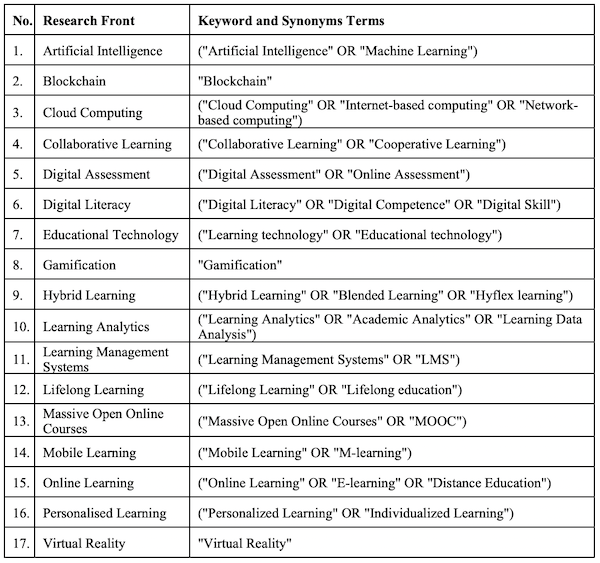
To address the above questions, bibliometric information could be retrieved from various databases, including publications indexed in Google Scholar. However, in this study, the data was derived from Scopus across all publication types (journal articles, conference papers, book chapters, books, etc.) from 2019 to 2023. This was done using 17 high-frequency keywords and their synonyms (as shown in Table 1). The search syntax was defined as follows: TITLE-ABS-KEY ((“synonyms keyword terms”) AND (“higher education”)). This search string was designed to ensure the validity and reliability of the data collection. The results, including all available bibliometric information, were exported in CSV format after a thorough manual check.
Table 1: Research Fronts and Keywords using Synonyms in the Search String
In this paper, we introduce the concept of the Impact Factor (IF), a crucial tool for identifying key research fronts using the Clarivate Analysis CPT approach (Research Fronts, 2017). The CPT indicator, a significant component of this approach, plays a central role in this process. It is defined as the ratio of the average citation impact of a research front to the age/occurrence of its citing papers and is calculated as follows:

where: Pcore is the number of foundational core papers, i.e., the highly cited papers; Pciting represents the number of citing articles, i.e., the total of articles citing the core papers; Tciting indicates the age of citing articles, which is the number of citing years, from the earliest year of a citing paper to the latest one.
In this case, the higher the CPT number, the hotter or the more impactful the topic.
The CPT approach primarily focuses on highly cited papers and their citing articles. To achieve a more comprehensive assessment of impact, it is essential to also consider publication productivity and the diachronic growth rate. Additionally, rather than solely using the age of citing articles, this study evaluated the gap between the average (mean) publication years of core papers and their citing papers. This approach reflects both the extent and immediacy of a research front. Therefore, we introduce a new indicator for the impact factor (IF) of research fronts as follows:

Here, besides the Pcore and Pciting indicators mentioned above, S is the total articles published in the investigated period times, R is the growth rate, and ΔT is the gap between the average (mean) years of the core and citing papers. ΔT is described as:

where Tcore and Tciting are the average (mean) years of the core and citing papers, determined by the time distribution of their publications.
Practically, the normalised impact factor NIF is used in the present and discussion of the obtained results:

where 〖(S×R × P_citing)/(P_core × ΔT)}〗_max is the maximum value of IF.
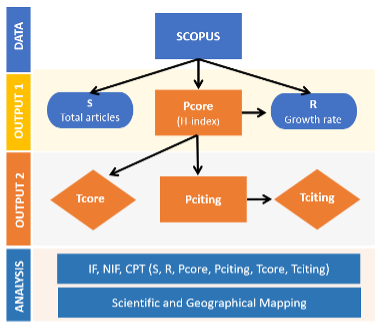
Figure 1 illustrates the search string and analysis process, detailing the different steps involved. At the first output level (Output 1), the annual number of publications relevant to each research trend was identified, and both the total number of publications (S) and the growth rate (R) were calculated (see Table 2). To determine the number of highly-cited core papers (Pcore), articles were ordered in descending order of citations, and the Hirsch score (H-index) (Hirsch, 2005) was computed. The H-index represents both the productivity and impact of a scholar or group, and it is used here to identify Pcore.
At the second output level (Output 2), the average publication years of the core papers (Tcore) were established from the Pcore articles. This step involved calculating the number of citing articles (Pciting), i.e., the total number of articles citing the core papers, and determining the average citation year (Tciting).
The analysis process presented the values of the Impact Factor (IF), Normalised Impact Factor (NIF), and Citation Productivity and Trajectory (CPT) indicators, along with Scientific and Geographical Mapping.
The results are presented below according to the two research objectives:
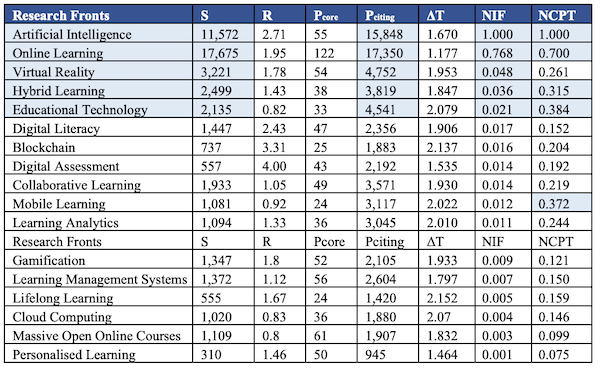
Table 2 presents the results of the data collection for the total (S) number of articles published from 2019 to 2023 for the 17 research fronts mentioned above. The results show that the topics most frequently researched and published were: Online Learning (with a total of 17,675 articles over five years), Artificial Intelligence (11,572 articles), Virtual Reality (3,221), Hybrid Learning (2,499), Educational Technology (2,135), Collaborative Learning (1,933), Learning Management Systems (1,372) and Gamification (1,347), etc.
Table 2: The Total Number of the Publications (S) and the Growth Rate (S), Core Papers (Pcore), Citing Papers (Pciting), Time Gap (ΔT), Normalised NIF and NCPT of Research Fronts
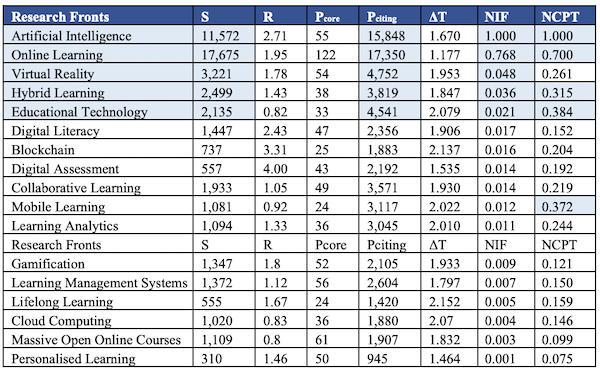
The growth rate (R) of publications over the past five years was estimated using the ratio S(2023)/S(2019). Accordingly, the eight topics with the highest R ratios were: Digital Assessment (R = 4.0), Blockchain (R = 3.31), Artificial Intelligence (R = 2.71), Digital Literacy (R = 2.43, Online Learning (R = 1.95), Gamification (R = 1.80), Virtual Reality (R = 1.78) and Lifelong Learning (R = 1.67). Notably, for the first two research fronts, in 2019, only a few dozen scientific articles were published globally each year but by 2023, the number had risen to several hundred, even surpassing the more than 1,000 articles published annually for the third front. Clearly, Digital Assessment, Blockchain, and Artificial Intelligence were truly emerging research topics in the digital education ecosystem, followed by topics like Digital Literacy, Online Learning, and Gamification.
It was observed that some research fronts have a high number of annual publications and are still quite relevant but, globally, they have almost reached saturation over the past decade. These research topics include Learning Management Systems, Collaborative Learning, Mobile Learning, Cloud Computing, Educational Technology, and Massive Open Online Courses. Even, for the three latter topics, R is smaller than one, e.g., a negative trend was observed.
The gap ΔT between the average years of the core and citing papers ranged from 1.117 to 2.52 years (see Table 2). As already mentioned above, the smaller the ΔT the more immediate response of the citing papers. In this case, it is interesting that the small ΔT corresponds to the high growth rate R for three research fronts: Online Learning (R = 1.85 and ΔT = 1.177), Digital Assessment (R = 4 and ΔT = 1,535), and Artificial Intelligence (R = 2.1 and ΔT = 1.67).
The normalised impact factor (NIF) for each research front was determined using Formula (4) and is listed in Table 2. The five research fronts with the highest IF were: Artificial Intelligence (NIF = 1.0), Online Learning (NIF = 0.768), Virtual Reality (NIF = 0.048), Hybrid Learning (NIF = 0.036), and Educational Technology (NIF = 0.021). It is clearly seen that the IF values were dominated by S and Pciting values. This means that the impactful research fronts were characterised by mass research productivity and a high number of citing papers.
For comparison, the obtained primary research fronts were checked with Formula 1 of the Clarivate Analysis. The findings were normalised and presented, also in Table 3. The five research fronts with the highest NCPT were: Artificial Intelligence (NCPT = 1.0), Online Learning (NCPT = 0.70), Educational Technology (NCPT = 0.384), Mobile Learning (NCPT = 0.372), and Hybrid Learning (NCPT = 0.315). In comparison to the IF indicator, the front of Virtual Reality was out of the top five and, instead, the front of Mobile Learning was presented. Indeed, the front of Mobile Learning exhibited only 1,081 of total publication, and the growth rate was already down (R = 0.92). However, it included 24 of the core papers and 3,117 of the citing papers, so then the ratio of average citing papers Pciting/Pcore was rather high. In any case, the Clarivate Analysis approach pulled the front of the Virtual Reality out of the top five and into the top six only.
Table 3: The Rankings of the IF, S, Pciting and CPT Indicators for Impactful Research Fronts in Digital Education Ecosystem
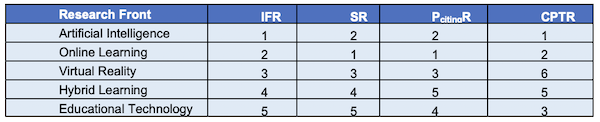
The detailed results regarding the ranking of the Impact Factor (IFR), publication productivity (SR), citing papers (PcitingR), and CPT ranking (CPTR) for the five most impactful research fronts, presented in descending order of IF, are shown in Table 3. According to this approach, the IF ranking was ordered as follows: Artificial Intelligence, Online Learning, Virtual Reality, Hybrid Learning, and Educational Technology. Among them, the top one and two were in excellent alignment with those from CPT ranking. There is an interchange order in the top three to five, however, and all of them were in the top five, except the CPT ranking of the front of Virtual Reality placed in the top six. The alignment between the CPT and IF approaches is acceptable.
Artificial Intelligence
The findings from recent publications reflect an increasing integration of artificial intelligence and machine learning technologies in higher education, with a focus on enhancing personalised learning, improving administrative efficiency, and addressing ethical concerns. The cited studies, each with significant citation counts, underscore the critical and transformative role of artificial intelligence in modern educational settings.
In the realm of personalised learning and adaptive systems, artificial intelligence and machine learning have been increasingly used to create adaptive learning environments in higher education. These systems customise educational content based on individual student needs, leading to improved engagement and outcomes. Regarding AI-powered educational tools, the development and implementation of these tools, such as intelligent tutoring systems, automated essay scoring, and virtual teaching assistants, have significantly enhanced learning processes and provided valuable support for both students and educators (Park & Kim, 2019).
In terms of ethics and bias in artificial intelligence, significant attention has been given to the ethical implications of artificial intelligence in higher education. Research has concentrated on the risks of algorithmic bias, data privacy issues, and the need for transparency and fairness in artificial intelligence applications (Kaur et al., 2022).
Artificial intelligence and machine learning have also been employed in predictive analytics in higher education, particularly to identify at-risk students, predict academic success, and optimise educational pathways. These predictive models help institutions make data-driven decisions to enhance student retention and success. Finally, artificial intelligence has been applied to streamline administrative tasks in universities, such as admissions processing, scheduling, and student advising. AI-driven chatbots and virtual assistants have been widely adopted to improve operational efficiency and student support.
The data listed in Table 4 highlights the countries and institutions with the highest overall publication numbers. The top institutions by affiliated papers were Harvard Medical School (USA) – 102 papers, Ministry of Education (China) – 89, Tecnológico de Monterrey (Mexico) – 80, Sichuan University (China) – 70 and the Chinese Academy of Medical Sciences (China) – 60. The top countries by total number of publications consisted of China – 3,008 papers, USA – 2,060, India – 1,013, UK – 570 and Germany – 471.
Table 4: Top 10 Countries and Institutions’ Publication Productivity in the Research Front “Artificial Intelligence”
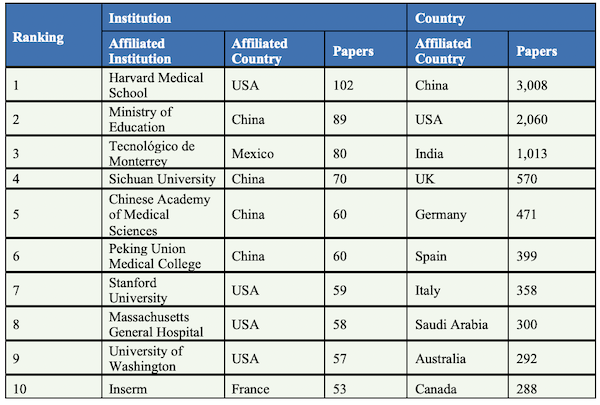
This ranking clearly shows that Harvard Medical School led in the number of papers affiliated with a specific institution, while China ranked as the top country in terms of total publications. India and Germany were also significant contributors to the global academic landscape, with substantial numbers of total publications.
Additionally, the ranking emphasises the leading role of institutions from the USA, China, the UK, and Germany in academic research on AI. Mexico and India were notable for their strong presence, with Mexico represented among the top institutions and India among the top countries.
Concerning contributions from developing countries, five institutions made a significant impact: Tecnológico de Monterrey (Mexico) ranked third, Ministry of Education (China) was second, Sichuan University (China), fourth, and the Chinese Academy of Medical Sciences (China) was tied for fifth with the Peking Union Medical College (China). The presence of institutions from China and Mexico highlights the growing influence of developing countries in global digital education research. These contributions demonstrate how strategic investment in education and research allows developing nations to shape emerging global research trends effectively.
Online Learning
The research front on online learning emphasises the significant role of online learning, e-learning, and distance education in higher education, particularly in response to global disruptions like the Covid-19 pandemic. These studies, which have garnered substantial citations, highlighted both the benefits and challenges associated with these modes of education, underscoring the need for strategic planning and support to maximise their potential (Hodges et al., 2020).
For student engagement and motivation in e-learning, a major area of research focuses on the factors that influence student engagement and motivation in online learning environments. Studies highlight the importance of interaction, instructor presence, and multimedia content in maintaining student interest (Bao, 2020).
Regarding the impact of e-learning on academic performance, several studies have examined how e-learning affects student academic performance. Research indicates that while e-learning can be as effective as traditional classroom instruction, it requires students to possess strong self-regulation and time management skills (Bernard et al., 2014).
Challenges and opportunities in distance education have been analysed with respect to issues like the digital divide, as well as the potential to reach a broader student population. These studies emphasise the need for institutional support and robust digital infrastructure to ensure effective distance learning (Dhawan, 2020).
Research on the adoption of e-learning technologies has investigated the factors influencing the adoption of e-learning technologies in higher education. Critical factors include institutional readiness, faculty training, and student acceptance, all of which are essential for successful implementation (Almazova et al., 2020).
The data listed in Table 5 presents a ranking of countries and institutions based on their contributions to academic publications. It is divided into two main categories: institutions and their affiliated countries, and countries with the highest number of publications. Top institutions by Affiliated Country include: Tecnológico de Monterrey (Mexico) – 175 papers, Bina Nusantara University (Indonesia) – 164, Universiti Teknologi MARA (Malaysia) – 94, University of South Africa (South Africa) – 91, and Universiti Teknologi Malaysia (Malaysia) – 8. Top Countries by Total Number of Publications consist of China – 3,055 papers, USA – 1,825, Russia – 963, Indonesia – 953 and Malaysia – 764.
Table 5: Top 10 Countries and Institutions’ Publication Productivity in the Research Front “Online learning”
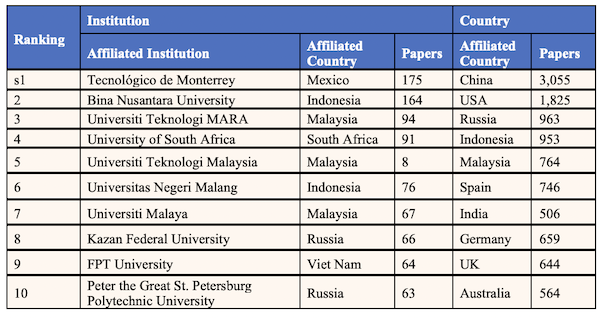
This ranking highlighted the influence of certain institutions and countries in academic research, reflecting the global distribution of scholarly contributions. Notably, while China, the USA, and Russia led in terms of the total number of publications, none of their affiliated institutions appeared in the top five for individual contributions. Conversely, Indonesia and Malaysia were both top contributing countries and home to leading institutions on the list.
Table 5 highlights the strong presence of developing countries in digital education research. Mexico's Tecnológico de Monterrey ranked first, with Indonesia and Malaysia also well-represented by multiple institutions, such as Bina Nusantara University (second) and Universiti Teknologi MARA (third). The University of South Africa and Vietnam's FPT University also featured prominently. These contributions underscore the growing influence of developing nations in shaping global digital education research, fueled by strategic investments in education and research infrastructure.
Virtual Reality
The research also underscores the transformative potential of Virtual Reality (VR) in higher education. The studies highlighted VR's effectiveness in enhancing learning outcomes, boosting student engagement, and providing immersive educational experiences. However, challenges such as high costs and implementation barriers must be addressed to fully harness VR's capabilities in educational settings.
Research studies have explored various applications of VR in higher education, including immersive simulations for complex subjects, virtual laboratories, and interactive learning environments. These applications have demonstrated potential in improving student engagement and comprehension (Radianti et al., 2020). The impact of VR on learning outcomes has been examined, with findings showing that VR enhanced students' understanding and retention of complex concepts through experiential learning (Hamilton et al., 2021).
Challenges associated with implementing VR in higher education, such as high costs, technical difficulties, and the need for adequate training, have been addressed. Overcoming these barriers is crucial to fully realising VR's educational potential. Additionally, VR's role in increasing student engagement and motivation has been a key focus. Research indicates that VR can create immersive and interactive experiences that enhance student involvement and interest in learning activities (Merchant et al., 2014). Moreover, VR has been investigated for developing specific skills, such as in medical training, engineering simulations, and soft skills development, offering a safe and controlled environment for skill enhancement (Kamińska, 2019).
Table 6 presents a ranking of institutions based on the number of affiliated papers, along with the countries with the highest total number of publications. For this research front, Tecnológico de Monterrey in Mexico led with 60 affiliated papers, while the University of Toronto in Canada and Universidad Católica de Ávila in Spain had the fewest, with 15 affiliated papers each. China dominated with the highest total number of publications at 654. The University of Illinois Urbana-Champaign and Texas A&M University, both based in the USA, showed strong individual contributions with 18 papers each, and the USA overall had 590 publications. Hong Kong Polytechnic University and the University of Hong Kong also contributed significantly, reflecting Hong Kong's influence in the academic landscape. The UK's and Spain's contributions were notable, with 182 and 165 papers, respectively, while Germany rounded out the list with 155 papers.
Table 6: Top 10 Countries and Institutions’ Publication Productivity in the Research Front “Virtual Reality”
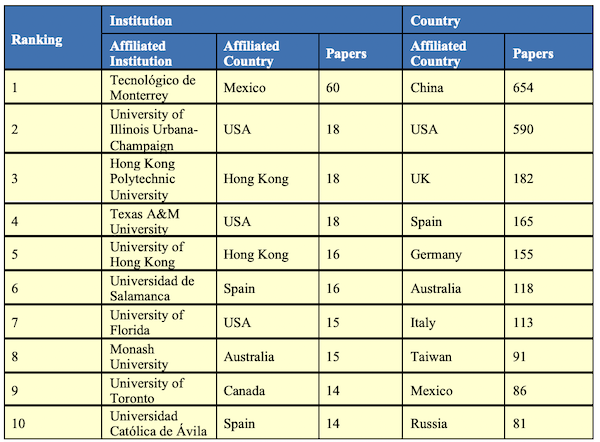
Note that, for this high-technology field, the table highlights a relatively modest presence of developing countries among the listed research affiliations, with Mexico's Tecnológico de Monterrey being the only developing country institution in the top 10 (ranked first). Most other institutions were from developed nations or regions, such as the USA, Hong Kong, Spain, and Australia. Mexico’s top ranking underscores its increasing impact on global research. However, the overall table suggests that developing countries still had significant room for growth in contributing to global digital education research compared to their developed counterparts.
Hybrid Learning
The growing role of hybrid, blended, and hyflex learning models in higher education was clearly demonstrated. Studies on the effectiveness of these models revealed that combining face-to-face instruction with online components can enhance learning outcomes, flexibility, and student satisfaction (Graham et al., 2013). Research into student perceptions of blended learning environments indicated that while students value the flexibility and accessibility offered, they may encounter challenges related to technology use and balancing online with in-person components (Garrison & Vaughan, 2008).
Regarding the challenges and best practices in hyflex learning, research has highlighted issues such as the need for advanced technology and the complexities of managing various learning modalities simultaneously. Best practices for effectively implementing hyflex learning environments have also been identified (Keshavarz, 2023). Additionally, studies assessing the impact of blended learning on student achievement showed that well-designed blended learning environments can lead to improved academic performance compared to traditional methods (Prihatmojo et al., 2021).
Furthermore, research has focused on the adoption and implementation of hybrid learning models in higher education, identifying critical factors for successful integration, such as faculty training, institutional support, and robust technology infrastructure.
Table 7 presents the top 10 countries and institutions contributing to publication productivity in the research front of "Hybrid Learning." The data includes both specific institutions with their affiliated countries and the overall publication output by country.
Table 7: Top 10 Countries and Institutions’ Publication Productivity in the Research Front “Hybrid Learning”
The top five institutions by affiliated papers can be summarised as follows: Universidad de Salamanca (Indonesia) – 22 papers, Universitas Negeri Malang (Indonesia) – 22, Universiti Teknologi MARA (Malaysia) – 20, Norwegian University of Science and Technology (Norway) – 20 and Central China Normal University (China) –18. The top five countries by total number of publications were China – 301 papers, Indonesia – 174, USA – 170, UK – 157 and Russia – 143.
While the USA, UK, and Russia were key contributors to global research on hybrid learning, as reflected in their national publication numbers, none of their affiliated institutions appeared in the top institution rankings. Table 7 illustrates the diverse geographic contributions to hybrid learning research, with significant outputs from Asia, Europe, and North America. In particular, Table 7 highlights strong contributions, with seven of the top 10 institutions hailing from developing nations. Indonesia, with Universitas Negeri Malang and Bina Nusantara University, and Malaysia, with Universiti Teknologi MARA and Universiti Malaya, played prominent roles. Mexico's Tecnológico de Monterrey and China's Central China Normal University also demonstrated significant impact. These contributions reflect the growing influence of developing nations in global digital education research, though there remains room for further growth.
Educational Technology
Studies on the integration of educational technology in higher education have focused on strategies and frameworks for successful adoption. Key factors identified included institutional support, faculty training, and technology infrastructure. The significant impact of learning and educational technology in higher education was highlighted by research demonstrating how learning technology enhanced student engagement. Various technological tools made learning more interactive and engaging, thereby improving student participation and motivation (Bedenlier et al., 2020).
The effectiveness of e-learning tools and platforms has also been assessed, with findings indicating that well-designed e-learning tools can enhance learning experiences and outcomes by providing interactive and flexible learning options. Research on technological innovations and their impact on learning outcomes supported the positive effects of these innovations on student performance and learning efficiency.
However, challenges in implementing learning technologies remain, including resistance to change, lack of resources, and insufficient training. Strategies for overcoming these challenges have also been discussed (Alamri et al., 2021).
Table 8 highlights the top 10 countries and institutions contributing to publication productivity in the research front of "Educational Technology." This table underscores the significant global engagement in educational technology research, with notable contributions from institutions in Russia and Australia. North-Caucasus Federal University and Kazan Federal University, both from Russia, stand out as key contributors, while Monash University and The University of Queensland, both based in Australia, emphasise Australia's strong presence in this field. At the country level, China and the USA dominated in publication output. Tecnológico de Monterrey (listed under Mexico in this table) leads among institutions with 30 papers, marking its fourth appearance in the research front rankings, demonstrating a significant contribution to the field.
Table 8: Top 10 Countries and Institutions’ Publication Productivity in the Research Front “Educational Technology”
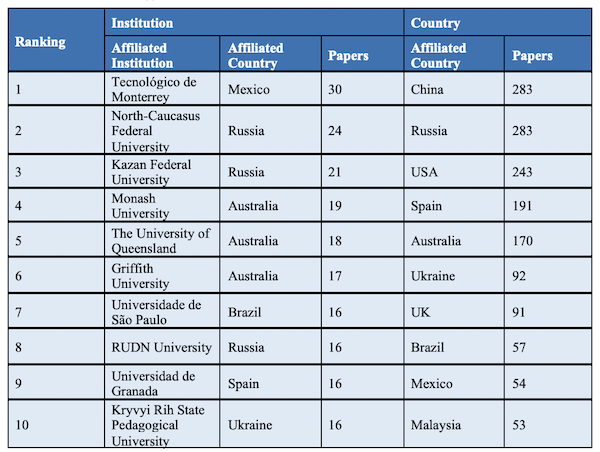
The data in the table reveals the strong presence of institutions from developing countries contributing to global digital education research. Mexico's Tecnológico de Monterrey ranks first with 30 papers, demonstrating Mexico’s significant impact. Brazil's Universidade de São Paulo ranks seventh with 16 papers, showcasing Latin America's growing involvement. Additionally, Russia features prominently with three institutions in the top 10, further reflecting the influence of developing countries in this field. While developed nations such as Australia, Spain, and the USA are also present, the representation of Mexico, Brazil, and Russia underscore the important role of developing countries in shaping digital education research globally. These nations are increasingly contributing to international academic discourse, though there is still room to expand their influence in this rapidly evolving area.
This study provides valuable insights into the digital education ecosystem by identifying key research fronts and the global distribution of research activities. By applying bibliometric methods and introducing a new Impact Factor (IF) approach, this research mapped the evolving digital education landscape from 2019 to 2023, highlighting key areas such as artificial intelligence, online learning, virtual reality, hybrid learning, and educational technology. The study also pinpointed the organisations and countries driving these trends.
The implications are significant, especially for developing countries:
In conclusion, this research provides practical insights for developing countries to drive innovation, expand access, and promote equity in their education systems by leveraging global digital education trends.
Finally, in the next decade, research in the digital education ecosystem is expected to transform significantly, influenced by technological advancements and shifting societal demands. Researchers, particularly from developing countries, should prioritise areas that address these changes. For example, artificial intelligence offers immense potential to create personalised and adaptive learning environments tailored to the unique needs of students, enhancing both engagement and learning outcomes. Similarly, the integration of immersive technologies like virtual reality and augmented reality could revolutionise online learning by making it more interactive and accessible, especially for complex or hands-on subjects. Hybrid learning models, which combine traditional teaching with digital tools, will be essential for developing inclusive and flexible education systems that cater to diverse learning preferences and contexts. Blockchain technology also holds promise for transforming academic credentialing and record-keeping, providing secure and transparent systems that foster trust and facilitate global recognition of qualifications. Additionally, enhancing digital literacy for both educators and students remains a critical research area, as it ensures readiness to navigate the demands of a technology-driven world.
Alamri, H.A., Watson, S., & Watson, W. (2021). Learning technology models that support personalization within blended learning environments in higher education. TechTrends, 65(1), 62-78. https://doi.org/10.1007/s11528-020-00530-3
Almazova, N., Krylova, E., Rubtsova, A., & Odinokaya, M. (2020). Challenges and opportunities for Russian higher education amid Covid-19: Teachers’ perspective. Education and Information Technologies, 25, 703-721. https://doi.org/10.3390/educsci10120368
Bao, W. (2020). Covid-19 and online teaching in higher education: A case study of Peking University. Human Behavior and Emerging Technologies, 2(2), 113-115. https://doi.org/10.1002/hbe2.191
Bedenlier, S., Bond, M., Buntins, K., Zawacki-Richter, O., & Kerres, M. (2020). Facilitating student engagement through educational technology in higher education: A systematic review in the field of arts and humanities. Australasian Journal of Educational Technology, 36(4), 126-150. https://doi.org/10.14742/ajet.5477
Bernard, R.M., Borokhovski, E., Schmid, R.F., Tamim, R.M., & Abrami, P.C. (2014). A meta-analysis of blended learning and technology use in higher education: From the general to the applied. Journal of Computing in Higher Education, 26, 87-122. https://doi.org/10.1007/s12528-013-9077-3
Chinchua, S., Kantathanawat, T., & Tuntiwongwanich, S. (2022). Increasing programming self-efficacy (PSE) through a problem-based gamification digital learning ecosystem (DLE) model. Journal of Higher Education Theory and Practice, 22(9), 131-143. https://doi.org/10.33423/jhetp.v22i9.5370
Dhawan, S. (2020). Online learning: A panacea in the time of Covid-19 crisis. Journal of Educational Technology Systems, 49(1), 5-22. https://doi.org/10.1177/0047239520934018
Donthu, N., Kumar, S., Mukherjee, D., Pandey, N., & Lim, W.M. (2021). How to conduct a bibliometric analysis: An overview and guidelines. Journal of Business Research, 133, 285-296. https://doi.org/10.1016/j.jbusres.2021.04.070
Ellegaard, O., & Wallin, J.A. (2015). The bibliometric analysis of scholarly production: How great is the impact? Scientometrics, 105, 1809-1831. https://doi.org/10.1007/s11192-015-1645-z
Garrison, D.R. & Vaughan, N.D. (2008). Blended learning in higher education: Framework, principles, and guidelines. Jossey-Bass. https://doi.org/10.1002/9781118269558
Graham, C.R., Woodfield, W., & Harrison, J.B. (2013). A framework for institutional adoption and implementation of blended learning in higher education. The Internet and Higher Education, 18, 4-14. https://doi.org/10.1016/j.iheduc.2012.09.003
Hamilton, D., McKechnie, J., Edgerton, E., & Wilson, C. (2021). Immersive virtual reality as a pedagogical tool in education: A systematic literature review of quantitative learning outcomes and experimental design. Journal of Computers in Education, 8(1), 1-32. https://doi.org/10.1007/s40692-020-00169-2
Hirsch, J.E. (2005). An index to quantify an individual's scientific research output. Proceedings of the National Academy of Sciences, 102(46), 16569-16572. https://doi.org/10.1073/pnas.0507655102
Hodges, C., Moore, S., Lockee, B., Trust, T., & Bond, A. (2020). The difference between emergency remote teaching and online learning. Virginia Tech. https://bit.ly/3PNT9t2
Kamińska, D., Sapiński, T., Wiak, S., Tikk, T., Haamer, R.E., Avots, E., ... & Anbarjafari, G. (2019). Virtual reality and its applications in education: Survey. Information, 10(10), 318. https://doi.org/10.3390/info10100318
Kaur, D., Uslu, S., Rittichier, K.J., & Durresi, A. (2022). Trustworthy artificial intelligence: A review. ACM Computing Surveys (CSUR), 55(2), 1-38. https://doi.org/10.1145/3491209
Keshavarz, M. (2023). Hybrid-flexible course design: Implementing student-directed hybrid classes. Quarterly Review of Distance Education, 24(1), 83. https://bit.ly/40zzRN0
Kummanee, J., Nilsook, P., & Wannapiroon, P. (2020). Digital learning ecosystem involving STEAM gamification for a vocational innovator. International Journal of Information and Education Technology, 10(7), 533-539. https://doi.org/10.18178/ijiet.2020.10.7.1420
Merchant, Z., Goetz, E.T., Cifuentes, L., Keeney-Kennicutt, W., & Davis, T.J. (2014). Effectiveness of virtual reality-based instruction on students' learning outcomes in K-12 and higher education: A meta-analysis. Computers & Education, 70, 29-40. https://doi.org/10.1016/j.compedu.2013.07.033
Nguyen, L.T., & Tuamsuk, K. (2022). Digital learning ecosystem at educational institutions: A content analysis of scholarly discourse. Cogent Education, 9(1), Article 2111033. https://doi.org/10.1080/2331186X.2022.2111033
Prihatmojo, A., Suprapto, I., & Munisah, E. (2023). Blended project-based learning (BPjBL) on students’ achievement: A meta-analysis study. International Journal of Instruction, 16(3). 1114-1126. https://doi.org/10.29333/iji.2023.16359a
Radianti, J., Majchrzak, T.A., Fromm, J., & Wohlgenannt, I. (2020). A systematic review of immersive virtual reality applications for higher education: Design elements, lessons learned, and research agenda. Computers & Education, 147, 103778. https://doi.org/10.1016/j.compedu.2019.103778
Research Fronts. (2017, June 30). Research fronts: 2016. Institutes of Science and Development, Chinese Academy of Sciences. Clarivate Analytics. http://www.casisd.cn/zkcg/zxcg/201706/P020170630548078477885.pdf
Rojas-Sánchez, M.A., Palos-Sánchez, P.R., & Folgado-Fernández, J.A. (2023). Systematic literature review and bibliometric analysis on virtual reality and education. Education and Information Technologies, 28(1), 155-192. https://doi.org/10.1007/s10639-022-11167-5
Tan, Y. (2024). A bibliometric analysis of scholarly literature related to digital literacy in higher education during the pandemic period. Cogent Education, 11(1), Article 2341587. https://doi.org/10.1080/2331186X.2024.2341587
Wang, G., He, J. (2022). A bibliometric analysis on research trends of digital literacy in higher education from 2012 to 2021. International Journal of Emerging Technologies in Learning (iJET), 17(16), 43-58. https://doi.org/10.3991/ijet.v17i16.31377
Author Notes
Tran Ai Cam is the President of Nguyen Tat Thanh University in Vietnam, with over 26 years of experience in higher education. She supervises postgraduate students and leads research in areas such as Management, Leadership, Quality Assurance, and Digital Transformation, with a particular focus on University Governance, Innovation, Human Resource Management, and Digital Education. Dr. Tran has authored more than 30 book chapters and articles published in reputable journals. Additionally, she has been instrumental in successfully implementing the Entrepreneurial University model in Vietnam. Email: tacam@ntt.edu.com (https://orcid.org/0009-0006-7411-4280)
Nguyen Huu Thanh Chung holds a PhD in Science and Technology Management from VNU University of Social Sciences and Humanities. His research focuses on ranking, rating, and benchmarking in higher education. Currently, he is developing 4.0 Entrepreneurial University models, which emphasise entrepreneurship, innovation, digital transformation, individualised learning, and sustainable development. In this capacity, he has been actively involved in managing the University Performance Metrics (UPM) rating system. Email: chungnht@vnu.edu.vn (https://orcid.org/0000-0001-5952-7710)
Cite as: Cam, T.A., & Chung, N.H.T. (2025). Exploring impactful research fronts of the digital educational ecosystem: A bibliometric analysis. Journal of Learning for Development, 12(1), 107-124.