Stella Hadjistassou, Shaunna Joannidou, Pedro J. Molina Muñoz, Petros Louca, and Georgios Ellinas
2026 VOL. 13, No. 1
Abstract: Within the trajectories of design-based research (DBR) and multimodal theory, this study captures the iterative processes undertaken to design, develop, and deploy game-based Augmented Reality (AR) applications for learning, exploration, and collaboration within higher education settings. Three game-based scenarios were designed set in a prehistoric Neolithic site, Choirokoitia, in the Mediterranean region. The study investigated the pedagogical and technological affordances, complexities, and contradictions that our interdisciplinary team experienced during these iterative processes. Using a multimodal perspective and drawing on Klopfer and Squire’s (2008) framework, we delineated six phases, from aligning the AR scenario design with European project requirements and creating multimodal contexts, to identifying future research directions. The results demonstrate the intricacies and iterative processes utilised in harnessing multiple software and hardware resources for the conception and realisation of AR embedded within culturally and historically rooted contexts that enact affordances for exploration and collaboration. These endeavours were underpinned by pedagogical imperatives that focus on task-oriented activities.
Keywords: augmented reality, design-based research, multimodality
In higher education (HE), multiple scholars have explored the role of augmented reality (AR) in enriching user experiences and facilitating interaction with diverse semiotic resources, including 3D artefacts and environments. A major challenge for educators lies not only in the “ability to adapt the affordances and constraints of tools to particular circumstances” (Jones & Hafner, 2012, p. 13), but also in developing tools that leverage available modalities. In many cases, teachers do not have the technical expertise, resources, infrastructure, support, or time to design different tools to meet their pedagogical needs. Farmer and Gruba (2007) postulate that software design often adheres to nonstandard development approaches, limited organisational structure, and documentation. Educators often select, adapt, and deploy tools from a broad repertoire of novel technologies. Zhang and Zou (2020) classify the technologies into five categories: “technologies for mobile learning, multimedia learning and socialisation, speech-to-text and text-to-speech recognition, and digital-game-based learning” (p. 696). The latter has received considerable attention, with scholars delving into the added value, principles, strategies, semiotic resources, and modalities that galvanise learning experiences, skill development, interaction, collaboration, and competition (Gee, 2003). With the rising popularity of virtual environments (VR), focus was placed on game-based activities, before shifting attention to the development and deployment of game-based activities using AR (Hellermann, et al., 2017; Hadjistassou & Molka-Danielsen, 2016; Hadjistassou, et al., 2021). Accessibility to mobile devices and advanced software facilitates the design of demanding, entertaining, and rewarding experiences. In HE, interdisciplinary teams deploy AR to design pedagogically driven interventions (Hadjistassou et al., 2021).
Several studies have examined the role of design-based research (DBR) in capturing the iterative development of game-based experiences (Klopfer & Squire, 2008). This article employs DBR and adopts a multimodal perspective to investigate the complex iterative processes inherent in the design and deployment of AR applications for foreign language learning. Building on Klopfer and Squire’s (2008) framework, the study utilised a design narrative to document the bottom-up processes involved in developing AR applications for the Neolithic site of Choirokoitia in Cyprus. The AR scenarios integrate game-based activities enriched with AR to introduce students to the practices and customs of Choirokoitians. The study aimed to explore the processes by which an interdisciplinary team of practitioners harnessed various technologies and multimodal resources to develop AR game-based scenarios on Choirokoitia. The study accomplished two things; it (1) applied a multimodal lens to investigate the design, development, and deployment of AR task-driven scenarios for language learning; and (2) examined the pedagogical implications of the AR scenarios. It also examined the collaborative nature of these processes, capturing the participatory dynamics as stakeholders contributed to developing and refining AR scenarios. It began with the brainstorming stage and progressed through the six stages involved in developing and deploying the AR scenarios.
DBR offers a framework to investigate the multifaceted processes involved in developing novel technological solutions for learning, interaction, collaboration, and gaming. DBR delves into both the theoretical and practical trajectories driving technological solutions (Kelly, 2003; Tinoca et al., 2022). As Anderson and Shattuck (2012) postulate, DBR “evolved near the beginning of the 21st century and was heralded as a practical research methodology that could effectively bridge the chasm between research and practice in formal education” (p. 16). DBR offers a path to investigate the nonlinear design and development processes through various theoretical, methodological, and social lenses. Its scope is not limited to interventions that emerge through the deployment of newly designed artefacts to mediate learning but also extends to examine the synergy, contradictions, and challenges generated as theory, cultural artefacts, and practice form an integral component of the design and development processes. Collins et al. (2004) note that “design experiments bring together two critical pieces in order to guide us to better educational refinement: a design focus and assessment of critical design elements” (p. 21).
DBR studies may range from case studies to large-scale studies informed by quantitative measures of analysis. They draw on distinctive epistemic features such as theoretical trajectories, institutionally situated contexts, artefacts, and iterative design processes, which are embedded in experimental approaches to enrich educational practices. Anderson and Shattuck (2012) identify several defining features of DBR, including: (a) enactment in situated educational contexts; (b) design and implementation of interventions; (c) employment of mixed methods; (d) use of iterative procedures; (e) collaboration among teachers and researchers; and (f) emergence of design principles. However, these principles capture both the affordances and complexities experienced in DBR. As Barab and Squire (2004) note, “One of the challenging components of doing educational research on design-based interventions is designed to characterise the complexity, fragility, messiness, and eventual solidity of the design and doing so in a way that will be valuable to others” (p. 4). Multiple studies have been conducted using DBR, ranging from STEM to information communication technologies for education and foreign language learning (Anderson & Shattuck, 2012; Tinoca et al. 2022). Zheng (2015) demonstrates that in most DBR studies scholars “tested technological intervention through designing, developing, implementing, and revising particular technological tools” (p. 409).
Recently, Ticona et al. (2022) noted that studies using DBR focus primarily on “virtual reality environments, mobile learning, educational robotics, online teaching, and digital storytelling” (p. 6). Earlier studies focused on the design of game-oriented activities combining real-world and virtual simulations to explore an environmental disaster and its implications (Klopfer et al., 2002). Some studies have also examined AR and game-based learning. Klopfer and Squire (2008), for example, rely on design narrative to examine the underlying processes involved in designing an AR game, Environmental Detectives. Hadjistassou et al. (2021) examined the development of game-based activities to promote cultural heritage, learning, and intercultural exchanges in Sweden and Cyprus. These studies indicate the multimodal nature of AR development and deployment for learning and meaning making in cultural contexts.
Multimodality explores the different modes, including images, audio, and oral and written communication (Kress, 2010). Modes refer to the semiotic resources that generate new meaning and are informed and moulded by cultural and social practices and values (Bezemer & Jewitt, 2010). Kress (2010) defines a mode as “a socially shaped and culturally given semiotic resource for making meaning” (p. 79). For instance, by leveraging various tools for second and foreign learning, affordances can be enacted for delivering content through multiple modes, including written and visual content. Multimodality encompasses “the cultural technologies of representation… still and dynamic images, 3D objects, colours, writing, speeches, layouts, music, etc.” (Culache & Obadă, 2014). Multimodality extends beyond written communication and learning. Hampel and Hauck (2006) argue that meaning making needs to include “notions of design, authorship, and dissemination, and the increasing importance of modes other than writing in virtual language learning spaces, which contribute to an enhanced understanding of the phenomenon of new literacies” (p. 3).
New technologies present new trajectories for meaning making by offering multiple innovative modes where their use in different contexts facilitates an “orchestration of meaning” (Kress et al., 2001). Advancement and accessibility to new technologies enhance the capacity to enact and transmit new forms of communication. Different modes enact different affordances for meaning making in various situations, such as in educational contexts where pedagogical choices and decisions can generate distinctive pedagogical implications (Airey & Erikson, 2019). Moreover, instructors can harness these tools to utilise multiple modes embedded in pedagogical affordances, engaging learners in new meaning-making activities. For instance, practitioners can utilise AR and deploy multiple modes, including oral and written texts, dialogue, augmented and physical representations, and interactions between avatars and artefacts, to facilitate engaging learning experiences. AR facilitates interactions with peers, avatars, content, virtual and physical artefacts (Kiyokawa et al., 2000). AR game-based scenarios enact affordances for distributed learning, task-driven problem-solving, and collaborative interactions with semiotic resources, critical thinking, and action-taking embedded in socially and culturally driven processes.
The design of AR applications often adheres to a top-down approach, where instructors and students are trained on various applications rather than participating in their design process (Lasica et al., 2020). Tobar-Muñoz et al. (2023) identify a gap in AR experiences, particularly evident across three levels: (i) between developers, who strive to enrich classrooms with AR; (ii) teachers who are not fully immersed in the added value of these experiences; and (iii) students, as end-users of these technologies. In some HE contexts, instructors lead the development of AR activities by employing different authoring tools (Hellermann et al., 2017; Sydorenko et al., 2021). In other cases, instructors participate in the design of AR applications (Cuendet et al., 2013; Hadjistassou et al., 2021; Tobar-Muñoz et al., 2023). DBR relies on a collaborative framework, where practitioners negotiate “the study from initial problem identification, through a literature review, to intervention design and construction, implementation, assessment, and to the creation and publication of theoretical and design principles” (Anderson & Shattuck, 2012, p. 17).
This study was part of a three-year transnationally funded project, the Digital Methods Platform for Arts and Humanities (DiMPAH), which focused on developing Open Educational Resources (OERs) to promote digital heritage, novel technologies, and innovative pathways to learning. An interdisciplinary research team based at a university in the Mediterranean region led the design of AR applications and scenarios centred on Sanby Borg in Sweden and Choirokoitia in Cyprus. This study specifically focused on the AR game-based scenarios developed for Choirokoitia. Throughout the six-phase iterative design process, pedagogical and technological affordances and contradictions were encountered, which shaped the iterative design process.
Integrating a multimodal lens into DBR facilitates an examination of iterative processes and semiotic resources in AR design, demonstrating the affordances and contradictions faced by an interdisciplinary team developing game-based learning. The study addresses the following research questions:
RQ1. How did an iterative design-based research approach shape the conception, development, and enactment of a game-based AR application for heritage learning in higher education?
RQ2. What pedagogical and technological affordances, tensions, and design principles emerged through the iterative development of the AR scenarios?
Building on Klopfer and Squire (2008), a design narrative was employed where the multimodal nature of AR environments guided the investigation of iterative DBR processes. Klopfer and Squire (2008) introduced a seven-stage design narrative to capture the AR iterative design processes: (a) brainstorming, (b) designing a user scenario, (c) developing a prototype, (d) conducting field trials, (e) implementing the scenarios in classroom contexts, (f) expanding to additional contexts, and (g) customising the game. This study examined how an interdisciplinary research team utilised the diverse modalities afforded by AR. The design narrative captures the multiple iterations needed to design and refine AR scenarios, including the deployment of game-based engines and other software for scenario development, and the iterative changes throughout the process. This approach facilitates close observation and monitoring of the evolving dynamics and processes involved in AR development and deployment, as well as their implications for learning.
Two instructors, a researcher, and a software developer met almost weekly over two years to design, develop, and implement the AR scenarios. Discussions focused on multimodal semiotic resources, Unity’s affordances and limitations, other design software, and the hardware available to students and instructors. The research team visited the Choirokoitia site to collect 360° videos and identify potential AR game-based scenarios. After developing the AR activities, pilot testing was conducted in the summer of 2022 with a group of 25 graduate researchers from various fields, including electrical and computer engineering. Feedback from written evaluations informed further refinements.
Consistent with DBR tenets (Klopfer & Squire, 2008), the iterative design process served as the primary instrument for data collection and analysis. Data were generated through various instruments including virtual monthly meetings, written exchanges, cloud-based platforms, and a structured survey capturing usability, engagement, and task performance. Field notes and collaborative decision-making, technical challenges, and multimodal interactions complemented the survey data. Quantitative responses were summarised descriptively, while qualitative data from discussions, documents, and field notes were analysed thematically to reveal emerging pedagogical and technological insights that shaped the AR design and deployment.
This section presents the iterative nature of the Choirokoitia AR game-based design, development, and deployment, rather than simply explicating the framework. Building on Klopfer and Squire’s (2008) approach, it examines the underlying path through which the DBR framework shaped the AR application’s conception and enactment (RQ1), and identifies pedagogical and technological affordances, tensions, and emerging design principles (RQ2), demonstrating both the implementation and processes involved.
Phases one to three address RQ1, tracing the early design trajectory, establishing the foundations for the iterative refinements that follow, while progressively surfacing pedagogical and technological affordances and tensions relevant to RQ2. During brainstorming meetings, we focused on the following areas: (a) alignment of scenarios with the development of heritage environments to leverage the semiotic resources and modes of AR technologies to create meaning-making activities and interactions (van Lier, 2000); (b) the role of game-based scenarios in exploring the heritage sites and modal affordances; (c) the software available for AR development, including its affordances and limitations; (d) task-oriented activities for creating new meaning; (e) multimodal value and interaction of the AR modes, including images, 3D artefacts, 360° videos, narratives, text, and CGI avatars; (f) deployment of mobile devices to experience the sites and multimodal content; and (g) students’ interest and motivation. Our goal was to design scenarios that engage learners in meaning-making activities by leveraging the semiotic resources of the AR environment (Satar et al., 2023; van Lier, 2000).
Choirokoitia was selected for its cultural significance, values, and rituals, learners’ shared affinity, cultural artefacts, lifestyle, and distinctive architecture. Unity and C# were used for AR development. Simultaneous localisation and mapping (SLAM) was utilised for creating point clouds, environment scanning and detection process, and mapping out the environment, enabling seamless navigation and task completion. We explored blending 360° content with the physical environment. We also brainstormed multiple game-based activities and tasks to make these experiences immersive and engaging. Specific attention was paid to the emerging modal affordances during the design of:
For the deployment of different software programmes, we brainstormed a set of goals and pedagogical values to meet learners’ needs while engaging them in novel and interactive learning experiences. Hypothetical scenarios were introduced, such as the burial rituals of that era and possible paths to situate them within a mystery. Finally, we discussed students’ access to hardware, such as mobile phones, their everyday use practices or “cultures-of-use,” and familiarity with AR technologies (Thorne, 2003).
In the ideation phase, we set three goals: (a) to design AR scenarios blending imaginative themes with Choirokoitians’ lifestyle, practices, and rituals; (b) to add a mysterious element for engagement; and (c) to include task-based activities. Choirokoitia is part of the high school curriculum, so many students were already familiar with its cultural significance. The site and country’s geographic location were integrated into the introductory scene. The goal was to leverage semiotic resources and interactional and modal possibilities in the game-based scenario to support learning. Using a prerecorded message, the introductory scene aimed to engage learners with Choirokoitia. Non-Player Characters (NPCs) resembling young inhabitants were customised to enrich the scenarios.
We decided that the various modes deployed—such as images, 3D artefacts, avatars, and audio, and written content—would act as conduits for students to enact and experience their modes of learning within the realm of multimodal ensembles and symbolic tools (Philippe et al., 2020; Gee, 2003). Site exploration through 360° images and 3D content was designed as a navigational path through the village, circular homes, and artefact interactions linked to task-driven activities. We anticipated that most local high school students had already visited Choirokoitia, either during a school excursion or through personal exploration.
Our goal was to create game-oriented tasks with solid pedagogical foundations, aligned to curricula, focusing on the mystery of Choirokoitia’s abandonment, circular homes, gender roles, rituals, and practices. During activity development, we ensured that the artefacts and modes offered students with meaningful interactions.
We decided that collecting artefacts specific to the excavation site as rewards could benefit students and support activity completion, while carefully selecting the artefacts. We debated whether to also use the name of the artefacts in Greek as a route to promote cultural affinity and understanding of the historical value of these 3D cultural artefacts. Further, the instrumental areas that we discussed were the technical considerations, and the “cultures-of-use” (Thorne, 2003) of this form of communication and students’ expectations in realising these interactions.
The affordances and limitations of Unity and assets store were assessed in realising these AR activities. Students’ access to wi-fi and Android devices with the requisite technical specifications, and limited experience with AR in formal learning contexts, were also considered. Further training was imperative for the AR-mediated activities. These considerations had further implications, for instance, in developing guidelines for the technical specifications and steps required for downloading and accessing the scenarios, keeping each activity under 10 minutes for better student engagement and minimising mobile device overheating.
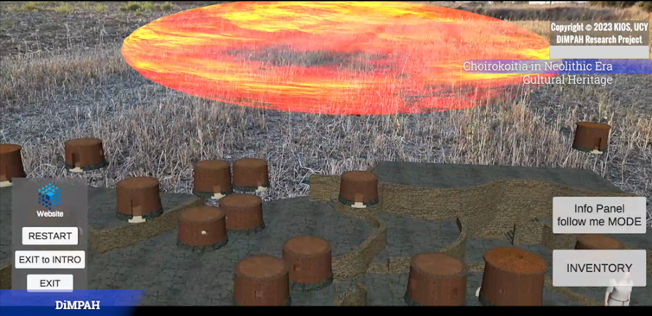
We utilised Unity’s 3D game engine and AR software development kit (SDK) to develop task-based activities for Android devices using the latest API version. A refined Sketchfab 3D model of Choirokoitia was integrated into Unity (see Figure 1). Custom avatars featured dynamic clothing, lip-synching blendshapes, and expressive animations. Additional 3D elements—including circular homes, a stone vessel, mudbricks, and wood—were created or refined in Maya before integration into Unity. Motion capture and keyframe techniques were used for animation, and audio elements were curated to enhance immersion. Activities were designed to last under 10 minutes to maintain engagement and prevent device overheating.
Introductory scene: A 360° skybox of Choirokoitia, including replicas of circular structures, was rendered in Unity. A World Atlas and a 2D map of Cyprus were added, with markers pinpointing key Neolithic sites. Raycasting measured students’ device proximity to virtual objects, providing immediate feedback: green markers for correct and red for incorrect selections. A female avatar narrated Choirokoitia’s historical significance, appearing to hold and rotate a circular home using Unity’s transform component for 360° y-axis rotation. Text overlays and virtual arrows enriched the blended physical and 3D environment, serving as interactive UI elements. The scene concluded with a quiz displaying a map of Cyprus, prompting learners to locate Choirokoitia.
First scenario: First Circular home—A programmable teleport function enabled the female avatar to teleport to the 3D Choirokoitia site. A dynamic inventory system linked to interactive objects and construction materials allowed students to build a circular structure. False clues prompted investigation of historically accurate materials. The activity helped students identify the components of a circular structure. Six 3D objects—including stones, wood, and reeds – and two inaccurate ones, were designed to enhance material recognition. The inventory system offered real-time feedback, ensuring smooth progression and preparation for subsequent tasks.
Second scenario: Lost girl—Three female and several male models were imported, representing Choirokoitia residents’ roles. Each object and avatar was equipped with collision objects. Animation layers were used to control animation sequences and manage entry and exit timings. To enhance immersion, audio Clotho—a young female character searching for her mother and crying—was integrated into the scene and dynamically triggered using C# and synchronisation. Text overlays and instructions were added to encourage students to participate in Clotho’s quest.
Third scenario: Lighting a fire—3D objects including flint stone, pyrite, and fungus were imported into the scene. Scripts enabled their interaction and inclusion in the inventory system, and allowed tapping and clicking for object collection. A 3D fire base camp was imported. Students were tasked with selecting and arranging the required 3D objects in their inventory to ignite a fire. This activity aimed to immerse students in the practical skills and routines essential to life in Choirokoitia during ancient times, adopting a Role-Playing Game (RPG) perspective.
Phases four to six focused on deployment and evaluation, addressing RQ2 by identifying the pedagogical and technological affordances, tensions, and emerging design principles that arose through testing, deployment, and refinement. In Phase Four, we initiated pilot testing of the AR scenarios to assess user interface effectiveness, system stability and performance, usability, content quality, user experience, scalability, and compatibility. Additionally, we evaluated student motivation, task completion, and knowledge development within the multimodal learning context. Our goal was to ensure a seamless user experience without technological barriers to engagement. To evaluate the AR’s effectiveness in education, we engaged a group of 25 engineers, graduate and postdoctoral students, and researchers. Ethical protocols were strictly followed, with all participants providing written consent. During the pilot testing, participants completed a questionnaire via Google Forms, which included forty Likert-scale, open-ended, and demographic questions to gather feedback on interface usability, task execution, and integration of game-based learning elements. Following the pilot phase, twelve participants submitted written feedback responses, while others shared oral feedback during or after testing.
During the pilot testing phase, the AR application was demonstrated by connecting a tablet to a smart screen, followed by participant exploration via mobile phones. A key challenge encountered was the variability in hardware capabilities among participants’ devices, with several not meeting Google AR compatibility requirements, which blocked access. This hardware heterogeneity underscored a critical technological complexity, balancing broad accessibility while maintaining application functionality. The first successful user was a senior researcher and avid gamer, who initially faced difficulties with accurate pose tracking, environmental control, and 3D artefacts but eventually navigated the scenarios and assisted others. Common challenges included device compatibility, calibration, pose tracking accuracy, environmental control adjustments, artefact uploading, and navigation within the AR environment. These challenges highlighted the need for swift technical support and compatibility planning in future implementations. An important contradiction emerged between the desire for immersive, high-fidelity AR experiences, which require advanced hardware such as the Oculus Quest, and the goal of broad accessibility across different devices, including lower-end smartphones.
Half of the researchers (50%) enjoyed the AR experiences, with 41.7% agreeing that 3D objects integrated seamlessly into the physical environment. Half (50%) reported that they did not face any major challenges with this seamless integration, while 58.3% reported that they considered the AR application to be user-friendly and easy to navigate. Participants highlighted the need for AR compatibility with both iOS and Android devices, and suggested hardware like the Oculus Quest to enhance immersion. Participants also highlighted system compatibility challenges, requesting faster uploading for task completion and image uploading. Some noted technological limitations, including challenges in seamless downloading and accessibility of AR applications during testing. Some participants responded orally that they encountered technological limitations during testing, including difficulties with seamless downloading and intermittent accessibility challenges with the AR applications. These insights underscore the critical importance of continued technological refinement, testing across diverse device types, and optimisation of the user interface to enhance usability and learner engagement.
Following pilot testing, we optimised system usability, design, performance, responsiveness, and game-based activities. Participants’ reports on device compatibility, calibration, and interaction challenges led us to revise hardware and software requirements, ensuring clearer guidance on optimal conditions for AR viewing. Performance discrepancies between the Unity editor and devices prompted re-recording audio content in Audacity to resolve playback challenges. Customisation and refinement of 3D objects were conducted to ensure optimal functionality. Avatar animations and 3D lip synchronisation were executed, with additional real-life images integrated to enhance the AR experience. Interaction mechanisms for 3D artefacts, scene parameter adjustments, and precise fine-tuning were implemented, and in some cases, level-of-detail (LOD) techniques were applied to manage scene rendering complexity. Bottleneck challenges were addressed to ensure smooth AR scenario execution.
Game-based activities, instructions and guidelines were revised for clarity, while feedback mechanisms, performance assessment, and progression logic were enhanced. We consulted with experienced instructors to ensure the game-based activities aligned with learning objectives and intended outcomes. This collaborative effort created a comprehensive experience in which pedagogical elements were integrated and realised within the scenarios. To support this goal, additional reading materials on Choirokoitia’s cultural and historical significance were provided.
In the summer of 2023, the enhanced scenarios were deployed in an undergraduate Spanish language classroom with twelve Greek-Cypriot students pursuing degrees in various disciplines such as English and early childhood education. All students were in their early twenties. The introduction to Choirokoitia and AR scenarios was conducted via a smart-screen projection. Subsequently, we presented the system requirements and provided step-by-step guidelines for downloading and accessing the AR application. Half of the students had iOS devices, so they shared their peers’ Android devices and collaborated on the activities. Most students requested technical support for system compatibility and hardware challenges. Students whose Android devices did not meet the technical requirements were provided with mobile phones. Initially, most students struggled to access the AR scenarios, facing challenges with rendering and interaction. With our guidance and support, all groups accessed and completed the game-based activities. Students interacted and navigated closely in the environment. Some students still encountered challenges with calibrating devices, aligning spatially, adjusting environmental controls, and identifying appropriate actions to progress through the activity. They solicited assistance from the research team and support from their peers to overcome these challenges.
Group feedback provided in class indicated students’ enthusiasm for the experience and their eagerness to progress through the scenarios. Some recommended using AR glasses to enhance the experience and address hardware limitations. Unlike previous AR implementations in other classrooms, these students showed a strong interest in integrating AR into higher education (HE) curricula.
Our goal is to implement the AR scenarios in diverse classroom contexts and geographic locations to foster intercultural exchanges. Within the next months, we will implement the AR scenarios into various English as a foreign language courses to enhance interaction, experimentation, and hands-on experience with different technologies, thereby enriching students’ learning experiences, digital skills, language proficiency, and cultural understanding. These activities will be aligned with learning goals and objectives, extending beyond current pedagogical practices. AR glasses will be used for optimal user experience and mitigation of performance challenges associated with specific hardware requirements. We have already acquired the XReal Light Development Kit (DK) and a pair of XReal glasses. Currently, we are developing AR scenarios tailored to this hardware. By deploying the AR scenarios using the XReal glasses, we aim to focus students’ attention on the game content and task-based activities, thereby enhancing the overall learning experience, with deeper immersion through wider field of view and 6 Degrees of Freedom (6DoF), as well as the ability to use a beam to point and interact with scene objects.
We will invite students to experiment with AR glasses and engage in intercultural exchanges with peers from HEIs across Europe, bringing multimodal content mediated by AR technology into their learning. This approach allows them to experience historical scenes, environments, events, artefacts, and personas through simulated experiences. It will help students develop a deeper understanding, appreciation, and connection with cultural sites around Europe, while engaging in personalised learning paths. We have already developed AR scenarios for another EU member state, Sweden, focusing on the Sandby Borg massacre. These scenarios include, in addition to CGI avatars, video-recorded storytelling using chromakey techniques. Our goal is to enrich these AR game-based scenarios with more complex tasks, encouraging students to participate in small groups and collaboratively solve task-based activities. We plan to develop supplementary artefacts, avatars, and game-based components within the AR environment to further enhance students’ learning experiences. As part of this goal, we have integrated chat functionality into the AR scenarios to foster real-time interaction among students across EU member states. However, we have not yet tested this feature during field trials due to challenges related to wireless internet quality, such as the need for high-speed connections with minimal lag.
Choirokoitia scenarios’ development and deployment provide key insights into the complex processes, from conceptualisation, ideation, and prototype development to the pilot testing, implementation, enhancement, and future directions, as outlined by Klopfer and Squire (2008). Their seven-phase approach offered a structured foundation that guided the development of a customised solution aligned with students’ needs, teacher expectations, and project requirements. The iterative development provided a path to balance pedagogical and research goals with technological innovations. To achieve this goal, the historical events of that era were considered to develop scenarios that were technologically innovative while retaining cultural and historical value. The first three phases established connections with cultural heritage and set goals for learning, collaboration, and interactivity through game-oriented scenarios to create multimodal learning experiences. Pilot testing, however, revealed key usability and accessibility challenges— such as pose tracking, hardware compatibility, and user interaction—that guided refinements.
While half of the participants found the scenarios immersive and engaging, others encountered technical barriers, including device compatibility challenges and environmental control limitations. The findings align with existing literature emphasising the importance of providing constructive technical support and ensuring compatibility across platforms for successful AR deployment (Petrov & Atanasova, 2020). Furthermore, students indicated the need for greater immersion and enhanced experiences through advanced hardware, as well as seamless content delivery. These insights informed subsequent refinements, including performance optimisation, audio re-recording, and the integration of high-fidelity 3D objects, refining the AR applications for enhanced learning experiences.
When implemented in a classroom setting, students engaged with cultural and historical content and collaborated to overcome technical challenges, fostering teamwork and problem-solving skills. The gamified structure of the activities motivated students to progress through scenarios, reflecting the value of game-based elements’ integration into AR applications. However, hardware accessibility emerged as a significant barrier, with students relying on shared devices or institutional support to access the AR application, which demonstrated the need for more inclusive solutions, such as AR glasses to ensure equitable participation. Despite these challenges, students expressed enthusiasm for the AR experiences and supported their integration into formal curricula, underscoring AR’s potential to enhance higher education learning.
The research demonstrates the potential of AR to create multimodal learning experiences aimed at building cultural understanding, digital literacy, and student engagement. The iterative process helped address technical, pedagogical, and usability challenges, highlighting the role of continuous refinement in achieving successful game-based activities mediated via AR technologies. Future endeavours will explore the integration of AI to enhance interactivity, personalisation, and customisable feedback. AI-mediated adaptive content delivery, dynamic storytelling, and AI-powered non-player characters (AIPCs) can enact new paths to further align AR scenarios with individual learner needs, fostering deeper engagement and learning. These advancements, combined with the use of AR glasses, will address current limitations in hardware compatibility, paving the way for broader adoption in diverse educational contexts.
In the future, we aim to integrate artificial intelligence (AI) into the AR scenarios to create interactive, dynamic, and personalised learning. While various methods have been used for integrating AI into AR environments, we will initially focus on demanding yet manageable areas to enhance the multimodal value of the experiences: dynamic storytelling, chatbots for assistance, collaborative NPCs, AIPCs, and adaptive content delivery.
AI generative techniques can create dynamic, user-guided stories, where outcomes shift based on students’ choices. Rather than relying on avatars with pre-recorded responses and scripted action sequences, virtual assistants, equipped with natural language understanding capabilities, can provide real-time assistance to students, supporting task completion and enabling diverse learning outcomes. We also plan to develop collaborative AIPCs with behaviour models to facilitate intelligent student engagement and adaptive interactions, offering guided responses to questions, enhancing the learning experience. Additionally, adaptive delivery mechanisms, guided by structured prompts, can adapt content complexity and challenge levels in real time, based on user proficiency, engagement metrics, and learning pace. These initiatives could have significant educational implications, including personalised content delivery, historical reenactments, cultural understanding, collaboration, and digital skill development. Shifting the focus from a linear educational pathway embedded in traditional curricula to adaptive, learner-driven trajectories has the potential to transform the educational experience.
Moreover, integrating AI into AR for pedagogical purposes necessitates expanding our interdisciplinary team to include software developers, specialising in machine learning and instructional design. Designing such experiences will be challenging but essential for advancing educational innovation and aligning with emerging labour market needs. These steps are crucial for equipping students with cultural understanding, interdisciplinary knowledge, and the skills and competencies required to succeed in professional and culturally diverse contexts.
Many research studies exploring the role of AR in education often fail to comprehensively address the intricate processes involved in designing AR applications. This study offers a range of considerations encompassing technical, multimodal, cultural, historical, and linguistic dimensions. By adopting a design-based research approach, it illuminates an intricate web of interrelated variables, encompassing both technical and pedagogical aspects. These experiences highlight the necessity of meticulous planning, design, deployment, pilot testing, evaluation, enhancement, and implementation. The multidisciplinary nature of this study not only enhances the applications but also introduces additional complexity to their design, development, and implementation. The design trajectory is demanding, marked by iterative processes, yet remains inherently pedagogical, with the potential to reshape educational practices. Resources, interdisciplinary collaboration, time, effort, and creativity are indispensable components in developing AR scenarios that align with pedagogical objectives and cater to students’ needs. Such efforts can serve as foundational steps towards a gradual transformation of education, fostering closer integration of disciplines and contributing to transformations not only in education but also in social and cultural practices.
Availability of data and materials: The AR scenarios are available through the Dariah Teach Platform https://teach.dariah.eu/
Airey, J., & Erikson, G. (2019). Disciplinary literacies in higher education: New perspectives on teaching and learning. Routledge.
Anderson, T., & Shattuck, J. (2012). Design-based research: A decade of progress in education research? Educational Researcher, 41(1), 16-25. https://doi.org/10.3102/0013189X11428813
Barab, S., & Squire, K. (2004). Design-based research: Putting a stake in the ground. The Journal of the Learning Sciences, 13(1), 1-14. https://doi.org/10.1207/s15327809jls1301_1
Bezemer, J., & Jewitt, C. (2010). Multimodal analysis: Key issues. In L. Litosseliti (Ed.), Research methods in linguistics (pp. 180-197). Continuum.
Collins, A., Joseph, D., & Bielaczyc, K. (2004). Design research: Theoretical and methodological issues. The Journal of the Learning Sciences, 13(1), 15-42.
Cuendet, S., Bonnard, Q., Do-Lenh, S., & Dillenbourg, P. (2013). Designing augmented reality for the classroom. Computers & Education, 68, 557-569.
Culache, O., & Obadă, D. (2014). Multimodality as a premise for inducing online flow on a brand website: A social semiotic approach. Procedia—Social and Behavioral Sciences, 149, 261-268.
Farmer, R., & Gruba, P. (2007). Towards model-driven end-user development in CALL. Computer Assisted Language Learning, 19(2-3), 149-191.
Gee, J.P. (2003). What video games have to teach us about learning and literacy. Palgrave Macmillan.
Hadjistassou, S., Louca, P., Joannidou, S., & Molina, P. (2021). Design-based research as a framework for developing and deploying augmented reality applications and scenarios for intercultural exchange. EuroCALL Conference Proceedings.
Hadjistassou, S.K., & Molka-Danielsen, J. (2016). An experienced Austrian educator’s view on the 3D skills implemented to design and integrate an alien mystery in OpenSim. International Journal of Computer-Assisted Language Learning and Teaching, 6(4), 1-19.
Hampel, R., & Hauck, M. (2006). Towards an effective use of virtual learning environments in foreign language teaching. ReCALL, 18(1), 3-20. 10.1017/S0958344006000711
Hellermann, J., Thorne, S.L., & Fodor, P. (2017). Mobile reading as social and embodied practice. Classroom Discourse, 8(2), 99-121.
Jones, R.H., & Hafner, C.A. (2012). Understanding digital literacies. Routledge. https://doi.org/10.4324/9780203095317
Kelly, A. (2003). Design research in education: Yes, but is it methodological? The Journal of the Learning Sciences, 13(1), 115-128.
Kiyokawa, K., Billinghurst, M., Hayes, S.E., Gupta, A., Sannohe, Y., & Kato, H. (2002). Communication behaviors of co-located users in collaborative AR interfaces. In Proceedings of the International Symposium on Mixed and Augmented Reality (ISMAR’02). https://www.cs.columbia.edu/~feiner/courses/mobwear/resources/kiyokawa-ismar02.pdf
Klopfer, E., & Squire, K. (2008). Environmental detectives: The development of an augmented reality platform for environmental simulations. Educational Technology Research and Development, 56(2), 203-228.
Klopfer, E., Squire, K., & Jenkins, H. (2002). Environmental detectives: PDAs as a window into a virtual simulated world. Proceedings of IEEE International Workshop on Wireless and Mobile Technologies in Education, 95-98. https://dl.acm.org/doi/10.5555/645964.674392
Kress, G. (2010). Multimodality: A social semiotic approach to contemporary communication. Routledge.
Lasica, I., Meletiou-Mavrotheris, M., & Katzis, K. (2020). Augmented reality in lower secondary education: A teacher professional development program in Cyprus and Greece. Education Sciences, 10(4), Article 121. https://doi.org/10.3390/educsci10040121
Petrov, A., & Atanasova, I. (2020). The effect of augmented reality on students’ learning performance in STEM education. Information, 11(4), 209. https://doi.org/10.3390/info11040209
Philippe, S., Souchet, A.D., Lameras, P., Petridis, P., Caporal, J., Coldeboeuf, G., & Duzan, H. (2020). Multimodal teaching, learning, and training in virtual reality: A review and case study. Virtual Reality & Intelligent Hardware, 2(5), 421-442. https://doi.org/10.1016/j.vrih.2020.07.008
Satar, M., Hauck, M., & Bilki, Z. (2023). Multimodal representation in virtual exchange: A social semiotic approach to critical digital literacy. Language Learning & Technology, 27(2), 72-96. https://hdl.handle.net/10125/73504
Sydorenko, T., Thorne, S.L., Hellermann, J., Sanchez, A., & Howe, V. (2021). Localized globalization: Directives in augmented reality game interaction. The Modern Language Journal, 105(3), 720-739. https://doi.org/10.1111/modl.12722
Thorne, S.L. (2003). Artifacts and cultures-of-use in intercultural communication. Language Learning & Technology, 7(2), 38-67. http://dx.doi.org/10125/25200
Tinoca, L., Piedade, J., Santos, S., Pedro, A., & Gomes, S. (2022). Design-based research in the educational field: A systematic literature review. Education Sciences, 12(6), Article 410. https://doi.org/10.3390/educsci12060410
Tobar-Muñoz, H., Baldiris, S., & Fabregat, R. (2023). Co-design of augmented reality games for learning with teachers: A methodological approach. Technology, Knowledge and Learning, 28, 901-923. https://doi.org/10.1007/s10758-023-09643-z
van Lier, L. (2000). From input to affordance: Social interactive learning from an ecological perspective. In J.P. Lantolf (Ed.), Sociocultural theory and second language learning: Recent advances (pp. 245-259). Oxford University Press.
Zhang, R., & Zou, D. (2020). Types, purposes, and effectiveness of state-of-the-art technologies for second and foreign language learning. Computer Assisted Language Learning, 1-47. https://doi.org/10.1080/09588221.2020.1744666
Zheng, L. (2015). A systematic literature review of design-based research from 2004 to 2013. Journal of Computers in Education, 2(4), 399-420.
Author Notes
Dr Stella Hadjistassou is a research fellow at the KIOS CoE at the University of Cyprus. She served as the Acting Director of the Language Center at UCY for two years where she held a visiting lecturer position. Stella completed a PhD in Rhetoric/Composition and Linguistics from Arizona State University. She also holds an MTESOL degree and a bachelor’s degree in English Literature. She specialises in Computer-enhanced Language Learning, Applied Linguistics, Social Virtualities, Augmented Reality, Artificial Intelligence, ecological perspectives in language teaching and learning in multimodal learning environments, and Cultural-historical Activity Theory (CHAT). Stella has taught multiple conventional, hybrid, and online courses in the United States and in Cyprus in second language teaching and technology, teaching methodology, research methods, sociolinguistics, and English as a second language. She has also published in the area of computer-enhanced language learning. She has collaborated in various national and European funded projects related to XR, cultural heritage, STEM-subjects, Mobile-based learning, and teacher education. Email: stella1@asu.edu (https://orcid.org/0000-0003-2963-8393)
Dr Shaunna Joannidou holds a PhD in Technology Enhanced Learning from the Department of Educational Research at Lancaster University, UK. She was the Education Coordinator at the UCY Language Centre (2 years) and has also served as the Acting Director of the Language Centre at UCY (6.5 years). She specialises in Continuing Professional Development in the use of new technologies in foreign language teaching. Shaunna has delivered numerous teacher training seminars for the Ministry of Cyprus English language teachers and has also developed and led virtual learning environments for professional development opportunities in education. She teaches English for Academic Purposes (EAP) as well as English for Specific Academic Purposes (ESAP) for the Medical School and the Department of Physics. Shaunna has been involved in numerous EU funded projects including VocTEL 2013-2015 (Vocational Training in Technology Enhanced Learning), IntlUNI 2012-2015 (The Challenges of the Multilingual and Multicultural Learning Space in the International University), CiELL 2018-2020 (Comics for inclusive English Language Learning), which won the British Council International ELTons award for Digital Innovation as well as received a Judges’ Commendation for Equality, Diversity and Inclusion (EDI), and DimPAH 2020-2023 (Digital Methods Platform for Arts & Humanities). Email: shaunna@ucy.ac.cy (https://orcid.org/0000-0001-7067-7867)
Dr Pedro J. Molina Muñoz is a Spanish language instructor at the Language Centre of the University of Cyprus. He holds an MA in “Information and Communication Technologies in Language Teaching and Processing” from the National Distance Education University of Spain (UNED) in 2014 and completed his PhD at the University of Granada in 2016. He is a teacher trainer and has delivered teacher training in many institutions as the Ministry of Education and Culture of Cyprus or the Cervantes Institute. He is also the organizer and coordinator of the “Training Days for Instructors of Spanish Language in Cyprus” and the “UCY-LC International Forum of Young Researchers” and has numerous publications. He has presented his work in numerous local and international conferences. His research interests include Teaching Spanish as Foreign Language, New methods in foreign language teaching, Second Language Acquisition, Networked Learning, Innovative Technology Applications in Foreign Language Teaching, Online Learning, Augmented Reality, Teachers Training, and Professional Development. Email: munoz@ucy.ac.cy (https://orcid.org/0000-0001-7958-1271)
Mr Petros Louca is an A Class IT Officer managing the Sector of Applications Development of Information Applications Service, at the University of Cyprus, collaborating with the KIOS Research and Innovation Center of Excellence in EU funded research programs, including ReDesign and DiMPAH. Among his IT multi-disciplinary work involvement, he focuses on designing, developing and deploying Augmented Reality mobile applications for educational purposes, based on the taught curriculum, through research and innovation for achieving a higher degree of student engagement by employing immersive learning experiences. Email: louca.petros@ucy.ac.cy (https://orcid.org/0000-0002-3616-1557)
Dr Georgios Ellinas holds a BS, MSc (1993), MPhil (1995), and a PhD (1998) in Electrical Engineering from Columbia University, where he received the Eliahu Jury Award for “outstanding achievement in communications or signal processing” during his PhD studies. Dr Ellinas is currently a professor (and past Chair 2014-2020) of the Department of Electrical and Computer Engineering at the University of Cyprus. Prior to joining the University of Cyprus Dr Ellinas was an Associate Professor of Electrical Engineering at City College of the City University of New York (2002-2005). Before joining academia, Dr Ellinas was a Senior Network Architect at Tellium Inc (2000-2002). Dr. Ellinas also served as a Research Scientist/Senior Research Scientist in Telcordia Technologies’ (formerly Bell Communications Research (Bellcore)) Optical Networking Research Group, where he performed research for the DARPA-funded Optical Networks Technology Consortium (ONTC), Multiwavelength Optical Networking (MONET) and Next Generation Internet (NGI) projects from 1993 to 2000. Dr Ellinas also served as an Adjunct Assistant Professor at Columbia University and the University of Maryland Baltimore County, teaching courses on multiwavelength optical networking in 1999 and 2000, respectively. He has co-authored two books on optical networks (J. Wiley 2007, Cambridge University Press 2008), is the co-editor of another two books on optical networks (Springer 2011, Springer 2017), has co-authored 18 book chapters and more than 285 journal and conference papers, and is the holder of 30 patents on optical networking. Email: gellinas@ucy.ac.cy (https://orcid.org/0000-0002-3623-7742)
Cite as: Hadjistassou, S., Joannidou, S. Muñoz, P.J.M., Louca, P., & Ellinas, G. (2026). Designing and evaluating a game-based AR application for heritage learning: Insights from the Choirokoitia mystery game. Journal of Learning for Development, 13(1), 147-161.