Angélica Monteiro, Carlinda Leite, Ana Machado and Rita Barros
2025 VOL. 12, No. 2
Abstract: This study explores the implications of open and distance learning environments for promoting educational practices suitable for inmates. The research questions focus on the regulatory, technological and humanistic perspectives of digital technology in prison, addressing the relationship between adult education policies and practices, the experience of distance learning in the prison context, and the implications of these policies in the field. Data collected from documentary analysis and four interviews with trainers and administrative staff highlight the need for comprehensive and inclusive policies and strategies to enhance digital inclusion and lifelong learning opportunities for these populations. Recommendations include expanding the conditions for research, fulfilling adult education rights in prison, increasing digital literacy and competencies, ensuring safe internet use, and fostering a supportive, open and distance learning environment within the prison system.
Keywords: digital technologies, prison education, distance learning, adult education policies, digital inclusion
The digital era has transformed the conditions for effective active citizenship. Digital citizenship involves individuals' capacities to engage in society with access to the information, resources, and services that underpin citizens' rights and responsibilities (Gazi, 2016). In this sense, large-scale investments are necessary to provide opportunities for all to acquire digital competencies to ensure that new technologies enhance rather than undermine citizenship rights and civic participation.
This effort includes providing digital learning environments for adult participation in society in general and broader adult subject domains, since the Digital Economy and Society Index indicates that 40% of adults lack basic digital skills and this rises among vulnerable adult populations. Against this backdrop, although three-quarters of the world’s countries reported improvements in adult learning and education (ALE) quality through curriculum enhancements, learning materials, and information and communication technologies (ICT) usage, these improvements have not been transferred to the prison education system, which, according to Akin (2023), requires further study so that it can adapt to the demands of the 21st century. Therefore, in this context, it is particularly relevant to develop studies that contribute to "robustly useful knowledge" (Atkinson & Delamont, 2006, p. 749).
Regarding the state of the art of digital technologies in prison education, Barros et al. (2023) conducted a scoping review identifying four main research perspectives: technical, humanistic, regulatory, and organisational/community. These four orientations provide a comprehensive understanding of how digital technologies can be integrated into prison education. They reveal the complexity and multiple aspects to be considered, from education's personal and social impact to the policies and organisational structures needed to support initiatives and research. The technical, humanistic and regulatory perspectives oriented the study presented in this article.
The technical perspective (Farley et al., 2014) involves the implementation of solutions such as online and mobile learning, particularly in prison environments, where direct access to the internet might be restricted.
The humanistic perspective (Manger et al., 2019; Renbarger et al., 2019) emphasises personal development and individual well-being as facilitated by education. It considers learning from a holistic orientation, which goes beyond technical skills to include emotional and social aspects.
The regulatory perspective (Pike & Adams, 2012; Crabble, 2016) addresses the educational and justice policies that shape the use of digital technologies in prison education. It includes sociological and economic contributions that have direct implications for these policies.
The study related to this article aimed to identify the connections between adult education policies and practices, the experience of distance learning in the prison context, and the implications of these policies in the field. In its structure, the article begins with a brief overview of the issues related to open and distance learning in the Portuguese system. Afterwards, it presents the methodology and results organised according to the theoretical perspectives guiding the study. The answers to the research questions are presented in the discussion and, based on these, the study's conclusions are outlined.
Access to technology for adult learners includes personal or provided devices with internet access and ensuring virtual environments accommodate diverse learner characteristics. Improved internet access alone does not guarantee educational use (White & Selwyn, 2012). Adult education should respect cultural and situational diversity, promote knowledge linked to real-life praxis, and empower individuals to engage with the world critically (Hurtado, 2005). Considering these ideas, it is essential to develop open and distance learning environments to provide more flexible learning opportunities for adults, especially those in vulnerable situations.
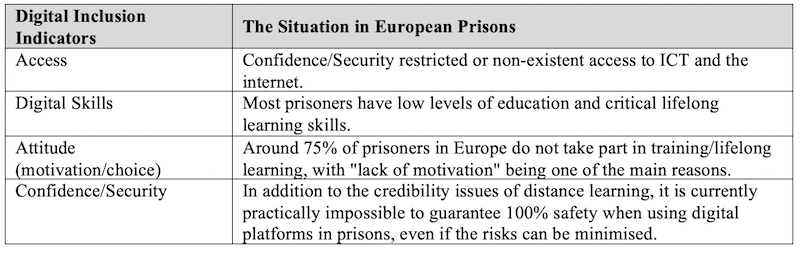
Inclusive virtual environments are vital for marginalised groups, such as prisoners. Monteiro & Leite (2016) noted limited ICT and internet access in European prisons, hindering digital inclusion (Hawley et al., 2013). Table 1 illustrates this situation, relating digital inclusion indicators (UK Government Digital Service, 2014) to European prison conditions, based on the "Survey on Prison Education and Training in Europe" (Hawley et al., 2013).
Table 1: Digital Inclusion in Prisons
Source: Monteiro et al. (2015).
Chalatsis (2016) highlighted the importance of ICT in personalised learning for prisoners, providing access to current materials and ensuring continuity despite transfers. This idea has led various European countries to invest in ICT projects for prisons, which align with prisoners' right to quality and diverse education (Council of Europe Recommendation on Education in Prison, 2011).
Monteiro et al. (2015) describe e-learning as varying in physical contact (entirely online or blended), training context (formal, non-formal, informal), moderation type (with or without a tutor), timing (synchronous or asynchronous), communication means (LMS, cloud, social networks, mobile devices), and the organisation of environment, activities, and strategies. The content's type, quality, format, interactivity, and accessibility are also variable. This diversity necessitates a critical view of e-learning benefits and limitations for digital inclusion (Seale, Draffan & Wald, 2010; Warschauer, 2003).
Table 2 summarises the necessary characteristics for effectively implementing these projects in prisons.
Table 2: Characteristics of Education and Training Projects in Prisons
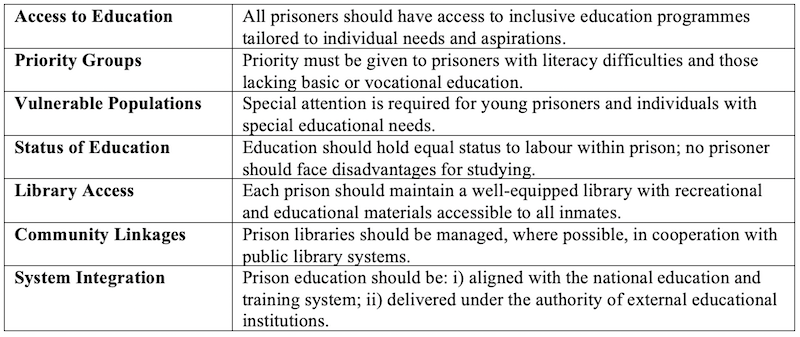
Source: Adapted from Council of Europe recommendation on education in prison, 2011, p. 15.
Following the same reasoning, Imandeka et al. (2024) state that European prisoners can access non-formal learning alternatives, general education classes, and vocational training programmes. However, the authors also identified barriers to developing "smart prisons", such as "the high cost of smart technology, ineffective technology design, poor management, ageing facilities, increased violence and ethical concerns" (p. 1).
According to the literature, in Europe, several e-learning projects have been developed in prison contexts, funded by European Lifelong Learning programmes (Moreira et al., 2017, p. 102): the "Grundtvig 2005, PIPELINE" aimed to improve prison education in Europe with ICT and reduce recidivism and promote social reintegration; Grundtvig 2006, Game On, developed e-learning content and games for small prisons to improve personal development and work skills, including for marginalised groups; "Grundtvig 2006, Distance Learning Environments", explored distance learning methods to expand education and training for prisoners; "Grundtvig 2007, Future Integration" developed alternative educational methods to reintegrate marginalised groups with interactive and independent learning; "Leonardo da Vinci 2008, LICOS" developed a European e-learning framework for prison education, taking into account pedagogical, organisational, political and security aspects; and "Grundtvig 2009, EEPP" established a dialogue between prison staff and educators, creating a community of trainers to promote learning and the reintegration of people at risk of exclusion. The Elis platform was developed in 2004, in Germany and Austria, to guarantee immediate access to educational content and professional modules for students and teachers in prison contexts. Another example mentioned by the authors is the Virtual Campus, implemented in the UK, whose aim was to address the diverse needs of prisoners, guaranteeing secure access to specific content via a "whitelist" and creating e-portfolios with each student's profile.
In Portugal, higher education through open and distance learning has been the responsibility of the Universidade Aberta since 1988. However, from 2019 onwards, Decree-Law no. 133/2019 has regulated courses in distance learning. Concerning non-degree courses, since the 1990s, adult learners have been able to undertake free-standing courses, MOOCs, and specialised programmes across various educational and training institutions, with a broad range of distance learning options available.
From the perspective of distance education in prison contexts, two e-learning projects are being developed in prisons: the EPRIS project (Monteiro et al., 2018) and the "Distance Education and e-Learning in Prisons in Portugal — Ead@EPPt" project, which is organised into two sub-projects, one with a pedagogical nature (Development and Evaluation of an Inclusive Virtual Pedagogical Model) and the other with a technological nature (Virtual Campus for Education, Training, Employability and Digital Citizenship) (Moreira, 2021).
EPRIS is a project conceived and developed by the Piaget Institute through its Research Unit in partnership with the Directorate General for Reintegration and Prison Services (DGRSP) and the Santa Casa de Misericórdia do Porto. Intending to support the future social and labour market reintegration of women in prison, the project aimed to contribute to employability and social justice, enhancing the self-esteem of these women (Monteiro et al., 2018).
For this purpose, the project included an e-learning training offer through the Moodle platform (intranet), whose characteristics enabled: online communication as a space for online socialising, clarifying doubts and sharing experiences and learning content through forums; using assessment tools and consulting opinions; supporting different types of continuous and discrete media (text, audio and video); and recording user entries in the training environment as well as tasks carried out.
The project also aimed to encourage inmates to use digital technologies, with a view to lifelong learning, monitoring individual efforts in learning and encouraging group dynamics, particularly those developed in a virtual environment. The possibility of all the inmates having a personal laptop until the end of the course allowed them to work on the proposed activities in their respective cells.
The Ead@EPPt project resulted from the collaboration protocol between Universidade Aberta and the DGRSP in 2016. It arose from the need and commitment to create and develop a Virtual Campus designed for the prison population, with secure access for the development of activities in the field of teaching and training in Distance Education and eLearning (Moreira, 2021; Silva et al., 2019).
Considering that, even in prison, citizens have the same rights to access education and training as the general population, the project aimed to foster and empower prisoners to take control of their destinies while contributing positively to their community. The programme focused on human rights, gender equality, sustainability, and interculturality within Lifelong Learning, aiming to contribute to developing autonomy, solidarity, cultural and social pluralism, and democratic values. The pedagogical strategy used cinema to promote reflection and debate among prisoners, helping them to reconsider their societal role (Moreira, 2021).
Given the above and taking into consideration the importance of developing studies focusing on the policies, technological and humanistic issues of education in prisons, the analysis presented in this article addresses the following questions:
RQ1 – What is the relationship between adult education policies and the use of digital technologies in prisons?
RQ2 – How have open and distance learning environments been implemented in Portuguese prisons?
RQ3 – What implications do these policies and practices have for the design of research and the promotion of open and distance education suitable for inmates?
These questions are based on the regulatory (RQ1), technological (RQ2), and humanistic (RQ3) perspectives.
The study used documentary analysis (Bowen, 2009) of outputs and documents resulting from adult education congresses, manifestos of adult education associations, and Portuguese legislation on education in prisons, namely: CONFINTEA VII Seventh International Conference on Adult Education: Final report; Adult Learning and Education for Sustainable Development: A transformative agenda (UNESCO, 2023); ICAE and Global Civil Society Manifesto (ICAE, 2022); Manifesto for Adult Learning in the 21st Century: The Power and Joy of Learning (EAEA, 2024); Decree-Law 265/79 (Portuguese Republic, 1979); Decree-Law 115/2009 (Portuguese Republic, 2009).
The analysis followed the procedures of documentary analysis (Yin, 2014). This process involved selecting and collecting documents, coding and categorising the data, analysing it and drawing inferences based on the theoretical framework.
In the second phase, four personal interviews were conducted with trainers and administrative staff to gather their opinions on the implications of adult education policies. The participants were contacted by e-mail. The questions were prepared based on the research questions. For the study presented in this article, we selected the questions related to the perspective of the policies, the technology used and the humanistic perspective of open and distance learning environments in prison.
These semi-structured interviews were conducted from February to May 2022 by videoconference. They lasted an average of one hour or until data saturation, since there was no pre-set time limit. Data was interpreted using content analysis (Yin, 2014), following the steps: organisation of the data, content-centred coding aimed at identifying themes, categorisation, inference, and interpretation.
The sample consisted of two prison training project coordinators, a prison education manager and a leader of a prison education association, all of whom had extensive knowledge of how education works in prisons. Despite the small number of interviewees, the sample contained key informants from the two projects under study from the point of view of implementation, the two people responsible for training and policy, namely, the manager and the leader of the prison education association.
For ethical reasons, authorisation was obtained from the institutions where the research was conducted and from the interviewees, who signed an informed consent declaration. Detailed information about the study was provided, and to maintain anonymity, the interviewee names were changed to codes (P01-P04).
The data from the documentary analysis and the interviews were organised according to the research questions and framed by the different research perspectives on adult education and digital technologies in prison (Monteiro et al., 2015).
Regarding RQ1, the regulatory perspective, there has been a clear development in the prison system in Portugal since the 1979 reform (DL 265/79) that impacts ALE. Initially, the focus and priority were to combat high illiteracy rates. Over the years, since Law 115/2009 (article 38º) was passed, the focus has shifted towards vocational training, "to promote employability and social reintegration conditions". However, a concern remains about ensuring compulsory education, especially for young and illiterate people. P04 described this process:
We're already 40 years into prison education in Portugal (...) This was a gradual process that began with the Prison Reform of '79, which, in a way, kick-started the possibility of prison education coming under the Ministry of Education (…) In the 1990s, we saw the consolidation of this education system in prisons, even with the introduction of teaching by certified [vocational training] modules (P04).
In 2009, the Law (DL 115/2009, article 38) initiated the duty to promote inmates' attendance at other levels of education through distance learning methods. According to interviewee P03, this modality has increased over the years:
What happens is the guarantee of educational training from the literacy level up to the 12th grade in in-person sessions... and then we have higher education, which … is conducted through distance learning. (...) (P03).
Besides the legislation on education in prison, the documentary analysis allowed us to identify the key contributions of three documents to adult education, as presented in Table 3.
Table 3: Documentary Analysis
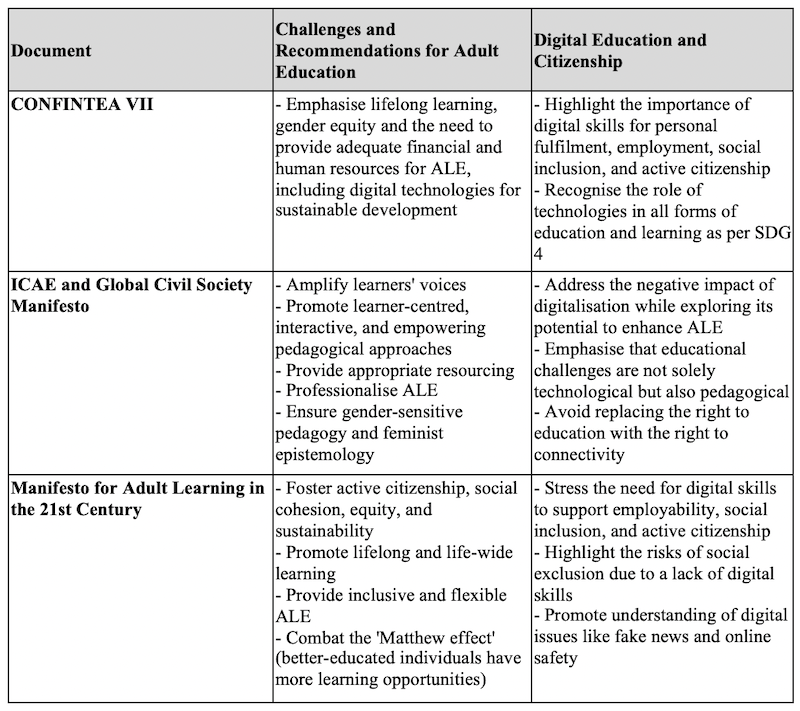
Source: self-authored with study data.
Table 3 presents the main contributions and recommendations from the analysed documents concerning adult education. These guidelines impact prison education, encouraging inmate participation in all educational aspects and highlighting the importance of tailoring ALE programmes to meet the needs of inmates, focusing on inclusion and participation and the development of digital competencies.
According to the documents, adult education bridges the digital divide, providing individuals with digital competencies essential for personal fulfilment, employment, social inclusion, and active citizenship. However, there is no direct reference to the prison context in the Sustainable Development Goal (SDG) 4 indicators from the 2030 Agenda (UNESCO, 2015), which explicitly recognised the role of technologies in all types of education and learning.
Regarding RQ2, the technological perspective, the most recent DGRSP annual activity report showcased the importance of introducing digital technologies in prisons, as shown in the following extract:
In 2022, online training continued to be part of the TD [training department] routine, with 47 actions and 1,128 trainees, corresponding to 12,728 hours of training volume. (…) In 2023, TD will continue to invest in better training its pool of trainers to use digital tools. (DGRSP, 2021, p. 9).
Despite these expectations, online prison education is mainly provided by external institutions using their own resources. Interviewee P01 reported that there are still institutional barriers, such as some disbelief among the staff regarding this learning modality and difficulties in using technological equipment inside prison cells.
Data from the interviews indicated that the schools (P03, P04) or the training institution (P01) provided the learning resources. In this context, positive and negative aspects were mentioned, such as:
Therefore, in terms of positive aspects, we understood that using blended learning allowed us to work with the inmates to help them build their knowledge. (…) It is not necessarily a negative aspect. Still, there were at least moments and specific cases where we had to think about more practical issues, such as limitations on internet access. (P01).
In addition to the technological perspective, interviewees P01 and P02 described pilot tests and the continuous adaptation to technological and logistical challenges. In turn, P04 highlighted the difficulty of promoting online interactions in prison during the Covid crisis. These statements demonstrate the need for longitudinal studies into the quality of digital training and digital learning environments in prisons.
Concerning RQ3, the humanistic perspective, the DL 115/2019 (Article 7) states that prisoners have the right "to take part in work, education and teaching, training, religious, socio-cultural, civic and sporting activities and in programmes aimed at dealing with specific problems"; and it is referred to in Article 38 that: "Education shall be organised in connection with vocational training and work, to promote conditions for employability and social reintegration".
The interviewees P01 and P02 underscored the positive impact of distance education on inmates' autonomy and personal growth. In this sense, P03 referred to the transformational potential of learning in prison:
Because one of the great advantages of choosing this option while in prison is that, here, in the classroom, they feel like students and talk about topics that are not only related to the lessons but also about each other's hardships and the system... it's a bit outside the system! (P03).
The following study discussion is organised according to the research questions.
Concerning the first research question — What is the relationship between adult education policies and the use of digital technologies in prisons? — according to ALE regulations, learners need autonomy, critical thinking skills, and civic and psychosocial development activities. On the other hand, due to the inherent constraints of the prison context, where inmates are temporarily excluded from society, the right to learn, as stated in prison education policies, is mainly associated with the development of crucial lifelong learning competencies in connection with future integration into the labour market.
Regarding this regulatory perspective, key documents, such as CONFINTEA VII, ICAE and the Global Civil Society Manifesto, and the Manifesto for Adult Learning in the 21st Century, highlight the importance of lifelong learning, digital competencies, and inclusive education, although with limited specific references to prison education.
Digitalisation is one of the areas in which ALE plays a fundamental role (EAEA, 2019). However, there is a lack of policies keeping pace with recent technological changes and the use of open and distance learning environments, especially in prisons.
Related to the second research question — "How have open and distance learning environments been implemented in Portuguese prisons? — the two projects analysed were aligned with the intentions expressed by the annual reports from the DGRSP, emphasising the need to develop training activities based on digital technologies. According to the training managers interviewed, there were still barriers to overcome regarding connectivity, security, and technological equipment. Understandably, large-scale financial investment is hampered by the country's socio-economic conditions, which impact the conditions of prison establishments (Pike & Adams, 2012; Crabble, 2016). In this sense, resource investment and training are mandatory in order to navigate different learning environments safely. This investment may reflect on the quality of inmate training and the restructuring of education in the prison context, leading to better results, higher levels of participation, and lower procedural costs.
Considering the third research question — What implications do these policies and practices have for the design of research and the promotion of open and distance education suitable for inmates? — the documentary analysis and the interviews allowed for identification of some implications of promoting open and distance education. There is a need to develop policies that guarantee the right to digital education within the prison system. It is also essential to promote conditions to build digital literacy and technological competencies to implement prison policies, which align with contemporary ALE regulations that advocate increasing adults' motivation and participation in decision-making. Barros et al. (2023) state that "encouraging greater participation in learning inside prison can contribute to developing a lifelong learner profile". Moreover, the open and distance learning in prison could contribute to developing digital competencies necessary to play an active part in society.
This study showed a lack of investment in technological infrastructure within Portuguese prisons to enable the implementation of distance learning platforms. The security issue mentioned by the interviewees highlights the importance of implementing a secure internet access system, allowing inmates to use online resources in a controlled and supervised way.
Another contribution was indentifying the need to articulate the prison system with various modalities and types of education to ensure that educational programmes are aligned with the national educational system, allowing the inmates to continue their studies after release. From a research standpoint, the data underscored the importance of conducting longitudinal studies to evaluate digital education's impact on inmates' social reintegration, and how different teaching modalities (e-learning, blended learning) affect inmates' learning and reintegration.
From an ethical perspective, it is essential to consider an inmate's categorical and contextual vulnerability (Gordon, 2020) and be aware of the power dynamics inside the prison (British Educational Research Association, 2018). According to Barros et al. (2023), in conducting prison research, specific information about the learners should not be reported back to the prison authorities, in order to ensure the quality of the pedagogical relationship and to promote the best conditions for learning as in any environment.
There is a gap between official policies and prison practices regarding digital technologies. Recognising that prison education, supported by digital technologies, presents a challenge due to the specificities of this context, the study presented here allowed for the identification of what is stated in ALE official documents and the views of managers and trainers who develop projects in the prison context, as oriented by three perspectives: regulatory, technological, and humanistic.
Data reinforced the importance of investigating technological, social, and cultural barriers that hinder the implementation of digital learning programmes in prisons and developing and evaluating new pedagogical models integrating digital technology adapted to the specific inmates' needs.
Acknowledgement: This work was co-funded by the Foundation for Science and Technology, IP (FCT), under the multi-year funding allocated to CIIE [UIDB/00167/2020, UIDP/00167/2020, and UID/00167: Centre for Research and Intervention in Education].
Akin (2023). The Akin 2023 ESG survey: Highlights, trends and developments. https://www.akingump.com/en/insights/podcasts/the-akin-2023-esg-survey-highlights-trends-and-developments
Atkinson, P., & Delamont, S. (2006). In the roiling smoke: Qualitative inquiry and contested fields. International Journal of Qualitative Studies in Education, 19(6), 747-755. https://doi.org/10.1080/09518390600975974
Barros, R., Monteiro, A., & Leite, C. (2023). Learning with digital technologies in prison: A scoping review. Digital Education Review, 43, 1-17. https://doi.org/10.1344/der.2023.43.1-17
Bowen, G. (2009). Document analysis as a qualitative research method. Qualitative Research Journal, 9(2), 27-40. https://doi.org/10.3316/QRJ0902027
British Educational Research Association. (2018). Ethical guidelines for educational research (4th ed.). https://www.bera.ac.uk/publication/ethical-guidelines-for-educational-research-2018- online
Chalatsis, X. (2016). Education in penitentiary context. In F. Torlone & M. Vryonides (Eds.), Innovative learning models for prisoners (pp. 1-9). Firenze University Press.
Council of Europe (2011). Recommendation of the Committee of Ministers to member states on the European prison rules. https://wcd.coe.int/ViewDoc. jsp?id=955747.
Crabbe, M. (2016). Education for offenders in prison. Journal of Pedagogic Development, 6(3), 3-7.
EAEA (2024). Manifesto for adult learning in the 21st Century: The power and joy of learning. https://eaea.org/wp-content/uploads/2024/06/EAEA_manifesto_FINAL.pdf
EAEA (2019). Manifesto for adult learning in the 21st Century: The power and joy of learning. eaea_manifesto_final_web_version_290319.pdf
Farley, H., Murphy, A., & Bedford, T. (2014). Providing simulated online and mobile learning experiences in a prison education setting: Lessons learned from the PLEIADES pilot project. International Journal of Mobile and Blended Learning, 6(1), 17-32. https://doi.org/10.4018/ijmbl.2014010102
Gazi, Z. (2016). Internalisation of digital citizenship for the future of all levels of education. Education and Science, 41(186), 137-148. https://www.proquest.com/openview/d888d34402f1b266a0433b06e07a0558/1
Gordon, B.G.B. (2020). Vulnerability in research: Basic ethical concepts and general approach to review. Ochsner Journal, 20(1), 34-38. https://doi.org/10.31486/toj.19.0079
Hawley, J., Murphy, I., Souto-Otero, M. (2013). Prison education and training in Europe: Current state-of-play and challenges. http://ec.europa.eu/education /library/study/2013/prison_en.pdf
Hurtado, C. (2005). Introducción al pensamiento de Paulo Freire. In A. Casali, L. Lima, C. Nunez & A.M. Saul (Coord.), Propuestas de Paulo Freire para una renovación educativa. Instituto Tecnológico y de Estudios Superiores de Occidente.
ICAE (2022). ICAE and Global Civil Society manifesto. https://mcusercontent.com/731aeaa034be063208d9bb5a6/files/11ec29a1-b847-1543-83ae-d6fda3a18830/ICAE_Manifesto_EN.pdf
Imandeka, E., Putra, P., Hidayanto, A., & Mahmud, M. (2024). Exploring the world of smart prisons: Barriers, trends, and sustainable solutions. Human Behavior and Emerging Technologies, 2024, 1-21. https://doi.org/10.1155/2024/6158154
Manger, T., Eikeland, O.J., & Asbjørnsen, A. (2019). Why do not more prisoners participate in adult education? An analysis of barriers to education in Norwegian prisons. International Review of Education, 65(5), 711-733. https://doi.org/10.1007/s11159-018-9724-z
Monteiro, A., Barros, R., & Leite, C. (2015). Lifelong learning through e- learning in European prisons. rethinking digital and social inclusion. https://epale.ec.europa.eu/sites/default/files/monteirobarrosleite2015.pdf
Monteiro, A., & Leite, C. (2016). Inclusive digital online environments as a device for pedagogic differentiation: A taxonomy proposal. Journal of E-Learning and Knowledge Society, 12(4). https://doi.org/10.20368/1971-8829/1115
Monteiro, A., Leite, C., & Barros, R. (2018). Eu ganhei mais o gosto de estudar: o e-learning como meio de aprendizagem ao longo da vida de reclusas de um estabelecimento prisional português ["I have started to enjoy studying": e-learning as a mean of inmates: lifelong learning in a Portuguese prison). Educ. Soc., Campinas, 39(142), 129-150. https://doi.org/10.1590/ES0101-7330216156650
Moreira, J.A. (2021). Educação digital em rede em espaços prisionais. Whitebooks.
Moreira, J.A, Reis-Monteiro, A., & Machado, A. (2017). Higher education distance learning and e-learning in prisons in Portugal. [La educación superior a distancia y el e-Learning en las prisiones en Portugal]. Comunicar, 51, 39-49. https://doi.org/10.3916/C51-2017-04
Pike, A., & Adams, A. (2012). Digital exclusion or learning exclusion? An ethnographic study of adult male distance learners in English prisons. Research in Learning Technology, 20(4). http://search.ebscohost.com/login.aspx?direct=true&db=eue&AN=86228117&lang=pt-br&site=ehost-live&scope=site
Portuguese Republic. (2009). Decree-Law no. 133/2019. Official journal, Series I (October). https://diariodarepublica.pt/dr/detalhe/decreto-lei/133-2019-124392062
Portuguese Republic. (1979). Decree-Law no. 265/1979. Official journal, Series I (August). http://www.dgpj.mj.pt/sections/ leis-da-justica/pdf-ult2/decreto-lei-n-265-79-de
Renbarger, R., Rivera, G., & Sulak, T. (2019). What predicts literacy, numeracy, and problem-solving for incarcerated individuals? A PIAAC examination. Journal of Offender Rehabilitation, 58(3), 199-219. https://doi.org/10.1080/10509674.2019.1582575
Seale, J., Draffan, E.A., & Wald, M. (2010). Digital agility and digital decision-making: Conceptualising digital inclusion in the context of disabled learners in higher education. Studies in Higher Education, 35(4), 445-461.
Silva, S., Moreira, J.A., & Alcoforado, L. (2019). Educação digital no ensino superior em Portugal em contexto de reclusão: O campus virtual educonline@pris. EccoS – Revista Científica, São Paulo, 51, e16256. https://doi.org/10.5585/EccoS.n51.16256
UK Government digital service (2014). Digital inclusion strategy. https:// www.gov.uk/government/publications/government-digital-inclusion-strategy/goverrnment-digital-inclusion-strategy
UNESCO (2023). CONFINTEA VII Seventh International Conference on Adult Education: Final report; adult learning and education for sustainable development: A transformative agenda. https://unesdoc.unesco.org/ark:/48223/pf0000386113
UNESCO (2015). Education for sustainable development. https://en.unesco.org/themes/education-sustainable-development
Warschauer, M. (2003). Technology and social inclusion: Rethinking the digital divide. The MIT Press.
White, P., & Selwyn, N. (2012). Learning online? Educational internet use and participation in adult learning, 2002 to 2010. Educational Review, 64(4), 451-469.
Yin, R. (2014). Case study research design and methods (5th ed.). Sage.
Author Notes
Angélica Monteiro has a PhD in Education and is an Assistant Professor at FPCEUP, a CIIE researcher, and LabDERE co-Coordinator. Email: armonteiro@fpce.up.pt (https://orcid.org/0000-0002-1369-3462)
Carlinda Leite has a PhD in Education, is a Full and Emeritus Professor at FPCEUP, a CIIE Researcher, and UPORTO Teacher. Email: carlinda@fpce.up.pt (https://orcid.org/0000-0001-9960-2519)
Ana Machado has a PhD in Education, and is a CIIE/FPCEUP Researcher. Email: namachado.fpceup@gmail.com (https://orcid.org/0000-0003-3175-1379)
Rita Barros has a PhD in Education, is a Coordinating Professorat the Piaget Institute. And a Coordinator of the Education Research Group — INSIGHT — Piaget Centre Research for Ecological Human Development. Email: rita.barros@ipiaget.pt (https://orcid.org/0000-0002-3596-9992)
Cite as: Monteiro, A., Leite, C., Machado, A., & Barros, R. (2025). Open and distance education policies and practices in prisons in Portugal. Journal of Learning for Development, 12(2), 427-438.