Aziz Naciri, Mohamed Radid, Lahoucine Ben Yahya and Ghizlane Chemsi
2026 VOL. 13, No. 1
Abstract: Distance learning has become an effective alternative to face-to-face learning in many fields, including the health professions. This study aims to identify the factors influencing nursing and health techniques students' motivation using learning management systems. A multicentre cross-sectional study was conducted with students from Moroccan public higher education institutions providing distance education in the health sciences. Student motivation was tested using the Situational Motivation Scale. The Learning Management System was evaluated through a questionnaire containing four sub-components: course content quality, online learning activities, course technology, and student support. Both correlation and logistic regression analyses were conducted to meet the study objectives. A total of 1,061 students took part in the study. The multiple logistic regression analysis indicated that course content quality and online learning activities were the key factors impacting students' motivation. This study highlighted the importance of prioritising student motivation in the design and development of distance learning courses through Learning Management Systems.
Keywords: computer-assisted instruction, distance learning, health professions, motivation, nursing, online learning
Distance learning is a growing form of learning in health professions education (O’Doherty et al., 2018). It provides for a new pedagogical relationship between teachers and students. Indeed, students can take their courses at a distance using educational platforms without being present on campus. Distance learning can be arranged in a synchronous way, where the teacher and the students meet and learn at the same time during an online session within a platform, or in an asynchronous manner in which the students learn at their own pace through different media (audio, video, interactive content) made available to them through Learning Management Systems (LMS) (Hrastinski, 2008). LMSs also bring significant advantages in terms of personalising learning. They enable instructors to tailor content to the specific needs of each student, adjusting teaching aids and assessment methods according to individual skill levels and progress (Kem, 2022). In the healthcare field, where both practical and theoretical knowledge are crucial, this personalisation capability promotes more effective learning. Likewise, trainers can identify potential difficulties and offer targeted support to ensure that students achieve the required skills before confronting real-life clinical situations. However, implementing LMSs in the healthcare sector also involves challenges. One of the main obstacles is the need for a solid technological infrastructure and adequate technical support, which can be problematic in resource-constrained regions (Turnbull et al., 2020). Furthermore, developing specific content for LMSs requires a significant investment in time and resources, as well as close collaboration between educational experts and healthcare specialists.
Moreover, the success of learning processes using these digital devices is strongly linked to the students’ motivation. Previous studies have indicated that student motivation is vital to learning outcomes (Brooker et al., 2018; Lim, 2004; Regmi & Jones, 2020).
Motivating students to use LMSs in nursing education remains a challenge for several reasons. Firstly, these students are often attached to direct human interaction, particularly important in health-related fields, where face-to-face learning enables connections with teachers and peers that might be lacking in a digital environment. Moreover, LMSs may be perceived as unengaging tools, partly because users often experience them primarily through static materials (e.g., PDFs and videos), despite the availability of interactive functionalities such as quizzes, polls, and conferencing. This lack of engagement could lead to a drop in motivation among students, who are looking for more dynamic and immersive learning experiences (Khatatbeh et al., 2024). In addition, the autonomous learning management made possible by LMSs requires a high degree of self-discipline, which is not always easy for students to maintain. Finally, the technical interface of LMSs and problems of access to digital tools might also discourage some students, especially if such systems are not well integrated into their learning path.
From this perspective, a retrospective meta-analysis indicated that intrinsic motivation is associated with positive educational outcomes, such as student achievement and reduced anxiety, and students’ psychological need for competence was identified as a key predictor of this type of motivation (Howard et al., 2020). Similarly, another meta-analysis highlighted that intrinsic motivation is related to students' success and well-being, while identified regulation is associated with perseverance (Howard et al., 2021).
Learning motivation is the degree of involvement and effort students make to achieve learning objectives (Huitt, 2001). During distance learning, students must manage communication with their teachers, interact with the educational content, and manipulate technology (Castro & Tumibay, 2021). Some studies indicate challenges and factors that can hinder students' motivation during online courses. These contextual factors could be related to the instructor, the course made available to students online, and the LMS.
Regarding instructors, some studies have linked instructors' skills to student motivation in the context of distance education. Instructors who do not adopt effective teaching practices might decrease student motivation (Teodorescu et al., 2022). The findings of the study conducted by Meşe and Sevilen (2021) showed the important role of the instructor, especially the teaching methods adopted and the way of presenting the lessons. Moreover, faculty who establish interactions with students are actively involved in enhancing the engagement and motivation of their learners (Jaggars & Xu, 2016). In the same perspective, the results of a meta-analysis confirmed that teacher autonomy support and competence more strongly predicted students' motivation (Bureau et al., 2022).
Furthermore, the perceived quality of the online course has been studied extensively with student motivation. Indeed, students' perceptions of course design and online instruction significantly predict their motivational beliefs (Artino, 2008; Kim & Frick, 2011; Teodorescu et al., 2022). In this sense, distance learning courses that incorporate interactive formats increase students' motivational scores (Chiu, 2022). Similarly, when the course content matches the students' expectations, students show higher motivation levels (Meşe & Sevilen, 2021). Also, the effective use of educational tools and platforms can increase student motivation (Luo et al., 2019). Technology-related issues affect student motivation levels (Teodorescu et al., 2022). Students proficient in information technologies and with strong technical skills are more motivated in online learning as they encounter fewer obstacles (Muilenburg & Berge, 2005).
A review of the literature reveals a certain discordance regarding the factors influencing student motivation to use LMSs. Some studies focus on external factors, such as easy access to learning resources and institutional support, while others emphasise internal factors such as students' autonomy and personal interest in digital technologies. Some investigations have also suggested that teacher commitment and the quality of interaction in the virtual environment play a key role, while other authors place less emphasis on these aspects, prioritising the platform's technical and ergonomic features. This diversity of viewpoints reflects a lack of consensus on the most decisive elements in motivating students to use LMSs, underlining the need for further research to clarify these contradictory influences.
The present study is based on self-determination theory (SDT) (Ryan & Deci, 2017; Vallerand, 2000). This theory was the subject of several researchers in different contexts, including the education sector, especially in teaching in digital contexts. SDT recognises three types of motivation: intrinsic motivation, extrinsic motivation and amotivation, classified along a continuum of self-determination. Intrinsic motivation reflects the highest degree of self-determination, characterised by participation in activities for the pleasure or personal satisfaction they provide. Extrinsic motivation, on the other hand, is based on external factors and can be broken down into four types of regulation: external regulation, motivated by rewards or sanctions, with a low degree of self-determination; introjected regulation, where engagement is aimed at avoiding shame or reinforcing pride, while still under external control; identified regulation, marked by voluntary participation based on the perceived value of activities, with a moderate degree of self-determination; and integrated regulation, where engagement is aligned with personal values, representing a high degree of self-determination. Finally, amotivation refers to a state of lack of motivation, where the individual sees no clear reason to invest in activities, characterised by a non-self-determined state.
Furthermore, the stages of regulation suggested by SDT are ordered according to the degree of self-determination. High self-determination represents intrinsic motivation, while low self-determination represents amotivation. SDT provides an opportunity to examine contextual factors influencing student motivation in the digital environment. Further, a systematic literature review concluded there was a lack of evidence related to student motivation during distance learning in health professions education in Morocco (Naciri et al., 2021).
The present study is crucial in nursing education, as it provides a better understanding of the factors that motivate students to use LMSs, thus facilitating the adoption of these pedagogical tools. A better understanding of these factors would enable educational institutions to adapt their teaching strategies and improve student engagement in their learning. In addition, this understanding could help to design more effective platforms, tailored to the specific needs of healthcare learners.
In the context of the present research, teaching-learning was mainly face-to-face, offering direct interaction between teachers and students. However, the experience of the Covid-19 pandemic marked a turning point with the increased integration of distance learning and the use of LMSs. This transition, initially driven by the need to maintain pedagogical continuity, has demonstrated significant benefits. Since then, distance learning has become firmly entrenched in educational practices.
This study aims to identify the factors influencing motivation among health science students using LMSs.
We conducted a quantitative multicentre cross-sectional study among Moroccan nursing and health techniques students. This cross-sectional approach provides data at a specific point in time, making it easier to identify students' current perceptions and behaviours. The multicentre aspect, involving several Moroccan nursing and health technology institutions, enables comparison of students' experiences in different contexts. This helped to identify common trends. The quantitative study provided measurable, objective data, facilitating statistical analysis of motivating factors.
This study included nursing and health technology students enrolled in distance learning courses at four Moroccan public higher education institutions. There were no exclusion criteria. Since all target participants were invited and all responded, the sample size estimation was not undertaken. The participants in this study were 1,061 nursing and health technology students.
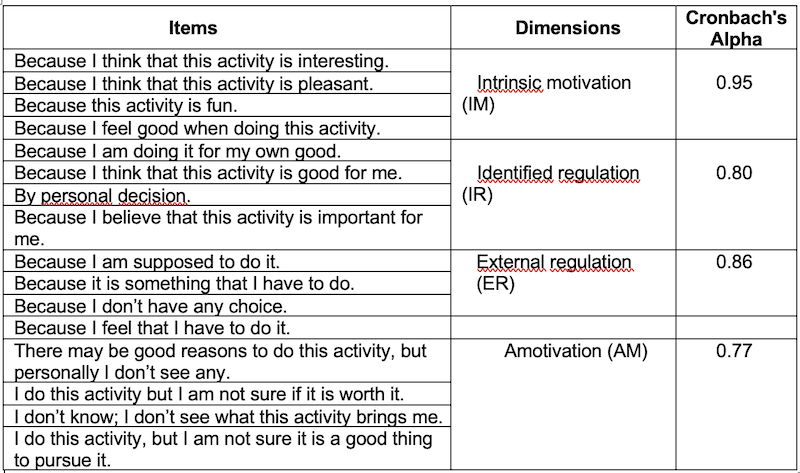
The research instrument used was a self-administered questionnaire consisting of two parts, in addition to the participants' socio-demographic data. The first part focused on students' motivation in online courses. It was examined using the Situational Motivation Scale with permission from the original authors. It is a validated instrument, consisting of 16 items, that was developed by Guay et al. (2000). It contained 16 items categorised into four subscales, each with four items: intrinsic motivation (IM), external regulation (ER), identified regulation (IR), and amotivation (AM). Participants provided responses to these items using a Likert scale that ranged from 1 to 7, with 1 indicating "strongly disagree" and 7 indicating "strongly agree." The Cronbach's alpha results for the subscales were: 0.95 for intrinsic motivation, 0.80 for identified regulation, 0.86 for external regulation, and 0.77 for amotivation (Guay et al., 2000) (Table 1).
Table 1: Items and Dimensions of the Situational Motivation Scale
The second part consisted of a survey based on the standards of course design guidelines (Quality Matters, 2020). It included 29 items assessed on a five-point Likert scale, ranging from 1 (strongly disagree) to 5 (strongly agree), classified into four thematic sections: course content quality (11 items), online learning activities (eight items), course technology (three items) and student support (seven items). It was first assessed for content validity by four experts. Two were experts in education and technology assessment, assessment engineering, and university pedagogy. One of these was a full professor and the other was an associate professor. The third expert was an assistant professor in nursing, and the fourth expert was a PhD student specialising in educational technologies and, at the same time, a permanent teacher in nursing and health techniques. The content validation process was carried out according to Polit & Beck (2006). The content validity index (CVI) results were 0.95, indicating good content validity. Likewise, Cronbach's alpha test result was α = 0.92, indicating strong internal consistency (Taber, 2018). However, Cronbach's alpha for the four dimensions was: course content quality (α = 0.86), online learning activities (α = 0.76), course technology (α = 0.7) and student support (α = 0.76) (Table 2).
Table 2: Cronbach's Alpha Results for Sections of the Learning Management System Rating Scale used in this Study

The consistency of each question with the total subscale score was also assessed using item-total correlation. The results were satisfactory, ranging from 0.44 to 0.64. It should be noted that students who participated in the pilot test (n = 20) were excluded from the final study participants.
Data was collected using a self-administered paper questionnaire distributed by the primary researcher, who was a lecturer in nursing and a PhD specialising in educational technologies. The estimated time required to complete the questionnaire was 10 to 15 minutes. Participants were invited to participate in the study and informed consent was obtained. The research objectives and their right to withdraw from participation in the study were explained to them.
In the presentation of the data, quantitative variables were expressed as either mean (standard deviation) or median (interquartile range), while qualitative variables were reported as frequencies and percentages. The dynamic clustering method was utilised to determine the classification of participants into two groups: low or high motivation. Moreover, logistic regression analyses were carried out to examine the factors linked to student motivation using LMSs. The variables with a p-value lower than 0.25 in the univariate analysis were included in the multivariate logistic regression analysis. SPSS V. 23.0 was utilised for data management and conducting the statistical analysis.
This study was approved by the regional health direction in Laâyoune-Sakia El Hamra (No: 571/22), the regional health direction in Souss Massa (No: 4535/22), the Higher Institute of Nursing Pro¬fessions and Technical Health in Marrakech (No: Ispits/133/08.03). Furthermore, informed consent was obtained from all participants.
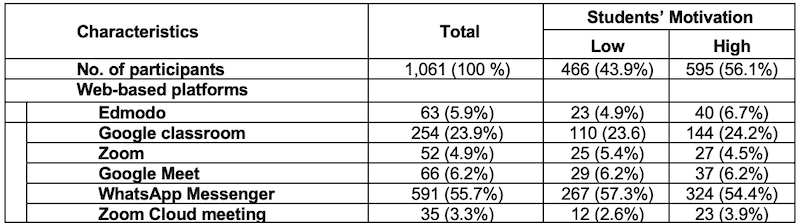
A total of 1,061 students participated in the present study. About a quarter of the students (23.9%) reported using the Google Classroom educational platform. However, more than half (55.7%) indicated that WhatsApp Messenger was their most used tool for distance learning. Regarding student motivation, 56.1% showed a high level of motivation, and 98% were in the Bachelor’s degree cycle. WhatsApp Messenger (54.4%) and Google Classroom (24.2%) were the most used tool for distance learning courses (Table 3). Some of the participants' characteristics have already been presented in a previous study aimed at identifying which of these variables was associated with self-determined student motivation (Naciri et al., 2023).
Table 3: Participants' Characteristics and their Motivational Levels in the Context of Distance Education Courses
Furthermore, the results presented in Table 4 show the mean and median scores of the student motivation subscales. External regulation was the highest sub-component, with a mean score of 4.53 ± 1.38 and a median of 5 (IQR, 3.5-6), followed by identified regulation (4.34 ± 1.52) with a median of 4.5 (IQR, 3-6), and intrinsic motivation (3.75 ± 1.38), with a median of 3.5 (IQR 2.5-5).
Table 4: Subscales of Student Motivation

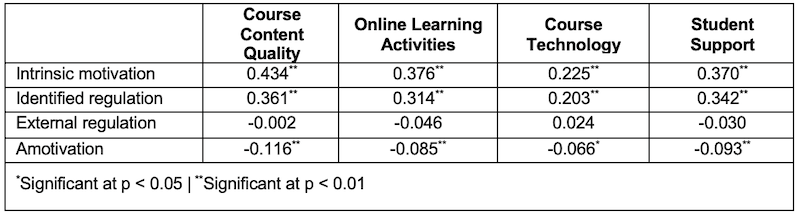
The Pearson correlation results presented in Table 5 show a positive and significant correlation between the quality of the course content and intrinsic motivation (r = 0.434, p < 0.01) and identified regulation (r = 0.361, p < 0.01), and a negative and significant correlation between the quality of the course content and amotivation (r = -0.116, p < 0.01). It means that when the quality of the course content increases, students' intrinsic motivation and identified regulation increase and vice versa. However, improving the quality of the course reduces students' amotivation. Furthermore, online learning activities are positively and significantly correlated with intrinsic motivation (r = 0.376, p < 0.01) and identified regulation (r =.314, p < 0.01), and negatively and significantly with amotivation (r = -0.085, p < 0.01). Regarding the course technology, a positive and significant correlation was recorded with intrinsic motivation (r = 0.225, p < 0.01) and identified regulation (r = 0.203, p < 0.01), and a weak negative but significant correlation with amotivation (r = -0.066, p < 0.01). Finally, the student support and the subscales, intrinsic motivation (r = .370, p < 0.01) and identified regulation (r = 0.342, p < 0.01), evolved in the same direction significantly.
Table 5: Pearson Correlation among Student Motivation Subscales and Distance Learning Components
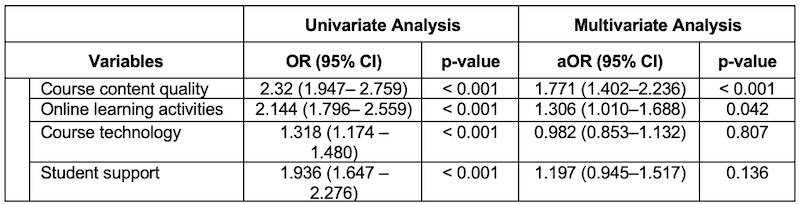
The univariate regression analyses, as shown in Table 6, suggest a potentially strong and significant association between student motivation and course content quality (OR = 2.32; 95% CI = 1.947-2.759; p < 0. 001), online learning activities (OR = 2.144; 95% CI = 1.796-2.559; p < 0.001), course technology (OR = 1.318; 95% CI = 1.174-1.480; p < 0.001), and student support (OR = 1.936; 95% CI = 1.647-2.276; p < 0.001). Nonetheless, the outcomes of multiple logistic regression (as shown in Table 6) illustrate that course content quality (aOR = 1.771; 95% CI = 1.402-2.236; p < 0.001) and online learning activities (aOR = 1.306; 95% CI = 1.010-1.688; p < 0.042) were the only factors significantly influencing students' motivation in a distance learning context (Figure 1).
Table 6: Factors Influencing Students' Motivation during Learning on Educational Platforms Using Univariate and Multivariate Analysis
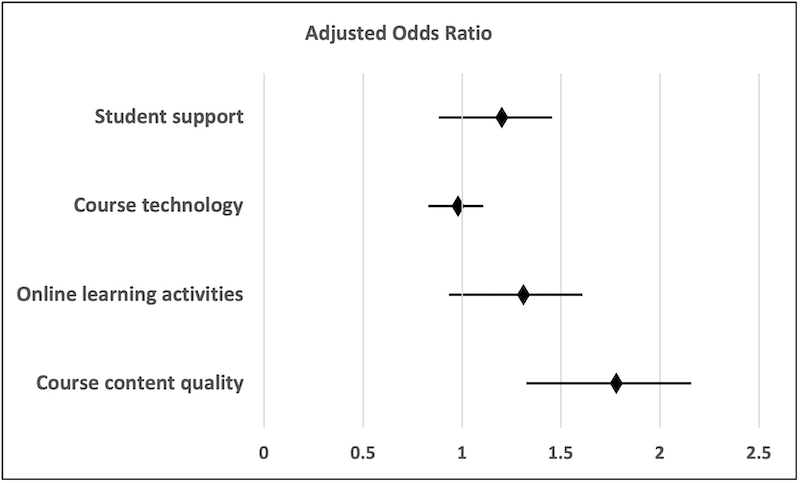
The participants of this study were nursing and health techniques students using LMSs at various higher education institutions. The objective was to analyse student motivation in a digital environment to determine the factors associated with student motivation using different educational platforms.
Logistic regression results showed that course content quality provided to students at a distance influences their motivations. This result is consistent with previous studies (Meşe & Sevelin, 2021; Teodorescu et al., 2022). From this perspective, learning becomes more attractive if the educational resources offered to students within the platforms are clear, well-articulated, and have a rhythmic structure. As a result, students become more involved, and their motivation might increase.
Moreover, our results indicated that online learning activities were significantly associated with student motivation in distance education courses. This finding is similar to other investigations (Çebi & Güyer, 2020; Teodorescu et al., 2022). Online learning activities can take many forms: video lectures, hands-on interactive activities (simulations or serious games), discussions with the instructor or between pairs, and assessment activities. Diversifying these activities during distance learning or the appropriate choice of such an activity could increase students' motivational scores depending on the nature of the courses. In this sense, the research conducted by Teodorescu et al. (2022) indicates that the pedagogical practices of online teachers influence students' learning motivation. Likewise, students' interactions with the various learning activities reinforce their motivation to take the courses (Çebi & Güyer, 2020).
Furthermore, technology-related issues and using LMSs have not been associated with student motivation. The lack of correlation could be attributed, in part, to the computer skills that students acquired through the widespread implementation of distance learning during the Covid-19 pandemic. It may also be due to the ease of use of the platforms employed, particularly because a significant proportion of students used communication applications such as Whatsapp Messenger. Notably, computer literacy significantly predicts the intention to learn in digital environments (Reddy et al., 2021).
Also, in the context of our study, the results indicated that online student support was not associated with their motivation. These results are in discordance with the study conducted by Fryer & Bovee (2016). The authors reported that strong faculty support in distance learning could positively affect student motivation. Further, supporting students in a digital environment is crucial for student success (Rumble, 2000).
The current study has some strengths. First, the number of participants was very large. Second, the study was multicentric and conducted at four institutions in different regions of Morocco. This allowed us to generalise our results to all Moroccan nursing and health technique students taking distance education courses. However, it is necessary to clarify certain limitations of the study. Indeed, the research should have included details on the nature of the modules delivered and the number of hours spent on each distance learning course. Students' motivation may differ according to the number of hours allocated to distance learning courses and the complexity of each subject. Furthermore, this study provided some pedagogical implications. Decision-makers in nursing and health techniques training institutions must take steps, on the one hand, to implement adequate LMSs for distance learning in order to develop the skills of future nurses and health technicians, and, on the other hand, to create spaces or pedagogical laboratories for instructors to create quality distance courses.
This research provides clear, concise, and complementary contributions to the research conducted by Naciri et al. (2023). The results obtained from the detailed analysis of each aspect have significantly contributed to the scientific community. Consequently, several technological developments could be developed to enhance the distance learning experience. First of all, it would be relevant to invest in artificial intelligence and augmented reality tools that would enable teachers to tailor learning more closely to students' individual needs. These technologies could also make learning more interactive and immersive by simulating practical environments and real-life situations. In addition, the integration of advanced collaborative platforms and more powerful LMS tools could facilitate communication, interaction and monitoring of student progress, while fostering a more engaging learning environment. Features such as adaptive assessments based on intelligent algorithms and real-time feedback systems could help students to understand better their strengths and weaknesses. Finally, it is crucial to continue encouraging teachers to explore innovative pedagogical approaches, such as serious games, simulations and interactive activities, which not only increase student motivation but also reinforce their active participation in learning. These developments should enable us to meet better students' needs and improve the effectiveness of distance learning in institutions like the Higher Institute of Nursing and Health Techniques (ISPITS).
The findings of this study provided a better understanding of students using LMSs. Indeed, the correlation between the motivation subscales and the LMS subcomponents was demonstrated. Furthermore, based on the research findings, it was concluded that in a distance learning context, the quality of course content and online learning activities emerged as significant factors associated with student motivation. This means that if the course has high quality content and the online learning activities are well designed, it could increase students' motivation to engage more in online learning. Based on the findings obtained, several research perspectives can be envisaged to further our understanding of the factors influencing student motivation in e-learning. It would be relevant to explore the contextual factors specific to different distance learning environments, in order to determine how these elements interact with the use of LMSs. A comparison of the impact of different LMS platforms on student motivation could also offer interesting insights, particularly by studying interactivity, about accessibility or the adaptation of teaching resources to learners' needs. In addition, it would be useful to further investigate the relationship between the quality of educational content and motivation by analysing the influence of various pedagogical practices, such as the personalisation of learning, instructor feedback or student engagement strategies. Finally, a further line of research could focus on the impact of collaboration and peer interaction in a distance learning setting, to assess the extent to which these elements help modulate student motivation and engagement. Such complementary research could thus provide concrete recommendations for improving the effectiveness of online pedagogical practices and LMSs.
Artino, A.R. (2008), Motivational beliefs and perceptions of instructional quality: Predicting satisfaction with online training. Journal of Computer Assisted Learning, 24, 260-270. https://doi.org/10.1111/j.1365-2729.2007.00258.x
Brooker, A., Corrin, L., de Barba, P., Lodge, J., & Kennedy, G. (2018). A tale of two MOOCs: How student motivation and participation predict learning outcomes in different MOOCs. Australasian Journal of Educational Technology, 34(1). https://doi.org/10.14742/ajet.3237
Bureau, J.S., Howard, J.L., Chong, J.X.Y., & Guay, F. (2022). Pathways to student motivation: A meta-analysis of antecedents of autonomous and controlled motivations. Review of Educational Research, 92(1), 46-72. https://doi.org/10.3102/00346543211042426
Castro, M.D.B., & Tumibay, G.M. (2021). A literature review: Efficacy of online learning courses for higher education institution using meta-analysis. Education and Information Technologies, 26, 1367-1385. https://doi.org/10.1007/s10639-019-10027-z
Çebi, A., & Güyer, T. (2020). Students’ interaction patterns in different online learning activities and their relationship with motivation, self-regulated learning strategy and learning performance. Education and Information Technologies, 25, 3975-3993. https://doi.org/10.1007/s10639-020-10151-1
Chiu, T.K.F. (2022). Applying the self-determination theory (SDT) to explain student engagement in online learning during the COVID-19 pandemic. Journal of Research on Technology in Education, 54, S14-S30. https://doi.org/10.1080/15391523.2021.1891998
Fryer, L.K., & Bovee, H.N. (2016). Supporting students' motivation for e-learning: Teachers matter on and offline. The Internet and Higher Education, 30, 21-29. https://doi.org/10.1016/j.iheduc.2016.03.003
Guay, F., Vallerand, R.J. & Blanchard, C. (2000). On the assessment of situational intrinsic and extrinsic motivation: The Situational Motivation Scale (SIMS). Motivation and Emotion, 24, 175-213. https://doi.org/10.1023/A:1005614228250
Howard, J.L., Bureau, J., Guay, F., Chong, J.X.Y., & Ryan, R.M. (2021). Student motivation and associated outcomes: A meta-analysis from self-determination theory. Perspectives on Psychological Science, 16(6), 1300-1323. https://doi.org/10.1177/1745691620966789
Howard, J.L., Chong, J.X.Y., & Bureau, J.S. (2020). The tripartite model of intrinsic motivation in education: A 30-year retrospective and meta-analysis. Journal of Personality, 88(6), 1268-1285. https://doi.org/10.1111/jopy.12570
Hrastinski, S. (2008). Asynchronous and synchronous e-learning. Educause Quarterly, 31, 51-55.
Huitt, W. (2001). Motivation to learn: An overview. Educational Psychology Interactive, Valdosta State University, 12, 29-36. http://www.edpsycinteractive.org/topics/motivation/motivate.html
Jaggars, S., & Xu, D.I. (2016). How do online course design features influence student performance? Computers & Education, 95, 270-284. https://doi.org/10.1016/j.compedu.2016.01.014
Kem, D. (2022). Personalised and adaptive learning: Emerging learning platforms in the era of digital and smart learning. International Journal of Social Science and Human Research, 5(2), 385-391.
Khatatbeh, H., Amer, F., Ali, A.M., Al Bashtawy, M., Kurnianto, A., Abu-Abbas, M., . . . Hammoud, S. (2024). Challenges of distance learning encountering nursing students after the COVID-19 pandemic: A study from the Middle East. BMC Nursing, 23(1), 1-13.
Kim, K-J., & Frick, T.W. (2011). Changes in student motivation during online learning. Journal of Educational Computing Research, 44(1), 1-23. https://doi.org/10.2190/EC.44.1.a
Lim, D.H. (2004). Cross cultural differences in online learning motivation. Educational Media International, 41(2), 163-175, DOI: 10.1080/09523980410001685784
Luo, N., Zhang, Y., & Zhang, M. (2019). Retaining learners by establishing harmonious relationships in e-learning environment. Interactive Learning Environments, 27, 118-131.
Meşe, E., & Sevilen, Ç. (2021). Factors influencing EFL students’ motivation in online learning: A qualitative case study. Journal of Educational Technology & Online Learning, 4(1), 11-22. http://doi.org/10.31681/ jetol.817680
Muilenburg, L.Y., Berge, Z.L. (2005). Student barriers to online learning: A factor analytic study. Distance Education, 26, 29-48. https://doi.org/10.1080/01587910500081269
Naciri, A., Radid, M., Kharbach, A., & Chemsi, G. (2021). E-learning in health professions education during the COVID-19 pandemic: A systematic review. Journal of Educational Evaluation for Health Professions, 18, 27. https://doi.org/10.3352/jeehp.2021.18.27
Naciri, A., Radid, M., Sine, H., Kharbach, A., & Chemsi, G. (2023). Self-determined motivation and associated factors among health professions students in distance learning: A cross-sectional study in Morocco. Korean Journal of Medical Education, 35(1), 33. https://doi.org/10.3946/kjme.2023.247.
O’Doherty, D., Dromey, M., Lougheed, J., Hannigan, A., Last, J., & McGrath, D. (2018). Barriers and solutions to online learning in medical education—An integrative review. BMC Medical Education, 18, 1-11. https://doi.org/10.1186/s12909-018-1240-0.
Polit, D.F., & Beck, C.T. (2006). The content validity index: Are you sure you know what's being reported? Critique and recommendations. Research in Nursing & Health, 29(5), 489-497. https://doi.org/10.1002/nur.20147
Quality Matters (2020). Quality matters: Specific review standards from the QM Higher Education Rubric (6th ed.).
Reddy, P., Chaudhary, K., Sharma, B., & Chand, R. (2021). The two perfect scorers for technology acceptance. Education and Information Technologies, 26, 1505-1526. https://doi.org/10.1007/s10639-020-10320-2
Regmi, K., & Jones, L. (2020). A systematic review of the factors–enablers and barriers–affecting e-learning in health sciences education. BMC Medical Education, 20, 91. https://doi.org/10.1186/s12909-020-02007-6
Rumble, G. (2000) Student support in distance education in the 21st century: Learning from service management. Distance Education, 21(2), 216-235. https://doi.org/10.1080/0158791000210202
Ryan, R.M., & Deci, E.L. (2017). Self-determination theory: Basic psychological needs in motivation, development, and wellness. Guilford Publications. https://doi.org/10.1521/978.14625/28806
Taber, K.S. (2018). The use of Cronbach’s Alpha when developing and reporting research instruments in science education. Research in Science Education, 48(6), 1273-1296. https://doi.org/10.1007/s11165-016-9602-2
Teodorescu, D., Aivaz, K.A., & Amalfi, A. (2022). Factors affecting motivation in online courses during the COVID-19 pandemic: The experiences of students at a Romanian public university. European Journal of Higher Education, 12(3), 332-349, DOI: 10.1080/21568235.2021.1972024
Turnbull, D., Chugh, R., & Luck, J. (2020). Learning management systems: An overview. Encyclopedia of education and information technologies, 1052-1058.
Vallerand, R.J. (2000). Deci and Ryan’s self-determination theory: A view from the hierarchical model of intrinsic and extrinsic motivation. Psychological Inquiry, 11(4), 312-318. http://www.jstor.org/stable/1449629
Author Notes
Aziz Naciri is a PhD in Educational Sciences, with a specialisation in Educational Technology, from the Faculty of Sciences, Ben M’Sik, Hassan II University of Casablanca, Morocco. He is currently a Lecturer and Coordinator of the Social Worker program at the Higher Institute of Nursing and Health Techniques (ISPITS) of Laayoune, under the Ministry of Health and Social Protection. His research areas and interests include educational technologies in health sciences education, simulation-based learning, training engineering, didactics of sciences and health techniques, digital pedagogy, and the integration of artificial intelligence in healthcare education. Email: aziz.ncr@gmail.com (https://orcid.org/0000-0001-7318-6633)
Mohamed Radid is a PhD in Physical Chemistry. He is currently the Vice Dean of the Faculty of Sciences Ben M'Sik, Hassan II University, since 2014. He is a Member of the Observatory of Research in Didactics and University Pedagogy (ORDIPU) and a Member of the Board of Directors of Association for the Development of Evaluation Methodologies in Education (ADMEE)—Europe. He is an expert in the fields of teaching and research on educational and technologies assessment, engineering of assessment, Chemistry Didactics, and University Pedagogy. Email: m.radid@gmail.com (https://orcid.org/0000-0002-0449-8569)
Lahoucine Ben Yahya is a PhD student in Educational Sciences at Hassan II University of Casablanca. His research interests focus on educational technology and digital learning environments. He also serves as a lecturer at the Higher Institute of Nursing Professions and Health Techniques, where he is involved in nursing and health sciences education. Email: benylaho@gmail.com (https://orcid.org/0000-0002-8841-1108)
Ghizlane Chemsi is a PhD in Educational Technology. She is a Professor at the Faculty of Sciences Ben M'Sik, University Hassan II, Casablanca, Morocco. She operates in several fields of educational sciences, including educational technologies and assessment, and engineering of assessment. She is a Member of the Observatory of Research in Didactics and University Pedagogy (ORDIPU), a Member of the Association for the Development of Evaluation Methodologies in Education (ADMEE)—section Morocco and Laboratory of Mathematics, Artificial Intelligence, and Digital Learning, Hassan II University, Casablanca, Morocco. Email: g.chemsi@gmail.com (https://orcid.org/0000-0001-7241-4892)
Cite as: Naciri, A., Radid, M., Ben Yahya, L., & Chemsi, G. (2026). Factors influencing nursing and health techniques students' motivation using learning management systems: A multicentre cross-sectional study. Journal of Learning for Development, 13(1), 68-80.