Ricarda Micallef, Joy Hurman and Neil West
2026 VOL. 13, No. 2
Abstract: The Staff Learning and Development Homepage homepage was launched in January 2024 at Kingston University. Its creation required reviewing current practice and opportunities through investigation and communication with the input of multiple stakeholders and course activity owners. Our PowerApp, a behind-the-scenes tool, was our innovative, and free, solution for managing data. To build the platform and engage colleagues from concept to launch required sharing learned experiences, constantly looking in new directions for solutions, plus creating consistent standards. Initial engagement with the Homepage was positive, with ongoing evaluation planned.
Keywords: journey, development, ambitious, enterprising
Kingston University, London employs 1,800 staff across a range of disciplines, including academics in the sciences, engineering, healthcare, business, the arts, and the humanities, plus support staff covering different Directorates, including library and IT services, Human Resources (HR), finance and student services. Initially a polytechnic, it was inaugurated as a university in 1992 (Kingston University, n.d.). Kingston University supports Future Skills to ensure students are able to succeed in their careers beyond university (Yonkers, 2024).
Multiple departments provide learning and development opportunities for staff, but there was no oversight body for all the resources that were available, and each department produced material, and publicised and delivered it in different ways, with no clear path for staff to find what was available to support them. Therefore, to ensure ease and accessibility for staff, a new digital platform was proposed for staff learning and development. This was part of the university’s vision to ensure staff ambitions are supported. As digital learning and digital usage is now fundamental to higher education, a web-based platform was proposed (Alenezi, 2023).
The aim of the project completed was to bring together all learning and development opportunities for staff on one platform, and to streamline processes for quality assurance.
Definitions of ‘learning and development’ differ (Garavan, 2020). Learning and development cover all lifelong learning activity, supporting individuals in gaining skills and knowledge to help them do their jobs to the best of their abilities. Professional growth and staff development is required throughout the course of a career (Bambang Purwanto, 2023). Whilst some learning activity in the workplace is mandatory for compliance purposes, there are also multiple opportunities to support other elements of the job, such as teaching and learning or research support for academics. In an academic environment, staff training is important to ensure inclusion practices for colleagues, and students, so it is important that robust processes and support are in place (Filippou et al., 2025). It is also acknowledged that professional development programmes supporting lifelong learning, and incorporating formal and non-formal approaches, increase the knowledge and skills of staff (Owusu-Agyeman, 2024) along with supporting career development and progression (Mather & Bam, 2025).
To help streamline learning and development for staff at Kingston University two secondments were put in place from April 2023 to April 2024, utilising one academic and one professional services member of staff to identify current practice, bring all stakeholders together and create a ‘one-stop-shop’ for learning and development opportunities — the Learning and Development Homepage. Staff development in higher education requires a systematic and policy-led approach to be successful (Solomon et al., 2023), with the strategic input of Human Resources (HR), being crucial to create a strategic approach to transform outcomes (Al-Hamad et al., 2023). Where policy supports development of colleagues, this supports outcomes (Rachmad, 2025). At Kingston University, the Organisational Development (OD) team work as part of HR to support the university’s strategy ‘through consulting, designing and implementing organisational and development initiatives for all staff across the University’. Therefore, the OD team were the host team to implement the creation of the new Learning and Development Homepage.
It was important to ensure an evidence-based approach was taken; therefore, prior to the creation of the Learning and Development Homepage, research was undertaken to ensure what was created considered the evidence of the staff voice, along with learning from external sources, to ensure the learner was at the heart of the process (Panda, 2023). An inductive mixed-methods approach was used to ensure that no preconceptions were in place and the processes at the time could be reviewed individually. The methods of investigation prior to the creation of the Homepage included a review of the internal Intranet staff site, StaffSpace, along with interviews of current activity owners, focus groups, evaluation of the staff survey results, a review of other university webpages and consultation with some colleagues from those universities.
A thorough review of the StaffSpace platform was conducted. This review involved an extensive search, link testing, examination of departmental homepages, and exploration of the historical and current content of StaffSpace. The findings revealed that Kingston offers a substantial amount of content for its staff. However, due to departmental restructures, changes in website administration, and evolving Learning and Development activities, much of the content on Staff Space had become outdated and irrelevant. Consequently, staff across Kingston faced difficulties in navigating StaffSpace effectively to meet their personal goals or to access information on active departments and recent updates. The analysis highlights the necessity for a centralised location to host all Learning and Development activities, ensuring better accessibility and up-to-date information for all staff members.
During investigations it was found that there were there are at least 29 different systems actively offering staff development, with 416 learning events then available from 156 key links. There were 10 booking sites in use and seven platforms/websites used to host learning material for staff.
Individually, 39 course activity owners were interviewed to understand the learning and development that they offered, their target audiences, formats, and systems used. They were invited to share their current ways of working, what worked and what could be improved. These stakeholders were identified from the Staff Intranet investigations. All Faculty leadership teams were also visited to gain feedback. Those with responsibility or administration rights to these booking systems for the same reasons were also interviewed.
There were 27 quotations related to learning and development. Reviewing comments related to learning and development revealed that the learning opportunities available came across very strongly. Opportunities for training, learning on the job and skills development were also mentioned. There were 17 comments asking for more training opportunities, with two specific to mandatory training, saying there should be more compulsory training. Three comments focused on skills development. Most of these were generic and asked for more opportunities. There was also a comment requesting more in-house training and not relying on just LinkedIn. Multiple comments were also given related to systems in use not being fit for purpose, so the drive towards the creation of the new ‘one-stop-shop’ was positive. Lack of awareness of learning and development opportunities was also highlighted, as noted previously (Krille & Krille, 2020).
Six focus groups with 38 participants were carried out. When asked about the potential name of the new ‘one-stop-shop,’ learning and development were the preferred words to use (65%, n = 22/34) compared to the other options of just learning, training and development. and one-stop-shop. For design, 54% preferred an icon and title. However, 44% wanted an icon, title and description. Therefore, a hover button with description was used in the final design to cover all areas. As seen in multiple previous studies (Coomber, 2019; Holmes, 2020), the biggest barriers to participation in learning and development were time, workload and knowing what was available. The key drivers for participation were personal development, learning new skills and personal interest.
Early in the development process, other United Kingdom based university websites were explored and reviewed for their approach to promoting staff learning and development. We compared and ranked 14 university websites that we could access as visitors, on accessibility, ease of finding information and visuals. Themes used were also captured to review terminologies used throughout the sector. Interviews also took place with three university website content creators after a direct approach to explore current practice and rationales for their sites. Through these investigations we were able to create concepts for the one-stop-shop that emphasised ease of use, learning subjects important to a university workplace and data management best practice.
The development of the new Learning and Development Homepage was accomplished within an ambitious timeline, from April 2023 to January 2024, and totalling a nine-month project duration. This project involved integrating comprehensive insights obtained during the research phase. The design process was meticulously executed to ensure that all information gathered was utilised appropriately, with the full endorsement and support of the course activity owners.
The establishment of a forum for course activity owners facilitated the exchange of ideas, increased awareness of available courses, and contributed to the streamlining of processes. These forums, convened bi-monthly, have become a regular feature of the organisation's collaborative efforts. In the initial four forums, a total of 89 course activity owners actively participated. This engagement underscores the collaborative spirit and commitment to enhancing the Learning and Development framework. The key departments involved in Learning and Development activities across the institution included the following, highlighting the breadth of departmental engagement in this initiative:
To allow ongoing self-management of the Homepage by the course activity owners, with oversight review provided by OD, governance structures were put in place, with communication through the forums. A learning and development policy and learning and development manual were created. The manual, for use by course activity owners, provided guidance for setting up, delivering and evaluating a learning event, to ensure they were in line with the university’s values, structures and processes, based on a validated approach (Micallef et al., 2022).
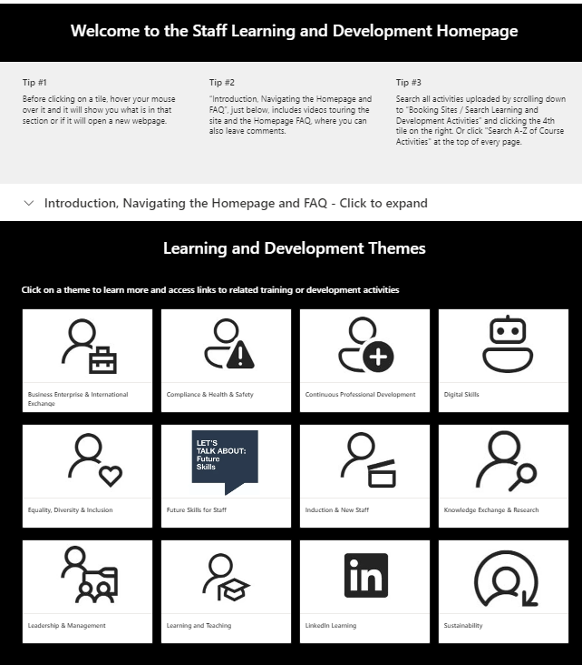
The overall design of the homepage was created based on the feedback and intel gathered, with 12 key themes, linking to direct StaffSpace pages with more information and an A-Z list of specific named courses. Of the 12 themes, some were direct links, while others had subthemes, where multiple information sources were available. For example, Digital Skills had subthemes including Canvas Training, Core Technologies, Data Insight Training, JISC Discovery tool, etc. The twelve themes used were applicable to all staff, whether academic or professional, to encourage integration and support the ongoing development of all, although some aspects might have been more applicable to certain groups. The twelve themes were: Business Enterprise and International Exchange; Compliance; Continuous Professional Development; Digital Skills; Equality, Diversity and Inclusion; Health and Safety; Induction and New Staff; Knowledge Exchange and Research; Leadership and Management; Learning and Teaching; LinkedIn Learning and Sustainability. The look and feel of the Learning and Development Homepage followed the university’s brand guidelines, however black and white were used to be clear and distinctive compared to other pages. Feedback on accessibility of the pages was gained from multiple stakeholders prior to launch. Figure 1 shows the front-page design.
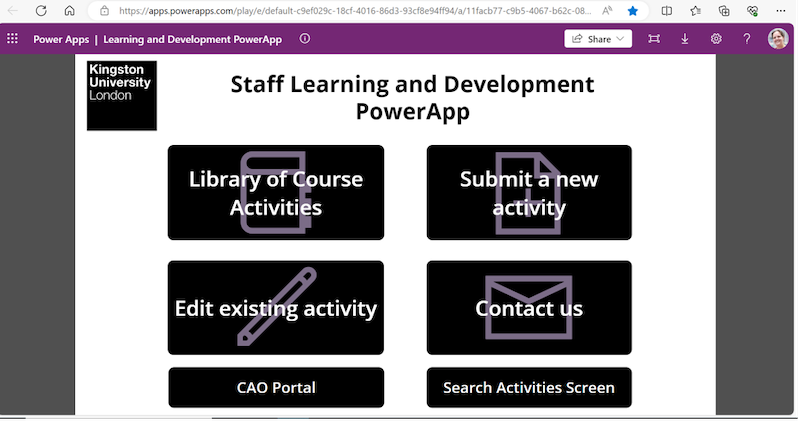
Using a PowerApp was innovative for Kingston University, so work was needed to collaborate with an IT expert who supported the work (Yegulalp, 2015). PowerApps provide a way to use information in a user-friendly way (Mercurio & Merrill, 2021). The PowerApp provides a route for course activity owners to input named courses onto the site to appear in an A-Z list. If the course needs to be edited or removed, they can also do this. The PowerApp links to a Sharepoint list that contains all of the information, which can be overseen by an administrator, for a final governance check of the courses that have been added, and this information is then translated into an easy-to-read format on the Learning and Development Homepage for the end user. Figure 2 shows the user interface for the course activity owners using the PowerApp.
The use of the PowerApp is underpinned by a Learning and Development Policy along with a Learning and Development Manual, which provides step-by-step instructions for use of the PowerApp, and what information should be entered. The manual was also created to give guidance and support for any course activity owner who was new to the process and led them through the considerations for planning, running and evaluation of a learning event. Governance processes also governed management of content on the Learning and Development Homepage and its subpages. On the Learning and Development Homepage it has been made clear that that the front page is links but any linked pages are the responsibility of that team to maintain, so any queries should be directed to the correct team. Knowing more visitors would be visiting the team pages, multiple teams were inclined to update and develop their sites, through individual meetings and after discussions in the course activity owner fora.
Throughout the design and development of the homepage, the creators were entrusted with a high degree of independence. This autonomy enabled them to establish relationships and build trust with various stakeholders, gaining valuable insights throughout the process. Regular feedback sessions with HR and OD colleagues provided additional perspectives, ensuring alignment with the project's desired outcomes. The dedicated focus on the design and delivery of the project fostered a concentrated effort, which significantly contributed to the project's successful completion.
For the launch of the Learning and Development Homepage videos were created for StaffSpace explaining what the site is, how it was developed and why staff should use it. Multiple demonstration sessions also took place in person across all campuses and online.
In the two months since the launch, site analytics have shown there were 7,866 site visits, with 827 unique viewers. As of April 2026, there had been 1,690 unique visitors, showing reach across most staff. Due to increased views Course Activity Owners have also been updating their offerings to ensure the content that viewers see is up-to-date and relevant, hence, ensuring continued quality of opportunity to support the development areas needed by staff. Feedback from colleagues included emails such as:
I have just watched the recording for the new Learning and Development Homepage overview. Thank you so much. It was very helpful. I have been at Kingston for 3 years now and the training/staff development online materials and access finally made sense!
Since the launch, additional initiatives have been introduced within the university, such as an updated approach to appraisals. The Learning and Development Homepage is prominently listed as a resource to facilitate developmental conversations for staff and is accessible via the front page of the staff intranet for ease of use. The usage of the Learning and Development Homepage, while constant throughout the year, has seen an increase in usage during the appraisal window, as planning for personal development in the next academic year takes place. Discussing Learning and Development during the appraisal allows continued reflection on individuals’ lifelong learning and their professional identity (Friedman, 2023). It also allows the line manager to support the ongoing learning journey of each individual through being a critical friend (MacPhail et al., 2021). Continued promotion of the site during university-wide, departmental, and faculty meetings is enhancing its visibility and increasing support among staff members. To continue the journey of staff learning, and exploring opportunities that are available to staff in the academic year 2025-2026, ‘unlocking your learning’ 30-minute hybrid drop-in sessions were introduced, to offer staff guidance, demos and Q&A. These run once a month. The Learning and Development Homepage is also included as a link to the induction booklet, so new staff can see the importance that the leadership team places on development opportunities.
Whilst the project was completed within a limited timeframe, which was at times a challenge, it was important to ensure that all current practices were reviewed prior to a solution being created. Working with all identified stakeholders was a positive step, and ongoing collaborations will be key to the continuing success and evolution of the project.
The use of the PowerApp was innovative, but seeing the success of the design, the implications for Kingston University include that it can now be used as a blueprint for other webpage designs. Whilst the Learning and Development Homepage was for staff, its easy-to-access design menu has provided the template for staff systems also. The design was utilised in the creation of a Student Hub page, to support their navigation of issues, such as accommodation, campus life, disability services and wellbeing, etc. A simple, yet engaging, design can be used for multiple purposes, both internally and beyond.
Limitations remain, as the homepage is not a comprehensive learning management system (LMS). Future work should include evaluating the feasibility of integrating all current processes into a unified LMS. This scoping effort aimed to streamline operations and enhance the user experience by consolidating various functionalities into a single system. There is also scope to review and incorporate Artificial Intelligence (AI) tools in the future, to ensure data is current and reviewed regularly using an automated approach, therefore reducing reliance on human input. Human review, however, should still also be required. AI could also be used to support analysis for learners and perhaps link to available external development opportunities, such as free e-learning courses (Okanlawon et al., 2025).
The Learning and Development Homepage will continue to support learners to find information about all opportunities in one place, and this is something that all institutions, both in the United Kingdom and beyond, are urged to use to support their staff. Evaluation of usage and uptake of courses is also encouraged, to ensure constant review of availability, and uptake, to streamline appropriate opportunities. Implications for staff in academic, professional and corporate environments are that all can benefit from easy access to all available development opportunities, to support engagement with corporations and upskilling to ensure ongoing career support, whatever the role.
Al-Hamad, N., Oladapo, O.J., Afolabi, J.O.A., & Olatundun, F. (2023). Enhancing educational outcomes through strategic human resources (HR) initiatives: Emphasizing faculty development, diversity, and leadership excellence. Education, 1-11.
Alenezi, M. (2023). Digital learning and digital institution in higher education. Education Sciences, 13(1), 88. https://doi.org/10.3390/educsci13010088
Bambang Purwanto, M. (2023). Professional growth and staff development (How to encourage employees to pursue professional development). International Journal of Technology and Education Research, 1(01), 153-165.
Coomber, R. (2019). How do professional service staff perceive and engage with professional development programmes withing higher education institutions? Perspectives: Policy and Practice in Higher Education, 23(2-3), 61-69. https://doi.org/10.1080/13603108.2018.1543216
Filippou, K., Acquah, E.O., & Bengs, A. (2025). Inclusive policies and practices in higher education: A systematic literature review. Review of Education, 13, e70034. https://doi.org/10.1002/rev3.70034
Friedman, A.L. (2023). Continuing professional development as lifelong learning and education. International Journal of Lifelong Education, 42(6), 588-602. https://doi.org/10.1080/02601370.2023.2267770
Garavan, T.N., O’Brien, F., Duggan, J., Gubbins, C., Lai, Y., Carbery, R., Heneghan, S., Lannon, R., Sheehan, M., & Grant, K. (2020). Definitions and the evolution of learning and development research and practice. In Learning and development effectiveness in organisations. Palgrave Macmillan, Cham. https://doi.org/10.1007/978-3-030-48900-7_2
Holmes, A. (2020) What are the barriers and opportunities for continuing professional development for professional services staff in UK HE? Perspectives: Policy and Practice in Higher Education, 24(3), 79-86. DOI: 10.1080/13603108.2020.1750501
Kingston University. (n.d.). Kingston University London – A UK-based university which features in the latest OS World University Rankings league table of the world’s top universities. https://www.kingston.ac.uk
Krille, C., & Krille, C. (2020). Barriers to participation in professional development. In Teachers' participation in professional development: A systematic review, 27-39.
MacPhail, A., Tannehill, D., & Ataman, R. (2021). The role of the critical friend in supporting and enhancing professional learning and development. Professional Development in Education, 50(4), 597-610. https://doi.org/10.1080/19415257.2021.1879235
Mather, M.F., & Bam, N.E. (2025). Factors influencing academic staff satisfaction and retention in higher education: A literature review. European Journal of Education, 60, e70025. https://doi.org/10.1111/ejed.70025
Mercurio, R., & Merrill, B. (2021). Power apps. In Beginning Microsoft 365 collaboration apps: Working in the Microsoft cloud (pp. 351-370). Apress.
Micallef, R., Kayyali, R., & Ooms, A. (2022). The PRACTICE framework for organising and delivering a learning event for pharmacists' lifelong learning. Currents in Pharmacy Teaching and Learning, 14(4), 407-414. https://doi.org/10.1016/j.cptl.2022.03.004
Okanlawon, K., Olatunji-Ishola, C.O., & Alabi, O.A. (2025). From automation to personalization: A comprehensive survey on the role of AI in modern e-learning. Tech-Sphere Journal for Pure and Applied Sciences, 2(1). https://doi.org/10.5281/zenodo.15960870
Owusu-Agyeman, Y. (2024). How lifelong learning shapes the professional development of staff in higher education institutions. Quality Education for All, 1(2), 134-150, doi: https://doi.org/10.1108/QEA-01-2024-0013
Panda, S. (2023). Editorial: Learners as focus in ‘Learning for Development’ (L4D). Journal of Learning for Development, 10(3), i-iv. https://doi.org/10.56059/jl4d.v10i3.1259
Rachmad, Y.E. (2025). The new era of HR management: Prioritizing competence over degrees. United Nations Development Programme.
Solomon, M.A., Gebremedhin, A.A., & Tigistu, K.W. (2023). Continuous professional development in higher education: A systematic review of its conceptualizations, trends and challenges (2011-2020). Bahir Dar Journal of Education, 23(1), 21-39.
Yegulalp, S. (2015). Microsoft power apps helps non-developers build mobile apps. InfoWorld.Com. https://www.proquest.com/trade-journals/microsoft-powerapps-helps-non-developers-build/docview/1737990071/se-2
Yonkers, A. (2024). Embedding future skills: A university-wide approach. In S. Norton, M. Phillips & I. Ugiagbe-Green (Eds.), Lighting the labyrinth: Enhancing student success through the 3Es, 35.
Author Notes
Ricarda Micallef is an Associate Professor in Pharmacy Practice at Kingston University with extensive experience of training and developing Pharmacists and Pharmacy students. From experience within the pharmacy sector her PhD focused on designing a tool to ensure the successful delivery and evaluation of a learning event. She has published widely on pharmacy services and pedagogical interventions. During a secondment opportunity she supported the University to develop the Staff Learning and Development Homepage. Email: r.micallef@kingston.ac.uk (https://orcid.org/0000-0003-0427-1177)
Joy Hurman is a Learning and Development Consultant at Kingston University with experience of working in multiple sectors and organisations to support their ongoing development offer. She oversaw the project to develop and launch the Staff Learning and Development Homepage. Email: j.hurman@kingston.ac.uk (https://orcid.org/0009-0006-8592-0114)
Neil West is a senior coordinator in the student casework team at Kingston University with experience of working across the University on various projects. He was instrumental in understanding the technology required to enable a successful launch of the Staff Learning and Development Homepage during his secondment opportunity. Email: n.west@kingston.ac.uk (https://orcid.org/0009-0003-3573-7299)
Cite as: Micallef, R., Hurman, J., & West, N. (2026). Creation and implementation of a learning and development homepage for a higher education institution. Journal of Learning for Development, 13(2), 387-395.