Khue Van Tran and Mai Thi Truc Le
2025 VOL. 12, No. 2
Abstract: While engaging with feedback is of significance for learning, current studies have highlighted students’ lack of engagement with feedback. This study aimed at identifying predictors of university students’ feedback use in a blended learning environment based on the extension of the Planned Behaviour Theory. Data were collected via a questionnaire from 374 Vietnamese students who were learning English as a foreign language at a private university in the South of Vietnam. The extension model was tested using partial least square structural equation modelling. The findings revealed that the original model was effective in predicting students’ use of feedback, with attitude and perceived behavioural control as direct predictors of intention, which is an influential factor of students’ use of feedback. It is recommended that educators should employ strategies to enhance self-regulation skills, foster positive attitudes towards feedback, and empower students’ self-efficacy in dealing with feedback, thereby optimising their utilisation of feedback.
Keywords: feedback intention, feedback use, theory of planned behaviour, English as a foreign language, higher education
Since Covid-19 was brought under control, schools around the world have returned to face-to-face or shifted to blended learning modes (Batista-Toledo & Gavilan, 2022). Likewise, some Vietnamese tertiary institutions continue running their training programmes with blended learning modes, which aligns with the Vietnamese government’s policies for the integration of technology in education in the period 2025-2030 (Do et al., 2021).
Blended learning has gained recognition as an essential educational approach in the twenty-first century since it can provide personalised education to every individual in diverse learning contexts, including schools, universities and even at home (Thorne, 2003). Despite its significance, less research has been conducted on blended learning environments in Vietnam (Nguyen et al., 2020).
In blended learning (BL), feedback plays a crucial role in providing students with information about their performance (Hattie & Timperley, 2007), whether through classroom interactions like questions and clarifications, referred to as feedback talk, verbal feedback in written assignments (Heron et al., 2023), or technology-driven methods, such as text-based, audio-visual and automatic feedback (Hahn et al., 2021; Ryan, 2020). Therefore, engaging with feedback is vital for students’ effective learning (van der Kleij & Adie, 2020). However, there is a contradiction between the conception of effective feedback and students’ use of feedback. Current literature has highlighted that students seem to be engaging less with feedback (Jensen et al., 2021; Winstone et al., 2022), while previous studies have identified influential factors affecting students’ engagement with feedback (e.g., Goto et al., 2021; Kyaruzi et al., 2019). However, there has been scant research conducted on determinants of feedback adoption in the BL context post-Covid-19. Consequently, there is a need for further investigation into the factors influencing students' intention to use and the actual use of feedback in BL environments in Vietnamese higher education.
To address this gap, this study draws on the theory of planned behaviour (TPB) proposed by Ajen (1991). TPB indicated that human behaviours can be determined by behavioural intentions that are predicted by several factors, including attitude toward behaviour (ATT), subjective norm (SN), and perceived behavioural control (PBC). By applying this model, this study aims to examine the factors influencing students’ intention to use and the use of feedback in the BL context in higher education in Vietnam. Moreover, it has been identified that the original model has not fully predicted behaviour (Bauer et al., 2018; McEachan et al., 2011). Therefore, this study extends the original model by exploring the factor self-regulation, which has been found as a predictor of actions in the field of medicine (Brown & Hirschfield, 2007; Fatima et al., 2021). This study seeks to provide insights into influential factors for feedback use and explore the extent to which self-regulation impact on students’ feedback is used in the BL context.
Blended learning refers to the combination of face-to-face teaching with synchronous or asynchronous online learning (Hashemi & Si Na, 2020). This learning mode allows educators both to deploy technology based techniques in the language classroom to optimise students’ learning process, and to employ the advantages of the traditional face-to-face classroom (Thorne, 2003). In blended learning mode, the proportion of online course delivery ranged from 30% to 79% (Graham, 2006). In this study, blended learning is defined as a rotation of face-to-face teaching with synchronous online learning.
No matter how effective the feedback information provided, feedback is useless without students using it (van der Kleij & Adie, 2020). By actively engaging with feedback, students demonstrate their understanding of the target knowledge, thus enhancing their self-regulation and improving their learning outcomes (Carless & Boud, 2018). To enhance students’ feedback engagement, it is necessary to improve their feedback literacy (Carless & Boud, 2018). Despite recognising students’ significant roles in the feedback process, it is evident that the transmission view of feedback continues to dominate and students’ passive role in the feedback process is still common (Winstone et al., 2022). Students’ lack of engagement with feedback is not only limited in a face-to-face classroom but also in an online learning environment (Jensen et al., 2021), even though the implementation of technology in the feedback process has been considered as a way to enhance the benefits of feedback toward students’ learning.
Considering enhancing students’ involvement with the feedback process, several recent studies, using either qualitative or quantitative designs, have been conducted to identify the factors that influence students’ engagement with the feedback process or the intention to use feedback in learning.
Regarding qualitative research, Harrison et al. (2016) conducted their study with six focus group interviews from three medical schools from the US, the UK and the Netherlands. The students had feedback from multiple sources and compiled these into portfolios. Four factors identifying students’ acceptance of feedback were found: personal agency, authenticity and relevance of assessment, grades and comparative ranking, and scaffolding of feedback. Likewise, Mahfoodh (2022) conducted semi structured interviews with 10 EFL students, and collected data from students’ written evaluations and the teacher’s feedback. They identified two main factors that influenced students’ utilisation of teacher written feedback, including feedback related factors and student related factors.
In terms of quantitative research, Kyaruzi et al. (2019) conducted their research on 2,767 Grade 11 students in Tanzania in traditional face-to-face classrooms. Drawing on the assumption that perception would affect behaviours and outcomes perception (Ajzen, 1991), Kyaruzi et al. found that students’ perceptions of the quality of teacher feedback and scaffolding were significant predictors of students’ feedback use, however, teachers’ controlling practice might have a negative effect for students’ use of feedback. In general, their model can explain nearly 60% of variance. Likewise, Goto et al. (2021) carried out their study on third-year pre-service teachers pursuing a Bachelor of Education degree, who had experience in both face-to-face classroom and blended learning environments. Using the survey instrument developed from the original unified theory of acceptance and use of technology (UTAUT2), their findings suggested that hedonic motivation, perceived relevance, habit, and social influence were predictors for the behavioural intention to use online formative feedback, which explains 63.6% of the variance as reported by the participants. Both studies appear to be effective in providing predictors of feedback use or predictors of behavioural intention toward feedback use and can explain about 60% of the variance in their respective contexts. However, regarding the first study, conducted by Kyaruzi et al. (2019), they did not shed light on the role of behavioural intention, which can only turn beliefs into actions if intentions are strong enough (Ajzen, 1991). Additionally, in terms of the second study, Goto et al. (2021) only focused on behavioural intention and ignored how intentions affected the behaviours, since good intentions might not lead to real actions (McEachan et al., 2011).
Generally, these studies provide various factors that impact on students’ engagement with feedback. These studies were all cross-sectional studies, which limit their findings/results being generalised to other contexts. Moreover, there is a lack of research identifying students’ use of feedback in blended learning after Covid 19. To bridge the gap, the current study draws on the theory of planned behaviour (TPB) by Ajen (1991) to explore the influential factors of students’ use of feedback (UOF) in such a blended learning context. By integrating TPB, we aim to understand the determinants of students’ feedback behaviours and provide actionable insights for improving educational practices.
According to the theory of planned behaviour (TPB) developed by Ajzen (1991), people's behaviours can be predicted by their behavioural intentions, which are determined by three intercorrelated predictors: attitude toward behaviour (ATT), subjective norm (SN), and perceived behavioural control (PBC). These predictors are crucial in understanding the behaviours of individuals, including students’ responses to feedback.
The first predictor, ATT, is the extent of an individual’s favourable or unfavourable evaluation of a behaviour. Researchers who examined students’ attitudes towards feedback believed that attitude could affect students’ acceptance and use of feedback (Cheah & Li, 2020; Zumbrunn et al., 2022). However, positive attitude sometimes does not lead to the expected behaviour, which implies that other factors are involved in the formation of a behaviour (Erten & Köseoğlu, 2022).
The second predictor, SN, describes how social pressures influence an individual to engage in or refrain from performing a behaviour. Previous researchers identified several external agents influencing students performing actions in an educational context, such as family, teachers, friends, classmates, etc. (Ababneh et al., 2022). Previous research found that SN can affect individuals from collectivist cultures (Ham et al., 2015), while the influence may be the opposite for those from individualistic cultures (Yuan et al., 2015). Moreover, some also found that the SN partly defines ATT (Terry et al., 1999). The third predictor, PBC, refers to the degree to which an individual perceived a behaviour was easy or difficult to perform. In the blended learning environment, technology-mediated feedback has been recognised for creating more convenience for students to engage with feedback (Winstone & Carless, 2019). However, several related studies have highlighted that technology also hinders students from engaging with feedback (Mensink & King, 2020; Jensen et al., 2021; Winstone et al., 2021).
According to TPB, an individual with favourable ATT, positive SN, and high levels of PBC is more likely to have a stronger behavioural intention to engage in a specific behaviour. Furthermore, this intention directly affects the associated behaviour. In addition, it is worth-noting that PBC not only influences intentions but also directly predicts behaviour (Ajzen, 2002). To effectively measure the PBC variable, Ajzen (2002) suggested researchers should consider assessing the items of the two constructs, including self-efficacy and controllability.
TPB suggests that an individual with favourable ATT, positive SN, and high levels of PBC is more likely to have a stronger behavioural intention to engage in a specific behaviour, which directly affects the actual behaviour. In addition, it is worth-noting that PBC not only influences intentions but also directly predicts behaviour (Ajzen, 2002). The TPB developed by Ajzen (1991) has been widely used as a theoretical framework to comprehend and anticipate deliberate behaviours in various fields, including education (Ababneh et al., 2022; Correia et al., 2022; Erten & Köseoğlu, 2022; Yan & Cheng, 2015).
In our study, we adopted the TPB framework to explore factors influencing students' intentions and the actual use of feedback. This framework was suitable because responding to feedback is a volitional behaviour. Applying the TPB, our study contributes to theoretical advancements in behaviour prediction and offers practical implications for educational interventions. Understanding these predictors helps educators design strategies to enhance students' engagement with feedback, ultimately improving educational outcomes (Patterson, 2001).
This study aimed to examine the factors that influence students’ use of feedback (UOF) in educational settings by applying the TPB and integrating self-regulated learning (SRL) as an extension to the model. Specifically, the study had two objectives:
Drawing from TPB, we proposed the following hypotheses related to the first objective.
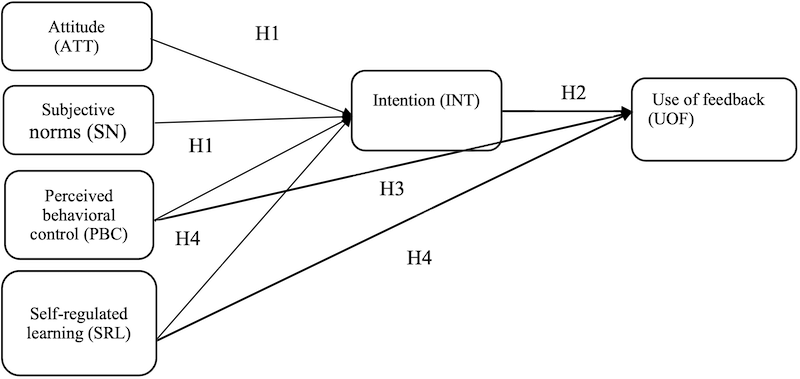
H1: ATT towards feedback, SN and PBC act as predictors of students’ INT towards feedback.
H2: INT towards feedback is a predictor of students’ UOF.
H3: PBC is a predictor of students’ UOF.
However, it has been widely accepted in the literature that INT alone cannot fully explain the performance of behaviours (McEachan et al., 2011; Bauer et al., 2018). Regarding the theory, the narrower the gap between the intention and behaviour, the more likely the behaviour will be performed. Therefore, current researchers (e.g., Bauer et al., 2018; Lihua, 2022; Wang et al., 2023) have proposed extending the existing theoretical model to better understand determinants of certain behavioural intention and behaviour.
In the educational setting, self-regulated learning (SRL) refers to students’ ability to monitor and control their learning behaviour to achieve a desirable objective (Zimmerman, 2002). In the SRL model proposed by Butler and Winne (1995) and Nicol and Macfarlane-Dick (2006), monitoring of tactics and strategies are an important metacognitive process enabling students to generate internal feedback (Chou & Zou, 2020). To make external feedback effective, it is necessary for students to generate internal feedback (Chou & Zou, 2020). This process emphasises the significance of students’ metacognitive strategies in engaging with external feedback. In the same vein, several research findings highlighted the relationship between SRL and students’ UOF that students with high self-regulation tend to actively engage with feedback given by their instructors (Brown & Hirschfield, 2007; Fatima et al., 2021). Besides, Hall et al. (2008) and Wang et al. (2023) also found that SRL can narrow the gap between INT and behaviour in the medical field with TPB. Therefore, our current research extended the original model of TPB by incorporating SRL to minimise the gap between INT and students’ UOF. We propose the following hypothesis associated with our second objective:
H4: SRL influences both students’ INT and UOF.
This study adopted a quantitative research design to investigate the predictors of Vietnamese EFL students’ feedback INT and UOF in a blended learning environment at a private university in the south of Vietnam. This quantitative research design was appropriate for the purpose of the study because it was the most effective approach to test predictor of outcomes (Creswell & Creswell, 2018).
In this study, we aimed to identify predictors of students’ INT and UOF by examining the extension of the original PBT with the additional factor, namely self-regulation. To achieve the objectives, we employed a survey questionnaire adapted from validated TPB and SRL scales. The collected data were analysed using descriptive statistics, exploratory factor analysis (EFA) and partial least squares structural equation modelling (PLS-SEM) to examine the proposed relationships among the constructs.
This study is grounded in the TPB and extended by incorporating SRL as an additional predictor. As shown in Figure 1, the model hypothesises that students’ ATT, SN, PBC, and SRL influence their INT to use feedback, which, in turn, predicts their actual UOF. Additionally, PBC and SRL are also hypothesised to have direct effects on feedback use. The conceptual framework is presented in Figure 1.
The participants were 374 Vietnamese EFL first-year students, including 209 males (55.9%) and 165 females (44.1 %) from different majors. According to Kock and Hadaya (2018), the minimum sample size for the PLS-SEM research model can be calculated by the equation (2.846/bmin) ^ 2,0). Using a significance level of 5%, and a minimum path coefficient (bmin) of 0.2, the calculation yielded a minimum sample size of (2.846/0.2) ^2 = 154.5049. Therefore, the numbers of participants in this study were qualified for data analysis. The participants were recruited using a convenience sampling technique. We approached them in their classroom and carefully presented our research. Those who expressed interest in participating were invited to sign consent forms. Once we obtained their consent forms, we provided them with a link to a Google Form to complete the questionnaire. These students were selected from a population of 2,340 students who enrolled in English preparation courses at Modern University (pseudonym) in Can Tho city, Vietnam. This institution was selected because it is the only one in the region offering English blended-learning courses, which aligned with the purposes of the study.
The participants’ age was between 19 and 21. At the university, all first-year students were required to enrol in English preparation courses before they commenced their major studies. At the time of conducting this study, the participants had been learning English for over six months. Their English programmes were delivered with a blended learning mode, which involved a combination of face-to-face sessions and synchronous online sessions with a fixed schedule. Particularly, classes were scheduled weekly, with three days of face-to-face sections and two days of synchronous online sections.
The questionnaire was the primary instrument for data collection. Prior to completing the questionnaire, the participants’ consent forms provided were obtained. The questionnaire included two sections. The first section gathered participants’ demographic information while the second section involved detailed questions aiming at measuring variables in the proposed research models.
The second section comprised 47 items with 6-point scales adapted from validated questionnaires used in previous studies. The scale involved two negative options (strongly disagree and mostly disagree) and four positive options (slightly agree, moderately agree, mostly agree, and strongly agree). First, we adapted 19 items from the previous TPB scales on the formative assessment questionnaire developed by Yan and Cheng (2015) and the conception of feedback created by Kyaruzi et al. (2019). These items included 10 items on ATT measuring participants’ feelings and emotions regarding feedback; four items on SN checking participants’ perception of the importance of others’ opinions on feedback; six items on PBC examining participants’ beliefs about their self-efficacy and control when using feedback; three items on INT assessing participants’ INT and willingness to use feedback. Additionally, we selected 12 items from the metacognitive self-regulation subscale of learning questionnaire developed by Pintrich et al. (1991) to examine participants’ SRL. Finally, we adapted 12 items on UOF questionnaires developed by Kyaruzi et al. (2019), and all items on students’ feedback used the subscale from the assessment experience questionnaire developed by Gibbs and Simpson (2003) to measure students’ UOF.
The questionnaire was translated into Vietnamese, which was proofread by our two colleagues with over five years of experience in teaching English and Vietnamese translation courses. To ensure the reliability of the questionnaire, a pilot test was conducted with 50 participants. Five disqualified items were excluded because the Correlated Item-Total Correlations were below 0.3. These items included two items on SRL (“During class time I often miss important points because I'm thinking of other things” and “I often find that I have been reading for class but don't know what it was all about”), and three items on the UOF subscale (“The feedback does not help me with any subsequent assignments”, “I do not use the feedback for revising”, and “I tend to only read the marks”). The forty-two remaining items are presented in Table 1.
Table 1: Cronbach Alpha of each Cluster in the Questionnaire
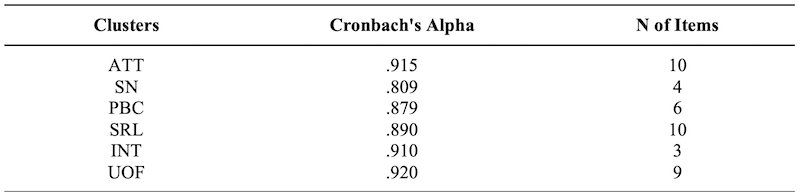
An exploratory factor analysis (EFA) with Principal Axis Factoring and the Promax rotation was run and 30 qualified items related to ATT, SN, PBC, and SRL were loaded into three factors. However, three items from PBC (“I am in charge of deciding when I should use feedback,” “I know how to use feedback,” and “I have enough knowledge to use feedback”) were disqualified and subsequently removed. The analysis was run a second time with the remaining 27 items, which were loaded into three factors. Specifically, four items from SN were loaded into the ATT factor, resulting in a total of 14 items for this factor. We still named this factor ATT. The Kaiser-Meyer-Olkin Measure of Sampling Adequacy (KMO) was 0.961. Additionally, the initial eigenvalues were greater than one, which was considered significant. Furthermore, Bartlett's Test was .000, indicating that all variables were significantly correlated. Simultaneously, similar EFA procedures were applied to the three qualified items related to the INT and nine items on UOF. The KMOs were 0.737 and 0.936, respectively. Additionally, the initial eigenvalues were significant, with a value that exceeded one. In addition, Bartlett's Tests were .000, suggesting the variables were significantly correlated.
To collect quantitative data for this study, an online survey via Google Forms was sent to the participants at the beginning of October 2023. Out of 408 responses, 374 were qualified for data analysis, resulting in a response rate of 91.6%. The qualified responses were processed using IBM SPSS Version 26 to run Exploratory Factor Analysis (EFA) and SmartPLS Version 4 to test the hypotheses.
Ethical issues were strictly considered in this study. Specifically, the study was approved by the university's ethics review committee. Additionally, the participants were informed about the study's purpose, potential risks, their rights, and the need for their signed consent forms. They were also advised that they could withdraw from the study at any time without providing an explanation. During data analysis, they were assigned numbers to ensure their anonymity. The data provided were used solely for this study and were to be deleted after five years.
Table 2 presents the information about factor loading, Cronbach’s alpha, composite reliability and average variance extracted (AVE) of variables of the model.
Loadings with 28 observed variables from the original model and 10 additional variables related to SRL were examined. One item (SRL3) on SRL was excluded because its loading value was below the threshold of 0.7. After removing it, the loading values of the 37 remaining items, the Cronbach’s alpha, and AVE were over the threshold of 0.7. Furthermore, the HTMT was below the threshold of 0.9. It was concluded that the variables achieved reliability, convergent validity, and discriminant validity.
Table 2: Reliability and Validity Results in the Model
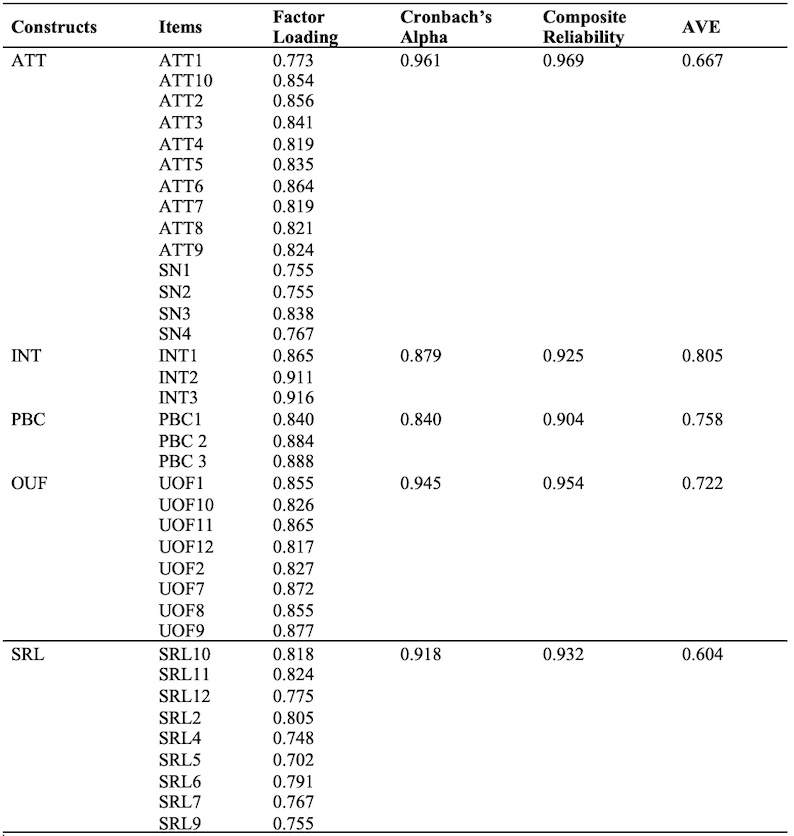
Table 3: Heterotrait–Monotrait Ratio (HTMT) in the Model

Figure 2 and Table 4 show that ATT (β = 0.346, t = 5.456, p = 0.000), PBC (β = 0.238, t = 4.689, p = 0.001), and SRL (β = 0.319, t = 5.043, p = 0.000) positively affected INT, supporting hypotheses H1 and H4. Moreover, INT (β = 0.417, t = 8.693, p = 0.000) and SRL (β = 0.542, t =10.470, p = 0.000) had a positive direct effect on students’ UOF, which supports H2 and H4. However, PBC (β = - 0.025, t = 0.618, p > 0.05) had no impact on students’ UOF, which does not support H3.
R2 results showed that the model explained 75% of the variance the UOF. The INT and SRL were determining factors while PBC did not influence the UOF. Additionally, factors, such as ATT, SRL, and PBC had indirect effects on UOF, ranking from the highest effect to the lower ones respectively.
F2 showed that the independent variables with f were below 0.3, namely ATT (f = 0.142), BHC (f = 0.097), and SRL (f = 0.116) had little effect on INT. Meanwhile, INT (f = 0.326) and SRL (f = 0.599) had significant effects on students’ UOF.
Table 4: Path Coefficients Model
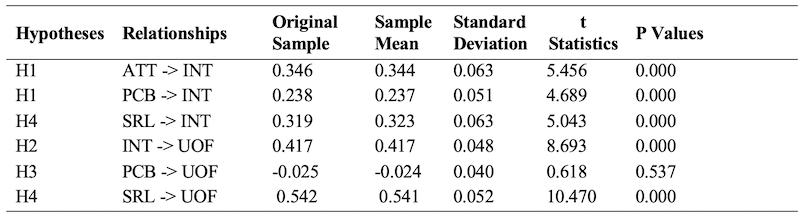
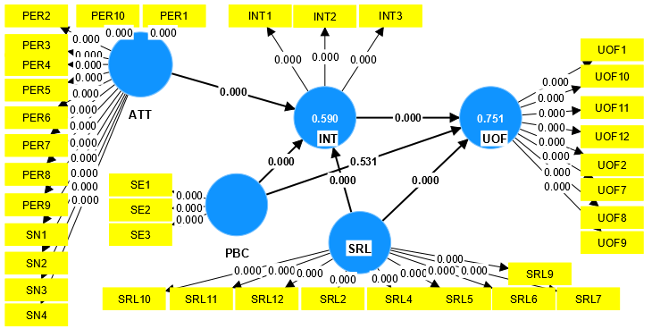
As seen in the model, the INT mediated the effects of ATT, PBC and SRL on students’ UOF. The bootstrapping was run to test the indirect effects, and the results showed that ATT (β = 0.390, t = 9.585, p = 0.000), PBC (β = 0.228, t = 5.983, p = 0.000), and SRL (β = 0.133, t = 4.440, p = 0.000) indicated that INT significantly mediated the effects of ATT and PBC on students’ UOF.
The current study examined the predictors of students’ UOF drawn on the extension of the original framework. Our findings were consistent with the original model in the way that students' ATT and PBC were found to be predictors for INT, which directly affected students’ UOF. However, unlike the original model, the construct SN was merged with the construct ATT, which was aligned with the finding by research using structural equation modelling as stated by Terry et al. (1999). In this regard, the cause of actual action was from the perception of satisfying others (Fishbein & Ajzen, 1975; Liska, 1984, cited in Terry et al., 1999). The reason for this combination between the two constructs was attributed to the Vietnamese context, whose culture is collectivist.
As per our hypothesis, the SRL construct had both indirect effect on behaviour through intention and direct effect on the actual intention. This finding is in line with the current research by Wang et al. (2023), which confirmed the impact of SRL to human behaviour. In addition, it highlighted the vital role of metacognitive strategies in students’ internalisation of feedback process and concured with the findings of Brown & Hirschfield (2007) and Fatima et al. (2021) in the way that higher self-regulated learners are more motivated in responding to their instructors’ feedback. To the best of our knowledge, this is the first study to identify how SRL impacts on students’ INT and UOF.
From the findings, personal factors such as SRL, ATT toward feedback use and PBC have effects on students’ UOF. The findings infer that the more favourable the ATT, PBC and SRL students have, the more likely they will use feedback. Our findings are aligned with Carless and Boud's (2018) conception of students’ feedback literacy emphasising the significant roles of students in engaging with feedback. Therefore, understanding and maximising the positive impact of these factors, including SRL, ATT, and PBC, could greatly enhance students’ feedback uptake.
Drawing on an extended model of the PBT using a PLS-SEM approach, this study provides insights into predictors of INT to use and UOF. We found that ATT, PBC, and SRL significantly influenced students' intentions and use of feedback. Notably, while feedback intention and SRL directly impact UOF, PBC does not. These results underscore the importance of considering INT and SRL in educational strategies to improve feedback utilisation among students. The study contributes to existing knowledge by validating the extended PBT model and highlighting the roles of INT and SRL.
Based on the findings of this study, there are several pedagogical recommendations for enhancing students’ feedback uptake. Firstly, to enhance INT to UOF it is important to consider the ATT and PBC. Educational institutions should promote positive attitudes toward feedback among students. This can be done by conducting workshops or training sessions on the benefits of feedback underscoring the significant role of feedback in improving students’ academic performance. Additionally, to promote the positive impact of PBC, it is recommended to apply the self-efficacy strategies suggested by Bartimote-Aufflick et al. (2016), including supporting students’ psychological needs, providing students positive feedback on performance, and providing scaffolding. Secondly, teachers should incorporate SRL strategies into their teaching practices to help students develop skills for managing their learning and effectively using feedback. Techniques such as goal-setting, self-assessment, and reflective practices can be embedded into the curriculum to enhance students' SRL abilities. Lastly, enhancing feedback literacy is crucial, meaning that students should understand feedback, know how to deal with feedback and use it successfully by recognising their significant roles and those of their teachers (Carless & Boud, 2018).
This study has several limitations. First, it relied on quantitative design with the self-reported questionnaires to generate the results, which might be affected by social desirability bias (Dörnyei & Dewaele, 2022). Further research should explore diverse research methodologies to validate findings. Secondly, the study's sample was confined to university students in Vietnam, limiting generalisability to broader educational contexts. Future studies should be conducted with larger numbers of participants in various educational levels and contexts so that the findings can be replicated across different contexts and time periods. Lastly, while our model explains 75% of variance in students’ UOF, additional factors may influence UOF that were not captured. Further investigations should explore these factors to enrich understanding of the entire landscape of the topic.
Ababneh, K.I., Ahmed, K., & Dedousis, E. (2022). Predictors of cheating in online exams among business students during the Covid pandemic: Testing the theory of planned behaviour. The International Journal of Management Education, 20(3), 1-15. https://doi.org/10.1016/j.ijme.2022.100713
Ajzen, I. (1991). The theory of planned behaviour. Organizational Behaviour and Human Decision Processes, 50(2), 179-211. https://doi.org/10.1016/0749-5978(91)90020-T
Ajzen, I. (2002). Constructing a TPB questionnaire: Conceptual and methodological considerations. Citeseer. https://www.researchgate.net/publication/235913732_Constructing_a_Theory_of_Planned_Behavior_Questionnaire
Bartimote-Aufflick, K., Bridgeman, A., Walker, R., Sharma, M., & Smith, L. (2016). The study, evaluation, and improvement of university student self-efficacy.Studies in Higher Education, 40(11), 1918–1942. https://doi.org/10.1080/03075079.2014.999319
Batista-Toledo, S., & Gavilan, D. (2022). Implementation of blended learning during Covid-19. Encyclopedia, 2(4), 1763-1772. https://doi.org/10.3390/encyclopedia2040121
Bauer, D., Arnold, J., & Kremer, K. (2018). Consumption-intention formation in education for sustainable development: An adapted model based on the theory of planned behaviour. Sustainability, 10(10), 34-55. https://doi.org/10.3390/su10103455
Brown, G.T., & Hirschfield, G.H. (2007). Students’ conceptions of assessment and mathematics: Self-regulation raises achievement. Australian Journal of Educational & Developmental Psychology, 7, 63-74.
Butler, D.L., & Winne, P.H. (1995). Feedback and self-regulated learning: A theoretical synthesis. Review of Educational Research, 65(3), 245-281. https://doi.org/10.3102/00346543065003245
Carless, D., & Boud, D. (2018). The development of student feedback literacy: Enabling uptake of feedback. Assessment & Evaluation in Higher Education, 43(8), 1315-1325. https://doi.org/10.1080/02602938.2018.1463354
Cheah, S., & Li, S. (2020). The effect of structured feedback on performance: The role of attitude and perceived usefulness. Sustainability, 12(5), 1-14. https://doi.org/10.3390/su12052101
Chou, C-Y., & Zou, N-B. (2020). An analysis of internal and external feedback in self-regulated learning activities mediated by self-regulated learning tools and open learner models. International Journal of Educational Technology in Higher Education, 17(1), 1-27. https://doi.org/s41239-020-00233-y
Correia, E., Sousa, S., Viseu, C., & Leite, J. (2022). Using the theory of planned behaviour to understand the students’ pro-environmental behaviour: A case-study in a Portuguese HEI. International Journal of Sustainability in Higher Education, 23(5), 1070-1089. https://doi.org/10.1108/IJSHE-05-2021-0201
Creswell, J.D., & Creswell, J.W. (2018). Research design: Qualitative, quantitative, and mixed methods approaches. Sage Publications.
Do, Q.H.M., Pham, A.M., Van, T.T.N., & Nguyen, T.T.T. (2021). Prospects of blended learning implementation at FPT University Can Tho, Vietnam. Vietnam Journal of Education, 5(3), 43-53. https://doi.org/10.52296/vje.2021.101
Dörnyei, Z., & Dewaele, J-M. (2022). Questionnaires in second language research: Construction, administration, and processing. Taylor & Francis.
Erten, S., & Köseoğlu, P. (2022). A review of studies in the field of educational sciences within the context of theory of planned behaviour. Journal of Turkish Science Education, 19(2), 389-402. https://doi.org/10.36681/tused.2022.127
Fatima, S., Ali, M., & Saad, M.I. (2021). The effect of students’ conceptions of feedback on academic self-efficacy and self-regulation: Evidence from higher education in Pakistan. Journal of Applied Research in Higher Education, 14(1),180-199. https://doi.org/10.1108/JARHE-07-2020-0209
Gibbs, G., & Simpson, C. (2003). Measuring the response of students to assessment: The Assessment Experience Questionnaire. 11th Improving Student Learning Symposium, 26, 30. www.semanticscholar.org/paper/Measuring-the-response-of-students-to-assessment%3A-Gibbs Simpson/57111701f9d713bde7780f6442e6bb4c1cf1b43b
Goto, J., Batchelor, J., & Lautenbach, G. (2021). Factors that influence the acceptance and use of formative feedback in an online undergraduate module. The African Journal of Information Systems, 13(3), 259-295.
Graham, C.R. (2006). Blended learning systems: Definition, current trends and future directions. In C.J. Bonk & C.R. Graham (Eds.), The handbook of blended learning: Global perspectives, local designs. Vol. 1 (pp. 3-21). Pfeiffer.
Hahn, M.G., Navarro, S.M.B., Valentín, L.D.L.F., & Burgos, D. (2021). A systematic review of the effects of automatic scoring and automatic feedback in educational settings. IEEE Access, 9, 108190-108198. https://doi.org/10.1109/ACCESS.2021.3100890
Hall, P.A., Fong, G.T., Epp, L.J., & Elias, L.J. (2008). Executive function moderates the intention-behaviour link for physical activity and dietary behaviour. Psychology & Health, 23(3), 309-326. https://doi.org/10.1080/14768320701212099
Ham, M., Jeger, M., & Frajman Ivković, A. (2015). The role of subjective norms in forming the intention to purchase green food. Economic Research-Ekonomska Istraživanja, 28(1), 738-748. https://doi.org/10.1080/1331677X.2015.1083875
Harrison, C.J., Könings, K.D., Dannefer, E.F., Schuwirth, L.W.T., Wass, V., & van Der Vleuten, C.P.M. (2016). Factors influencing students’ receptivity to formative feedback emerging from different assessment cultures. Perspectives on Medical Education, 5(5), 276-284. https://doi.org/10.1007/S40037-016-0297-X
Hashemi, A., & Si Na, K. (2020). The effects of using blended learning in teaching and learning English: A review of literature. The Eurasia Proceedings of Educational & Social Sciences (EPESS), 2020, 18, 173-179.
Hattie, J., & Timperley, H. (2007). The power of feedback. Review of Educational Research, 77(1), 81-112. https://doi.org/10.3102/003465430298487
Heron, M., Medland, E., Winstone, N., & Pitt, E. (2023). Developing the relational in teacher feedback literacy: Exploring feedback talk. Assessment & Evaluation in Higher Education, 48(2), 172-185. https://doi.org/10.1080/02602938.2021.1932735
Jensen, L.X., Bearman, M., & Boud, D. (2021). Understanding feedback in online learning–A critical review and metaphor analysis. Computers & Education, 173(2021), 1-12. https://doi.org/10.1016/j.compedu.2021.104271
Kyaruzi, F., Strijbos, J-W., Ufer, S., & Brown, G.T. (2019). Students’ formative assessment perceptions, feedback use and mathematics performance in secondary schools in Tanzania. Assessment in Education: Principles, Policy & Practice, 26(3), 278-302.
Lihua, D. (2022). An extended model of the theory of planned behaviour: An empirical study of entrepreneurial intention and entrepreneurial behaviour in college students. Frontiers in Psychology, 12(2021), 1-12.
Mahfoodh, O.H.A. (2022). Factors influencing EFL students' utilisation of teacher written feedback. TEFLIN Journal: A Publication on the Teaching & Learning of English, 33(1), 98-122. http://dx.doi.org/10.15639/teflinjournal.v33i1/98-122
McEachan, R.R.C., Conner, M., Taylor, N.J., & Lawton, R.J. (2011). Prospective prediction of health-related behaviours with the theory of planned behaviour: A meta-analysis. Health Psychology Review, 5(2), 97-144. https://doi.org/10.1080/17437199.2010.521684
Mensink, P.J., & King, K. (2020). Student access of online feedback is modified by the availability of assessment marks, gender and academic performance. British Journal of Educational Technology, 51(1), 10-22. https://doi.org/10.1111/bjet.12752
Nguyen, N.T.L., Le, H.T.T., Nguyen, N.T., & Dang, T.M. (2020). Using blended learning model in improving self-study competence in Physics subject of high school students. Vietnam Journal of Education, 4(1), 53-60. https://doi.org/10.52296/vje.2020.8
Nicol, D.J., & Macfarlane-Dick, D. (2006). Formative assessment and self-regulated learning: A model and seven principles of good feedback practice. Studies in Higher Education, 31(2), 199-218. https://doi.org/10.1080/03075070600572090
Patterson, R.R. (2001). Using the theory of planned behaviour as a framework for the evaluation of a professional development workshop. Microbiology Education, 2(1), 34-41. https://doi.org/10.1128/me.2.1.34-41.2001
Pintrich, P.R., Smith, D.A.F., Garcia, T., & McKeachie, W.J. (1991). A manual for the use of the Motivated Strategies for Learning Questionnaire (MSLQ). https://eric.ed.gov/?id=ED338122
Ryan, T. (2020). Effective feedback in digital learning environments. Melbourne CSHE Discussion Paper. ERIC. http://hdl.voced.edu.au/10707/609416.
Terry, D.J., & Hogg, M.A. (1999). Attitudes, behaviour, and social context: The role of norms and group membership. Psychology Press.
Thorne, K. (2003). Blended learning: How to integrate online and traditional learning (1st ed.). Kogan Page Publishers.
van der Kleij, F., & Adie, L. (2020). Towards effective feedback: An investigation of teachers’ and students’ perceptions of oral feedback in classroom practice. Assessment in Education: Principles, Policy & Practice, 27(3), 252-270. https://doi.org/10.1080/0969594X.2020.1748871
Wang, W., Wu, M., Hua, Y., Zhang, X., & Feng, G. (2023). Using an integrated model of the theory of planned behaviour and the temporal self-regulation theory to explain physical activity in patients with coronary heart disease. Frontiers in Psychology, 14(2023), 1-13. https://doi.org/10.3389/fpsyg.2023.1049358
Winstone, N., Boud, D., Dawson, P., & Heron, M. (2022). From feedback-as-information to feedback-as-process: A linguistic analysis of the feedback literature. Assessment & Evaluation in Higher Education, 47(2), 213-230. https://doi.org/10.1080/02602938.2021.1902467
Winstone, N., Bourne, J.E., Medland, E., Niculescu, I., & Rees, R. (2021). “Check the grade, log out”: Students’ engagement with feedback in learning management systems. Assessment & Evaluation in Higher Education, 46(4), 631-643. https://doi.org/10.1080/02602938.2020.1787331
Winstone, N.E., & Carless, D. (2019). Designing effective feedback processes in higher education: A learning-focused approach (1st ed.). Routledge.
Yan, Z., & Cheng, E.C.K. (2015). Primary teachers’ attitudes, intentions and practices regarding formative assessment. Teaching and Teacher Education, 45, 128-136. https://doi.org/10.1016/j.tate.2014.10.002
Yuan, S., Ma, W., Kanthawala, S., & Peng, W. (2015). Keep using my health apps: Discover users’ perception of health and fitness apps with the UTAUT2 model. Telemedicine and E-Health, 21(9), 735-741. https://doi.org/doi.org/10.1089/tmj.2014.0148
Zimmerman, B.J. (2002). Becoming a self-regulated learner: An overview. Theory into Practice, 41(2), 64-70. https://doi.org/10.1207/s15430421tip4102_2
Zumbrunn, S., Ekholm, E., Broda, M., & Koenka, A.C. (2022). Trajectories of students’ writing feedback attitudes. The Journal of Experimental Education, 91(3), 1-20. https://doi.org/10.1080/00220973.2022.2064413
Author Notes
Khue Van Tran is a Lecturer in English at the Department of English, FPT University, Can Tho Campus, Vietnam. His research focuses on blended learning and educational technology. Email: KhueTV@fe.edu.vn (https://orcid.org/0000-0003-0791-3104)
Mai Thi Truc Le is a Lecturer in English at the Department of English, FPT University, Can Tho Campus, Vietnam. Her research interests include technology-enhanced learning and blended learning. Email: Mailtt15@fe.edu.vn (https://orcid.org/0000-0002-2616-7314)
Cite as: Tran, K.V., & Le, M.T.T. (2025). Predictors of university students’ feedback use in a blended learning context. Journal of Learning for Development, 12(2), 275-289.