Marien Alet Graham, Ishmael Magare and Irma Eloff
2025 VOL. 12, No. 2
Abstract: Recent research studies on student well-being in higher education have emphasised the importance of various psychological factors, however, in online learning environments, demographic factors have been shown to have particularly strong relationships with well-being. This mixed-methods study explored the relationship between demographic variables and student well-being in open and distance learning (ODL) using the PERMA framework. The participants (age: mean = 38.2, SD = 6.5) were BEd students in primary education at an ODL institution in Botswana. Data from a survey (n = 215) and focus-group interviews (7 groups, n = 35) revealed that the only significant demographic predictor of undergraduate students’ perceived well-being was higher levels of education. Qualitative analyses indicate that higher qualifications were related to career advancement, self-actualisation, self-confidence, social status, multi-level learning, a sense of belonging and positive emotions. This study assists in gaining insight into which demographic variable/s enhance student well-being, that, in turn, may help in designing optimal ODL learning environments to support students effectively.
Keywords: open and distance learning, PERMA model, Sub-Saharan Africa, well-being
Student success and well-being in Open and Distance Learning (ODL) have garnered significant attention in recent years (Bowden et al., 2021; Mashile et al., 2023). The Covid-19 pandemic precipitated mass movement to ODL platforms to secure continued learning and improve access to quality education, thereby intensifying the need to understand the dynamics of student learning and well-being in these learning environments (Bozkurt, 2022).
Some studies (e.g., Koh et al., 2022) specifically examined factors such as self-efficacy that predict academic success for university students, revealing differentiated pathways to student success, such as increased behavioural regulation but decreased emotional regulation. While it may initially appear counterintuitive that decreased emotional regulation is conducive to academic development, consider the case of expressive suppression as an emotion regulation strategy. When individuals employ expressive suppression while regulating their emotions, especially in the context of social information, it can result in memory impairment, which suggests that students who adopt expressive suppression face difficulties in socialising, not only with other students but also with their peers, thereby hindering their ability to seek help and collaborate with others (Hafiz, 2015). Other studies have also shown that suppression of emotional expression leads to individuals experiencing more unfavourable feelings and consumes working memory, which could lead to poorer academic achievement (Nadeem et al., 2023). Social factors, such as stress and alcohol consumption, alongside emotional factors such as self-esteem, anxiety and fatigue, have also been associated with varying degrees of student success (López-Moreno et al., 2021). In this regard, student well-being is related to creating the conditions that foster student engagement and success in higher education (Bowden et al., 2021).
In predicting student well-being in higher education, various psychological factors such as hope, life satisfaction and optimism have been highlighted (Rand et al., 2020). In online learning environments, demographic variables such as gender, disability status, regional belonging, socio-economic standing and education level, have been strongly associated with student performance (Rizvi et al., 2019). These demographic factors, which are strongly associated with student achievement, are intricately linked to well-being. This connection is evident in the existing literature: gender (Díaz et al., 2022), disability status (Tough et al., 2017), regional belonging (Morrison, 2021), socio-economic standing (Sainz et al., 2021), and education level (Kristoffersen, 2018) have all been linked to aspects of student well-being. Therefore, the associations between student demographics, well-being and long-term student success bear relevance.
This study seeks to investigate the demographic variables that may be associated with students’ well-being and, consequently, their academic success in an open university environment. Conducted within the Sub-Saharan African context, this study focuses on a region where many tertiary education students are first-generation students, i.e., the first person in their family to attend university. In the African context, supporting well-being over a distance and in online learning environments presents significant challenges. First-generation students in ODL settings may also not have the benefit of friends or family members with prior university experience. First-generation students in ODL settings may also not have the benefit of friends or family members with prior university experience. The assumption, therefore, is that understanding the demographic variables that may contribute to increased well-being could provide insights into how to design ODL learning environments to best support students. The research question guiding this inquiry was: What demographic factors are significant predictors of undergraduate students' perceived well-being in ODL?
Extensive research (Delle Fave et al., 2023; Guse, 2022; Kristjánsson & VanderWeele, 2024) has examined demographic variables associated with well-being and, particularly subjective well-being (SWB; related to happiness and life satisfaction), across all life spans, with the majority of studies finding that well-being and SWB are multi-dimensional and depend on many different key indicators.
On a global level, the World Happiness Reports (Helliwell et al., 2023) explore the demographics of well-being and happiness annually. An analysis (Ngamaba, 2017) of the 2010-2014 World Values Surveyi data, based on 59 countries, found that factors driving SWB included gender, health, freedom of choice, gross domestic product (GDP) per capita, employment and income, friends, leisure and religion. Main et al. (2019) considered data from 15 countries from the Children's Worlds Survey, an international study of child SWB. They found that material resources were related to SWB in all countries, with varied types and magnitude of associations. Jebb et al. (2020) considered variables significantly associated with SWB across 166 nations and found highly consistent results with marriage, employment and life meaning, in that married individuals, employed individuals and individuals with life meaning had a higher SWB than their counterparts. Furthermore, Blanchflower (2021) studied age-related trends in well-being across 145 countries and found the U-shape to hold for the majority of countries (including countries in Africa), indicating the highest happiness levels on the happiness curve occurred during the younger and older phases of life with the lowest levels around midlife. In an educational context, Skaalvik and Skaalvik (2018) considered the well-being of teachers in Norway. They found that teachers who perceived their jobs as "second-order" reported lower teacher well-being.
Turning to Sub-Saharan Africa, Wilson Fadiji et al. (2023) studied the relationship between the demographic variables such as age, sex, religious practice, and standard of living with life satisfaction and meaning in life in urban adults in Ghana. Their study found that living standards predicted life satisfaction, as well as the presence of meaning in life. Similarly, Nanor et al. (2021) conducted a study in rural communities in Ghana and found that SWB was dependent on religion, health and transportation, with the latter being the most significant due to the poor conditions of the roads in the rural communities.
In South Africa, Morton et al. (2018) found that being older, having a high level of education, and having a high income significantly predicted SWB, emphasising the comparative importance of the variables of social determinants and SWB in societal functioning. Savahl et al. (2020) used data from the second wave of the South African Children's Worlds Study conducted on South African children between the ages of 8 and 12, and found a significant association between children’s engagement with family and friends and participation in daily activities and their SWB. More recently, Adedeji et al. (2023) conducted a study on 1,049 South African adults and found that both socio-economic status (SES) and social capital were significant predictors for happiness, which, of course, speaks to other broader life outcomes such as well-being.
Although substantial literature exists on the demographic determinants of SWB globally, few studies have systematically explored these relationships within the Sub-Saharan African context, particularly in ODL settings. Prior research has emphasised socioeconomic status, education, and health as key contributors to well-being, but limited attention has been paid to how these factors intersected in non-traditional higher education contexts. This study addressed that gap by focusing on a sample of adult BEd students in Botswana and identified higher qualifications as the only significant demographic predictor of student well-being. The findings contribute to a growing body of work that seeks to understand how demographic variables shape the student experience and success in online and distance learning environments, particularly in under-researched African contexts.
The PERMA theory of well-being developed from rigorous cross-sectional studies conducted in positive psychology (Seligman, 2018) and served as the framework for the current study, along with self-determination theory (SDT) (Ryan & Deci, 2020). The PERMA framework utilises positive emotion (Umucu et al., 2020), engagement (Delfino, 2019), relationships (Eloff, 2021), meaning and accomplishment (Tansey et al., 2018) as conceptual markers to elucidate well-being in human populations. SDT constitutes three human psychological needs: competence, autonomy, and relatedness (Rigby & Ryan, 2018). The researchers premise that human flourishing prevails under conditions with a significant correlation between inherent values and life experiences. In our study, autonomy is a central psychological need. SDT determines undergraduate students’ quest for personal development and undergirds the internal motivation to explore and adapt to the environment and ultimately improve their well-being (Schultz & Ryan, 2015).
Between 2020 and 2022, this study was conducted at an Open University, focusing on individuals pursuing a BEd in primary education. Participants were recruited via a WhatsApp group, with inclusion criteria specifying students who had enrolled in the BEd in primary education between 2015 and 2017 and subsequently completed their studies. Utilising convenience sampling facilitated efficient recruitment via WhatsApp, with 215 respondents (mean age: 38.2, primarily female: 86.5%) reflecting the university's typical demographics. The participants' nationalities were distributed as follows: 91.2% Motswana, 6.5% Zimbabwean, 1.4% Zambian and 0.9% Kenyan, while the mother tongue of the participants included over 10 languages, with Setswana having the highest percentage (75.8%). The majority were admitted in 2017 (54.0%), held bachelor's degrees (66.4%), and had teaching experience averaging 12.7 years, with the distribution of their teaching placements being: big villages (32.6%), city or town schools (25.1%), small villages (23.3%), and remote areas (11.6%). Nearly half were married (47.4%), followed by those who were single (40.0%).
The sample for the focus group interviews comprised 35 individuals who expressed their willingness to participate in the focus group interviews through an open-ended question in the survey. Of these 35 individuals, again, the majority were female (74.3%), came from the 2017 cohort (51.4%), were teaching in big villages (40.0%), their nationality was Motswana (88.6%) and their mother tongue was Setswana (65.7%).
A sequential explanatory mixed-methods approach (Creswell & Creswell, 2018) was employed where surveys (based on the well-known Seligman’s (2011) PERMA framework, which consisted of 5-point Likert scale ordinal response options) and focus-group interviews were conducted in conjunction with one another. The former considered the PERMA model [Positive emotions (PE), Engagement (EN), Relationships (REL), Meaning (MNG), and Accomplishment (ACC)] and the scale was tailored for an ODL context; the extent of the changes were reflected in Magare et al. (2022). The PE construct had 13 items with questions such as, “How often did you feel cheerful at the university?”, with response options, “Never (1)” to “Always (5)”. The EN construct (six items), REL construct (seven items), MNG construct (three items) and ACC construct (six items) had response options, “Strongly Disagree (1) to Strongly Agree (5)” with questions such as: EN: “I often got completely absorbed in what I was doing”, REL: “I had friends at the university that I cared about”, MNG: “I feel that my university life at the university had a purpose”, ACC: “I was a hard worker”. To establish reliability, Cronbach’s alpha (α) was used and all constructs were acceptable (α > 0.7) except the EN construct; for the latter, one of the EN items (“I kept at my university work until I was done with it”) had to be removed to obtain α > 0.7.
The focus-group interviews were semi-structured interviews, and participants were encouraged to speak freely. From the 35 individuals who agreed to participate in the interviews, seven groups were formed comprising five to seven participants each, and the interviews lasted for approximately one to one and a half hours each. Two of the focus groups were virtual, while five were in-person.
To ensure validity, construct validity was established by conducting correlations and items belonging to the same construct correlated more strongly (convergent validity) than items belonging to a different construct (discriminant validity). As there were numerous correlations run, the correlations are omitted for conciseness and only the relevant results are discussed in this section.
The research hypothesis: Demographic factors are significant predictors for undergraduate students’ perceived level of the PERMA model of well-being in an ODL context. For the quantitative data, certain categories within variables were combined due to sparse data, and one variable was excluded because of high correlation with another. Detailed methodological adjustments are documented via the following DOI:
https://doi.org/10.25403/UPresearchdata.25334905.v1
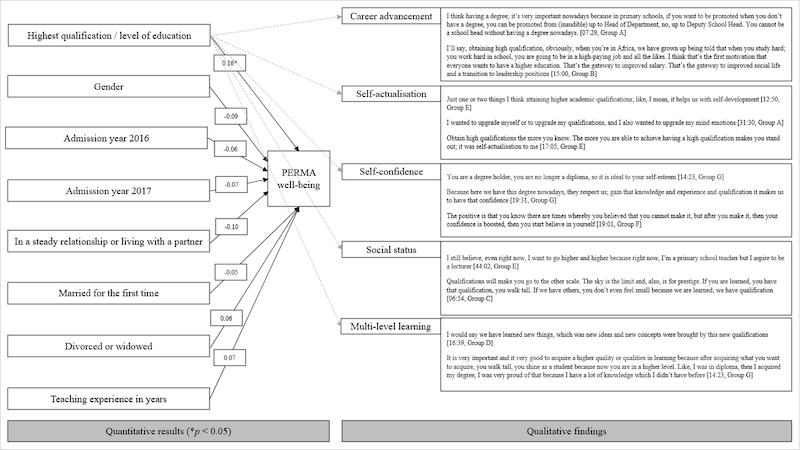
The only significant predictor was “higher qualifications” (Figure 1), and, subsequently, the comprehensive, qualitative dataset was analysed in relation to the occurrences of “higher qualifications” by means of thematic analysis (Braun & Clarke, 2006). A preliminary analysis was conducted to search for key emergent themes. This initial theme analysis was subsequently refined to finalise major themes by collapsing certain overlapping themes and adjusting the chronology in which themes were presented.
A multi-linear regression analysis was conducted to examine whether demographic variables predicted students’ perceived level of the PERMA model of well-being in an ODL context (Figure 1). The adjusted R2 (R2 = 0.089) value demonstrated that the predictor variables accounted for 8.9% of the variance in the perceived level of the PERMA model of well-being scores. The analysis of variance (ANOVA) that examined whether the regression model was a good fit for the data indicated that the predictor variables statistically significantly predicted the dependent variable of the PERMA model of well-being, F(8,201) = 2.462, p = 0.015, and the model was a good fit for the data (Table 1). However, the highest level of education variable was the only significant predictor of the level of students’ well-being in an ODL context (β = 0.20, p = 0.007); the higher the level of education, the higher the well-being and vice versa. Improved well-being, in turn, was related to creating conditions that fostered student engagement and success in higher education (Bowden et al., 2021).
Table 1: ANOVA Statistical Results

Since higher qualifications were found to be a predictor of student well-being, with the literature indicating the latter contributes to student success (Bowden et al., 2021), further fine-grained theme analysis of the qualitative data set was conducted as stated. Aligned with the literature that showed individuals with higher levels of education and qualifications reported better physical and mental health, higher life satisfaction, and greater overall well-being (e.g., Matud et al., 2022), the theme analysis in the current study sought to investigate how the notion of higher education qualifications, when considered in terms of well-being, presented within this population. Findings indicate that “higher qualifications” and their relations to well-being were construed in terms of career advancement, self-actualisation, self-confidence, social status, multi-level learning, a sense of belonging and positive emotions (Figure 1).
Higher Qualifications and Career Advancement
Financial independence, or financial health, refers to the ability to sustain oneself financially without external aid, while financial well-being signifies feeling secure, confident, and content with one's financial status. Both aspects contribute to a sense of security, stability, and control over life, crucial for overall well-being. Research by Iannello et al. (2021) demonstrated that financial well-being positively influenced subjective and psychological well-being in Italian and Portuguese participants aged 20-27. Similarly, Weida et al. (2020) found through quantitative analysis that individuals with sound financial health exhibited better physical and mental health. Advanced qualifications often lead to greater financial independence as they facilitate access to higher-paying jobs and career advancement opportunities. Studies by Ma et al. (2016) and Coetzee (2021) underscore the link between higher education, career progression, and career well-being. Nam (2023) further supports this connection, linking higher education and income with improved financial well-being. Career advancement and promotions, as demonstrated by Iannello et al. (2021) and Weida et al. (2020), enhance financial independence and well-being, contributing to overall welfare. Financial autonomy fosters security and stability, enabling individuals to navigate unforeseen circumstances. However, how finances are utilised affects well-being; spending on experiences, others, and small pleasures enhances well-being (Lloyd & Pennington, 2020). Career advancement not only provides financial independence but also empowers individuals with control over their lives, fostering autonomy, purpose, and fulfilment (Fan et al., 2018). Higher education qualifications correlate strongly with career advancement, as observed in the current study.
Higher Qualifications and Self-Actualisation
Self-actualisation, which varies across developmental stages (Ivtzan et al., 2013), correlates with well-being (Wallace, 2019; Wissing et al., 2021). Our study emphasises the significance of self-development, self-discipline, and self-motivation for well-being. Self-improvement involves continual growth, leading to enhanced self-esteem and well-being (Dogan et al., 2013). Self-discipline, an essential attribute for achieving success, has been shown to enhance mental health and well-being (Şimşir & Dilmaç, 2022). Similarly, self-motivation aligns with subjective well-being (Gordeeva & Sychev, 2021). Engaging in self-actualisation fosters fulfilment and happiness, fundamental for well-being. Wissing et al. (2021) found that flourishing individuals exhibited higher engagement, linking self-actualisation to well-being. Wallace (2019) directly links self-actualisation to well-being in healthcare professionals. Our study's findings resonate with these conclusions.
Higher Qualifications and Self-Confidence
The close connection between well-being and self-confidence that emerged in the current study has long been established in the literature (Ryff, 1989), but is here precipitated by the attainment of higher education qualifications as in earlier research, indicating that individuals with higher qualifications have higher self-confidence (Schoon & Mortimer, 2017). Malkoç and Mutlu’s (2019) study also showed that self-confidence, in conjunction with cognitive flexibility, significantly predicts psychological well-being. In their study, the authors found that self-confidence explained up to 38% of the variance in psychological well-being. Using hierarchical multiple regression on data from 1,990 participants from Spain, Matud et al. (2022) showed that self-confidence was a significant predictor of well-being. Many studies have shown the connection between self-confidence and well-being (Malkoç & Mutlu, 2019). Our study inserts the self-confidence that emanates from completing higher qualifications into the psychological dynamics between the experiences of self-confidence and well-being.
Higher Qualifications and Social Status
Social status has been a foundational aspect of human society throughout history, and emerged as a key construct in the pursuit of higher education qualifications for the participants in the current study. Social status determines how individuals perceive and treat one another in accordance with their status, reputation, and position in society. Many studies have shown that an individual’s level of education is a determinant of social rank (Mirowsky, 2017; Van Noord et al., 2019). In their study of the links between education, social status, and health, Mirowsky (2017) emphasised that educational achievement was indicative of social status. Van Noord et al. (2019) used a dataset based on information from 31 countries to investigate the link between educational level and social status and found that the level of education was an important source of subjective social status for all 31 countries. Theories on the interactions between educational and occupational prestige levels and status aspirations have long been investigated in various scientific disciplines (Mirowsky, 2017; Van Noord et al., 2019) and the findings from the current study seem to similarly suggest close correlations between perceived social status and the completion of an additional tertiary qualification.
Higher Qualifications and Multi-Level Learning
Pursuing and completing a higher qualification entails a multifaceted learning journey. Cooksey and McDonald (2019) underscored the development of skills like critical reflexivity during postgraduate studies, emphasising its inherent learning aspect. Narushima et al. (2018) demonstrated the positive association between continuing education and psychological well-being. Participants in our study highlighted the acquisition of qualification-specific knowledge, alongside transferable skills like technology use. These findings resonate with Ulmanen et al. (2016), who emphasised the affective and social dimensions of learning. Thus, higher qualifications involve not only specific learning but also multi-dimensional learning processes.
Higher Qualifications, a Sense of Belonging and Positive Emotions
Obtaining a higher qualification not only enhances practical skills and career prospects but also profoundly impacts individuals' sense of belonging and positive emotions (Kruse et al., 2020; Nicholson et al., 2018). Kruse et al. (2020) found increased belonging among student nurses engaging in professional development, while Nicholson et al. (2018) observed enhanced belonging and confidence through peer mentoring among primary school teaching assistants. Positive emotions and a sense of accomplishment are integral to well-being (Khaw & Kern, 2015). Our study revealed that completing a higher qualification correlates with well-being constructs such as belonging and joy. Participants reported anticipating access to higher social circles and experiencing a deeper sense of belonging and positive emotions following their qualification attainment. However, the transition period after university warrants tailored support due to reported developmental challenges (Robinson et al., 2021). Further exploration is needed to understand the nuances of belonging and positive emotions associated with higher qualification attainment.
Our study, utilising a sequential explanatory design, revealed that higher qualifications significantly predict the well-being of adult undergraduate students in an ODL context. This finding is of great importance, as the literature has shown that improved well-being leads to improved student success (Bowden et al., 2021). Anchored in the PERMA model of well-being (Seligman, 2011) and self-determination theory (Ryan & Deci, 2020), our findings resonate in six thematic areas: career advancement, self-actualisation, self-confidence, social status, learning, a sense of belonging, and positive emotions. Career advancement emerges as a crucial factor, providing tangible opportunities for promotion and enhanced salaries, thus contributing to hedonic well-being (Diener et al., 2018) and life satisfaction. Self-actualisation, especially significant for students from marginalised backgrounds, is facilitated through self-development, self-improvement, and self-discipline, fostering self-determination and overall well-being (Wissing et al., 2021). The attainment of higher qualifications bolsters self-confidence, impacting students' psychological well-being and functioning (Malkoç & Mutlu, 2019; Matud et al., 2022). Higher qualifications also correlate with social status, influencing workplace hierarchies and promoting subjective well-being (Mirowsky, 2017; van Noord et al., 2019). Learning through higher qualifications cultivates new skills and engagement, fostering social cohesion and well-being (Cooksey & McDonald, 2019; Narushima et al., 2018; Ulmanen et al., 2016). Finally, a sense of belonging and positive emotions associated with obtaining higher qualifications lay essential foundations for well-being (Alsarrani et al., 2022; Bian et al., 2015; Eloff, 2021). Our study underscores the interconnectedness of subjective and objective well-being components, highlighting the multifaceted benefits of higher qualifications in promoting well-being among adult undergraduate students, which, in turn, can lead to higher student success (Bowden et al., 2021).
The significance of the findings from the study relates to the specificity of higher qualifications as a predictor of the well-being of adult undergraduate students in an ODL context — amongst various other demographic variables. Furthermore, the study shows the associations of higher qualifications in terms of well-being, i.e., career advancement, self-actualisation, self-confidence, social status, multi-level learning, a sense of belonging and positive emotions. In addition, whilst well-being in tertiary education students has been studied widely in the global context, studies in Sub-Saharan Africa are still underrepresented. The recommendations, based on the findings of this study and that of the other research studies, are specified in the section below.
Limitations of this study include geographical limitations, lack of individual interviews and the range of demographic variables explored. The study is nested in the Sub-Saharan context, and while it provides insights into the dynamics of student well-being in online environments in Africa, it may have limited or varied applicability in other world contexts. This study also relied on focus group interviews rather than individual interviews in order to ensure diverse views and representivity. While focus groups were used to capture diverse perspectives and ensure representativeness, individual interviews might have provided deeper, more nuanced understanding of how higher qualifications influence experiences of well-being. Future studies could include an expanded list of demographic variables, individual interviews, and data collection in multiple countries.
Gaining insight into demographic variables that can predict and enhance student well-being in tertiary environments could contribute to student success in the long term. By understanding how these demographic variables contribute to well-being, educators and designers of ODL learning environments can tailor their approach to best support students from diverse backgrounds. The current study suggests the attainment of higher qualifications is a significant predictor of student well-being. As such, it is recommended that tertiary education students in ODL contexts should be supported to obtain higher qualifications by providing them with the resources and tools they need to succeed. In light of the qualitative findings, targeted student support interventions could subsequently include specific modules on career advancement, self-actualisation, self-confidence, social status (e.g., awareness of structural inequalities), multi-level learning, a sense of belonging and positive emotions. By inverting the constructs connected to well-being and higher education qualifications in this study, student support could be optimised. Tailored interventions could help ensure that students feel comfortable, engaged, and motivated in their learning, which could ultimately lead to better academic outcomes and increased student success. Support could also be in the form of financial support, creating mentorship programmes and fostering a supportive academic environment by, for example, creating a welcoming and inclusive culture, offering mental health services and promoting well-being to ensure success at the postgraduate level.
Ethical Approval: Ethical clearance was obtained from the University of Pretoria [Reference number EDU040/19]. Participants had to provide informed consent before participating in the study and the anonymity of all participants was ensured as the questionnaire didn’t capture any identifying information, and pseudonyms were used for the interviews. The participants were given no incentives to participate in the study and they could withdraw from the study at any time.
Adedeji, A., Olonisakin, T.T., Buchcik, J., & Idemudia, E.S. (2023). Socioeconomic status and social capital as predictors of happiness: Evidence and gender differences. Humanities and Social Sciences Communications, 10(1), Article 119, 1-8. https://doi.org/10.1057/s41599-023-01606-0
Alsarrani, A., Hunter, R.F., Dunne, L., & Garcia, L. (2022). Association between friendship quality and subjective wellbeing among adolescents: A systematic review. BMC Public Health, 22(1), 1-37. https://doi.org/10.1186/s12889-022-14776-4
Bian, Y., Zhang, L., Yang, J., Guo, X., & Lei, M. (2015). Subjective wellbeing of Chinese people: A multifaceted view. Social Indicators Research, 121, 75-92. https://doi.org/10.1007/s11205-014-0626-6
Blanchflower, D.G. (2021). Is happiness U-shaped everywhere? Age and subjective well-being in 145 countries. Journal of Population Economics, 34, 575-624. https://doi.org/10.1007/s00148-020-00797-z
Bowden, J.L-H., Tickle, L., & Naumann, K. (2021). The four pillars of tertiary student engagement and success: A holistic measurement approach. Studies in Higher Education, 46(6), 1207-1224. https://doi.org/10.1080/03075079.2019.1672647
Bozkurt, A. (2022). Resilience, adaptability, and sustainability of higher education: A systematic mapping study on the impact of the coronavirus (COVID-19) pandemic and the transition to the new normal. Journal of Learning for Development, 9(1), 1-16.
Braun, V., & Clarke, V. (2006). Using thematic analysis in psychology. Qualitative Research in Psychology, 3(2), 77-101. https://doi.org/10.1191/1478088706qp063oa
Coetzee, M. (2021). Career well-being and career agility as coping attributes in the modern career space. In N. Ferreira, I.L. Potgieter, & M. Coetzee (Eds.), Agile coping in the digital workplace. Springer. https://doi.org/10.1007/978-3-030-70228-1_3
Cooksey, R., & McDonald, G. (2019). What skills do I need? In R. Cooksey & G. McDonald (Eds.), Surviving and thriving in postgraduate research (pp. 27-53). Springer. https://doi.org/10.1007/978-981-13-7747-1_2
Creswell, J.W., & Creswell, J.D. (2018). Research design: Qualitative, quantitative, and mixed methods approaches (5th ed.). SAGE.
Delle Fave, A., Wissing, M.P., & Brdar, I. (2023). Beyond polarization towards dynamic balance: Harmony as the core of mental health. Frontiers in Psychology, 14, Article 1177657, 1-11. https://doi.org/10.3389/fpsyg.2023.1177657
Delfino, A.P. (2019). Student engagement and academic performance of students of Partido State University. Asian Journal of University Education, 15(3), 42–55.
Díaz, A., Oramas, M.J.G., & Matud, M.P. (2022). Gender and wellbeing. Frontiers in Psychology, 13, 1-3. https://doi.org/10.3389/fpsyg.2022.1080114
Diener, E., Lucas, R.E., & Oishi, S. (2018). Advances and open questions in the science of subjective well-being. Collabra: Psychology, 4(1), 1-49. https://doi.org/10.1525/collabra.115
Dogan, T., Totan, T., & Sapmaz, F. (2013). The role of self-esteem, psychological well-being, emotional self-efficacy, and affect balance on happiness: A path model. European Scientific Journal, 9(20), 31-42. https://doi.org/10.19044/esj.2013.v9n20p%p
Eloff, I. (2021). College students’ well-being during the COVID-19 pandemic: An exploratory study. Journal of Psychology in Africa, 31(3), 254-260. https://doi.org/10.1080/14330237.2021.1939055/
Fan, L., Chatterjee, S., & Kim, J. (2018, September). Relationships among financial ability, financial independence, and well-being of emerging adults: Does personality matter? 2019 Academic Research Colloquium for Financial Planning and Related Disciplines.
Gordeeva, T., & Sychev, O. (2021). Self-motivation strategies: The quality of internal dialogue is important for well-being and academic success. Psychological Science and Education, 26(5), 7-16. https://doi.org/10.17759/pse.2021260501
Guse, T. (2022). Positive psychological interventions in African contexts: A scoping review. Embracing Well-Being in Diverse African Contexts: Research Perspectives, 16, 375-397.
Hafiz, N. (2015). Emotion regulation and academic performance among IIUM students: A preliminary study. Jurnal Psikologi Malaysia, 29(2), 81-92.
Helliwell, J.F., Layard, R., & Sachs, J. D. (2023). The happiness agenda: The next 10 years. World Happiness Report.
Iannello, P., Sorgente, A., Lanz, M., & Antonietti, A. (2021). Financial well-being and its relationship with subjective and psychological well-being among emerging adults: Testing the moderating effect of individual differences. Journal of Happiness Studies, 22(3), 1385-1411. https://doi.org/10.1007/s10902-020-00277-x
Ivtzan, I., Gardner, H.E., Bernard, I., Sekhon, M., & Hart, R. (2013). Wellbeing through self-fulfilment: Examining developmental aspects of self-actualisation. The Humanistic Psychologist, 41(2), 119-132. http://dx.doi.org/10.1080/08873267.2012.712076
Jebb, A., Morrison, M., Tay, L., & Diener, E. (2020). Subjective well-being around the world: Trends and predictors across the life span. Psychological Science, 31(3), 293-305. https://doi.org/10.1177/0956797619898826
Khaw, D., & Kern, M. (2015). A cross-cultural comparison of the PERMA model of well-being. Undergraduate Journal of Psychology at Berkeley, 8(1), 10-23.
Koh, J., Farruggia, S., Back, L., & Han, C-W. (2022). Self-efficacy and academic success among diverse first-generation college students: The mediating role of self-regulation. Social Psychology of Education, 25(5), 1071-1092. https://doi.org/10.1007/s11218-022-09713-7
Kristjánsson, K., & VanderWeele, T.J. (2024). The proper scope of education for flourishing. Journal of Philosophy of Education. Advance online publication. Article qhae056, 1-17. https://doi.org/10.1093/jopedu/qhae056
Kristoffersen, I. (2018). Great expectations: Education and subjective wellbeing. Journal of Economic Psychology, 66, 64-78. https://doi.org/10.1016/j.joep.2018.04.005
Kruse, J., Didion, J., & Perzynski, K. (2020). Strengthening student nurses’ sense of belonging through attendance at a professional nursing conference. AORN Journal, 112(3), 227-236. http://doi.org/10.1002/aorn.13141
Lloyd, K., & Pennington, W. (2020). Towards a theory of minimalism and well-being. International Journal of Applied Positive Psychology, 5, 121-136. https://doi.org/10.1007/s41042-020-00030-y
López-Moreno, M., Garcés-Rimón, M., Miguel, M., & Iglesias-López, M. (2021). Influence of eating habits and alcohol consumption on the academic performance among a university population in the community of Madrid: A pilot study. Heliyon, 7(6), 1-6. https://doi.org/10.1016/j.heliyon.2021.e07186
Ma, J., Pender, M., & Welch, M. (2016). Education pays 2016: The benefits of higher education for individuals and society. Trends in Higher Education Series. College Board. https://files.eric.ed.gov/fulltext/ED572548.pdf
Magare, I., Graham, M.A., & Eloff, I. (2022). An assessment of the reliability and validity of the PERMA well-being scale for adult undergraduate students in an open and distance learning context. International Journal of Environmental Research and Public Health, 19(24), Article 16886, 1-15. https://doi.org/10.3390/ijerph192416886
Main, G., Montserrat, C., Andresen, S., Bradshaw, J., & Lee, B. (2019). Inequality, material well-being, and subjective well-being: Exploring associations for children across 15 diverse countries. Children and Youth Services Review, 97, 3-13. https://doi.org/10.1016/j.childyouth.2017.06.033
Malkoç, A., & Mutlu, A. (2019). Mediating the effect of cognitive flexibility in the relationship between psychological well-being and self-confidence: A study on Turkish university students. International Journal of Higher Education, 8(6), 278-287. http://doi.org/10.5430/ijhe.v8n6p278
Mashile, E.O., Fynn, A., & Matoane, M. (2023). Curriculum analytics of an Open Distance Learning (ODL) programme: A data-driven perspective. South African Journal of Higher Education, 37(3), 161-182. https://doi.org/10.20853/37-3-4835.
Matud, M., Bethencourt, J., Ibáñez, I., Fortes, D., & Díaz, A. (2022). Gender differences in psychological well-being in emerging adulthood. Applied Research in Quality of Life, 17(2), 1001-1017. https://doi.org/10.1007/s11482-021-09943-5
Mirowsky, J. (2017). Education, social status, and health. Routledge. https://doi.org/10.4324/9781351328081
Morrison, P. (2021). Wellbeing and the region. In M.M. Fischer & P. Nijkamp (Eds.), Handbook of regional science (pp. 779-798). Springer-Verlag. https://doi.org/10.1007/978-3-662-60723-7_16
Morton, D., van Rooyen, D., Venter, D., & Andersson, L. (2018). Social determinants of subjective well-being among young adults living in the Eastern Cape, South Africa. Journal of Psychology in Africa, 28(4), 284-290. https://doi.org/10.1080/14330237.2018.1509515
Nadeem, A., Umer, F., & Anwar, M. (2023). Emotion regulation as predictor of academic performance in university students. Journal of Professional & Applied Psychology, 4(1), 20-33. https://doi.org/10.52053/jpap.v4i1.157
Nam, S. (2023). Effects of financial empowerment and self-confidence in financial empowerment on financial well-being. Current Psychology, 42, 28309–28319. https://doi.org/10.1007/s12144-022-03916-z
Nanor, M., Poku-Boansi, M., & Adarkwa, K. (2021). Determinants of subjective well-being in rural communities: Evidence from the Juaben Municipality, Ghana. Cities, 113, 1-13. https://doi.org/10.1016/j.cities.2021.103140
Narushima, M., Liu, J., & Diestelkamp, N. (2018). Lifelong learning in active ageing discourse: Its conserving effect on well-being, health and vulnerability. Ageing & Society, 38(4), 651-675. https://doi.org/10.1017/S0144686X16001136
Ngamaba, K. (2017). Determinants of subjective well-being in representative samples of nations. The European Journal of Public Health, 27(2), 377-382. http://dx.doi.org/10.1093/eurpub/ckw103
Nicholson, L., Rodriguez-Cuadrado, S., & Woolhouse, C. (2018). Reframing peer mentoring as a route for developing an educational community of practice. Mentoring & Tutoring: Partnership in Learning, 26(4), 420-440. https://doi.org/10.1080/13611267.2018.1530163
Rand, K., Shanahan, M., Fischer, I., & Fortney, S. (2020). Hope and optimism as predictors of academic performance and subjective well-being in college students. Learning and Individual Differences, 81, 1-9. https://doi.org/10.1016/j.lindif.2020.101906
Rigby, C., & Ryan, R. (2018). Self-determination theory in human resource development: New directions and practical considerations. Advances in Developing Human Resources, 20(2), 133-147. https://doi.org/10.1177/1523422318756954
Rizvi, S., Rienties, B., & Khoja, S. (2019). The role of demographics in online learning; A decision tree-based approach. Computers & Education, 137, 32-47. https://doi.org/10.1016/j.compedu.2019.04.001
Robinson, O., Cimporescu, M., & Thompson, T. (2021). Well-being, developmental crisis and residential status in the year after graduating from higher education: A 12-month longitudinal study. Journal of Adult Development, 28, 138-148. https://doi.org/10.1007/s10804-020-09361-1
Ryan, R., & Deci, E. (2020). Intrinsic and extrinsic motivation from a self-determination theory perspective: Definitions, theory, practices, and future directions. Contemporary Educational Psychology, 61, Article 101860, 1-11. https://doi.org/10.1016/j.cedpsych.2020.101860
Ryff, C. (1989). In the eye of the beholder: Views of psychological well-being among middle-aged and older adults. Psychology and Aging, 4(2), 195-210. https://doi.org/10.1037/0882-7974.4.2.195
Sainz, M., Martínez, R., Moya, M., Rodríguez‐Bailón, R., & Vaes, J. (2021). Lacking socio‐economic status reduces subjective well‐being through perceptions of meta‐dehumanization. British Journal of Social Psychology, 60(2), 470-489. https://doi.org/10.1111/bjso.12412
Savahl, S., Adams, S., Florence, M., Casas, F., Mpilo, M., Isobell, D., & Manuel, D. (2020). The relation between children’s participation in daily activities, their engagement with family and friends, and subjective well-being. Child Indicators Research, 13, 1283-1312. https://doi.org/10.1007/s12187-019-09699-3
Schoon, I., & Mortimer, J. (2017). Youth and the great recession: Are values, achievement orientation and outlook to the future affected? International Journal of Psychology, 52(1), 1-8. https://doi.org/10.1002/ijop.12400
Schultz, P., & Ryan, R. (2015). The “why,” “what,” and “how” of healthy self-regulation: Mindfulness and well-being from a self-determination theory perspective. In B.D. Ostafin, M.D. Robinson, & B.P. Meier (Eds.), Handbook of mindfulness and self-regulation (pp. 81-94). Springer. https://doi.org/10.1007/978-1-4939-2263-5_7
Seligman, M. (2018). PERMA and the building blocks of well-being. The Journal of Positive Psychology, 13(4), 333-335. https://doi.org/10.1080/17439760.2018.1437466
Seligman, M. (2011). Flourish: A visionary new understanding of happiness and well-being. ATRIA Paperback. NHRD Network Journal, 9(4), 106-109. http://dx.doi.org/10.1177/0974173920160420
Şimşir, Z., & Dilmaç, B. (2022). The mediating roles of grit and life satisfaction in the relationship between self-discipline and peace: Development of the self-discipline scale. Current Psychology, 41, 8322-8332. https://doi.org/10.1007/s12144-021-01515-y
Skaalvik, E., & Skaalvik, S. (2018). Job demands and job resources as predictors of teacher motivation and well-being. Social Psychology of Education, 21(5), 1251-1275. https://doi.org/10.1007/s11218-018-9464-8
Tansey, T., Smedema, S., Umucu, E., Iwanaga, K., Wu, J-R., Cardoso, E., da Silva, C., & Strauser, D. (2018). Assessing college life adjustment of students with disabilities: Application of the PERMA framework. Rehabilitation Counseling Bulletin, 61(3), 131-142. https://doi.org/10.1177/0034355217702136
Tough, H., Siegrist, J., & Fekete, C. (2017). Social relationships, mental health and wellbeing in physical disability: A systematic review. BMC Public Health 17, 1-18. https://doi.org/10.1186/s12889-017-4308-6
Ulmanen, S., Soini, T., Pietarinen, J., & Pyhältö, K. (2016). The anatomy of adolescents’ emotional engagement in schoolwork. Social Psychology of Education, 19(3), 587-606. https://doi.org/10.1007/s11218-016-9343-0
Umucu, E., Wu, J-R., Sanchez, J., Brooks, J., Chiu, C-Y., Tu, W-M., & Chan, F. (2020). Psychometric validation of the PERMA-profiler as a well-being measure for student veterans. Journal of American College Health, 68(3), 271-277. https://doi.org/10.1080/07448481.2018.1546182
van Noord, J., Spruyt, B., Kuppens, T., & Spears, R. (2019). Education-based status in comparative perspective: The legitimization of education as a basis for social stratification. Social Forces, 98(2), 649-676.
Wallace, J. (2019). Meaningful work and well‐being: A study of the positive side of veterinary work. Veterinary Record, 185(18), 571-571.
Author Notes
Marien Alet Graham holds a doctoral degree in mathematical statistics from the University of Pretoria and is a C3-rated researcher with the National Research Foundation (NRF), South Africa. She has published over 100 articles in peer-reviewed journals and regularly presents her findings at national and international conferences. Email: marien.graham@up.ac.za (https://orcid.org/0000-0003-4071-9864)
Ishmael Magare holds a doctoral degree in Educational Psychology and is a lecturer at the Botswana Open University. He has a vast background in primary and tertiary education, and his focus is on teacher professional development and growth and well-being. Email: imagare@staff.bou.ac.bw (https://orcid.org/0000-0002-2415-1132)
Irma Eloff is a professor of Educational Psychology at the University of Pretoria, a registered educational psychologist and a member of the Academy of Science of South Africa (ASSAF). She is highly rated as a social scientist by the National Research Foundation in South Africa (B2). Email: irma.eloff@up.ac.za (https://orcid.org/0000-0001-8306-3979 4)
Cite as: Graham, M.A., Magare, I., & Eloff, I. (2025). Demographic factors that predict open university undergraduate students' well-being. Journal of Learning for Development, 12J(2), 413-426.
iThe World Values Survey explores how people's values and beliefs change over time, analysing their societal and political impacts (World Values Survey, 2020).