Intan Safiah, Muhammad Yunus, Amar Zaki, Ahadin and Hasniyati
2025 VOL. 12, No. 2
Abstract: In an era of rapid technological advancement, educational models must evolve to meet the ever-changing needs of students. Primary school students, being digital natives, require innovative learning approaches that integrate technology and promote essential skills, such as critical thinking. This study aimed to develop a Ubiquitous Project-based Learning (U-PjBL) model to enhance the critical thinking skills of elementary school students. The Borg and Gall study method and development model was adopted and validation testing was conducted to validate U-PjBL. The validation instrument referred to the characteristics of the learning model, including supporting theory aspects, syntax, reaction principles, social and support systems, as well as instructional and accompanying impact. Furthermore, the reliability of the U-PjBL model validation instrument was based on interobserver agreement obtained from the statistical analysis percentage. A t-test was used to examine and scrutinise the trial results generated by the model. Based on expert validation, U-PjBL was consistent with the characteristics of the learning model. Therefore, the developed U-PjBL model falls into the highly valid category. This means that the model can be used in learning activities. The trial results also showed that the developed U-PjBL model could improve the critical thinking skills of students.
Keywords: ubiquitous learning, project-based learning, ubiquitous project-based learning, critical thinking
Education is the fundamental foundation for shaping the future of individuals and the development of society. In the primary education stage, development of innovative learning approaches becomes more urgent to ensure the holistic growth of students (Serdyukov, 2017). One of the approaches that has been increasingly emphasised in recent years is Project-Based Learning (PjBL) (Le Thi Kim Thu, 2018). This approach provides students with unique opportunities to develop conceptual understanding, problem-solving skills, and collaborative skills through hands-on experiences in practical projects (Jaenudin, D. et al., 2020). In primary education, where students are in the early stages of cognitive and social development, experiential learning approaches, such as PjBL, are highly relevant. The constructivist theory proposed by Piaget (1952) asserts that learning is not merely a passive reception of information; rather, it involves an active process of discovery undertaken by the individual (Semmar & Al-Thani, 2015). PjBL facilitates this process by providing students with direct and collaborative experiences.
Furthermore, Vygotsky's perspective significantly contributes to this context. His social learning theory (1978) emphasises that collaborative learning in primary education is a fundamental aspect of PjBL. Thus, the ideas of these two theorists complement and support the implementation of PjBL, making it particularly relevant for fostering cognitive and social development during this critical stage of primary education (Chen & Yang, 2019).
The implementation of PjBL in elementary school presents challenges even though it has proven effective at various educational levels. Students at this level, having grown accustomed to interacting with technological devices, exhibit traits, such as self-directed learning, independence, and a strong inclination to select what and how to learn (Iftode, 2020; Ahadin et al., 2023). While regarded as digital natives (Lewis, 2018), these students frequently lack the skills required for proficiently planning and developing knowledge. However, despite their familiarity with technology, the lack of appropriate training has resulted in a deficiency of essential skills, such as critical thinking and problem-solving abilities (Järvelä et al., 2018). An important aspect of designing the PjBL model is its integration with technology (Chayomchai, 2020). According to a previous study, the rapid development of information and communication technology has transformed the educational landscape (Alam, 2020). Therefore, it is crucial to incorporate the concept of ‘ubiquitous learning’, or even learning in general, in the design. By leveraging technology and online resources, students can learn without any restrictions imposed by the physical limitations of the classroom space (Martin et al., 2013).
A key element in designing the PjBL model is its technological integration (Chayomchai, 2020). Previous research indicates that advancements in information and communication technology have significantly altered the educational environment (Alam, 2020). Thus, incorporating ‘ubiquitous learning’ (U-Learning) into the design is essential. U-Learning enables students to access educational resources at any time and in any place, creating a fluid learning experience across different contexts. By utilising technology and online materials, students can transcend the physical boundaries of the classroom, engaging in personalised, self-directed, and collaborative learning experiences (Martin et al., 2013). Additionally, U-Learning promotes real-time communication, adaptable learning settings, and access to varied multimedia resources, allowing students to enhance their understanding through exploration and interaction. This method not only supports the fundamental principles of PjBL but also encourages students to take charge of their learning journey, meeting the requirements of 21st century education.
This research aimed to develop a Ubiquitous Project-Based Learning (U-PjBL) model specifically designed for primary school students. The U-PjBL model integrates technology and takes into account the developmental characteristics of students. Its primary objective is to enhance critical thinking skills while providing a supportive and student-centred learning environment.
The U-PjBL model was developed based on socio-constructivist learning theory, Computer-Supported Collaborative Learning (CSCL), and information processing theory. These theories emphasise the importance of social interaction and collaboration, which are also integrated into the U-PjBL model. Based on these theoretical frameworks, the model is implemented within the context of learning. Consequently, this research elucidates the process of developing the U-PjBL model, which aims to address the learning needs of primary school students while simultaneously enhancing their critical thinking skills.
Ubiquitous Learning (U-Learning) is an approach that integrates information and communication technology (ICT), creating an accessible learning environment without any restriction. U-Learning is also a paradigm in a ubiquitous computing environment, enabling learning with the appropriate content at the designated place and time in an appropriate way (Pizarro, 2021). It allows students to study and develop the skill to access various learning resources on multiple devices. These learning resources should be capable of presenting learning situations and facilitating the progress of students on various devices (Suartama et al., 2021; Wang et al., 2017).
The main characteristics of U-Learning are permanency, accessibility, immediacy, interactivity, and the situating of instructional activities (Ogata & Yano, 2004) as follows: i) Permanency: Students do not lose their work, unless it is intentionally deleted, and the learning process is continuously recorded every day; ii) Accessibility: The learning process is self-directed, allowing students to access all the data, videos, and documents—all information is provided at the request of the students; iii) Immediacy: Students can obtain information speedily in any location, allowing for prompt solutions to problems; iv) Interactivity: Students interact synchronously or asynchronously with teachers or peers; v) Situating of instructional activities: Problems presented in learning are real-life issues occurring in the community, therefore, learning can seamlessly become a part of students' lives, presenting problems and the necessary knowledge naturally and authentically.
The U-Learning environment improves context-awareness and seamless learning experiences. It has four criteria, namely, context awareness, interactivity, personalisation, and flexibility (Virtanen et al., 2018). Context awareness is the skill of a system, device, or application to identify, understand, and respond to the situation or context of the surrounding environment. The context-aware learning environment can be built using Learning Management Systems with various approaches and functions. In information technology, it refers to the active recognition of the system or application and understanding of the context or environmental situation. Interactivity is the level of user engagement in interacting, communicating, and participating in a system, application, or environment. It includes all forms of user engagement in various activities, from simple to highly complex. Interactivity includes two-way responses between the user and the system or environment, creating a more engaging experience than merely being a passive observer. Personalisation is a strategy that customises experiences or content according to individual preferences, characteristics, or needs. The objective is to provide a more relevant, efficient, and satisfying experience for the user. Finally, flexibility refers to the skill individuals have to adapt to situations according to specific needs. In this context, students have the opportunity to learn, based on schedules, learning goals, or educational needs.
PjBL is an inquiry-based collaborative teaching approach where students integrate, apply, and build knowledge during joint work to create solutions to complex problems (Guo et al., 2020; Yunus et al., 2022). This approach has six advantages: i) driving questions, ii) focusing on learning objectives, iii) participating in educational activities, iv) collaborating among students, v) using technology scaffolding, and vi) creating tangible artefacts (Krajcik & Shin, 2014). The most important of these advantages is the creation of artefacts that solve authentic problems, thereby distinguishing PjBL from other student-centered learning models.
The main benefits of PjBL include opportunities for students to engage deeply in the scientific world (Larkin, 2016). These include asking fundamental questions and participating in scientific study, allowing the building and application of knowledge to discover solutions. Scientific practices have been proven to contribute to student engagement during learning (Lavonen et al., 2017). At the same time, PjBL allows students to see and appreciate the relationship between scientific practices and the real world, the importance of learning, conducting investigations, and the openness of the issues investigated (Hasni et al., 2016).
PjBL incorporates four key ideas: i) optimise learning effectiveness, ii) encourage students to actively build understanding, iii) encourage students to work collaboratively in an authentic learning environment, and iv) utilise cognitive tools (Terrón-López, Velasco-Quintana et al., 2015; Krajcik & Shin, 2014). Compared to traditional teaching, the approach has produced better academic achievements (Chen & Yang, 2019). According to the result of a previous study, it has been shown to improve critical thinking skills (Sasson et al., 2018). PjBL also contributes to developing the intrapersonal and interpersonal competencies of students (Kaldi et al., 2011).
Some of the approaches to implementing a project are structured, top-down, and bottom-up (Kozinski, 2018). The structured approach is reliable for implementing a project and it includes division into several modules, each containing tasks to be performed. Each step of a project’s activities is described clearly, whereby students can carry out the project effectively and achieve the planned goals. The five steps of PjBL are: i) Identification of a project, ii) Defining a plan, iii) Fixing a time frame and processing, iv) Providing guidance and monitoring a project, and v) Outcome of a project (Kozinski, 2018).
The first step is the identification of a project, where students are motivated to explore various sources in a real-life environment. The second step is defining a plan, allowing students to form groups, with one person as the leader and others as members. All members are encouraged to participate in the project activities. Through discussion, the group leader and members determine the respective roles, and decisions are also made on the strategy and tools needed for the project. The third step is fixing the time frame and processing, where students establish a structured schedule for project implementation. In this situation, students need to understand the importance of a schedule for project completion. The fourth step is providing guidance and monitoring a project, where the group leader and teachers monitor the project implementation process and guide the investigation of various sources. The fifth step is the outcome of a project, where students identify the impact of the product, and the results can be revised based on peer or user feedback.
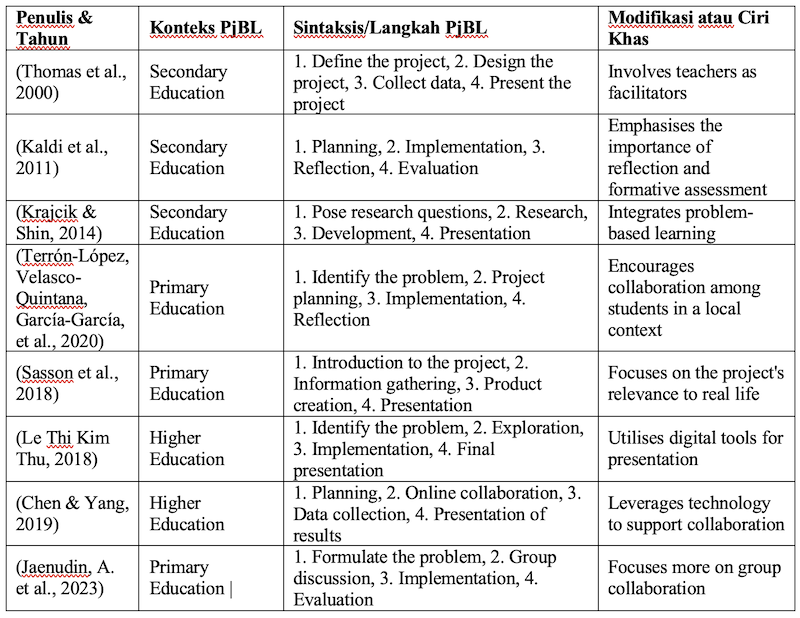
The development of the syntax of PjBL models across various contexts needs further clarification. In this context, syntax refers to the systematic steps or sequences typically employed in the implementation of PjBL. To provide a clearer illustration, Table 1 is presented below, illustrating a comparison of the syntax from several relevant studies.
Table 1: Comparison of the Syntaxes from Several Studies
Critical thinking skills are required of every student to solve problems in life. These are the skills required to think rationally when solving problems or making decisions (Poce et al., 2019). Critical thinking is synonymous with high-level thinking because it recognises that not all information read can be accepted as verified knowledge. Therefore, it necessitates a thorough re-evaluation of information before considering it as truth (Nugraha et al., 2017).
Critical thinking is the skill of thinking evaluatively in analysing the gap between reality and truth, designing problem-solving steps, and daily life implementation according to applicable norms (Rachmadtullah, 2015; Apriandi et al., 2023). It can be developed through problem-oriented learning that challenges students to apply skills, such as analysing, arguing, classifying, proving, and drawing conclusions. In addition, critical thinking skills include the process of identifying and analysing information sources, showing prior knowledge, making connections, and drawing conclusions. Some of the characteristics are: i) reasoning and guessing, ii) viewing situations from various perspectives and dimensions, iii) being open to change and innovation, iv) seeing thoughts without prejudice, v) having an open mind, vi) analytical thinking, and vii) paying attention to details (Rochmad et al., 2018).
Development of the U-PjBL model refers to the design of the Borg and Gall study and development model. The Borg and Gall model comprises ten steps: i) research and information collection; ii) planning; iii) development of a preliminary form of the product; iv) preliminary field testing; v) main product revision; vi) main field testing; vii) operational product revision; viii) operational field testing; ix) final product revision; and x) dissemination and implementation. In the context of the U-PjBL development study, the steps of the Borg and Gall model were modified. This modification was carried out in accordance with the objectives, needs, and field conditions (Gustiani, 2019; Yunus et al., 2022). In this study, the researchers simplified the development process to enhance efficiency. This simplification was necessitated by constraints related to time and resources. Based on the modifications made, the development model can be broadly categorised into three steps: i) Planning; ii) Product Development; and iii) implementation and Evaluation (Figure 1).
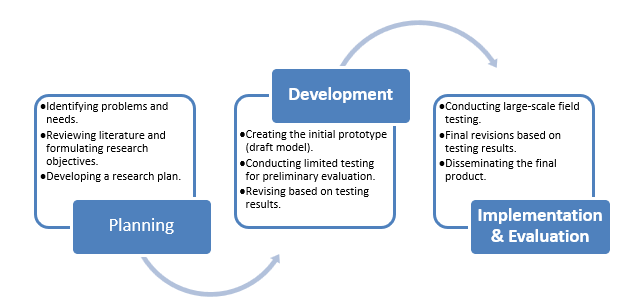
The planning stage focuses on initial research activities aimed at identifying the needs, problems, and objectives of the model to be developed. During this stage, a literature review is conducted, a needs analysis is performed, and learning objectives are established. The product development stage encompasses activities related to the design and development of the product, based on the data and information gathered from the preliminary phase. This stage includes three main activities: i) designing the model, ii) creating the product, and iii) conducting expert validation. Following the development stage, the next steps involve implementation and evaluation. At this stage, emphasis is placed on testing and evaluating the developed model.
The preliminary study aims to analyse and describe the problems in the field and conduct a needs analysis to support development of the U-PjBL model. It also focuses on a literature review through various study results and then undergoes analysis to serve as a reference in model development. Furthermore, the model development is continued, which takes the form of a model design (prototype). The prototype is the U-PjBL model to support learning implementation in elementary schools.
The subjects of this research were teachers and students from five primary schools located in the province of Aceh, Indonesia. A total of 150 students were randomly selected from five primary schools in Aceh Province, with 30 students from each school participating in the study. The sample was selected randomly to ensure representation from various backgrounds and school conditions. Teachers were chosen based on their willingness to apply project-based learning. They provided insights into current learning practices, while students contributed perspectives to ensure model relevance.
The developed model product was subjected to validation testing to validate the learning model. The validation instrument for the model refers to the characteristics of the learning model, including aspects of supporting theory, syntax, social system, reaction principles, and support system, as well as instructional and accompanying impact (Joyce & Weil, 2023). This study focused on testing the validity of the U-PjBL learning model and its effectiveness. The validity measured included the intervention components based on needs and state-of-the-art knowledge. The framework structure reflected the construction of developed product components supported by a particular theory. The effectiveness of the model was measured based on the achievement of critical thinking skills by the students.
The validation instrument for the U-PjBL model consisted of a validity sheet and effectiveness model using a critical thinking skill test developed by Saenab et al. (2021). Six learning experts were included as validators and validation was carried out on the U-PjBL model. Subsequently, scores were calculated using the average formula and compared with the validation assessment criteria. The criteria used in validation are shown in Table 2.
Table 2: Criteria for Learning Model Validation Assessment

The reliability calculation of the U-PjBL model validation sheet instrument was based on interobserver agreement from the statistical analysis of the percentage of agreement (R). It is considered reliable when the percentage is ≥ 75% (Borich, 1994).
Based on a survey, it was evident that the learning processes in primary schools had not yet reached a level conducive to higher-order thinking. The results of the questionnaire distributed to 45 teachers across three primary schools indicated that 75% of respondents experienced difficulties in implementing teaching models that could enhance students' higher-order thinking skills. This challenge was attributed to the teachers' limited understanding, which is essential for conducting learning activities that foster students' higher-order thinking abilities.
In an interview with the Head Teacher, it was stated that, although online learning facilities such as projectors and computers were available, the lack of training and understanding regarding the use of technology among teachers remained a significant barrier to the implementation of technology-based learning. This assertion was further supported by observational results. The observations conducted by the researchers revealed that learning activities tended to focus predominantly on rote memorisation and did not adequately involve activities that encouraged students to engage in critical or creative thinking. Consequently, despite the availability of facilities to support online learning, the utilisation of these resources to enhance students' higher-order thinking skills requires considerable improvement. This situation necessitates the development of teaching models that can promote higher-order thinking skills, particularly critical thinking skills, in alignment with technological advancements.
The U-PBL model combined two main learning approaches, namely ‘Ubiquitous’ and ‘Project-Based’ Learning. This model aimed to develop an equitable environment, allowing students to access and participate in real-world context learning projects with time and place flexibility.
U-PBL is a project-based learning model designed to be implemented in various settings, using a variety of data, and accessible on any device. This learning model was designed to accommodate the individual characteristics of students, allowing for lifelong learning. This methodology extends beyond the acquisition of hard skills and technology-based knowledge to developing soft skills. With U-PBL, students are expected to gain collaborative skills, critical thinking, creativity, and proficiency in communication.
The key elements of the U-PBL model are as follows:
1. Equal Learning
This includes the concept that learning is not bound by time, place, or specific media. Students can access learning materials, interact with instructors and peers, and participate in projects from different devices and locations.
2. Real-World Context-Based Projects
Projects used in U-PBL are designed to reflect real-world situations or relevant problems. These projects provide real and practical contexts for students to apply knowledge.
3. Time and Place Flexibility
Students have the flexibility to organise learning time according to individual needs. Materials can be accessed and students can also participate in projects either asynchronously (not simultaneously) or synchronously (simultaneously) and from different locations.
4. Collaborative Engagement
U-PBL encourages cooperation and collaboration among students, thereby enabling team work, sharing ideas, and supporting each other in solving complex problems.
5. Comprehensive Skill Development
Students develop various problem-solving, critical thinking, communication, and collaboration skills. Students also learn time management, self-directed learning, and how to design projects.
6. Utilisation of Technology and Online Resources
Technology is crucial in U-PBL, allowing students to access information, communicate online, develop digital products, and engage in technology-supported projects.
U-PBL leads to deep, flexible, real-world-relevant learning experiences, thereby enabling students to develop essential skills for future success. This method uses technology to provide greater accessibility and flexibility in learning while maintaining the essence of Project-Based Learning (PjBL), which is problem-solving and knowledge construction based on projects.
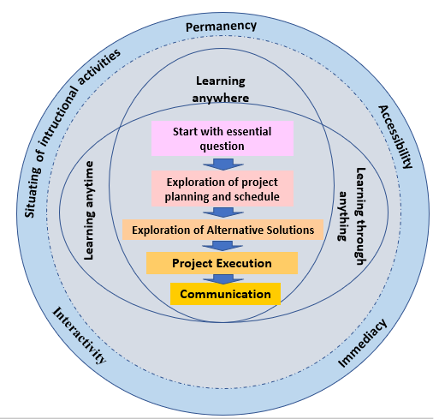
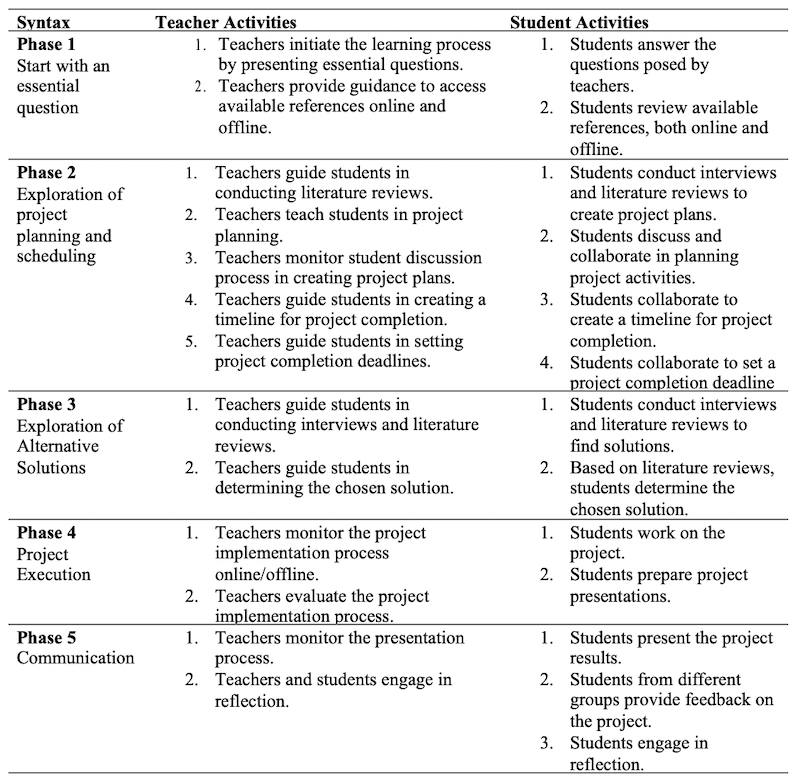
Figure 2 illustrates the three core aspects of the U-PjBL model: i) the phases of project implementation, ii) the ubiquitous learning environment, and ii) the integration of technology that enables flexibility, connectivity, and real-time access across learning setting. These components work together to create an engaging and adaptive learning experience. The figure is presented in two visual segments to reflect both the instructional flow and the technological environment in which it occurs. The project activities consist of five phases, namely, i) starting with essential questions, ii) exploration of project planning and the schedule, iii) exploration of alternative solutions, iv) project execution, and v) communication. Learning activities for the project can be carried out in the student environment, in an unlimited time, and in conditions that suit the needs of students. This model is expected to improve critical thinking, creativity, communication, and collaboration skills. The syntax and learning activities of U-PjBL model are shown in Table 3.
Table 3: Teacher and Student Activities in U-PjBL Model
Based on the expert validation data, the U-PjBL model obtained through the validity assessment instrument showed that the validation scores fell into the highly valid category. Table 4 shows the content validity assessment results of the U-PjBL model.
Table 4: Content Validity Assessment Results of U-PjBL Model
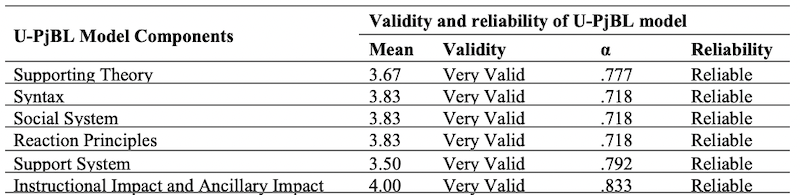
The validity scores of the U-PjBL model reviewed from the supporting theory showed an average of 3.67. Similarly, the syntax, social system, reaction principles, support system, as well as instructional and ancillary impact, had average values of 3.83, 3.83, 3.83, 3.50, and 4, respectively. All aspects of the validity assessment of the U-PjBL model met the validity criteria. A reliability analysis was conducted, showing that the coefficient scores for each component of the model validation, based on the assessment results of six experts, all fell into the reliable category. This showed that the U-PjBL model developed, based on the high percentage of agreement components, can be used to improve the critical thinking skills of students.
The U-PjBL model was implemented in elementary schools using an experimental design with two classes, namely, experimental and control. The experimental class used the U-PjBL model, while the control class used a different model. Table 5 shows the learning outcomes using U-PjBL and non-U-PjBL models.
Table 5 shows that the average score for the class taught using the U-PjBL model was 84.8, and 79.8 for non-U-PjBL. This shows that critical thinking skills of students taught using the U-PjBL model were higher than the non-PjBL.
Table 5: Group Statistics

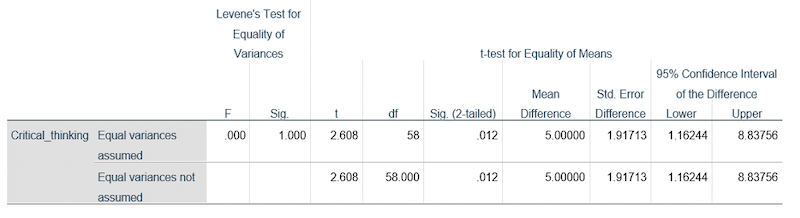
These findings are summarised in Table 6, which presents the results of the independent samples test between the two groups. The results of the difference test between U-PjBL and non-U-PjBL had a sig value (2-tailed) < 0.05, showing a significant difference in critical thinking skills. Therefore, it can be concluded that the U-PjBL model can improve critical thinking skills of students.
Table 6: Independent Samples Test
U-PjBL is a learning model that integrates the project learning process in offline and online learning environments. According to a previous study, learning that integrates offline and online learning environments can improve the understanding and critical thinking skills of students (Haleem et al., 2022). In a case where students encounter real-world situations that require detailed information, online information could be used to supplement the knowledge.
The U-PjBL model consists of five phases, namely, i) starting with essential questions, ii) exploration of project planning and scheduling, iii) exploration of alternative solutions, iv) project execution, and v) communication. Each learning phase should always be supported by both offline and online learning environments. At each phase, students consistently need additional information from online sources, enhancing access to more comprehensive and precise data.
The U-PjBL model is supported by the socio-constructivist, computer-supported collaborative learning (CSCL), and information processing theories. Socio-constructivist learning theory includes interaction among students, as well as between students and teachers with the support of technology (Kadek Suartama et al., 2020). This theory aligns with the U-PjBL model, emphasising active student engagement through collaborative activities. In this context, students engage in meaningful interactions with peers and teachers. In the U-PjBL model, these interactions are facilitated by technology, enabling students to collaborate and co-construct knowledge. This is crucial for developing critical thinking and problem-solving skills.
Furthermore, the CSCL theory plays a significant role in this model. CSCL theory focuses on knowledge construction through collaboration in social environments by creating virtual learning communities involving peers and teachers (Ng & Nicholas, 2007). Within the context of the U-PjBL model, CSCL supports this framework by establishing online or hybrid learning environments that allow students to collaborate and share ideas. The integration of technology in U-PjBL provides valuable opportunities for students to engage in discussions and receive immediate feedback from peers and teachers, fostering a deeper understanding of the learning material. This collaborative aspect is vital for developing higher-order thinking skills (Daud et al., 2019), as it encourages students to analyse, evaluate, and collaboratively create solutions.
Additionally, Information Processing theory contributes to the understanding of the U-PjBL model. This theory encompasses the processes of receiving, processing, storing, and retrieving information, which requires attention, memory, and reasoning abilities (Srivastava & Srivastava, 2019). According to this theory, learning is a process whereby students process, acquire, and store knowledge in both short-term and long-term memory. In the U-PjBL model, this theory encourages students to process and apply knowledge gained from collaborative activities and technology-supported learning environments (Vali, 2023). The integration of technology within the U-PjBL model ensures that students can access, process, and store information in ways that enhance their memory. This also supports students' reasoning abilities, which are essential components in developing critical thinking skills.
The integration of these three theories—socio-constructivism, CSCL, and Information Processing—directly influences the development of the U-PjBL model by creating an interactive learning environment. These elements are crucial for fostering higher-order thinking skills among students, as they encourage students to actively engage with learning content, collaborate with peers, and apply reasoning in meaningful contexts.
Based on the implementation results, it is evident that critical thinking skills are higher in the U-PjBL model compared to non-U-PjBL. The U-PjBL model trains the investigative skills of students with technology support (Urooj & Shahid Farooq, 2023). It also allows students to determine their solutions to problems using certain specific considerations. This flexibility allows for the exploration of interests in solving problems and creating motivation in the learning process.
In addition to project-based learning, the U-PjBL model is grounded in the principles of U-Learning. This concept empowers students to learn ‘anytime and anywhere’ through digital platforms, mobile devices, and online collaboration tools. U-Learning enables flexible, personalised, and context-aware learning experiences. According to Suartama et al. (2021), such an environment increases student engagement and accommodates diverse learning styles. Moreover, it supports equitable access to resources, especially for students in varied geographic or socioeconomic contexts, thus enhancing inclusion in primary education.
Recent research further supports the benefits of U-Learning enhancing student-centered outcomes. U-Learning environments foster personalisation, flexibility, and interactivity-elements that align with the design of U-PjBL (Virtanen et al., 2018). Digital technology also strengthens learning by enabling real-time feedback and seamless transitions between modes of learning (Haleem et al., 2022). Network-based U-Learning has been shown to increase contextual relevance and student autonomy (Wang et al., 2017). The findings of our study, which showed improved critical thinking among students using U-PjBL, were consistent with these studies. This confirms that the integration of technology-supported ubiquitous access with project-based learning can significantly enrich primary school education.
In conclusion, the U-PJBL model integrates project-based learning with U-Learning environments to enhance critical thinking skills in elementary school students. The model comprises five structured phases and is supported by digital technological infrastructure that enables flexible and accessible learning. The validation process confirmed the model’s reliability and very high validity. Its implementation showed significant improvement in students’ critical thinking abilities compared to traditional models. With its strong theoretical foundation and practical effectiveness. U-PjBL is highly suitable for broad application in future-oriented primary education.
Acknowledgements: The authors are grateful to the Directorate of Research, Technology, and Community Service, the Directorate General of Higher Education, Research, and Technology, the Ministry of Education, Culture, Research, and Technology, and the Institute for Research and Community Service at Syiah Kuala University for funding this study.
Ahadin, Safiah, I., Yunus, M., Suartama, K., Solehudin, M., & Dwi Hastuti, W. (2023). Different domiciles in online learning during the COVID-19 pandemic. Journal of Education and E-Learning Research, 10(3), 380-388. https://doi.org/10.20448/jeelr.v10i3.4725
Alam, A. (2020). Possibilities and challenges of compounding artificial intelligence in India’s educational landscape. International Journal of Advanced Science and Technology, 29(5), 5077-5094.
Apriandi, D., Krisdiana, I., Suprapto, E., & Megantara, B.A. (2023). Development and effectiveness of STEAM-C integrated learning devices to improve students’ creative thinking skills in specific cultural context. Journal of Learning for Development, 10(3), 440–451. https://doi.org/10.56059/jl4d.v10i3.813
Borich, G. (1994). Observation skill for effective teaching. MacMillan Publishing Company.
Chayomchai, A. (2020). The online technology acceptance model of generation-Z people in Thailand during COVID-19 crisis. Management and Marketing, 15(s1), 496-512. https://doi.org/10.2478/mmcks-2020-0029
Chen, C.H., & Yang, Y.C. (2019). Revisiting the effects of project-based learning on students’ academic achievement: A meta-analysis investigating moderators. Educational Research Review, 26. Elsevier Ltd. https://doi.org/10.1016/j.edurev.2018.11.001
Daud, M., Rahman, M.J.A., & Ensimau, N.K. (2019). Higher order thinking skills and collaborative learning approach among secondary school students. International Journal of Academic Research in Business and Social Sciences, 9(11), 1520–1528. https://doi.org/10.6007/ijarbss/v9-i11/6716
Guo, P., Saab, N., Post, L.S., & Admiraal, W. (2020). A review of project-based learning in higher education: Student outcomes and measures. International Journal of Educational Research, 102(April), 101586. https://doi.org/10.1016/j.ijer.2020.101586
Gustiani, S. (2019). Research and development (R&D) method as a model design in educational research and its alternatives. Holistics Journal, 11(2), 12-22. https://jurnal.polsri.ac.id/index.php/holistic/article/view/1849
Haleem, A., Javaid, M., Qadri, M.A., & Suman, R. (2022). Understanding the role of digital technologies in education: A review. Sustainable Operations and Computers, 3(May), 275-285. https://doi.org/10.1016/j.susoc.2022.05.004
Hasni, A., Bousadra, F., Belletête, V., Benabdallah, A., Nicole, M., & Dumais, N. (2016). Studies in science education trends in research on project-based science and technology teaching and learning at K-12 levels: A systematic review. Studies in Science Education, 7267, 0. https://doi.org/10.1080/03057267.2016.1226573
Iftode, D. (2020). Generation Z and learning styles. SSRN Electronic Journal, VII(21), 255-262. https://doi.org/10.2139/ssrn.3518722
Jaenudin, A., Hardi Raharjo, T., Puji Astuti, D., & Nuraini, S. (2023). Efforts to Increase student entrepreneurial intentions through the project-based learning learning model. Economic Education and Entrepreneurship Journal, 6(1), 8-14. https://doi.org/10.23960/e3j/v6i1.8-14
Jaenudin, D., Kurniasih, S., & Amalia, G.R. (2020). Improving students ability in problem solving and creativity through project-based learning, 438(Aes 2019), 259-262. https://doi.org/10.2991/assehr.k.200513.058
Järvelä, S., Hadwin, A., Malmberg, J., & Miller, M. (2018). International handbook of the learning sciences. In International handbook of the learning sciences (1st ed.). Routledge.
Joyce, B.R., & Weil, M. (2023). Models of teaching (5th ed.). Pearson.
Kadek Suartama, I., Setyosari, P., Sulthoni, & Ulfa, S. (2020). Development of ubiquitous learning environment based on moodle learning management system. International Journal of Interactive Mobile Technologies, 14(4), 182-204. https://doi.org/10.3991/ijim.v14i14.11775
Kaldi, S., Filippatou, D., & Govaris, C. (2011). Project-based learning in primary schools: Effects on pupils’ learning and attitudes. Education 3-13, 39(1), 35-47. https://doi.org/10.1080/03004270903179538
Kozinski, J. (2018). Project based learning. Engineering, 1-2, 30-31.
Krajcik, J.S., & Shin, N. (2014). Project-based learning. The Cambridge handbook of the learning sciences (2nd ed.), 275-297. https://doi.org/10.1017/CBO9781139519526.018
Larkin, T.L. (2016). The creative project: Design, implementation, and assessment. International Journal of Engineering Pedagogy (IJEP), 6(1), 72. https://doi.org/10.3991/ijep.v6i1.5387
Lavonen, J., Inkinen, J., Juuti, K., Salmela-Aro, K., Krajcik, J., & Schneider, B. (2017). The influence of an international professional development project for the design of engaging secondary science teaching in Finland. University of Helsinki. https://researchportal.helsinki.fi/en/publications/the-influence-of-an-international-professional-development-projec
Le Thi Kim Thu. (2018). Project-based Learning in 21st century: A review of dimensions for implementation in university-level teaching and learning. 4th ICEAC International Conference on English Across Cultures, October, 230-241.
Lewis, D. (2018). Digital native. New Design, (133), 60-61. https://doi.org/10.23956/ijarcsse.v7i7.111
Martin, R., McGill, T., & Sudweeks, F. (2013). Learning anywhere, anytime: Student motivators for m-learning. Journal of Information Technology Education: Research, 12(1), 51-67. https://doi.org/10.28945/1771
Ng, W., & Nicholas, H. (2007). Conceptualizing the use of online technologies for gifted secondary students. Roeper Review, 29(3), 190-196. https://doi.org/10.1080/02783190709554408
Nugraha, A.J., Suyitno, H., & Susilaningsih, E. (2017). The effect of problem based learning model on students’ critical thinking skills, science process skills, and motivation in elementary school. Journal of Primary Education, 6(1), 35-43.
Ogata, H., & Yano, Y. (2004). Context-aware support for computer-supported ubiquitous learning. Proceedings—2nd IEEE International Workshop on Wireless and Mobile Technologies in Education, October, 27-34. https://doi.org/10.1109/WMTE.2004.1281330
Piaget, J. (1952). The origins of intelligence in children. (M. Cook, Trans.). W. W. Norton & Company.
Pizarro, J.B. (2021). Prospects and challenges of ubiquitous learning in graduate education in northern Philippines. European Journal of Humanities and Educational Advancements (EJHEA), 2(12), 199-202.
Poce, A., Amenduni, F., & Medio, C. De. (2019). From tinkering to thinkering. Tinkering as critical and creative thinking enhancer. Journal of E-Learning and Knowledge Society, 15 (2), 101-112. https://doi.org/10.20368/1971-8829/1639
Rachmadtullah, R. (2015). Kemampuan Berpikir Kritis Dan Konsep Diri Dengan Hasil Belajar Pendidikan Kewarganegaraan Siswa Kelas V Sekolah Dasar. Jurnal Pendidikan Dasar, 6(2), 287. https://doi.org/10.21009/jpd.062.10
Rochmad, Agoestanto, A., & Kharis, M. (2018). Characteristic of critical and creative thinking of students of mathematics education study program. Journal of Physics: Conference Series, 983(1). https://doi.org/10.1088/1742-6596/983/1/012076
Saenab, S., Zubaidah, S., Mahanal, S., & Lestari, S.R. (2021). Recode to re-code: An instructional model to accelerate students’ critical thinking skills. Education Sciences, 11(1), 1-14. https://doi.org/10.3390/EDUCSCI11010002
Sasson, I., Yehuda, I., & Malkinson, N. (2018). Fostering the skills of critical thinking and question-posing in a project-based learning environment. Thinking Skills and Creativity, 29, 203-212. https://doi.org/10.1016/j.tsc.2018.08.001
Semmar, Y., & Al-Thani, T. (2015). Piagetian and Vygotskian approaches to cognitive development in the kindergarten classroom. Journal of Educational and Developmental Psychology, 5(2), 1-7. https://doi.org/10.5539/jedp.v5n2p1
Serdyukov, P. (2017). Innovation in education: What works, what doesn’t, and what to do about it? Journal of Research in Innovative Teaching & Learning, 10(1), 4-33. https://doi.org/10.1108/jrit-10-2016-0007
Srivastava, J., & Srivastava, V. (2019). Information processing theory in language learning among students. Journal of Emerging Technologies and Innovative Research, 6(6), 187-191.
Suartama, I.K., Sulthoni, Ulfa, S., Setyosari, P., Yunus, M., & Sugiani, K.A. (2021). Ubiquitous learning vs. electronic learning: A comparative study on learning activeness and learning achievement of students with different self-regulated learning. International Journal of Emerging Technologies in Learning, 16(3), 36-56. https://doi.org/10.3991/ijet.v16i03.14953
Terrón-López, M-J., Velasco-Quintana, P-J., García-García, M-J., Gaya-López, M-C., & Escribano-Otero, J-J. (2015). Design and Implementation of a comprehensive educational model: Project Based Engineering School (PBES). International Journal of Engineering Pedagogy (IJEP), 5(3), 53. https://doi.org/10.3991/ijep.v5i3.4673
Terrón-López, M.J., Velasco-Quintana, P.J., Lavado-Anguera, S., & del Carmen Espinosa-Elvira, M. (2020). Preparing sustainable engineers: A project-based learning experience in logistics with refugee camps. Sustainability (Switzerland), 12(12), 1-17. https://doi.org/10.3390/SU12124817
Thomas, J., Condliffe, B., & Quint, J. (2000). Whatever form a project takes, it must meet these criteria to be gold standard PBL. Interdisciplinary Journal of Problem-Based Learning, 22(1), 1-18.
Urooj, S., & Shahid Farooq, M. (2023). Impact of students’ ubiquitous learning through Web 2.0 Tool on students’ 21st century skills: Creativity. Journal of Positive School Psychology, 2023(2), 256-274. http://journalppw.comhttps//orcid.org/0000-0002-5848-5122
Vali, I. (2023). The impact of technology on collaborative learning. Proceedings of the 9th International Conference Education Facing Contemporary World Issues (Edu World 2022), 3-4 June, 2022, University of Pitești, Pitești, Romania, 5, 126-141. https://doi.org/10.15405/epes.23045.13
Virtanen, M.A., Haavisto, E., Liikanen, E., & Kääriäinen, M. (2018). Ubiquitous learning environments in higher education: A scoping literature review. Education and Information Technologies, 23(2), 985-998. https://doi.org/10.1007/s10639-017-9646-6
Vygotsky, L. S. (1978). Mind in society: The development of higher psychological processes. Harvard University Press.
Wang, X., Zhang, W., & Yang, X. (2017). Construction of course ubiquitous learning based on network. Eurasia Journal of Mathematics, Science and Technology Education, 13(7), 3315-3323. https://doi.org/10.12973/eurasia.2017.00728a
Yunus, M., Amirullah, Safiah, I., Ridha, S., & Suartama, I.K. (2022). Development of the CPOL design to improve the ability to develop teaching materials. Cypriot Journal of Educational, 17(5), 1655-1670.
Author Notes
Intan Safiah is a Lecturer in Primary Education, Universitas Syiah Kuala. Her research interests include project-based learning and technology integration in elementary schools. Email: intan.afia@usk.ac.id (https://orcid.org/0009-0009-0716-7018)
Muhammad Yunus is a Lecturer in Civic Education, Universitas Syiah Kuala. His research interests include educational technology and collaborative learning models. Email: Yunus.msalem@usk.ac.id (https://orcid.org/0009-0006-3220-9505)
Amar Zaki is Lecturer in Civic Education, Universitas Samudra. His research interests include project-based learning in civic education. Email: ammarzaki@unsam.ac.id (https://orcid.org/0009-0000-3227-4987)
Ahadin is a Lecturer in Primary Education, Universitas Syiah Kuala. Her research interests include education, particularly Indonesian language and literature education. Email: ahadin_selian@usk.ac.id (https://orcid.org/0000-0001-6687-1472)
Hasniyati is a Lecturer in Primary Education, Universitas Syiah Kuala. Her research interests include education, particularly Indonesian language and literature education. Email: hasniyati@usk.ac.id (https://orcid.org/0009-0007-6102-9834)
Cite as: Safiah, I., Yunus, M., Zaki, A. Ahadin, & Hasniyati. (2025). Development of ubiquitous project-based learning (U-Pjbl) model to improve critical thinking skills of elementary school students. Journal of Learning for Development, 12(2), 313-329.