Vidya Anesti and Irwanto Irwanto
2025 VOL. 12, No. 1
Abstract: Currently, advancements in science and technology have a significant impact on various aspects of human life, particularly in the field of education. In this context, augmented reality plays a crucial role in enhancing both learning and teaching experiences. This study presents the findings of a bibliometric analysis on published articles related to augmented reality from 2003 to 2023. A total of 2,955 journal articles were selected from the Scopus database for analysis. This study examines the annual growth rate of research, commonly used author keywords, highly cited articles, leading authors, influential journals, top contributing institutions, and the most active countries in the field. The findings indicate that: (1) the highest number of publications was recorded in 2023, with a total of 506 articles, (2) “augmented reality”, “virtual reality”, “education” and “mixed reality” were the most frequently used keywords, (3) studies by Wu et al., Akçayır, and Dwivedi et al. were the most cited documents, (4) Mantri, A., Yilmaz, R.M., and Vahabzadeh, A. were among the most influential authors, (5) Sustainability, Education Sciences, and the International Journal of Interactive Mobile Technologies were considered the leading journals, (6) Universiti Kebangsaan Malaysia, Universidad de Sevilla and Atatürk University were among the top institutions in this field, and (7) the United States, Spain, and China were the most significant countries contributing to this area of research. It is anticipated that this study will offer a meaningful contribution to future research on augmented reality, particularly in the educational field.
Keywords: research trends, bibliometric analysis, augmented reality, education
In the 21st century, as the world embraces the era of Industrial Revolution 4.0 and Society 5.0, the influence of science and technology continues to grow. In response to this, educational research in recent years has placed greater emphasis on the role of technology in learning and teaching. One of the rapidly growing technological advancements in education is augmented reality (AR). This technology utilises either image-based tracking (marker-based AR) or a markerless approach to create augmented experiences. According to Azuma (1997), AR media utilises a camera to project virtual objects onto a specific point within the camera’s view. This technology enables interaction and interpretation through the generated programme. Beyond the field of education, AR has found extensive applications in healthcare, the military, and the manufacturing sector. According to Kesim and Ozarslan (2012), integrating augmented reality with educational materials can enhance both the efficiency and engagement of the learning experience by connecting students’ understanding to real-world contexts. Similarly, Su Cai (2014) stated that AR offers additional learning benefits as a computer-assisted instructional tool. He also suggested that AR tends to be more effective for students with lower academic performance compared to those with higher achievements. Moreover, Liu and Chu (2010) stated that research on AR has also demonstrated its effectiveness in enhancing students’ motivation during the learning process. Specifically, the use of AR in education enables the development of AR applications that help visualise abstract concepts more effectively. These applications allow students to interact with and explore the material in a more engaging way. This content can be presented through the camera of a mobile device, such as a smartphone, laptop, or tablet. Consequently, students are able to view the information provided by the AR application. The study conducted by Ibanez et al. (2015) indicated that augmented reality enhances academic performance and offers immediate feedback.
Various researchers have put forward different definitions of AR. El Sayed et al. (2011) described AR as a technology that enhances real-world experiences by overlaying virtual objects onto real-life scenes, making them appear more realistic. This idea is reinforced by Chen and Tsai, who defined AR as a system that enables users to interact with two-dimensional (2D) or three-dimensional (3D) virtual objects integrated into a real environment. Based on Chen and Tsai’s (2012) perspective, AR offers several advantages across different domains, particularly in the learning process. In the past, numerous bibliometric studies explored the application of augmented reality in education, providing insights into emerging trends in this field. Recently, research on this topic has grown significantly, and when examining the key variables analysed, many studies appear to share similar themes.
This study explores research on AR in education by analysing articles published between 2003 and 2023. It examines the most commonly used keywords and highly cited documents, as well as the most prolific journals, authors, institutions and countries in this field.
The study was carried out while considering the following research questions (RQs):
RQ1: What was the total number of publications on AR that were released between 2003 and 2023?
RQ2: What were the most commonly appearing keywords related to AR in education?
RQ3: Which studies did the authors frequently reference throughout this time frame?
RQ4: Which publishers had the most frequently cited research on AR in the field of education?
RQ5: What were the most prolific journals in publishing research articles on current trends?
RQ6: Which institution published the highest number of works over the past two decades?
RQ7: Which country generated the highest number of research publications?
The Process of Selecting Articles for Content Analysis
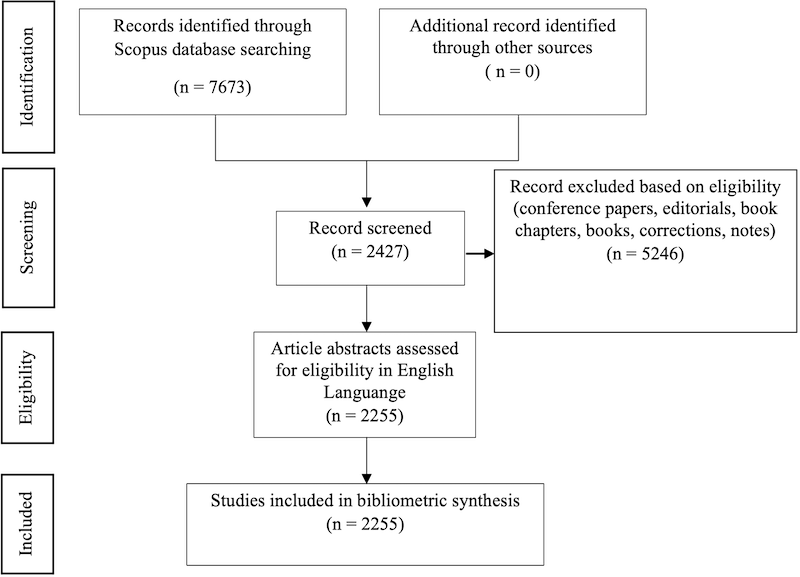
This study utilised content mapping and bibliometric analysis. To select published articles related to the use of AR in education, we set a time frame of 2003 to 2023. This decision was made because articles published before 2003 were highly limited. The literature sources were gathered from the Scopus database covering the years 2003 to 2023. Following the guidelines proposed by Liberati et al. (2009), this bibliometric analysis applied the Preferred Reporting Items for Systematic Review and Meta-Analysis (PRISMA) framework to provide a thorough overview of the literature on the application of AR in education. Figure 1 illustrates the complete process of conducting bibliometric mapping analysis by following the PRISMA protocol.
Table 1: PRISMA Flow Diagram of the Present Study
The Process of Selecting Articles for Bibliometric Mapping Analysis
To conduct a bibliometric mapping analysis, literature sources were retrieved from the Scopus database on December 31, 2023. The search was conducted using the advanced search feature, utilising the AND operator to filter the results. For this study, the selected keywords included “Augmented Reality” AND “education.” As a result, a total of 7,673 articles related to the use of AR in education were identified. The earliest article on AR was published in 1972. However, this study focuses on the data from 2003 to 2023, covering two decades. Since publications before 2003 were very limited, they were excluded from this research. This study focused solely on journal articles as the document type to ensure the selection of high-quality, peer-reviewed publications. A filtering process using Scopus was conducted to eliminate 5,246 irrelevant works. After removing documents that did not align with the study’s objectives, a total of 2,255 articles were selected. Subsequently, all the extracted articles were uploaded into the Similarity Visualization (VOS) application for further analysis.
In this study, Göktaş et al. (2012) utilised the Publication Classification Form to examine the chosen articles. To conduct the bibliometric analysis, the VOSViewer software, created by Van Eck and Waltman (2010), was utilised to generate network visualisations. This included identifying the most commonly used keywords, analysing words found in abstracts, and performing both citation and co-citation analyses in various articles. To conduct the analysis using bibliometric software, data was retrieved from the Scopus database and saved in a comma-separated values (.csv) format. The extracted data was then processed for descriptive statistics, citation analysis, and co-citation analysis. In quantitative research, bibliometric analysis is conducted using VOSviewer, one of the most widely used computer programmes to gather, examine, generate, and visualise bibliographic data. To present tables and graphs illustrating the number of publications per year, the most cited works, prolific authors, significant journals, leading institutions, and active countries, the researchers utilised Microsoft Excel.
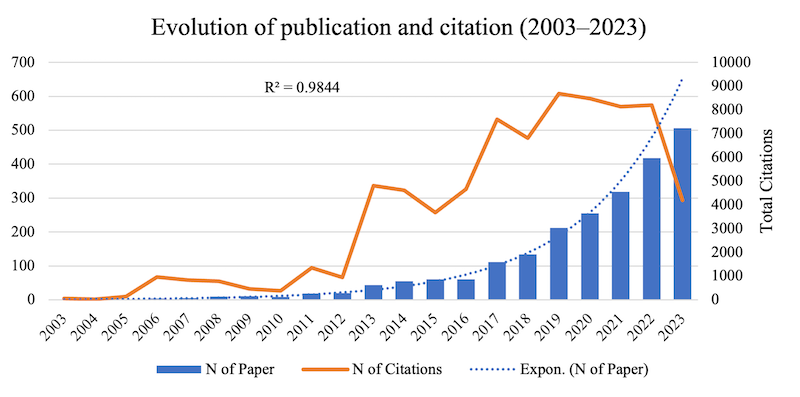
To answer question RQ1, a graphical table was designed to illustrate the yearly publication trends of scientific articles related to the application of AR in education. The visual representation indicates that the number of published articles fluctuated each year. Notably, the highest publication count occurred in 2023, whereas 2004 and 2005 recorded a significantly lower number of publications. In 2023, a total of 506 articles were published, indicating that research on the application of AR in education has remained highly popular. Despite this growing trend, studies on the use of AR can be traced back to as early as 1972. This demonstrates that the researchers analysed the progression of AR technology over time and explored various strategies for integrating it into education to enhance students’ engagement and enthusiasm for learning.
Figure 1 presents a summary of publications on the application of AR in education from 2003 to 2023. However, the growth of literature on AR adoption progressed at a slow pace between 2003 and 2010. The graphical data illustrates a steady development trend over the years. Over time, research on AR implementation has continued to advance. In the past two decades, the highest number of citations was recorded in 2019, reaching 8,683 citations (11.4%) across a total of 212 published papers. An analysis of the trend line for citation numbers demonstrates the growing influence of AR technology in the education sector. The data specifically shows that between 2019 and 2023, a total of 1,709 publications were recorded, accounting for 75.78% of all works published since 2003. The year 2023 marked the peak of publications, with 506 articles contributing to 22.43% of the total volume. This indicates that research on AR continued to expand significantly, reflecting a consistently positive trend and strong academic interest year after year. Thus, AR remains widely used and has the potential for further development across various fields. The graphical analysis indicates a determination coefficient (R²) of 0.98, demonstrating a strong and reliable exponential trend. This review was based on data from December 2023, revealing that only 506 documents (with 4,198 citations, accounting for 5.53%) were published that year. It is expected that contributions from scientific researchers will continue to rise, fostering ongoing growth in the years to come.
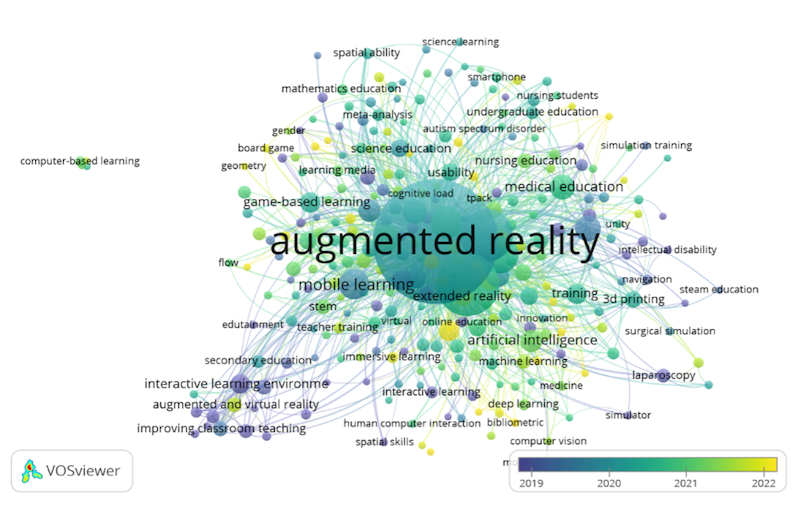
To answer RQ2, an analysis was conducted to determine the most commonly used words in articles. A bibliographic map was generated using a database containing frequently occurring keywords from published articles. To achieve this, a bibliographic database file from Scopus was uploaded into the programme. The VOSviewer software was then utilised to visually present bibliometric maps in a clear and comprehensible format (Van Eck & Waltman, 2010). The visualisation of keywords is presented in Figure 2. Subsequently, the relevant data was uploaded into the VOSviewer software, setting a minimum keyword occurrence of five as the threshold for analysis. A total of 288 keywords met this criterion, and 15 different clusters were formed. The analysis reveals seven clusters in the visualisation map. The most frequently occurring keyword was “Augmented Reality,” appearing 1,347 times with a total link strength (TLS) of 2,616. Additionally, the next most frequently used keywords were “Virtual Reality” (343 occurrences; TLS: 999), “Education” (240; 616), and “Mixed Reality” (118; 358).
As illustrated in Figure 2, a range of colors is displayed. These colors represent the publication dates of the reviewed documents based on the identified keywords. The yellow color signifies keywords that emerged more recently in publications. This suggests that the trending topics in recent publications include “metaverse”, “extended reality,” “design thinking,” and “digital transformation.” Furthermore, it is evident that AR was the central topic of discussion.
To answer RQ4, Table 2 presents the findings related to the documents with the highest citation counts. This table highlights the most frequently cited articles on the application of AR since 2003. Table 2 lists the top 10 most cited documents.
Table 2: Top 10 Most Cited Documents
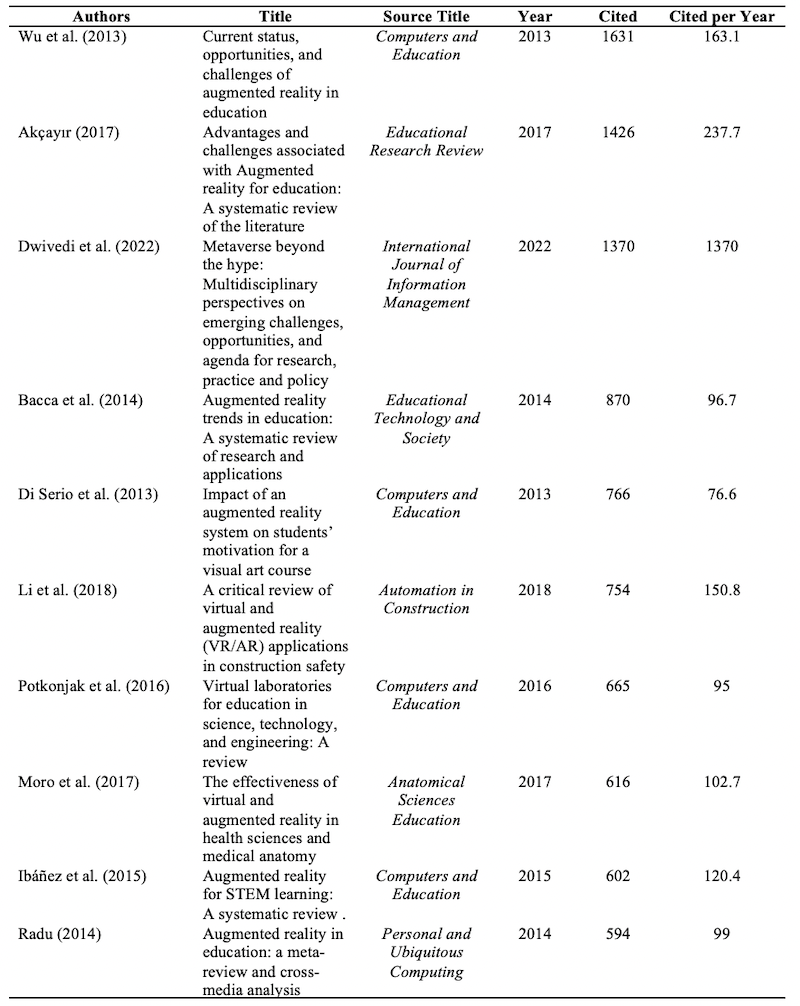
The top 10 articles listed in Table 2 were those with the most significant impact, as determined by their high citation counts. Based on the data, the most frequently cited publications were released after 2003. The first article in the table, titled “Current Status, Opportunities, and Challenges of Augmented Reality in Education,” received 1,631 citations, averaging 163.1 citations per year. In this study, Wu et al. (2013) highlighted how AR can address certain challenges in education while also identifying key topics and issues for future research. The study by Akçayır and Akçayır (2017), titled “Advantages and Challenges Associated with Augmented Reality for Education,” presents a systematic review of the existing literature. This article highlights one of the most frequently cited benefits of AR in education—its ability to enhance learning outcomes. The study by Dwivedi et al. (2022), titled “Metaverse beyond the Hype: Multidisciplinary Perspectives on Emerging Challenges, Opportunities, and Agenda for Research, Practice and Policy,” presents the role of AR technology in education — AR within the metaverse enhances learning by making it more interactive and immersive. This technology enables students to grasp abstract concepts more effectively through virtual simulations and exploration. Based on the analysis, a total of 75,819 citations were identified across 2,255 articles. The peak citation count occurred in 2019, reaching 8,683 citations. On average, the article received 251.2 citations annually.
To answer RQ3, Table 3 below presents the ten most prolific authors who published the highest number of studies on the application of AR in education. It is important to note that an author’s productivity is assessed based on the volume of their publications.
Table 3: Number of Publications in the Top 10 Authors
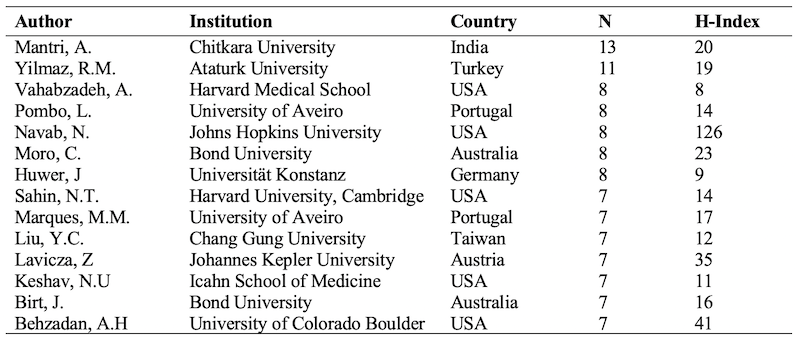
The data in Table 3 shows that Mantri, A. was the most productive author, having published a total of 13 works. Closely behind was Yilmaz, R.M., who contributed 11 publications. Next, Vahabzadeh, A., Pombo, L., Navab, N., Moro, C., and Huwer, J. each authored a total of eight publications. Other notable contributors include Sahin, N.T., Marques, M.M., Liu, Y.C., Lavicza, Z., Keshav, N.U., Birt, J., and Behzadan, A.H., each with seven publications. Additionally, Table 3 presents the most productive authors based on their H-index scores. The H-index is a metric used to assess academic productivity and impact by representing the balance between the number of publications and their citations in a single value. For instance, if a researcher has 10 published works, each cited at least 10 times, their H-index would be 10 (Hirsch, 2005). This index is utilised to evaluate the productivity of authors whose work is indexed in the Scopus database. As shown in Table 3, the three authors with the highest H-index values were Navab, N., with an H-index of 126, followed by Behzadan, A.H., with 41, and Lavicza, Z., with 35.
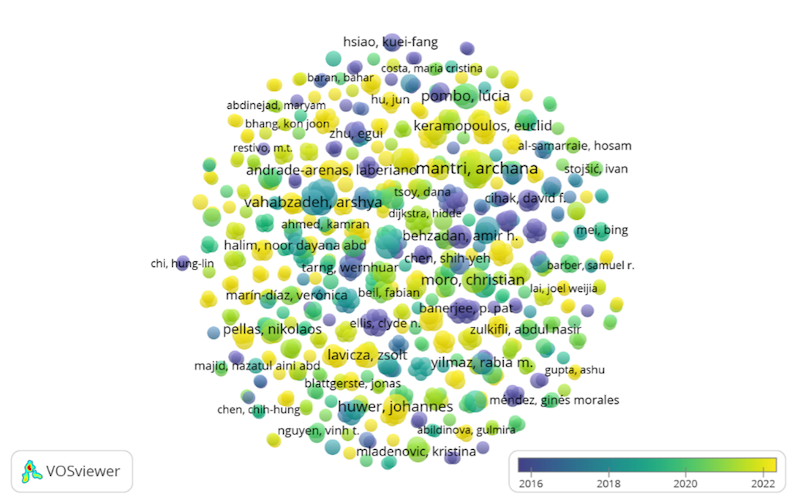
Using the VOSviewer programme, the researchers established a minimum threshold of two documents per author and at least ten citations per author. As illustrated in Figure 3, the collaboration network consists of 753 authors with 259 different clusters. Additionally, the findings indicate that these collaborations vary in both color and size. Moreover, each cluster remains isolated from the others. In bibliographic analysis, if a node appears and grows, it indicates an increase in the number of authors. The visualisation map analysis revealed that the clusters are not interconnected. From a bibliometric perspective, each cluster contains only a single author. This suggests that collaboration among researchers on the use of AR was relatively weak. Studies in this field are generally conducted by small, independent groups, typically involving just one author.
To answer RQ5 concerning the ten most productive journals based on the number of publications, h-index, Scopus quartile (Q), Scimago Journal Rank (SJR), and publisher, the findings are presented in Table 4.
Table 4: Top 10 Most Active Journals
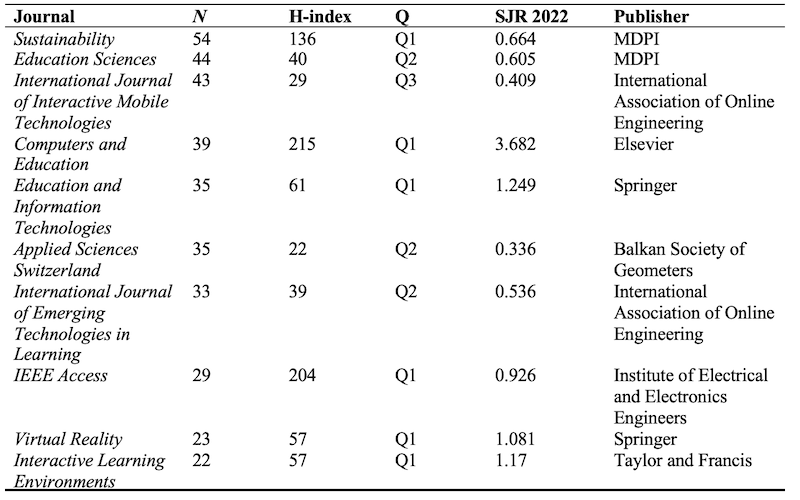
The findings indicate that a total of 357 journals contributed to the literature available in the Scopus database, each with varying levels of influence. As summarised in Table 4, Sustainability was the most prolific journal, publishing 54 articles. Other notable sources included Education Sciences, which produced 44 articles, and the International Journal of Interactive Mobile Technologies, with a total of 43 articles.
Based on the data in Table 4, Computers and Education held the highest h-index in research, reaching 215. It was followed by IEEE Access with an h-index of 204 and Sustainability with an h-index of 136. These figures indicate that these three journals had the greatest impact on research related to the application of AR. In terms of SJR (SCImago Journal Rank), Computers and Education also ranked the highest with a score of 3.682. It was followed by Education and Information Technologies, which had an SJR of 1.249, while Interactive Learning Environments came in third with a score of 1.17. Among the top 10 journals, most were highly ranked in the Scopus database, with six classified as Q1, three as Q2, and one as Q3. The Q-score serves as an analytical tool for determining journal rankings based on their scientific categories and corresponding impact factors. It indicates a journal’s position within its category and serves as a valuable reference for researchers when choosing where to publish. As noted by Asan and Aslan (2020), quartile rankings may differ depending on the scientific discipline. In terms of publisher, the table highlights that the most prolific contributors to research on AR applications in education were MDPI (n = 2) and the International Association of Online Engineering (n = 2). Meanwhile, other publishers within the top 10 each had one journal.
To answer RQ6, Table 5 presents an overview of the findings related to the country, type of institution, and the volume of published articles from the twelve most influential and productive research institutions. Based on the data in Table 5, these top twelve institutions collectively accounted for approximately 8.87% (n = 200) of the total journal articles.
Table 5: Top 12 Most Prolific Institutions
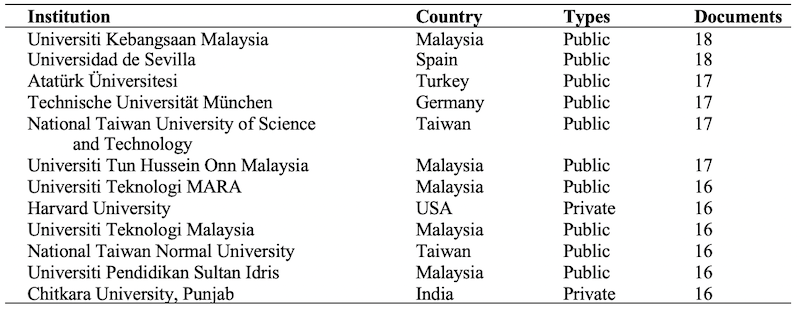
According to the review results presented in Table 5, the Universiti Kebangsaan Malaysia and Universidad de Sevilla were the most prolific institutions in applying AR in education, with 18 published articles each. The Atatürk University, Technische Universität München, National Taiwan University of Science and Technology, and Universiti Tun Hussein Onn Malaysia follow closely in second place, contributing 17 articles each. Universiti Teknologi MARA, Harvard University, Universiti Teknologi Malaysia, National Taiwan Normal University, Universiti Pendidikan Sultan Idris, and Chitkara University rank next, each producing 16 publications. The table also includes two private educational institutions, while the remaining ten universities were public research institutions. This suggests that public universities had a more significant role in AR research compared to private institutions. According to the table, the contributing institutions come from Malaysia, Spain, Turkey, Germany, Taiwan, the USA, and India.
To answer RQ7, the following ten leading countries, that made the highest number of contributions to scientific publications, are listed in Table 6.
Table 6: Top 10 Most Prolific Countries
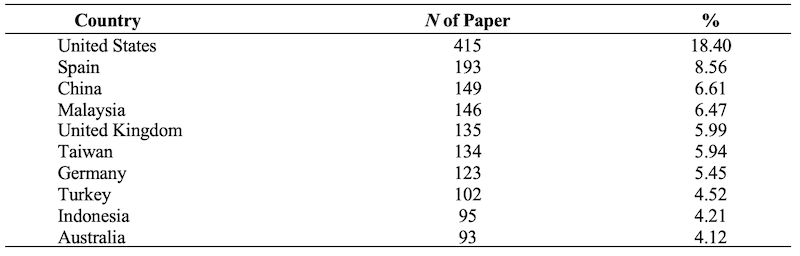
Based on the data in Table 6, the top 10 most productive countries in publishing scientific articles were identified. These nations collectively contributed 1,585 articles, accounting for 70.29% of the total publications. The United States leads the list with the highest number of articles, totaling 415, which represents 18.40% of all contributions. Spain follows in second place with 193 articles, making up 8.56% of the total. China ranks third, having published 149 articles or 6.61% of the overall count. Among Southeast Asian countries, Malaysia and Indonesia were also in the top 10, demonstrating significant contributions to scientific research output.
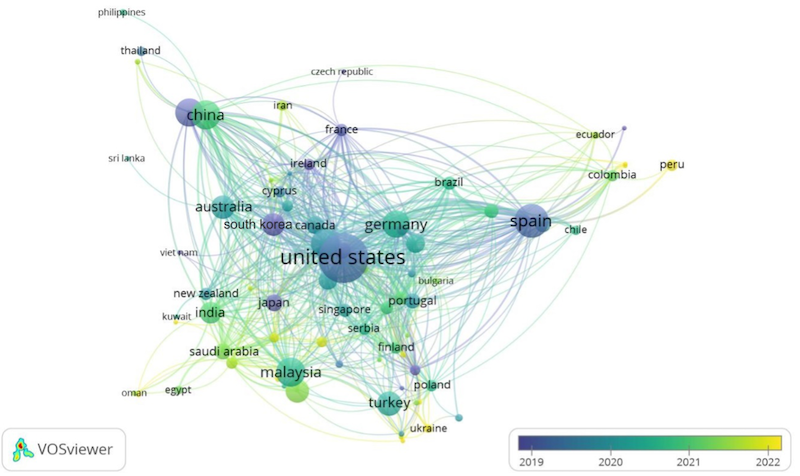
The visualisation map in Figure 4 illustrates the connections between bibliographies from different countries. In VOSviewer, a minimum of three occurrences is required, while the citation threshold is set at four. A total of 78 countries were selected for analysis. The findings, depicted in Figure 4 reveal nine distinct clusters of countries. Among these, Cluster 6 is the most prominent in the visualisation, including the US, Australia, and South Korea. The varying colors on the bibliographic map illustrate differences between country groups. According to the bibliographic data, the United States holds the highest rank, contributing 415 documents with a total link strength of 224. Spain follows in second place with 193 documents and a total link strength of 142, while China ranks third with 149 documents and a link strength of 108. Other notable contributors include Malaysia (146 documents; 76 link strength), UK (135; 183), and Taiwan (134; 53).
This study examined publications on the application of AR in education, sourced from the Scopus database on December 31, 2023. The data has been analysed and visualised using bibliometric techniques, including keyword frequency analysis, author collaboration mapping, and country-based bibliographic connections. The authors also analysed trends in publications over two decades (2003-2023) concerning the application of AR in education.
Based on the annual journal production graph, the number of article publications fluctuated each year. The data shows that in 2023, the publication rate was significantly high, whereas in 2004 and 2005, it was notably low. In 2023, a total of 506 articles were published, indicating that research on the application of AR in education remained highly popular. This suggests that AR-related studies continue to be a recurring trend each year. As illustrated in Figure 1, in the Methods section above, a bibliometric study conducted up to December 2023 indicates that the number of publications involving AR is expected to keep increasing in the coming years. The overall count of publications in 2023 is expected to be significantly greater than it was in 2003. This supports Price’s law (1986), which states that the number of publications will double within a decade. These findings align with previous research by Carmigniani and Furht (2011), which reinforces the notion that studies on AR will continue to expand in the coming decades. This growth is driven by the increasing interest of both academics and professionals in applying this technology. This is further supported by a study conducted by Irwanto et al. (2022), which reported a significant increase in the number of publications related to AR each year. Moreover, a study by Prahani et al. (2022) indicates a significant rise in the number of publications on AR research between 2002 and 2021. Therefore, we can expect the number of publications on AR to grow significantly over the next decade.
Additionally, the bibliometric analysis revealed that “Augmented Reality” is the most frequently used keyword. Besides that, other commonly appearing keywords include “virtual reality,” “education,” and “mixed reality.” These keywords might evolve over time but, at present, “Augmented Reality” remains a commonly used term. Similarly, research conducted by Putri et al. (2021) analysed connected networks, publication density, and publication periods, ultimately narrowing the focus to a single keyword — Augmented Reality. This aligns with the study conducted by Arici et al. (2019), which found that keywords related to AR appeared frequently. Some of the most common terms identified in their research included “augmented reality,” “education,” “learning,” “technology-enhanced learning,” and “student engagement.” A study by Prahani et al. (2022) also revealed that keywords related to AR frequently appeared in the various research papers they reviewed. This indicates that AR has become an increasingly appealing topic for researchers, particularly in the development of interactive learning media. Consequently, these findings further establish AR as one of the most innovative technologies with significant potential in the field of education over the two decades examined in this study.
The subject of AR remains a popular focus in research, particularly within the education sector. Based on the annual distribution of publications, the highest number of citations occurred in 2013. During that year, the work of Hsin-Kai Wu and colleagues received the most recognition, accumulating a total of 1,631 citations. The study conducted by Hsin-Kai Wu et al. (2013), titled “Current Status, Opportunities, and Challenges of Augmented Reality in Education”, highlighted the growing adoption of AR in the educational field. This rise in usage is attributed to AR’s ability to enhance learning experiences by making them more interactive and immersive. Akçayır was the next most cited, receiving 1,426 citations, followed by Dwivedi et al., who accumulated 1,370 citations. The study conducted by Akçayır (2017), titled “Advantages and Challenges Associated with Augmented Reality for Education: A Systematic Review of the Literature” explored the growing use of AR in the field of education. This research highlights that while AR offers significant potential in educational settings, the successful and sustainable implementation of this technology requires appropriate strategies to address both technical and pedagogical challenges. In their study titled “Metaverse beyond the Hype: Multidisciplinary Perspectives on Emerging Challenges, Opportunities, and Agenda for Research, Practice and Policy”, Dwivedi et al. (2022) highlight that incorporating technologies such as AR and virtual reality (VR) into the metaverse can create a more interactive and immersive learning experience. This advancement is considered a potential solution to the limitations of traditional education. Given the high number of citations, it can be concluded that Hsin-Kai Wu and colleagues have played a significant role in research on the use of AR during the two decades examined. This result aligns with the study conducted by Challenor and Ma (2019), which indicated that the research by Hsin-Kai Wu et al. was widely referenced.
Based on further findings, Table 3, in the Most Productive Author section above, shows that the most active authors conducted research on the application of AR. Based on further findings, it was revealed that the most active researchers in the study of AR applications were Mantri, A., with a total of 13 publications. Following closely, Yilmaz, R.M. authored 11 articles. Meanwhile, Vahabzadeh, A., Pombo, L., Navab, N., Moro, C., and Huwer, J. each contributed eight publications. Additionally, Sahin, N.T., Marques, M.M., Liu, Y.C., Lavicza, Z., Keshav, N.U., Birt, J., and Behzadan, A.H. each published seven articles. Mantri, A. from Chitkara University, India, also published numerous articles on AR, educational technology, and mobile-based AR, along with various other scientific works. One of his works, titled “A Framework Utilizing Augmented Reality to Improve Critical Thinking Ability and Learning Gain of the Students in Physics,” highlights the potential of AR to enhance the quality of education, particularly in physics. By offering effective visual and interactive tools, AR facilitates the learning of complex concepts. As a result, its application in the education sector is expected to grow rapidly (Mantri, 2020).
The journal ranking results that have been published were analysed based on productivity, with Sustainability emerging as the most prolific source, contributing a total of 54 documents. One possible reason for this finding is that one of the focus areas of Sustainability is education and awareness regarding sustainability. Additionally, this journal is published 24 times a year, providing researchers in AR and educators with ample opportunities to publish their work. Education Sciences ranks second with a total of 44 documents. The reason could be that this journal serves as a platform for discussing various issues and challenges in science education, especially in light of rapid advancements in educational technology. As a result, AR is increasingly being incorporated into learning to enhance interactivity and create a more immersive educational experience. The global trend in AR adoption may further drive continuous research and scientific publications. Additionally, it considers both traditional institutions and digital learning environments, such as online and mobile platforms. Ranked third is the International Journal of Interactive Mobile Technologies, which has published a total of 43 documents. The reason this journal remains active is its specific focus on interactive mobile-based technology, with AR being one of the rapidly advancing key technologies. The growing demand for AR research in education, industry, and entertainment expands this journal’s scope, allowing it to accommodate a wide range of articles in these fields.
The next most prolific institution was Universiti Kebangsaan Malaysia (Malaysia), which produced 18 research articles, demonstrating its dominance in the field of AR. According to the data presented in Table 5, in the The Most Prolific Institutions section above, most of the institutions with the highest publication numbers were located in Malaysia. This indicates that Malaysia has contributed significantly to research on the application of AR in education. Ng and Ramasamy (2018) stated that Malaysia has actively promoted AR usage, particularly in studying future trends in AR marketing. The countries that have made the most significant contributions to scientific article publications were also selected. As shown in Table 6, these ten countries collectively produced 1,585 articles, accounting for 70.29% of the total publications. The United States holds the leading position, followed by Spain and China. Among Asian nations, Malaysia and Indonesia rank among the top ten in terms of their significant contributions to scientific publications. Based on a review of the relevant literature, Zhang et al. (2022) discovered that the United States played a significant role in scientific publications, contributing a total of 415 documents. In this context, the United States leads in research impact, as reflected in the highest number of total citations, the highest H-index, and the largest volume of publications. This could be due to the fact that the United States’ global expenditure on research and development (R&D) tripled, rising from $726 billion in 2000 to approximately $2.4 trillion in 2019 (National Science Board, 2022).
A bibliometric analysis of research on AR in education from 2003 to 2023 revealed a notable rise in both the number of publications and scholarly interest in this field. The studies highlighted emerging trends, key contributions, and potential future directions for AR integration in educational settings. Overall, the findings confirm that AR holds significant potential to transform teaching and learning approaches. As technology continues to advance, research and application of AR in education are expected to expand further, contributing positively to the overall quality of education.
Based on the discussion findings, it can be inferred that the bibliometric analysis illustrates the publication trends regarding the use of AR in education from 2003 to 2023. The document selection process involved retrieving data from the Scopus database, which was then refined to yield a total of 2,255 relevant documents. Based on data analysis, the majority of journal publications were produced between 2019 and 2023, totaling 1,709 works, which accounted for 75.78% of all publications since 2003. The highest number of publications was recorded in 2023, with 506 articles, representing 5.53% of the total published works. Graphical data indicate a rapid increase in the use of AR in education, a trend that is expected to persist in the coming years.
The findings also revealed several frequently occurring keywords in studies related to the application of AR in education. These keywords were “Augmented Reality,” “Virtual Reality,” “Education,” and “Mixed Reality.” Among them, AR stands out as the central theme, appearing most frequently in research discussions. Regarding the number of publications, Sustainability stands out. The highest publication count was achieved by Universiti Kebangsaan Malaysia in Malaysia. According to the data, ten countries contributed a total of 1,585 articles, accounting for 70.29% of all published articles. Among these, the United States had the greatest share, followed by Spain and China.
This research has certain limitations, as it is based on a database retrieved on December 31, 2023. The study specifically examined the application of AR in education from 2003 to 2023. The findings indicated a steady increase in AR-related studies during this period. However, the data also revealed that research on AR grew at a slower pace between 2003 and 2010. Despite this slow initial growth, the body of literature on AR in education has expanded consistently over the years. Therefore, this study emphasises the exploration of AR’s role in the educational field. The database may undergo changes over time. In this study, we relied solely on Scopus as our database. The findings might vary if references from multiple databases, such as Web of Science, Google Scholar, Semantic Scholar, or ScienceDirect, were included. Therefore, future studies are encouraged to conduct a more extensive analysis of research trends related to AR applications, particularly in the education sector, by incorporating a broader range of sources. Additionally, it is expected that this study will serve as a valuable reference for future research, especially in the field of AR.
The integration of AR in education offers significant benefits. AR serves as an interactive learning tool that provides realistic visualisations, allowing students to better grasp and imagine learning outcomes. Utilising AR-based educational media encourages students to develop critical thinking skills by analysing real-world problems and situations. Since educational media is designed to facilitate learning with or without direct teacher involvement, AR enables students to access learning materials anytime and anywhere. Moreover, AR enhances comprehension by visualising abstract concepts and illustrating object structures, making it a highly effective learning medium. Given its potential, continuous research on global AR trends is essential to track its future advancements.
Akçayır, M., & Akçayır, G. (2017). Advantages and challenges associated with augmented reality for education: A systematic review of the literature. Educational Research Review, 20, 1-11. https://doi.org/10.1016/j.edurev.2016.11.002
Arici, F., Yildirim, P., Caliklar, Ş., & Yilmaz, R.M. (2019). Research trends in the use of augmented reality in science education: Content and bibliometric mapping analysis. Computers and Education, 142(March), 103647. https://doi.org/10.1016/j.compedu.2019.103647
Asan, A., & Aslan, A. (2020). Quartile scores of scientific journals: Meaning, importance and usage. Acta Medica Alanya, 4(1), 102-108. https://doi.org/10.30565/medalanya.653661
Azuma, R.T. (1997). A survey of augmented reality. Presence: Teleoperators and Virtual Environments 6, 355-385. https://doi.org/10.1561/1100000049
Bacca, J., Baldiris, S., Fabregat, R., Graf, S., & Kinshuk. (2014). Augmented reality trends in education: A systematic review of research and applications. Educational Technology and Society, 17(4), 133-149. http://www.jstor.org/stable/jeductechsoci.17.4.133
Carmigniani, J., Furht, B., Anisetti, M., Ceravolo, P., Damiani, E., & Ivkovic, M. (2011). Augmented reality technologies, systems and applications. Multimedia Tools and Applications, 51, 341-377. https://doi.org/10.1007/s11042-010-0660-6
Challenor, J., & Ma, M. (2019). A review of augmented reality applications for history education and heritage visualization. Multimodal Technologies and Interaction, 3(2). https://doi.org/10.3390/mti3020039
Chen, C.M., & Tsai, Y.N. (2012). Interactive augmented reality system for enhancing library instruction in elementary schools. Computers and Education, 59(2), 638-652. https://doi.org/10.1016/j.compedu.2012.03.001
Di Serio, Á., Ibáñez, M.B., & Kloos, C.D. (2013). Impact of an augmented reality system on students’ motivation for a visual art course. Computers and Education, 68, 586-596. https://doi.org/10.1016/j.compedu.2012.03.002
Dwivedi, Y. K., Hughes, L., Baabdullah, A. M., Ribeiro-Navarrete, S., Giannakis, M., Al-Debei, M. M., Dennehy, D., Metri, B. A., Buhalis, D., Cheung, C. M. K., Conboy, K., Goyal, D. P., Hinsch, C., Jeyaraj, A., Kim, Y. G., Koohang, A., Kshetri, N., Mariani, M. M., Mills, A., ... Wade, M. (2022). Metaverse beyond the hype: Multidisciplinary perspectives on emerging challenges, opportunities, and agenda for research, practice and policy. International Journal of Information Management, 66, 102542. https://doi.org/10.1016/j.ijinfomgt.2022.102542
El Sayed, N.A.M., Zayed, H.H., & Sharawy, M.I. (2011). ARSC (Augmented Reality Student Card): An augmented reality solution for the education field. Computers and Education, 56(4), 1045-1061. https://doi.org/10.1016/j.compedu.2010.10.019
Göktaş, Y., Kucuk, S., Aydemir, M., Telli, E., Arpacik, O., Yildirim, G., & Reisoglu, I. (2012). Educational technology research trends in Turkey: A content analysis of the 2000-2009 decade. Educational Sciences: Theory and Practice, 12(1), 191-199.
Ibáñez, M. B., & Delgado-Kloos, C. (2018). Augmented reality for STEM learning: A systematic review. Computers & Education, 123, 109–123. https://doi.org/10.1016/j.compedu.2018.05.002
Irwanto, I., Dianawati, R., Lukman, I.R. (2022). Trends of augmented reality applications in science education: A systematic review from 2007 to 2022. International Journal of Emerging Technologies in Learning, 17(13), 4-24. https://doi.org/10.3991/ijet.v17i13.30587
Kesim, M., & Ozarslan, Y. (2012). Augmented reality in education: Current technologies and the potential for education. Procedia — Social and Behavioral Sciences, 47(222), 297-302. https://doi.org/10.1016/j.sbspro.2012.06.654
Klopfer, E., & Squire, K. (2008). Environmental detectives development of an augmented reality platform for environmental simulations. Educational Technology Research and Development, 56(2), 203-228. https://doi.org/10.1007/s11423-007-9037-6
Li, X., Yi, W., Chi, H.L., Wang, X., & Chan, A.P.C. (2018). A critical review of virtual and augmented reality (VR/AR) applications in construction safety. Automation in Construction, 86(October 2017), 150-162. https://doi.org/10.1016/j.autcon.2017.11.003
Liu, T.Y., & Chu, Y.L. (2010). Using ubiquitous games in an English listening and speaking course: Impact on learning outcomes and motivation. Computers and Education, 55(2), 630-643. https://doi.org/10.1016/j.compedu.2010.02.023
Nagtegaal, I.D., Van De Velde, C.J.H., Marijnen, C.A.M., Van Krieken, J.H.J.M., & Quirke, P. (2005). Low rectal cancer: A call for a change of approach in abdominoperineal resection. Journal of Clinical Oncology, 23(36), 9257-9264. https://doi.org/10.1200/JCO.2005.02.9231
National Science Board. (2022). U.S. and global research and development. National Center for Science and Engineering Statistics. https://ncses.nsf.gov/pubs/nsb20221/u-s-and-global-research-and-development
Ng, C.C., & Ramasamy, C. (2018). Augmented reality marketing in Malaysia-Future scenarios. Social Sciences, 7(11). https://doi.org/10.3390/socsci7110224
Moro, C., Štromberga, Z., Raikos, A., & Stirling, A. (2017). The effectiveness of virtual and augmented reality in health sciences and medical anatomy. Anatomical Sciences Education, 10(6), 549–559. https://doi.org/10.1002/ase.1696
Potkonjak, V., Gardner, M., Callaghan, V., Mattila, P., Guetl, C., Petrović, V.M., & Jovanović, K. (2016). Virtual laboratories for education in science, technology, and engineering: A review. Computers and Education, 95, 309-327. https://doi.org/10.1016/j.compedu.2016.02.002
Prahanı, B.K., Saphıra, H.V., Wıbowo, F.C., Mısbah, & Sulaeman, N.F. (2022). Trend and visualization of virtual reality & augmented reality in physics learning from 2002-2021. Journal of Turkish Science Education, 19(4), 1096-1118. https://doi.org/10.36681/tused.2022.164
Price, D.J.S. (1986). Little science, big science. and beyond. Columbia University Press.
Putri, C.R., Soleh, S.M., Saregar, A., Anugrah, A., & Susilowati, N.E. (2021). Bibliometric analysis: Augmented reality-based physics laboratory with VOSviewer software. IOP Conference Series: Earth and Environmental Science, 1796(1). https://doi.org/10.1088/1742-6596/1796/1/012056
Radu, I. (2014). Augmented reality in education: A meta-review and cross-media analysis. Personal and Ubiquitous Computing, 18(6), 1533-1543. https://doi.org/10.1007/s00779-013-0747-y
van Eck, N.J., & Waltman, L. (2010). Software survey: VOSviewer, a computer program for bibliometric mapping. Scientometrics, 84(2), 523–538. https://doi.org/10.1007/s11192-009-0146-3
Wu, H.K., Lee, S.W.Y., Chang, H.Y., & Liang, J.C. (2013). Current status, opportunities, and challenges of augmented reality in education. Computers and Education, 62, 41-49. https://doi.org/10.1016/j.compedu.2012.10.024
Zhang, J., Yu, N., Wang, B., & Lv, X. (2022). Trends in the use of Augmented Reality, Virtual Reality, and Mixed Reality in surgical research: A global bibliometric and visualized analysis. Indian Journal of Surgery, 84(April), 52-69. https://doi.org/10.1007/s12262-021-03243-w
Author Notes
Vidya Anesti is currently pursuing a Master’s degree in Chemistry Education at the State University of Jakarta, Indonesia. She earned her Bachelor’s degree in Chemistry Education from the same university and obtained her professional teaching certification from Sultan Ageng Tirtayasa University, Indonesia. She is employed as a chemistry teacher at Nusantara 1 High School in Tangerang, Indonesia. Her research interests lie in the field of Education and Technology. Email: vidyanesti@gmail.com (https://orcid.org/0009-0007-9837-800X)
Irwanto Irwanto is an assistant professor at the Department of Chemistry Education, State University of Jakarta, Indonesia. He has been an active member of editorial board committees and reviewer committees of international journals and proceedings. He currently serves as a reviewer for several highly respected journals in Indonesia. He received his B.Ed. and M.Ed. from Yogyakarta State University, Indonesia. He received a Ph.D. from the same university. His research areas include game-based learning, augmented reality, STEM education, TPACK, and the effect of technology on teaching and learning. Email: irwanto@unj.ac.id (https://orcid.org/0000-0001-5842-5931)
Cite as: Anesti, V., & Irwanto, I. (2025). Research on augmented reality in education: A bibliometric analysis. Journal of Learning for Development, 12(1), 125-141.