Amir Karimi and Saibal Kumar Saha
2025 VOL. 12, No. 1
Abstract: Leadership in online education involves strategically managing digital learning environments to ensure effective instruction and engagement. This research aims to identify the publication trends and highlight trending research topics and scientific conversations in this field of leadership in online education. Using 947 records from the Scopus database, the evolution of leadership discourse in online education was examined using scientometric analysis to find the trends, most influential authors, institutions, publishing platforms, and countries. The extracted data spanned publications from 1981 to 2023. The trending topics evolved from knowledge management and school administration to e-learning and higher learning, and, after 2020, to challenges faced in imparting education due to Covid-19. The United States, China, and the United Kingdom emerged as leading contributors to this field. Co-authorship analysis highlighted international collaborations, which emphasised the growing global interest in leadership within virtual learning environments. These research findings could be helpful for researchers and managers in the field of education for adapting to the digital age.
Keywords: scientometric analysis, online learning, school, administration, remote learning
In past decades, education institutions have been greatly influenced by technology (Lustik, 2008; Alone, 2017; Wahab & Ali, 2020), resulting in a tremendous alteration of policies and programmes related to distance education (DE) and online learning. Organisations that have made significant investments in DE are seen to be spearheading the drive to implement new technologies (Williamson et al., 2020). Changes in higher education priorities, the need to provide access to a growing and diverse student population, increased competition among institutions for a significant role in global education, individualised instructional structures, and economic realities have contributed to DE's growth (Bozkurt, 2020; Bozkurt & Zawacki-Richter, 2021). Other factors include the desire to carve out a niche market, competition among institutions to increase enrolment, developments, and emerging trends in digital technologies.
In both classroom and online learning settings, institutions find it challenging to keep up with the quick speed of technological change (Bojović et al., 2020). Students are growing more tech-savvy and favour online learning over traditional classroom instruction (Halpern, 2020; Shraim, 2019). Despite these developments, schools should consider themselves as customers of new educational technologies and encourage their students to use them wisely. Furthermore, older students are returning to school to change occupations or enhance their employment abilities, making distance learning a desirable option (Kara et al., 2019). Programmes for remote learning may target this new audience, enabling universities to advertise their offerings throughout their nation or the globe (Clark, 2020). Academic leaders must design effective remote learning initiatives that enhance and advance the school's standing. Management leadership in distant learning has received less attention than other aspects. Researchers and practitioners may now contribute to educational leadership. The overall issue of leadership and management in remote education is receiving less attention despite growing interest (Beaudoin, 2002; Fernandez & Shaw, 2020); new publications tend to concentrate more on organisation and administration.
Significant research has yet to be done on DE leadership in the context of Leadership in Distance Education. There may be fewer studies on DE leadership than on other topics, such as media comparative studies, the concentration on educational rather than leadership difficulties, and the fascination with newly developing technologies and their uses. The following are requirements for leaders in the field of distance education: a thorough understanding of the subject and its place in higher education (Håkansson et al., 2019); strong interpersonal skills; knowledge of how new technologies are adopted (Tømte et al., 2019); familiarity with the principles of teaching and learning (Ewing & Cooper, 2021); knowledge of the characteristics of both adult learners and students of traditional age (Corbett & Spinello, 2017); the capacity to manage change; and recognition of and application of critical leadership traits (Van Wart et al., 2017).
The need for further research on leadership in online education is emphasised due to its underdevelopment, an overemphasis on pedagogical issues, and a common misconception regarding the importance of leadership. Restauri (2004) underscores the necessity of resources and support services for instructors and students in successful online distance learning programmes. Tallent-Runnels et al. (2006) provide a comprehensive literature review on online course instruction, addressing instructional techniques, technology, student engagement, and factors influencing student success. Nworie (2012) applied various leadership theories to the unique challenges of distance education leadership.
With millions of students engaged in online courses, online education has become a crucial aspect of higher education (Kristóf, 2020; Xie et al., 2020). It offers flexibility, resources, and cost-effectiveness (Alam, 2023; Thi Hue Dung, 2020). Administrative leaders in online education must adeptly navigate political challenges to promote best practices in technology-mediated learning. Vu et al. (2016) found that online learning options in higher education have surged, surpassing traditional enrolment. They identified two management models: decentralised administration (DA) and centralised administration (CA), with CA perceived as more robust.
Burnette (2015) discussed the challenges faced by online education administrators, including programme management and student engagement, and offered strategies for effective leadership. Håkansson Lindqvist and Pettersson (2019) explored Swedish school administrators' perspectives on digitisation and the essential digital skills for effective leadership, highlighting the complexity of digitisation and the need for resource allocation. Willermark and Islind (2022) examined the transition to virtual work practices, identifying key affordances for effective digitisation.
Al Ajmi (2022) investigated the impact of digital leadership on teachers' technology integration during the Covid-19 pandemic in Kuwait, while Karakose et al. (2021) analysed teachers' perceptions of principals' digital leadership roles. Pettersson (2021) provided a theoretical framework for understanding the interplay between educational methods, digital technology, and learning outcomes. Despite the wealth of literature on online education, studies on leadership remain underexplored, often overshadowed by pedagogical concerns. Effective leadership in remote education encompasses various competencies, including negotiation, communication, and management skills (Kuscu & Arslan, 2016; Wharton-Beck et al., 2022). Leaders must also be adept at policy creation and collaboration, with a forward-thinking approach to remote learning.
Leadership in remote learning is characterised by fostering innovative change and facilitating collaboration towards common goals (Beaudoin, 2015; Fernandez & Shaw, 2020). The evolving landscape of digital education necessitates leaders who can adapt to traditional and non-traditional educational environments (Bagwell, 2020; Pollock, 2020). Effective leadership ensures that remote learning programmes meet their objectives and adapt to user needs, relying on a convergence of vision, knowledge, design, management, and leadership (Lubin & Reio, 2023; Morris et al., 2020; Ragan et al., 2023).
Finally, the research landscape on leadership in online education can be enhanced through scientometric methodologies, which analyse scholarly publications and citation patterns to identify key themes and future research directions. These methodologies can help pinpoint significant authors and seminal works, guiding future inquiries into online education leadership.
Scientometrics, when used in scientific research, enables us to condense vast volumes of data (Rodríguez-Rodríguez et al., 2021) so that we may show the current level of knowledge as well as new patterns that are forming throughout time in a specific topic or field of study (Nobanee et al., 2021; Tamala et al., 2022). In recent years, scientometric analysis of scientific research has become one of the most popular approaches (Nair & Saha, 2023) for assessing the research output of individuals, teams, departments, colleges, nations, and publications. Nevertheless, there is no thorough scientific analysis of international research on education to look at how this sector is developing. Scientometrics can help us identify the structure of the literature, measure the quality and impact of research by providing a map of the scientific field, and measure the scientific impact of documents (Saha, 2022).
Patterns, developments, and trends may be examined using mathematical operations on quantitative criteria and citation data on scientific publications relevant to the subject of knowledge (Garg et al., 2022). The scientometric analysis is a dependable technique for quantitatively analysing the scientific features of publications, such as their amount and kind, often used keywords, highly active authors, and the ability to visualise a network of authorship and data occurrence in a particular subject (Li et al., 2021; Saha et al., 2023).
Despite the growing number of studies published, the topic of school administration in online learning has yet to undergo scientific analysis. The 21st century has seen a rise in the significance of online education because of the goals that students and programmes seek to accomplish, in addition to the realities of life and education. Thus, the goal of the current study was to provide answers to queries regarding: (1) Publication frequency, (2) Most Significant Publications, (3) Co-authorship – Country analysis, (4) Sources-based citation analysis, and (5) Co-occurrence.
This study follows the methodology of scientometrics, which aims to yield insights into the dynamics of scientific research. This point includes assessing the performance of individual researchers, academic institutions, and nations, facilitating informed policy-making, strategic funding allocations, and the overall direction of scientific initiatives (Yazdi et al., 2024). By systematically analysing trends and patterns in scientific communication, scientometrics plays a crucial role in enhancing our understanding of the progression and efficacy of research activities. Its rigorous analytical framework contributes significantly to the discourse surrounding the advancement of science and technology.
Based on the keywords ("online learning*" OR "virtual learning*" OR "distance education*" OR "digital* education*" OR "blended learning*" OR "remote learning*" OR "mobile learning*" OR "Electronic training*" OR "electronic learning*" OR "E-learning*") AND (“School Administ*” OR “education* leader*” OR “administ* of education*” OR “education administ*” OR “education* management*” OR "school* leader*" OR "school* super*" OR "education* authorit*" OR "administ* of school*" OR "principal* of the school*") 1,042 records were downloaded from Scopus in November 2023. Since Scopus is the largest curated abstract and citation database, it was used to extract the metadata of the published articles.
The dataset consisted of 2 Arabic, 3 Chinese, 1 Czech, 997 English, 2 German, 3 Lithuanian, 1 Persian, 7 Portuguese, 8 Russian, 1 Slovenian, 13 Spanish, and 4 Turkish documents. The dataset can be classified as 91 book chapters, 555 articles, 305 conference papers, 38 books, and 53 other types based on document type.
To perform further analysis, we considered only book chapters, articles, conference papers, and books that were in English out of the 1,042 records that were downloaded from Scopus published during 1981-2023. Hence, the dataset for analysis consisted of 947 records.
VOSviewer, R, and MS Excel were used to derive the graphs and network diagrams.
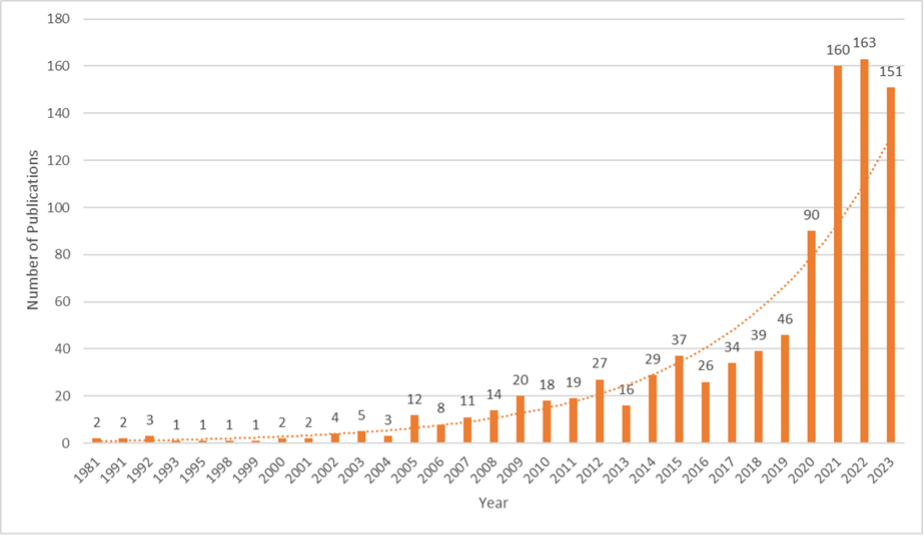
Figure 1 illustrates the publication frequency of the documents extracted. From the illustration, research publications on online education can be seen to date back to 1981. Until 2004, the number of publications was primarily in single digits. From 2005, the research momentum in this field saw a significant rise, and the yearly publications increased linearly till 2019. The publications doubled from 46 in 2019 to 90 in 2020. Also, the following year, a similar trend in publication was witnessed when the publications doubled from 90 in 2020 to 160 in 2021. The yearly publications maintained similar frequencies in 2022 and 2023. This number of publications can be attributed to the Covid-19 pandemic, which spread worldwide in early 2020 and disrupted the normal functioning of schools and other educational institutions. The education system was compelled to find alternative modes of teacher-student interaction, and with the popularity of the internet, online education was the obvious choice.
Five articles received more than 100 citations. The “COVID-19 Education and Education Technology” paper received 249 citations in three years (Teräs et al., 2020). The paper highlighted the problems of profitable digital learning solutions. The authors emphasised adopting pedagogical practises with digital solutions to enhance teaching-learning. The business models adopted for profit maximisation built on user data were confronted. The paper that received the second-highest number of citations (152), highlighted the home-schooling experience during Covid-19 (Bubb & Jones, 2020). The study investigated the perspectives of students, parents, and teachers on home-schooling. The findings indicate a swift and positive adaptation to home-schooling. It was found that there was increased creativity in learning, improved progress, more helpful feedback, and enhanced student independence. School leaders expressed a desire to implement changes based on the positive experiences of remote learning during the lockdown, turning the crisis into an opportunity for innovation. The study by Ivankova and Stick (2007) focused on students' persistence in educational leadership in higher education. The study by Ratten (2020) focused on the entrepreneurship education community.
Average citations per year for each article were calculated to ascertain the most significant publications. Figure 2 demonstrates the most significant publications.
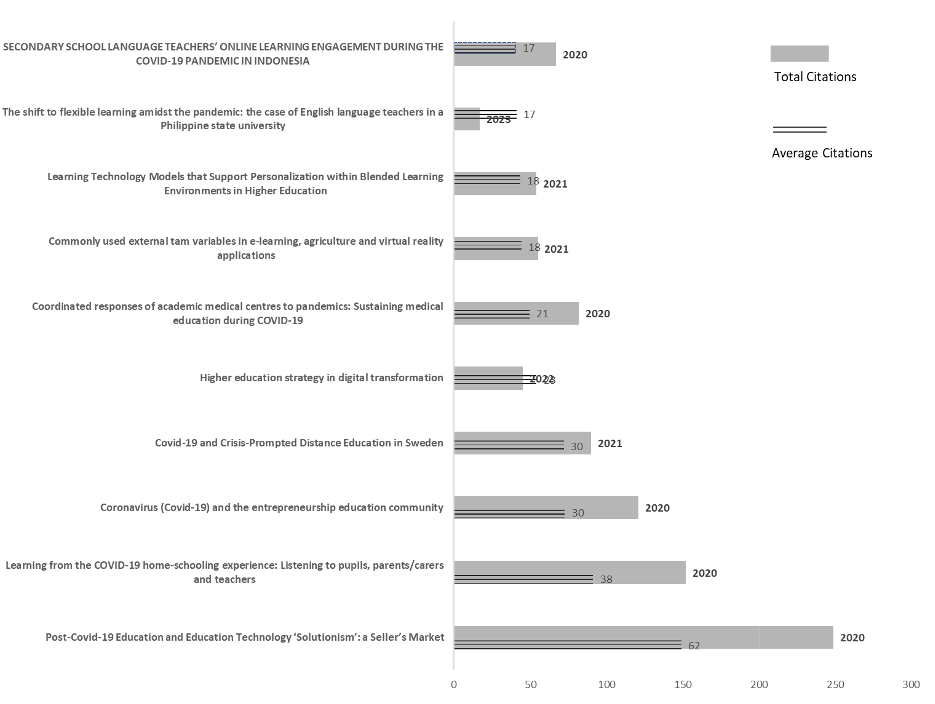
Figure 3 showcases the diagrammatic representation of co-authorship — analysis by country for the research done on virtual learning and school administration. The United States, China, and the United Kingdom have been the highest contributors in this research domain. Eight clusters were formed based on the publications. Australia, Germany, India, Poland, Singapore, South Africa, South Korea, and the United Arab Emirates are the prominent members of Cluster One. In Cluster Two, the prominent countries are Canada, Cyprus, Ireland, Jamaica, Norway, Sweden, and the United Kingdom. Cluster Three comprises Indonesia, Iran, Malaysia, Saudi Arabia, Taiwan, and Vietnam. Cluster Four's countries are France, Italy, Peru, the Russian Federation, and Spain. The most influential countries in Cluster Five are China, Ghana, the Philippines, and Thailand. Hong Kong, Japan, and the United States comprise Cluster Six, while Finland, Oman, and Ukraine are part of Cluster Seven. Greece, Nigeria, and Turkey are part of Cluster Eight. The United Kingdom, Australia, Canada, the United States, Japan, Finland, and Ireland have been working in this domain for a long time. At the same time, China, Thailand, Indonesia, the Russian Federation, India, Ukraine, Saudi Arabia, Vietnam, and Iran have produced publications on online learning and school administration in recent years (2021).
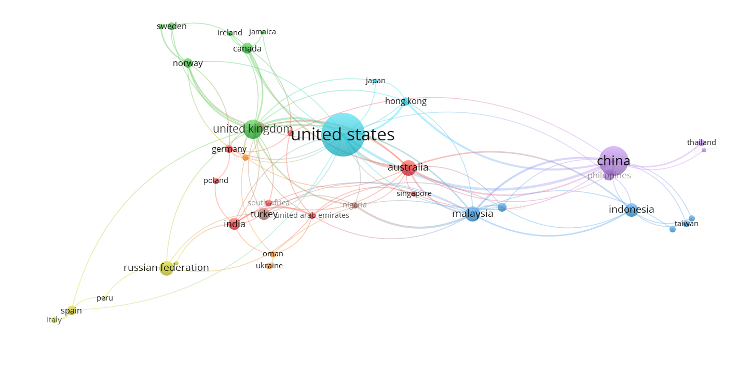
Figure 4 shows the sources-based citation analysis with weight on documents. The figure shows that "The ACM International Conference Proceeding Series" was the favourite platform for authors to publish their work on online learning and school administration. The “Conference Proceeding Series” published 29 documents and received 45 citations. It was followed by "Education and Information Technologies" and "Lecture Notes in Networks and Systems". Both these platforms have published 16 documents each. The former received 214 citations, while the latter received 15 citations.
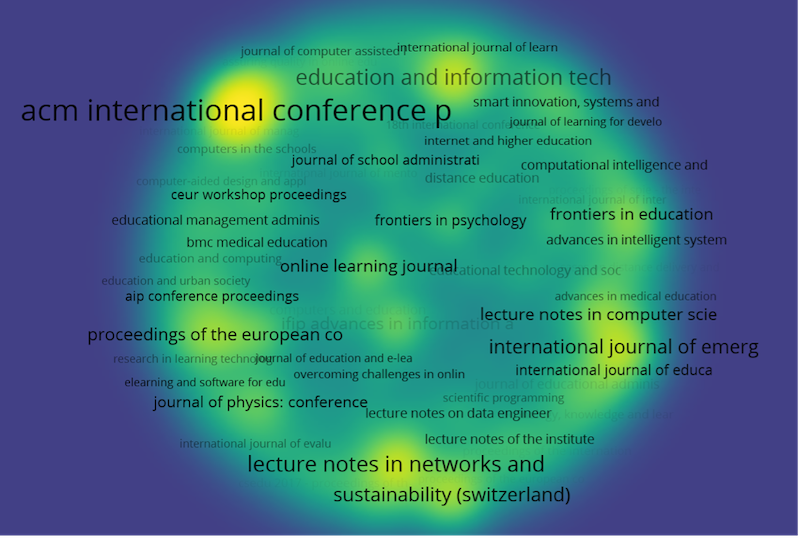
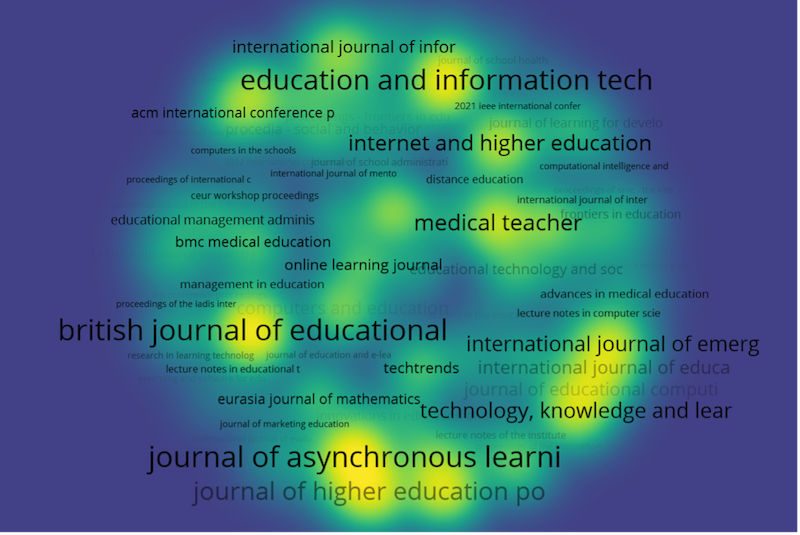
Figure 5 depicts the density visualisation of sources-based citation analysis with weight on citations. The "British Journal of Educational Technology" (231 citations), "Journal of Asynchronous Learning Networks" (231 citations), and "Education and Information Technologies" (214 citations) were the top three publication platforms that received the highest number of citations based on the documents published on online education and school administration. The other prominent platforms were "Journal of Higher Education Policy and Management” (170 citations) and “Sustainability (Switzerland)” (166 citations).
The analysis for co-occurrence of all keywords is shown in Figure 6. The figure shows the formation of four distinct clusters. The prominent keywords that comprise Cluster One are article, blended learning, covid-19, distance learning, education, educational leadership, higher education, human, leadership, learning, medical education, mobile learning, online learning, pandemic, pedagogy, remote learning, student, technology, and the United States. Cluster Two comprises artificial intelligence, big data, cloud computing, data mining, decision-making, digital storage, distance education, education computing, education management, information management, learning systems, online education, students, and teaching management. Cluster Three contains digital technologies, digital transformation, e-learning, education management, educational technology, ICT, information systems, information use, personnel training, professional aspects, school leaders, school leadership, surveys, and teachers. Cluster Four is formed based on the keywords collaborative learning, computer-aided education, curricula, developing countries, internet, knowledge management, learning management systems, management, motivation, multimedia systems, online systems, social networking, societies and institutions, teaching, teaching and learning, and virtual reality.
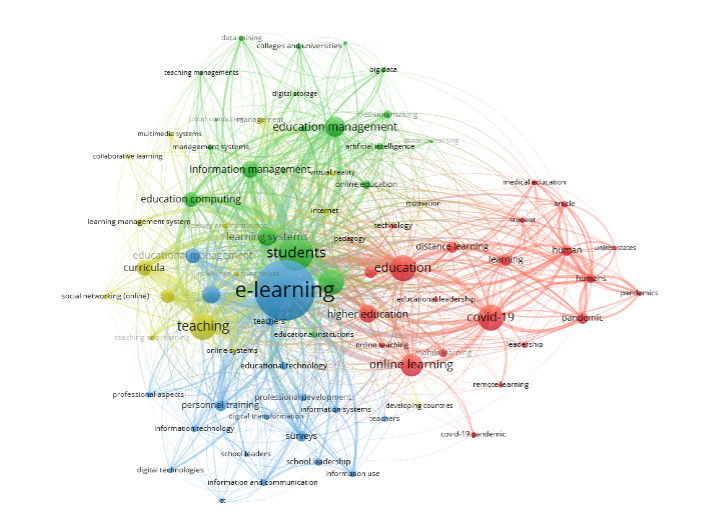
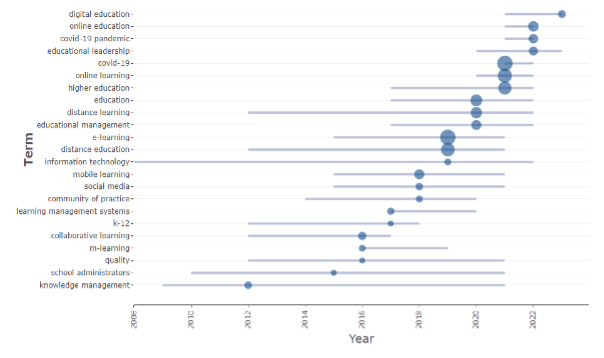
Figure 7 shows the trending topics based on author keywords. The figure shows that knowledge management, information technology, school administration, and quality have been topics of choice for researchers since 2008 and continue to be so even today. During the phase from 2012 to 2020, the focus area of research revolved highly around m-learning, collaborative learning, K-12, learning management systems, community of practice, social media, e-learning, and higher education. Research focus has recently skewed toward Covid-19, digital education, online learning, and educational leadership.
With the help of the Scopus database's 947 records, a scientometrics analysis was conducted to highlight the 43 Years of Leadership in Online Education. The research tried to focus on the trends and prospects in online education. Several insights were obtained based on the co-occurrence of keywords, trending topics, citation analysis, co-authorship analysis, most significant publications, and publication frequency. The rise in the number of publications per year indicates the popularity of online education in recent times. It was also found that researchers across the globe are collaborating to find better ways of imparting quality education to future generations online.
In distributed, virtual, or remote learning, leadership is crucial. Distributed leadership is a tool that virtual leaders should utilise to encourage sociability and preserve harmony within the group. Success in the virtual process depends on innovation, and leaders need to be ready to carry out internal and external educational changes. Distributed leadership is a new characteristic of an interacting network or group of people, and collaboration is crucial for the globalised individual. As a result of this leaderless leadership approach, an organisational entity that is more remarkable than the sum of its parts emerges.
Leaders in online education should be creative, aware of new technological developments, flexible, adaptive, and capable of evaluating the success of their programmes. They should also have informational, interpersonal, and decisional functions to establish quality and value in online education programmes. The best practises for leaders in remote education are to stay away from self-promotion, blend in with the academic community, and use a range of leadership techniques. Administrators should promote teacher, staff, and student innovation and entrepreneurial activity. Faculty support is an issue faced by distance education professionals at rural institutions. To overcome this, leaders must have a collaborative, successful leadership style that combines analytical, organisational, and decision-making abilities (Beaudoin, 2003; Sheninger, 2019; Yukl & Mahsud, 2010; Niemeyer-Rens et al., 2022). Leadership in online education is changing, focusing on the importance of creative thinking, flexibility, integrating technology, and learner-centred methods. To raise the calibre of education, leaders must: be adaptable to changing conditions, knowledgeable about new technology, able to encourage teamwork, put students' achievement first, and make decisions based on facts.
Leaders should provide opportunities for academics and staff to grow professionally, promote creativity and innovation, and prioritise ethical issues. They should allow academicians and staff to grow professionally, promote creativity and innovation, and prioritise ethical issues. Leaders should foster a culture of experimentation, risk-taking, and continuous improvement. They should adopt a culture of continuous improvement to promote innovation in technology integration, enhancement in teaching approaches, and adopt the latest curriculum designs with technological integration. These fresh viewpoints highlight how educational leadership is changing in the digital era and stress the value of flexible, student-focused, tech-savvy, and morally based leadership styles (Fernandez & Shaw, 2020; Ruben et al., 2023; Hénard & Roseveare, 2012; Amanchukwu et al., 2015).
Recent trends in the field of Leadership in Online Education highlight the increasing importance of adaptive leadership styles that respond to the dynamic nature of digital learning environments (Mallillin, 2022; Olowoselu, 2023). Key focus areas include integrating technology-enhanced learning tools, fostering inclusive and equitable online learning experiences, and developing collaborative leadership models that empower educators and students alike. Hot spots in research also emphasise the role of data analytics in informing decision-making processes (Chitpin, 2020), the impact of social presence on student engagement, and the necessity for continuous professional development for educators to lead effectively in virtual settings (Irby et al., 2023). As online education continues to evolve, these trends underscore the critical need for innovative leadership approaches that prioritise flexibility, community building, and learner-centered practises.
Future research on leadership in online education should explore how leadership styles must evolve to accommodate rapidly advancing technology and shifting learner needs. Future research should also focus on the impact of digital leadership on student engagement. Comparisons could also be made between the various leadership models in online and traditional education. As online education overcomes the challenges of geographical boundaries, cross-cultural leadership challenges in online education could also be explored by future researchers.
Amanchukwu, R.N., Stanley, G.J., & Ololube, N.P. (2015). A review of leadership theories, principles and styles and their relevance to educational management. Management, 5(1), 6-14.
Al Ajmi, M.K. (2022). The impact of digital leadership on teachers’ technology integration during the COVID-19 pandemic in Kuwait. International Journal of Educational Research, 112, 101928. https://doi.org/10.1016/J.IJER.2022.101928
Alam, A. (2023). Cloud-based e-learning: Scaffolding the environment for adaptive e-learning ecosystem based on cloud computing infrastructure. Lecture Notes in Networks and Systems, 459, 1-9. https://doi.org/10.1007/978-981-19-1976-3_1/COVER
Alone, K. (2017). Adoption of e-learning technologies in education institutions/organizations: A literature review. Asian Journal of Educational Research, 5(4). www.multidisciplinaryjournals.com
Bagwell, J. (2020). Leading through a pandemic: Adaptive leadership and purposeful action. Journal of School Administration Research and Development, 5, 30-34.
Beaudoin, M.F. (2002). Distance education leadership: An essential role for the new century. Journal of Leadership & Organizational Studies, 8(3), 131-144. https://doi.org/10.1177/107179190200800311
Beaudoin, M.F. (2003). Distance education leadership for the new century. Online Journal of Distance Learning Administration, 6(2), 1.
Beaudoin, M.F. (2015). Distance education leadership in the context of digital change. The Quarterly Review of Distance Education, 16(2), 33-44.
Bojović, Ž., Bojović, P.D., Vujošević, D., & Šuh, J. (2020). Education in times of crisis: Rapid transition to distance learning. Computer Applications in Engineering Education, 28(6), 1467-1489. https://doi.org/10.1002/CAE.22318
Bozkurt, A. (2020). Educational technology research patterns in the realm of the digital knowledge age. Journal of Interactive Media in Education, 2020(1), 18. https://doi.org/10.5334/JIME.570
Bozkurt, A., & Zawacki-Richter, O. (2021). Trends and patterns in distance education (2014–2019): A synthesis of scholarly publications and a visualization of the intellectual landscape. International Review of Research in Open and Distance Learning, 22(2), 19-45. https://doi.org/10.19173/IRRODL.V22I2.5381
Bubb, S., & Jones, M-A. (2020). Learning from the COVID-19 home-schooling experience: Listening to pupils, parents/carers and teachers. Improving Schools, 23(3), 209-222.
Burnette, D.M. (2015). Negotiating the mine field: Strategies for effective online education administrative leadership in higher education institutions. Quarterly Review of Distance Education, 16(3), 13-26. https://go.gale.com/ps/i.do?p=AONE&sw=w&issn=15283518&v=2.1&it=r&id=GALE%7CA439953328&sid=googleScholar&linkaccess=fulltext
Chitpin, S. (2020). Decision making, distributed leadership and the objective knowledge growth framework. International Journal of Educational Management, 34(2), 217-231.
Clark, J.T. (2020). Distance education. Clinical engineering handbook, (2nd ed.). 410-415. https://doi.org/10.1016/B978-0-12-813467-2.00063-8
Corbett, F., & Spinello, E. (2017). Connectivism and leadership: Harnessing a learning theory for the digital age to redefine leadership in the twenty-first century. Heliyon, e03250. https://doi.org/10.1016/j.heliyon.2020.e03250
Ewing, L.A., & Cooper, H.B. (2021). Technology-enabled remote learning during Covid-19: Perspectives of Australian teachers, students and parents. Technology, Pedagogy and Education, 30(1), 41-57. https://doi.org/10.1080/1475939X.2020.1868562
Fernandez, A.A., & Shaw, G.P. (2020). Academic leadership in a time of crisis: The Coronavirus and COVID-19. Journal of Leadership Studies, 14(1), 39-45. https://doi.org/10.1002/JLS.21684
Garg, K., Chaurasia, B., Gienapp, A.J., Splavski, B., & Arnautovic, K.I. (2022). Bibliometric analysis of publications from 2011–2020 in 6 Major Neurosurgical Journals (Part 1): Geographic, demographic, and article type trends. World Neurosurgery, 157, 125-134.
Håkansson Lindqvist, M. (2019). School leaders’ practices for innovative use of digital technologies in schools. British Journal of Educational Technology, 50(3), 1226-1240. https://doi.org/10.1111/BJET.12782
Håkansson Lindqvist, M., & Pettersson, F. (2019). Digitalization and school leadership: On the complexity of leading for digitalization in school. International Journal of Information and Learning Technology, 36(3), 218-230. https://doi.org/10.1108/IJILT-11-2018-0126/FULL/XML
Halpern, C. (2020). Distant learning: The experiences of Brazilian schoolteachers during the COVID-19 school closures. Journal of Ethnic and Cultural Studies, 8(1), 206-225. https://doi.org/10.29333/EJECS/595
Hénard, F., & Roseveare, D. (2012). Fostering quality teaching in higher education: Policies and practices. An IMHE Guide for Higher Education Institutions, 1(1), 7-11.
Irby, B.J., Pashmforoosh, R., Lara-Alecio, R., Tong, F., Etchells, M.J., & Rodriguez, L. (2023). Virtual mentoring and coaching through virtual professional leadership learning communities for school leaders: A mixed-methods study. Mentoring & Tutoring: Partnership in Learning, 31(1), 6-38.
Ivankova, N.V., & Stick, S.L. (2007). Students’ persistence in a distributed doctoral program in educational leadership in higher education: A mixed methods study. Research in Higher Education, 48, 93-135.
Kara, M., Erdoğdu, F., Kokoç, M., & Cagiltay, K. (2019). Challenges faced by adult learners in online distance education: A literature review. Open Praxis, 11(1), 5-22. https://doi.org/10.3316/INFORMIT.234110355704611
Karakose, T., Polat, H., & Papadakis, S. (2021). Examining teachers’ perspectives on school principals’ digital leadership roles and technology capabilities during the COVID-19 pandemic. Sustainability, 13(23), 13448. https://doi.org/10.3390/SU132313448
Kristóf, Z. (2020). International trends of remote teaching ordered in light of the Coronavirus (COVID-19) and its most popular video conferencing applications that implement communication. Central European Journal of Educational Research, 2(2), 84-92. https://doi.org/10.37441/CEJER/2020/2/2/7917
Kuscu, M., & Arslan, H. (2016). Virtual leadership at distance education teams. Turkish Online Journal of Distance Education, 17(3), 136-156. https://doi.org/10.17718/TOJDE.79230
Li, T., Cui, L., Xu, Z., Hu, R., Joshi, P. K., Song, X., Tang, L., Xia, A., Wang, Y., Guo, D., Zhu, J., Hao, Y., Song, L., & Cui, X. (2021). Quantitative analysis of the research trends and areas in grassland remote sensing: A scientometrics analysis of web of science from 1980 to 2020. Remote Sensing, 13(7), 1279.
Lubin, L., & Thomas G. Reio, J. (2023). From the standpoint of instructional designers: Critically investigating the coordination of ID contributions to collaborative online course development. New Horizons in Adult Education and Human Resource Development, 35(3), 117-140. https://doi.org/10.1177/19394225231202308
Lustik, C.M. (2008). Distance education leadership: Self-perceptions of effective leadership attributes. In Capella University ProQuest Dissertations Publishing.
Mallillin, L.L.D. (2022). Adaptive theory approach in leadership: A guide to educational management system and mechanisms. European Journal of Education Studies, 9(7).
Morris, N.P., Ivancheva, M., Coop, T., Mogliacci, R., & Swinnerton, B. (2020). Negotiating growth of online education in higher education. International Journal of Educational Technology in Higher Education, 17(1), 1-16. https://doi.org/10.1186/S41239-020-00227-W/METRICS
Nair, S.V., & Saha, S.K. (2023). Advancements in cyber security and information systems in healthcare from 2004 to 2022: A bibliometric analysis. In 2023 International Conference on Intelligent Systems, Advanced Computing and Communication (ISACC) (pp. 1-6). IEEE.
Niemeyer-Rens, R.F., Sullivan, G., & Self, S.W. (2022). Leadership adaptability within higher education. Journal of Higher Education Theory & Practice, 22(9).
Nobanee, H., Hamadi, F.Y., Al Abdulaziz, F.A., Abukarsh, L.S., Alqahtani, A.F., Alsubaey, S.K., Alqahtani, S.M., & Almansoori, H.A. (2021). A bibliometric analysis of sustainability and risk management. Sustainability (Switzerland), 13(6). https://doi.org/10.3390/SU13063277
Nworie, J. (2012). Applying leadership theories to distance education leadership. Online Journal of Distance Learning Administration, 15(5). http://www.westga.edu/~distance/ojdla/winter154/nworie154.html
Olowoselu, A. (2023). Educational management and leadership in online learning environment: Challenges and solutions. In Overcoming challenges in online learning (pp. 13-24). Routledge.
Pettersson, F. (2021). Understanding digitalization and educational change in school by means of activity theory and the levels of learning concept. Education and Information Technologies, 26(1), 187-204. https://doi.org/10.1007/S10639-020-10239-8/TABLES/2
Pollock, K. (2020). School leaders’ work during the COVID-19 pandemic: A two-pronged approach. International Studies in Educational Administration, 48(3). https://ir.lib.uwo.ca/edupub/268
Ragan, L.C., Cavanagh, T.B., Schroeder, R., & Thompson, K. (2023). Supporting faculty success in online learning: Requirements for individual and institutional leadership. In Leading the elearning transformation of higher education: Leadership strategies for the next generation, 116-137. https://doi.org/10.4324/9781003445623-10/SUPPORTING-FACULTY-SUCCESS-ONLINE-LEARNING-LAWRENCE-RAGAN-THOMAS-CAVANAGH-RAYMOND-SCHROEDER-KELVIN-THOMPSON
Ratten, V. (2020). Coronavirus (Covid-19) and the entrepreneurship education community. Journal of Enterprising Communities: People and Places in the Global Economy, 14(5), 753-764.
Restauri, S.L. (2004). Creating an effective online distance education program using targeted support factors. TechTrends, 48(6), 32-39. https://doi.org/10.1007/BF02763580
Rodríguez-Rodríguez, I., Rodríguez, J.V., Shirvanizadeh, N., Ortiz, A., & Pardo-Quiles, D.J. (2021). Applications of Artificial Intelligence, Machine Learning, Big Data and the Internet of Things to the COVID-19 pandemic: A scientometric review using text mining. International Journal of Environmental Research and Public Health 2021, 18(16), 8578. https://doi.org/10.3390/IJERPH18168578
Ruben, B.D., De Lisi, R., & Gigliotti, R.A. (2023). A guide for leaders in higher education: Concepts, competencies, and tools. Taylor & Francis.
Saha, S.K. (2022). Advancements in electronic healthcare: A bibliometric analysis. In International conference on communication, devices and networking (pp. 101-110). Springer Nature Singapore.
Saha, S.K., Saha, S., & Jha, A. (2023). Bibliometric analysis of published literature on mobile healthcare in the past one decade. In Advances in communication, devices and networking (pp. 99-110). Springer.
Sheninger, E. (2019). Digital leadership: Changing paradigms for changing times. Corwin Press.
Shraim, K. (2019). Online examination practices in higher education institutions: Learners’ perspectives. Turkish Online Journal of Distance Education, 20(4), 185-196. https://doi.org/10.17718/TOJDE.640588
Tallent-Runnels, M.K., Thomas, J.A., Lan, W.Y., Cooper, S., Ahern, T.C., Shaw, S.M., & Liu, X. (2006). Teaching courses online: A review of the research. Review of Educational Research, 76(1), 93-135. https://doi.org/10.3102/00346543076001093
Tamala, J.K., Maramag, E.I., Simeon, K.A., & Ignacio, J.J. (2022). A bibliometric analysis of sustainable oil and gas production research using VOSviewer. Cleaner Engineering and Technology, 7, 100437. https://doi.org/10.1016/J.CLET.2022.100437
Teräs, M., Suoranta, J., Teräs, H., & Curcher, M. (2020). Post-Covid-19 education and education technology ‘solutionism’: A seller’s market. Postdigital Science and Education, 2(3), 863-878.
Thi Hue Dung, D. (2020). The advantages and disadvantages of virtual learning. Asian Journal of Educational Research, 10(3), 45-48. https://doi.org/10.9790/7388-1003054548
Tømte, C.E., Fossland, T., Aamodt, P.O., & Degn, L. (2019). Digitalisation in higher education: Mapping institutional approaches for teaching and learning. Quality in Higher Education, 25(1), 98-114. https://doi.org/10.1080/13538322.2019.1603611
Van Wart, M., Roman, A., Wang, X.H., & Liu, C. (2017). Operationalizing the definition of e-leadership: Identifying the elements of e-leadership. International Review of Administrative Sciences, 85(1), 80-97. https://doi.org/10.1177/0020852316681446
Vu, P., Meyer, R., & Cepero, J. (2016). Models of administration for online learning programs in the U.S. higher education institutions. Journal of Applied Educational and Policy Research, 2(1), 24-31. https://stage-journals.charlotte.edu/jaepr/article/view/460
Wahab, A., & Ali, W. (2020). Online and remote learning in higher education institutes: A necessity in light of COVID-19 pandemic. Higher Education Studies, 10(3), 16-25. https://doi.org/10.5539/hes.v10n3p16
Wharton-Beck, A., Chou, C.C., Gilbert, C., Johnson, B., & Beck, M.A. (2022). K-12 school leadership perspectives from the COVID-19 pandemic. Policy Futures in Education. https://doi.org/10.1177/14782103221135620
Willermark, S., & Islind, A.S. (2022). Adopting to the virtual workplace: Identifying leadership affordances in virtual schools. Journal of Workplace Learning, 35(9), 22-37. https://doi.org/10.1108/JWL-05-2022-0052/FULL/PDF
Williamson, B., Eynon, R., & Potter, J. (2020). Pandemic politics, pedagogies and practices: Digital technologies and distance education during the coronavirus emergency. Learning, Media and Technology, 45(2), 107-114. https://doi.org/10.1080/17439884.2020.1761641
Xie, X., Siau, K., & Nah, F.F.H. (2020). COVID-19 pandemic – Online education in the new normal and the next normal. Journal of Information Technology Case and Application Research, 22(3), 175-187. https://doi.org/10.1080/15228053.2020.1824884
Yazdi, A., Karimi, A., & Mystakidis, S. (2024). Gamification in online education: A visual bibliometric network analysis. Information, 2024, 15(2), 81. https://doi.org/10.3390/INFO15020081
Yukl, G., & Mahsud, R. (2010). Why flexible and adaptive leadership is essential. Consulting Psychology Journal: Practice and Research, 62(2), 81.
Author Notes
Amir Karimi works at the Department of History Education, Farhangian University, Alborz, Iran. Email: amirkarimizanjani1379@gmail.com (https://orcid.org/0000-0002-0299-1771)
Saibal Kumar Saha works at the School of Business and Management, Christ University, Bangalore, India. Email: saibal115@yahoo.co.in (https://orcid.org/0000-0002-7842-698X)
Cite as: Karimi, A., & Saha, S.K. (2025). A scientometric analysis of research studies on 43 years of leadership in online education. Journal of Learning for Development, 12(1), 92-106.