Hilal Salim Marhoon Al-Mamari and Jeya Amantha Kumar
2025 VOL. 12, No. 1
Abstract: Massive open online courses (MOOCs) are online educational courses that provide learning opportunities without geographical, temporal, or enrollment limitations. However, the adoption of MOOCs in Omani higher education is still in its early stages. Therefore, this study aims to assess how attitudes, self-efficacy, experience with online teaching, administrative and colleague support predict MOOC readiness, and determine the extent of varied instructor attitudes and experience regarding MOOC readiness and self-efficacy. A survey of 130 respondents concluded that attitude and experience with online teaching predicted only 34.5% MOOC readiness, and other factors such as self-efficacy, administrative support, and colleague support were found not to influence readiness. Additionally, those with MOOC learning experience showed significantly higher readiness, and better attitude and self-efficacy. Faculty members with experience designing MOOCs had higher self-efficacy in their abilities, while their readiness and attitude were similar to those without this experience. Hence, these findings indicate a need for further professional development programmes and more exposure to MOOCs as a student to further spur the Omani MOOCs movement.
Keywords: faculty members, MOOC experience, MOOC readiness, Omani higher education, personal factors, online teaching and learning method
Massive open online courses (MOOCs) have gained popularity and support worldwide, but they are still relatively new in the Middle East, where the digital learning transformation due to the pandemic has only made clear the need for such a platform (Al-Harthi & Ani, 2023). According to Magd et al. (2022), digital learning has become increasingly popular due to its widespread adoption, particularly after the pandemic, and one of its key benefits, which is the ability to continue one's education from any location without difficulty. Hence, MOOCs fulfill this purpose by allowing students to complete courses at their own pace, regardless of background, age, location, or time zone (Kumar & Al-Samarraie, 2018; Mutawa, 2016), using automated feedback systems, peer grading, and community forums for support. While MOOC students have limited access to instructors due to their large enrollment numbers, MOOCs differ from online learning, which can be a lecture series related to formal, smaller courses that are self-paced with varying accessibility and openness, often pertaining to institutional affiliation with access to instructors. MOOCs structured with similar online resources provide the option to earn an official certificate (Pozzi et al., 2021).
Despite these benefits, Sallam (2017) noted that the adoption in the Arab region frequently varies depending on each country's digital infrastructure and internet penetration. Nevertheless, there has been some introduction of MOOCs throughout the region, using platforms such as Rwaq in Saudi Arabia (Aboulmagd, 2018), Edraak by Jordan's Queen Rania Foundation, MenaVersity in Lebanon, SkillAcademy and EgyMOOCs in Egypt (Abdel-Maksoud, 2019), Nadrus.com in the United Arab Emirates (UAE) and Iraqi-bMOOC in Iraq (Ali & Shiratuddin, 2018), which focus on offering Arabic language MOOCs (Mutawa, 2016). In contrast to other Arab countries, the use of MOOCs at Omani institutions does not seem to be widespread (Al Hosni & Al Ali, 2022). However, according to Al-Harthi and Ani (2023), several Omani HEIs are increasingly establishing online learning communities that encourage engagement while providing blended educational methods through more digital content. It has been theorised that this shift was due to the Covid-19 pandemic, which undoubtfully improved e-learning adoption and brought the application of digital learning technologies, such as Microsoft Teams and Moodle, to the fore in Omani educational institutions (Tawfik & Elmaasrawy, 2022). Omani HEIs have recently started to offer some online courses, yet teaching and learning in these courses still requires a certain percentage of physical attendance (Al-Harthi & Ani, 2023). Nevertheless, while these courses are not classified as MOOCs, they are a start that could lead in the direction of MOOC design and development as these strategies provide faculty members with badly needed digital teaching experience. Concurrently, introducing MOOCs as a tool has the potential to digitally revolutionise Oman's educational system and align with Oman Vision 2040 (Matriano, 2023).
Hence, given that MOOCs are a component of this transformation, we support Subramaniam et al.'s (2019) recommendations to examine the level of faculty readiness for MOOC adoption in higher education institutions. Before universities embrace MOOCs, empirical research on faculty preparation is essential (Ahmed et al., 2022) as this could reduce the risks and hurdles of MOOC implementation and increase its chances of success (Kurniasari et al., 2018). In such a setting, readiness comprises technology infrastructure, assistance from institutions, and guidelines that encourage lecturers to capitalise on MOOCs (Azevedo & Marques, 2017). However, we defined MOOC readiness in this study from the faculty member's perspective, which identified readiness as preparedness that lecturers individually believed they should have in developing and putting together their MOOCs so that they could be used to facilitate online teaching. Henceforth, various factors, such as personal and technical qualities, might influence instructors' preparedness to use them. Hung (2016) asserts that traits comprising self-efficacy, attitudes towards online learning, technical proficiency, access to resources, and institutional support might be used to gauge an educator's readiness to adopt online instruction. Therefore, by investigating such variables, we hypothesised that we could validate essential factors that could be used to predict MOOC readiness among faculty members in Oman.
Furthermore, in distance learning interventions, personal factors are vital in determining intention (Annamalai et al., 2021), commitment (Magd et al., 2022), attitude (Bervell, Kumar et al., 2022; Gasaymeh, 2009; Hung, 2016) and self-efficacy (Bakogianni et al., 2020). Likewise, according to Stajkovic et al. (2006), this reflects their belief in and dedication to accomplishing their objective based on their perceived competencies and knowledge. Moreover, self-efficacy also has a noticeable effect on a person's behaviour, notably the degree of perseverance demonstrated by an individual while confronting potentially strenuous activities and the flexibility required to approach tasks in a way to prevent failure (Mannila et al., 2018). Naghavi (2023) asserts that instructors with a high level of self-efficacy towards e-learning have a favourable attitude towards such interventions. Moreover, this also relates to their experience. According to Ventayen (2018), one of the primary considerations that affect a faculty member's readiness to accept MOOCs is their experience using technology for teaching and learning. According to Zou et al. (2021), faculty members will be more prepared to use MOOCs if they have adequate expertise in online teaching. Moreover, Evans and Myrick (2015) explained that faculty members who have never taught a MOOC usually have valid concerns about the MOOC’s purpose, which affects how prepared they are to adopt them.
Hence, internal factors are vital in determining the readiness of faculty members to adopt MOOCs (Hilali & Moubtassime, 2021). Nevertheless, Bakogianni et al. (2020) explained that external variables, such as institutional factors, could also impact its adoption. However, Samaila et al. (2022) concur that in the context of HEI, external elements related to distance learning and instruction, such as organisational and technological infrastructure, might not significantly influence users' intentions due to prior digital experience and stable economic background that reduces their dependence on these factors. Nevertheless, Scherer et al. (2021) claim that institutional culture and society’s may influence educators' readiness for online teaching in addition to self-efficacy. Koukis and Jimoyiannis (2019) explain that colleagues' support is one such aspect. Henceforth, this study reflects social norms in the lecturers' working environment, which Mutambik (2018) claims significantly impacts e-learning adoption among HEI lecturers. Magd, et al. (2022) agreed, explaining the importance of social interaction in such a context, yet added that administrative support in the form of an institution's engagement, technology, social interaction, and development of e-learning environment are also critical aspects in e-learning adoption in Omani HEI. According to Alqudah et al. (2022), the most significant barriers to e-learning at Arab institutions were academic, administrative, and technological issues. Hence, organisations that adjust to a changing environment by coordinating the objectives of students and instructors to create an accessible and motivating online learning environment will foster academic participation and enhance educational advancement (Fernandez et al., 2022).
Therefore, this study explores the factors influencing faculty members' readiness to adopt MOOCs such as teaching attitude (ATT), self-efficacy (SE), experience with online teaching and learning (EOT), administrative support (AS) and colleagues’ support (CS). Before the pandemic, Abdel-Maksoud (2019) and Sallam (2017) claimed that the MOOC movement at Arab HEIs was limited and deserved further investigation. Nevertheless, post-pandemic, Al Hosni and Al Ali (2022) emphasised the need for a more in-depth investigation into MOOC awareness among educators in Oman. Moreover, the experience with online teaching and learning due to this shift may have altered e-learning perception and behaviour (Kumar, Osman et al., 2022). Thus, MOOC experience is considered a vital consideration in this study, where we explore the effect and association between lecturer experience as a MOOC learner and as a MOOC developer. Additionally, Magd and Jonathan (2023) also explained that the use of online teaching and learning in Arab HEIs, as in Oman, is growing significantly slower than in Western countries, and, therefore, there is a prevailing information gap due to a lack of adequate research in online learning effectiveness post-pandemic.
While MOOCs are novel in Omani HEIs, this study focuses on faculty perspectives by exploring the following objectives:
The study was conducted using a quantitative correlational approach, which involved measuring the degree of association between two or more variables in a given population. This methodology is particularly useful when researchers aim to determine the strength and direction of a relationship between variables without manipulating them, and is typically used to illustrate how several variables relate to one another to create a modelling connection (Bornstein, 2011). Furthermore, using inferential statistics, our research aimed to delve deeper into the effects of prior MOOC experience based on three key factors — MR, ATT, and SE. Through this analysis, we aimed to identify and quantify the relationship between prior MOOC participation and its impact on the aforementioned factors, ultimately contributing to a better understanding of the role experience could play in MOOCs’ future adoption in the teaching process.
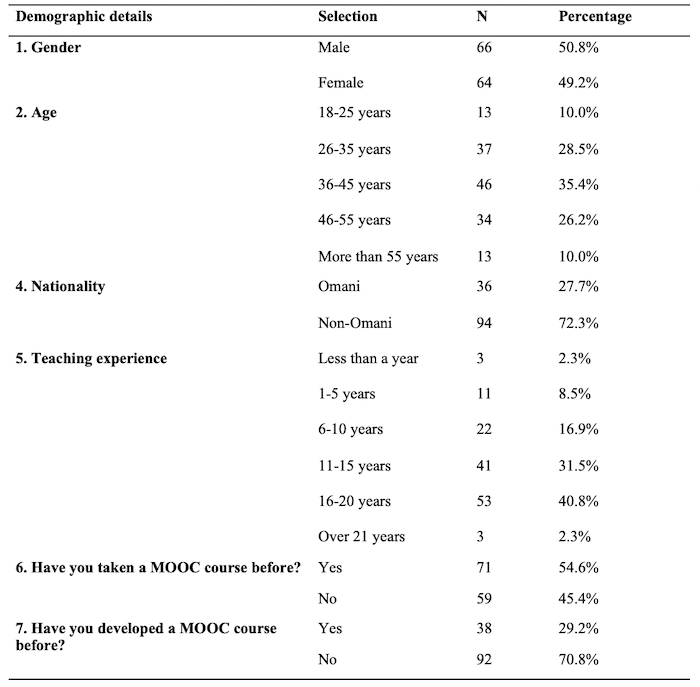
This study was executed at Sultan Qaboos University and was based on the demographic profile of 130 respondents. Male respondents made up 50.8% of the sample (N = 66), while female respondents made up 49.2% (N = 64) (Table 1). Most respondents were between the ages of 26-55 years, and the highest number of respondents were Most respondents were between the ages of 26-55 years, and the highest number of respondents were 36-45-year-olds (N = 46, 35.4%). Interestingly, most of the faculty members were non-Omani (N = 94, 72.3%), and a majority had teaching experience of between 16-20 years (N = 53, 40.8%) and 11-15 years (N = 41, 31.5%). The percentage of respondents that had taken a MOOC was 54.6% (N = 71), while a high percentage of respondents had no experience in developing a MOOC (N = 92, 70.8%).
Table 1: Demographic Details of the Respondents
The instrument for this study was an online questionnaire created through Google Forms. The items for MR were adapted from Mutambik (2018) and Subramaniam et al. (2019) to measure lecturers' preparedness and suitability to engage in designing and developing MOOCs for teaching and learning. ATT items were adapted from Bakogianni et al. (2020), measuring lecturers' positive or negative perceptions towards MOOC adoption. Next, self-efficacy was adapted from Mutambik (2018) and Ventayen (2018), to measure lecturers' perceptions of their abilities, knowledge, and skills to adopt MOOCs. SE relates to an individual's persistence when faced with complex tasks relating to personal abilities, knowledge, and skills (Mannila et al., 2018) when developing and designing their MOOCs. AS was adapted from Al-araibi, et al. (2019), while CS was from Bakogianni et al. (2020) and Mutambik (2018). These items were measured using a five-point Likert scale where respondents had to rate their perceptions from "strongly disagree = 1" to "strongly agree = 5". The instrument's validity was assessed by two subject matter experts in the area of education technology, and the reliability scores for all factors were found to be reliable based on Cronbach's Alpha coefficient being above 0.7 (Pallant, 2016).
The questionnaire for this study was sent using Google Forms, and the data was gathered utilising an online survey approach. The questionnaire was distributed to respondents by the administrative representative of each college, and the response was consensual. Additionally, the instrument remained open for participation for two months, and two reminders were sent out at intervals of two weeks to increase the percentage of respondents who responded. The questionnaire was designed to require responses to all items before submission to minimise missing item replies. After that, a CSV data file was downloaded from Google Forms and formatted in Microsoft Excel. Next, the information was sent to IBM’s SPSS, Version 27 to ascertain the data distribution's normality and perform the analysis. The sample size per group was over 30, hence, a normal distribution was assumed based on the central limit theorem (Ghasemi & Zahediasl, 2012).
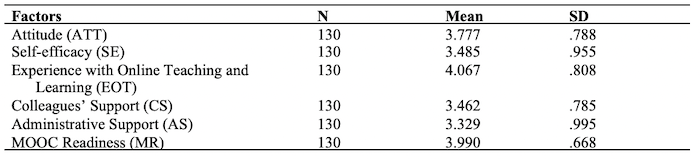
The results of this study indicated that, as a whole, the lecturers had a positive perception towards their ability to design and develop MOOCs for teaching and learning (M = 3.990, SD = .668). They positively perceived their EOT (M = 4.067, SD = .808), ATT (M = 3.777, SD = .788), SE (M = 3.485, SD = .955) and CS (M = 3.462, SD = .785). Among all the factors, AS had the lowest mean value at M = 3.323, SD = .995 (Table 2).
Table 2: Mean and SD Values of the Factors
Next, a multiple regression analysis was conducted to determine if ATT, SE, EOT, CS, and AS could be used to predict MR. It was found that these variables statistically significantly predicted MR at F (5,124) = 14.566, p < .000, R2 = .345. While this indicates that the regression model is a good fit for the data, only ATT and EOT were statistically significant to the prediction at p < .05 (Table 3). Likewise, based on the Pearson correlation analysis performed, it was observed that all factors were positively correlated with MR. However, internal factors, namely ATT (r = .490, p < 0.01), SE (r = .458, p < 0.01), AS (r = .391, p < 0.01) and CS (r = .305, p < 0.01) indicated moderate correlation (Table 4). Whereas, EOT (r = .500, p < 0.01) indicated a strong relationship, as explained by Pallant (2016).
Conversely, to determine how experience with MOOCs as a learner (ML) and as a developer (MD) influence MR, ATT and SE, a series of independent t-tests were performed. According to the findings, lecturers who had partaken in MOOCs as a learner had a higher MR (N = 71, M = 4.190, SD = .572) and were statistically different from their counterparts (N = 59, M = 3.750, SD = .699) at t (128) = 3.946, p < 0.05, d = .633). The ATT of ML (M = 4.132, SD = .627) were also statistically higher than their counterparts (M = 3.349, SD = .752) at t (128) = 6.479, p < 0.05, d = .686). Next, SE also reflected similar outcomes for ML (M = 3.835, SD = .771) compared to those without MOOC experience (M = 3.064, SD = .991) at t (128) = 4.987, p < 0.05, d = .877).
On the other hand, when comparing for MD, interestingly, those who had developed MOOCs (N = 38, M = 4.079, SD = .870) did not reflect a significant difference with their counterparts (N = 92, M = 3.954, SD = .566) for MR at t (128) = .971, p = 0.333, d = .686). Similarly, this was observed for ATT, where MD (M = 3.97, SD = 1.007) and non-developers (M = 3.711, SD = .672) were statistically not different at t (128) = 1.495, p = 0.137, d = .787). However, SE reflected significant difference at t (128) = 2.061, p = 0.041, d = .943) for MD (M = .3.750, SD = .995) and their counterparts (M = 3.375, SD = .922.
Table 3: Model Coefficient
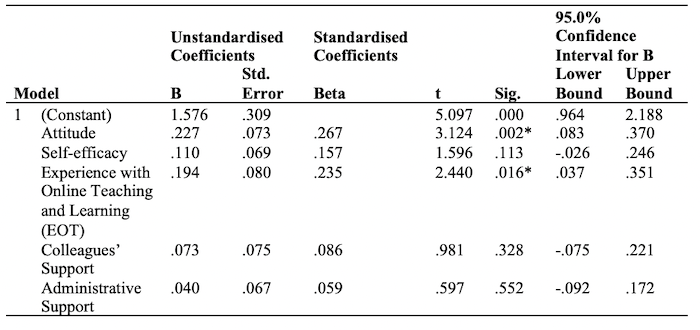
Table 4: Pearson Correlation
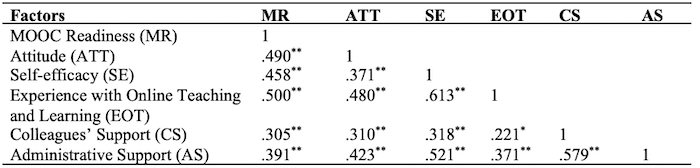
** Correlation is significant at the 0.01 level (2-tailed).
* Correlation is significant at the 0.05 level (2-tailed).
This study aimed to determine the factors that can be used to predict the readiness of faculty members in Omani higher educational institutions to adopt MOOCs. The model predicted only 34.5% of MR based on two significant factors, attitude and experience teaching online, rather than self-efficacy, colleagues' support and administrative support. Accordingly, Bervell, Umar et al. (2022) explained that faculty members' attitudes towards using online platforms in distance learning may improve if they believe they will help them accomplish their professional expectations. Likewise, empirical evidence has also confirmed a strong positive association between attitude and MOOCs, which predicts the success of MOOC adoption (Koukis & Jimoyiannis, 2019). In regard to experience teaching online, the findings concur with Ventayen (2018), who claimed a strong relationship between faculty members' readiness to accept MOOCs and their experience using technology for teaching and learning. Similarly, as explained by Zou et al. (2021), lecturers are usually more prepared to use MOOCs if they have adequate expertise in online teaching.
Nevertheless, while the other factors did not predict MR, they did have a positive moderate correlation with MR. Hence, our study also aligned with Naghavi's (2023) findings, claiming an association between self-efficacy, attitude, and e-learning adoption. Furthermore, in regard to academic support, SQU was one of the first universities in Oman to offer MOOCs, hence, the non-significant relationship in predicting MOOCs’ readiness may be due to a lack of policies and technical infrastructure needed to facilitate such endowments. Likewise, our study investigated whether professional colleagues and peers moderated their intention to use technology. However, our findings did not align with the results reported by Tandon and Kiran (2019), who claimed that professional colleagues and peers could moderate such intention. Despite their claim, we did not find any significant effect of professional colleagues and peers on their intention to use technology. Nevertheless, the findings of our study indicated that prior experience with MOOCs as a learner or student was paramount. This was due to the fact that such experience confers upon individuals a comprehensive understanding of the distinctive learning environment that MOOCs offer, as well as the requisite skills to navigate the platform effectively. As such, familiarity with MOOCs is a critical factor that could greatly influence learners' success in this unique educational setting.
Furthermore, our findings also indicated that lecturers who participated in MOOCs as a learner or student had significantly higher MR, ATT and SE than those who did not. The difference between these groups had a high impact, which also indicates the need to engage lecturers as users of MOOCs before encouraging them to develop their own MOOCs. It was also noteworthy that those who designed and developed a MOOC were not seen to differ from their counterparts, as we observed these lecturers reflected similar MR and ATT. Nevertheless, both groups significantly differed in terms of SE, where those who had developed a MOOC had a higher SE than their counterparts. This event may be attributable to a thoroughgoing familiarity with the process, a history of past successes, or the availability of resources and support networks needed to facilitate the process. Nevertheless, Evans and Myrick (2015) explained that lecturers who had never taught a MOOC usually had valid concerns about the MOOC's purpose, which affected how ready they were to adopt them. Hence, we stipulate that the main strategy in future endowments should be familiarity. Lecturers require guidance and examples that they can use to benchmark such endeavours, and when they are not aware of such requirements, they may assume MOOC design and development is an undemanding task to accomplish.
According to Al-Harthi and Ani (2023), there is still a lack of national policy to push the scope of Omani HEI towards MOOC adoption. Similarly, Magd and Jonathan (2023) posit that standardising the present e-learning approach in Oman's Ministry of Higher Education is vital. To this end, they advocate for providing comprehensive guidelines outlining the procedures and processes for establishing an efficient online teaching and learning environment. Such guidelines would ensure consistency and reliability in the delivery of online courses, ultimately leading to improved educational outcomes. Hence, while the evolution of MOOCs has led to the provision of entire degree programmes through micro-credentialing and badges (Kumar, Richard et al., 2022), institutions should formalise their programmes by establishing standardised frameworks and procedures to ensure consistency and effectiveness in MOOC implementation. Likewise, this will enable institutions to provide high-quality education to their students while maintaining their reputation for excellence in the field of online education.
Therefore, we conclude that the three main factors predicting MOOC adoption in Omani HEIs are ATT, EOT and experience with MOOCS. The findings also indicated that personal factors were an essential consideration. Experience with digital and online teaching, learning, and attitude are vital in adopting and transitioning towards MOOCs. Likewise, we suggest that one of the main areas that require urgency is professional development and exposure in areas relating to MOOCs. Courses should be designed as MOOCs to give lecturers experience and guidance towards developing their own MOOCs effectively. Moreover, we suggest future studies consider the challenges and benefits that lecturers perceived as enabling the implementation of strategies to improve and spur the Omani MOOCs movement. Also, consideration of how administrative policies could influence MOOCs' adaptation should be further explored.
It is important to acknowledge that the study conducted in Oman on the role of Massive Open Online Courses (MOOCs) in higher education was limited to a single institution. This presents some challenges in generalising the study's findings to other higher education institutions in Oman. It is also worth noting that, while the study identified correlations between various factors, it failed to account for the potential moderating influence of MOOC experience on these relationships. Therefore, future research endeavours should delve further into faculty members' views regarding MOOC objectives and technical possibilities to gain a more comprehensive understanding of the subject. This would help to understand better MOOCs' relevance in higher education and how they could be optimised to achieve desired outcomes. Therefore, while the study's findings are valuable, it is necessary to conduct further research to fully grasp the significance of MOOCs in the context of higher education in Oman.
Conflict of Interest: The authors declare no conflict of interest.
Funding: This research received no grant or contribution from any funding body.
Abdel-Maksoud, N.F. (2019). Factors affecting MOOCs' adoption in the Arab world: Exploring learners' perceptions on MOOCs' drivers and barriers. Higher Education Studies, 12(11), 164-177.
Aboulmagd, N. (2018). Learner engagement in a MOOC in the Arab world: A case study analysis using the community of inquiry framework [Master's Thesis, the American University in Cairo]. AUC Knowledge Fountain. https://fount.aucegypt.edu/etds/68
Ahmed, M.M., Sultana, N., Astri Dwi Jayanti, S., Mardoni, Y., & Helmiatin, H. (2021). Attitude towards entrepreneurship development courses of MOOCs. Asian Association of Open Universities Journal, 16(1), 129-141.
Al-araibi, A.A.M., Naz’ri bin Mahrin, M., Yusoff, R.C.M., & Chuprat, S.B. (2019). A model for technological aspect of e-learning readiness in higher education. Education and Information Technologies, 24(2), 1395-1431. https://doi.org/10.1007/s10639-018-9837-9
Al-Harthi, A.S.A., & Ani, W.T.A. (2023). Learner readiness for MOOCs in Omani higher education institutions: Disparities between projections and reality. Education and Information Technologies, 28(1), 303-319. https://doi.org/10.1007/s10639-022-11183-5
Al Hosni, A.K., & Al Ali, S.F. (2022). MOOCs in Omani higher education institutions: Use and popularity. Education, Language and Sociology Research, 3(1), 1-24. http://dx.doi.org/10.22158/elsr.v3n1p1
Ali, Q.A., & Shiratuddin, N. (2018). Effective design of blended MOOC in Iraq institutions. Journal of Education and Social Sciences, 9(2), 113-128.
Alqudah, H., Alwaely, S.A., Lahiani, H., & Aljarrah, H. (2022). Perspectives on e-learning in universities of the Arab countries. In 2022 International Arab Conference on Information Technology (ACIT), Abu Dhabi, United Arab Emirates, IEEE, 1-6. https://doi.org/10.1109/ACIT57182.2022.9994127
Annamalai, N., Kumar, J.A., Ramayah, T., & Osman, S. (2021). Investigating the use of learning management system (LMS) for distance education in Malaysia: A mixed-method approach. Contemporary Educational Technology, 13(3), ep313. https://doi.org/10.30935/cedtech/10987
Azevedo, J., & Marques, M.M. (2017). MOOC success factors: Proposal of an analysis framework. Journal of Information Technology Education Innovations in Practice, 16, 233-251. https://doi.org/10.28945/3861
Bakogianni, E., Tsitouridou, M., & Kyridis, A. (2020). MOOCs in teachers' professional development: Examining teacher readiness. Academia, (18), 9-40.
Bervell, B., Kumar, J.A., Arkorful, V., Agyapong, E.M., & Osman, S. (2022). Re-modelling the role of facilitating conditions for Google Classroom acceptance: A revision of UTAUT2. Australasian Journal of Educational Technology, 38(1), 115-135. https://doi.org/10.14742/ajet.7178
Bervell, B., Umar, I.N., Masood, M., Kumar, J.A., Armah, J.K., & Somuah, B.A. (2022). Promoting voluntary use behavior of learning management systems among tutors for blended learning in distance higher education. Contemporary Educational Technology, 14(4), ep379. https://doi.org/10.30935/cedtech/12193
Bornstein, R.F. (2011). Toward a process-focused model of test score validity: Improving psychological assessment in science and practice. Psychological Assessment, 23(2), 532. https://doi.org/10.1037/a0022402
Evans, S., & Myrick, J.G. (2015). How MOOC instructors view the pedagogy and purposes of massive open online courses. Distance Education, 36(3), 295–311. https://doi.org/10.1080/01587919.2015.1081736
Fernandez, A.I., Al Radaideh, A., Singh Sisodia, G., Mathew, A. & Jimber del Río, J.A. (2022) Managing university e-learning environments and academic achievement in the United Arab Emirates: An instructor and student perspective. PLoS ONE, 17(5): e0268338. https://doi.org/10.1371/journal.pone.0268338
Gasaymeh, A.M.M. (2009). A study of faculty attitudes toward internet-based distance education: A survey of two Jordanian public universities [Doctoral dissertation, Ohio University].
Ghasemi, A., & Zahediasl, S. (2012). Normality tests for statistical analysis: A guide for non-statisticians. International Journal of Endocrinology and Metabolism, 10(2), 486-489. https://doi.org/10.5812/ijem.3505
Hilali, E.E., & Moubtassime, M. (2021). Moroccan teachers of English acceptance and readiness to use MOOCs for continuing professional development. Universal Journal of Educational Research, 9(5), 891-900. https://doi.org/10.13189/ujer.2021.090501
Hung, M.L. (2016). Teacher readiness for online learning: Scale development and teacher perceptions. Computers & Education, 94, 120-133. https://doi.org/10.1016/j.compedu.2015.11.012
Koukis, N., & Jimoyiannis, A. (2019). MOOCS for teacher professional development: exploring teachers' perceptions and achievements. Interactive Technology and Smart Education, 16(1), 74-91. https://doi.org/10.1108/itse-10-2018-0081
Kumar, J.A., & Al-Samarraie, H. (2018). MOOCs in the Malaysian higher education institutions: The instructors' perspectives. The Reference Librarian, 59(3), 163-177. https://doi.org/10.1080/02763877.2018.1458688
Kumar, J.A., Osman, S., Sanmugam, M., & Rasappan, R. (2022). Mobile learning acceptance post pandemic: A behavioural shift among engineering undergraduates. Sustainability, 14(6), 3197. https://doi.org/10.3390/su14063197
Kumar, J.A., Richard, R.J., Osman, S., & Lowrence, K. (2022). Micro-credentials in leveraging emergency remote teaching: The relationship between novice users' insights and identity in Malaysia. International Journal of Educational Technology in Higher Education, 19(1), 18. https://doi.org/10.1186/s41239-022-00323-z
Kurniasari, F., Jusuf, E., & Gunardi, A. (2018). The readiness of Indonesian toward MOOC system. International Journal of Engineering & Technology, 7(3), 1631-1636. https://doi.org/10.14419/ijet.v7i3.15431
Magd, H., & Jonathan, H. (2023). Limitations and challenges of online teaching at higher education institutions in Oman. International Journal of Information and Education Technology, 13(5), 831-837. https://doi.org/10.18178/ijiet.2023.13.5.1875
Magd, H., Nzomkunda, A., Negi, S., & Ansari, M. (2022). Critical success factors of e-learning implementation in higher education institutions: A proposed framework for success. Global Business & Management Research, 14(2), 20-38
Mannila, L., Nordén, L.Å., & Pears, A. (2018). Digital competence, teacher self-efficacy and training needs. In Proceedings of the 2018 ACM Conference on International Computing Education Research, 78-85.
Matriano, M.T. (2023). Balancing of skills in the digital transformation of education and employability. In SHS Web of Conferences (Vol. 156, p. 08004). EDP Sciences. https://doi.org/10.1051/shsconf/202315608004
Mutambik, I. (2018). Exploring the readiness of students and English teachers to use e-learning for English as a foreign language in Saudi Arabia [Doctoral dissertation, University of Edinburgh].
Naghavi, M.A. (2023). Study of teachers and students attitude toward e-learning: Surveying in Iran’s e-learning universities. Research and Planning in Higher Education, 13(1), 157-176.
Pallant, J. (2016). SPSS survival manual (6th ed.). McGraw-Hill Education.
Pozzi, M., Prattichizzo, D., & Malvezzi, M. (2021). Accessible educational resources for teaching and learning robotics. Robotics, 10(1), 38. https://doi.org/10.3390/robotics10010038
Sallam, M.H. (2017). A review of MOOCs in the Arab world. Creative Education, 8(04), 564.
Scherer, R., Howard, S.K., Tondeur, J., & Siddiq, F. (2021). Profiling teachers' readiness for online teaching and learning in higher education: Who's ready? Computers in Human Behavior, 118(106675), 106675. https://doi.org/10.1016/j.chb.2020.106675
Stajkovic, A.D., Locke, E.A., & Blair, E.S. (2006). A first examination of the relationships between primed subconscious goals, assigned conscious goals, and task performance. The Journal of Applied Psychology, 91(5), 1172-1180. https://doi.org/10.1037/0021-9010.91.5.1172
Subramaniam, T.T., Suhaimi, N.A.D., Latif, L.A., Abu Kassim, Z., & Fadzil, M. (2019). MOOCs readiness: The scenario in Malaysia. International Review of Research in Open and Distributed Learning, 20(3), 80-101. https://doi.org/10.19173/irrodl.v20i3.3913
Tawfik, O.I., & Elmaasrawy, H.E. (2023). Assessing the factors that affected the development of cloud-based accounting education and students' academic performance in Oman. Arab Gulf Journal of Scientific Research, 41(2), 141-157.
Ventayen, R.J.M. (2018). Teachers' readiness in online teaching environment: A case of department of education teachers. PSU Journal of Education, Management and Social Sciences, 2(1). 94-106
Zou, C., Li, P., & Jin, L. (2021). Online college English education in Wuhan against the COVID-19 pandemic: Student and teacher readiness, challenges and implications. PloS One, 16(10), e0258137. https://doi.org/10.1371/journal.pone.0258137
Author Notes
Hilal Salim Marhoon Al-Mamari is a researcher specialising in e-learning technology at the Ministry of Education in the Sultanate of Oman. His research primarily examines the development of faculty members through the integration of advanced educational technologies. This includes exploring the effectiveness and accessibility of massive open online courses (MOOCs) and evaluating the preparedness of educators to utilise these innovative learning platforms. By focusing on these areas, Al-Mamari aims to enhance the quality of teaching and learning in Oman’s educational landscape. Email: hilal.almamri@moe.om (https://orcid.org/0009-0007-7744-3909)
Jeya Amantha Kumar is a research associate at Michigan State University with a PhD in Educational Technology from Universiti Sains Malaysia. Her research focuses on student engagement, multimedia learning, MOOCs, microcredentials, and AI-driven tools such as educational chatbots and human-computer interaction. Email: jeya.amantha@gmail.com (https://orcid.org/0000-0002-6920-0348)
Cite as: Al-Mamari, H.S.M., & Kumar, J.A. (2025). Role of prior experience with online teaching and learning in the prediction of MOOC readiness. Journal of Learning for Development, 12(1), 219-230.