
Yunus Doğan and Coşkun Akça
2025 VOL. 12, No. 1
Abstract: There is strong evidence in the relevant literature that the use of technology in higher education positively affects academic achievement and motivation. However, while there are some international studies on the effect of technology acceptance on college student commitment, it is understood that there has not been enough research in the national literature on this topic. In this context, this study aims to examine the effect of college students' tendencies toward using digital technology on student commitment. This research was conducted with a total of 321 Turkish college students and data were collected using the Student Commitment Scale in Higher Education developed by Çınkır et al. (2021) and the Tendency Scale for Using Technology in Class developed by Günüç and Kuzu (2014). The research revealed that college students generally have a favourable attitude (3.96) and inclination (3.82) towards using digital technology during classes, alongside a moderate level of dedication (3.42) to their university. Additionally, it was discovered that students who are highly committed to their higher education also tend to use digital technology more in classrooms. Notably, the analysis indicates that around 12% of the variance in college students' commitment to higher education can be explained by their inclination towards digital technology use. This emphasises the significance of integrating digital tools in educational settings, as it appears to positively influence students' engagement and commitment to their studies.
Keywords: Technology Acceptance Model, digital technology, student commitment, structural equation model
Technology plays a transformative role in higher education by reshaping traditional learning and teaching methods, impacting various aspects of the educational experience (Ahmad et al., 2024). With the integration of technology in higher education, geographical barriers have been overcome, significantly expanding access to education and enabling online and distance learning opportunities. This has democratised education, making it accessible to a broader audience regardless of their location or circumstances (Allen & Seaman, 2017). Moreover, the proliferation of online courses, virtual classrooms, and learning management systems has not only broadened access but also enriched the educational landscape with diverse learning modalities. These digital platforms offer flexibility and convenience, allowing students to engage with course materials at their own pace and according to their individual schedules. Additionally, technology has facilitated the accessibility of various interactive learning resources, enhancing the richness of educational experiences. Digital textbooks, multimedia presentations, e-books, and online libraries provide college students access to a wealth of materials, fostering self-directed and personalised learning experiences (Johnson et al., 2017). This abundance of resources empowers students to explore topics in depth, engage with multimedia content, and tailor their learning journey to suit their interests and preferences. As technology continues to evolve, its role in higher education will likely expand further, driving innovation and shaping the future of learning.
Technology also has the potential to increase college student commitment and motivation. Student commitment refers to the level of dedication, participation, and continuity that students exhibit towards their academic goals (Pike, 2016). When students perceive that technology makes their learning experiences more exciting and relevant, they are more likely to become more engaged and motivated (Chang et al., 2014). Interactive multimedia, gamified learning experiences, and social media platforms can capture students' interest, making learning more enjoyable and encouraging active participation (Talan et al., 2020; Dichev & Dicheva, 2017; Johnson et al., 2017). However, technology acceptance plays a crucial role in materialising all these positive effects of technology. In other words, the technology acceptance is instrumental in terms of the effectiveness of technology in education. Acceptance and adoption of technology by teachers, students, and other stakeholders enable successful integration and use of technology in educational environments. This integration is believed to increase students' active participation and engagement. In this context, technology acceptance provides an essential framework for examining the impact of the Technology Acceptance Model on student commitment in higher education. Furthermore, fostering a culture of technology acceptance involves addressing various factors such as usability, perceived usefulness, and ease of access. By promoting positive attitudes towards technology among students and educators, educational institutions can create an environment conducive to enhanced learning experiences and heightened student commitment. Therefore, understanding and promoting the Technology Acceptance Model is paramount for leveraging the full potential of technology to support student success in higher education.
The relationship between the Technology Acceptance Model and student commitment in higher education is an essential area of interest and research. This refers to individuals' willingness and readiness to adopt and use new technologies, while commitment relates to students' participation and interaction in their learning journeys. In the relevant literature, it is noted that technology acceptance forms the foundation for effective technology integration in areas such as adoption, engagement, pedagogical practices, access, and professional development (Davis, 1989; Venkatesh et al., 2003; Al-Emran et al., 2016). Where the studies examining the relationship between technology acceptance and student commitment levels were concerned, positive and significant relationships were found (Kahu, 2013; Sánchez-Franco & Roldán, 2005; Venkatesh et al., 2003; Venkatesh & Bala, 2008; Wu et al., 2010; Zhang et al., 2016). This suggests that the extent to which students accept and embrace technology influences their commitment to their academic pursuits. In this context, the objective of this research was to investigate the effect of the Technology Acceptance Model on student commitment in higher education, which is stated to play an essential role in academic success, personal development, and the overall educational experience. By elucidating the mechanisms through which technology acceptance influences student commitment, this research seeks to inform educational practices and policies aimed at fostering a supportive and conducive learning environment for students. Through empirical inquiry and rigorous analysis, this study aims to contribute to the growing body of knowledge on technology integration and its impact on student outcomes in higher education.
The aim of this study was to examine the effect of college students' tendencies toward using digital technology on student commitment. The following research question was formulated accordingly:
RQ1: Can technology acceptance affect student commitment?
Student commitment represents the level of dedication, interest, and responsibility that students exhibit in their academic endeavours. It encompasses a range of behaviours and attitudes, including regular attendance in classes, active participation in discussions, timely completion of assignments, consistent studying, and seeking additional learning opportunities outside the classroom. Student commitment is a critical factor for academic success because it significantly influences learning outcomes and personal development. Research supports the positive impact of student commitment on academic outcomes and underscores the importance of fostering participation, dedication, and responsibility in the educational environment (Rumberger, 2011; Sarwar & Ashrafi, 2014). Student commitment is a topic of great interest in the relevant literature and is widely studied in the fields of education, psychology, and sociology. In an academic context, student commitment reflects how much investment and dedication students put into their academic goals, including aspects such as attendance, participation, effort, and motivation.
There are numerous factors that can influence student commitment. These factors include individual characteristics such as personality traits, learning styles, and academic abilities, as well as environmental factors like instructional quality, academic discipline level, and the supportiveness of the learning environment. Previous research results show that a high level of student commitment is associated with several positive outcomes, such as higher academic achievement, greater perseverance in pursuing educational goals, and greater satisfaction with the educational experience. Conversely, low levels of student commitment are associated with negative outcomes like poor academic performance, high dropout rates, and disengagement from the educational process (Chang et al., 2014; Kahu, 2013; Willms, 2003). A study conducted by Robbins et al. (2004) found that students who display a high level of commitment are more likely to continue pursuing their academic goals even when faced with challenges. Similarly, a study by Mouratidis et al. (2011) demonstrated that students with a strong sense of commitment to their academic goals were more actively engaged in their learning and, consequently, had a higher likelihood of achieving greater academic success.
Theoretical frameworks that explain the relationships between student commitment and technology acceptance include the Technology Acceptance Model (TAM) and the Theory of Planned Behavior (TPB). TAM suggests that technology acceptance is influenced by perceived usefulness and perceived ease of use (Davis, 1989). Perceived usefulness refers to the degree to which an individual believes that technology will enhance their performance or productivity, while perceived ease of use refers to the degree to which an individual believes that technology is easy to use and learn. According to TAM, if university students perceive technology as useful and easy to use, they are more likely to accept and adopt it. This acceptance can ultimately impact their levels of commitment. On the other hand, the Theory of Planned Behavior (TPB) posits that technology acceptance is influenced by three factors related to behaviour: attitude toward the behaviour, subjective norm, and perceived behavioural control (Fishbein & Ajzen, 2010). Attitude toward the behaviour refers to an individual's evaluation of the behaviour as positive or negative, while subjective norm represents the social pressures or expectations that influence an individual's behaviour. Perceived behavioural control pertains to the ease or difficulty an individual perceives in performing the behaviour. In addition to TAM and TPB, other theoretical frameworks like the Unified Theory of Acceptance and Use of Technology (UTAUT) have been used to examine the impact of technology acceptance on student commitment. UTAUT is an extended version of TAM that incorporates additional factors like social influence and facilitating conditions (Venkatesh et al., 2003).
As technology continues to become increasingly prevalent in various aspects of life, students' skills in technology are becoming fundamental competencies. Students who embrace and accept technology can develop a sense of competence and readiness for the future. This can lead to an increased commitment to college because they realise the importance of education in a technology-focused world (Chen & Jones, 2018; Çakır & Solak, 2015; Wang & Wang, 2012; Nistor & Neubauer, 2010). There are numerous studies examining the relationship between technology acceptance and student commitment levels. The results of these studies indicate a positive relationship between technology acceptance and student commitment. For instance, a study conducted by Sánchez-Franco and Roldán (2005) found that students' perceived benefits and ease of use of e-learning technologies positively influenced their commitment to the e-learning process. The study also emphasised that students who perceived e-learning technologies as useful and user-friendly had higher levels of commitment. Furthermore, another study by Venkatesh and Bala (2008) investigated the impact of technology acceptance in a computer-based learning context on student commitment. The study revealed that students who perceived computer-based learning as beneficial and easy to use had higher levels of commitment to their academic activities.
In a study conducted by Teo (2009), it was found that perceived benefits and ease of use positively influenced students' commitment to using technology in the educational environment. The study highlighted that students who perceived technology as useful and easy to use tended to show more significant commitment to its adoption and integration into their learning experiences. Additionally, a study by Venkatesh et al. (2003), applying the Technology Acceptance Model (TAM) in online learning, showed that perceived usefulness and ease of use significantly impacted students' commitment to using online learning platforms. Research by Wu et al. (2010) demonstrated that social influence from peers and teachers and the availability of necessary resources and support significantly increased students' commitment to using educational technologies.
While there is a plethora of international research on the correlation between technology acceptance and student commitment, there is a noticeable dearth of such studies within the Turkish national literature. Consequently, this research aims to fill this gap and enrich the Turkish literature on the subject. Recognising the pivotal role of student commitment in academic success, this study seeks to augment existing international literature by providing insights tailored to the Turkish context. Hence, the research hypothesis was formulated as follows.
H1: Technology acceptance affects student commitment to higher education.
This quantitative study used a relational research design, which aimed to identify differences in the characteristics of a population. In relational studies, relationships between multiple variables are examined without any attempt to manipulate them (Cohen et al., 2007; Fraenkel et al., 2012; Lau, 2017). Relational research can also be referred to as a descriptive research method because it describes an existing relationship between variables. However, this descriptive approach to the relationship differs from descriptions found in other studies. A relational study explains the degree of association between two or more quantitative variables that are related to each other and does so using a correlation coefficient (Fraenkel et al., 2012).
In this study, SPSS 23 and Amos 22 package programmes were used in the analysis of the research data. Confirmatory factor analysis and reliability analysis results and descriptive statistics related to the scales were included; correlation analysis was performed to determine the relationships between variables and structural equation model path analysis was used to test the research hypothesis in the research model. The research model formed is illustrated in Figure 1.
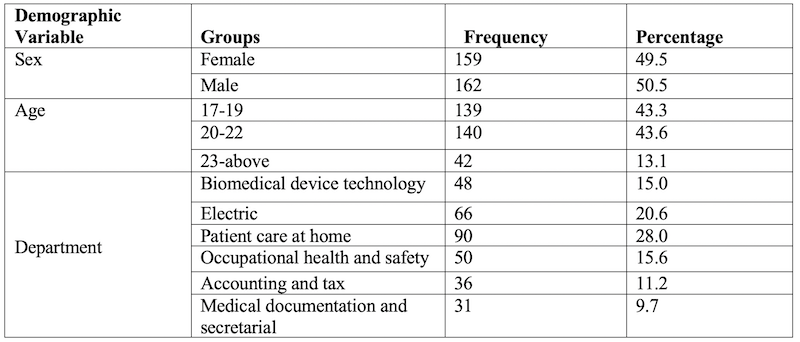
The research population consisted of 1,200 students studying in a college in Türkiye. Data were collected by the convenience sampling method from 321 students who agreed to participate in the research on a voluntary basis. The data of the study were collected between March and April 2022. Table 1 shows the demographic characteristics of the participants.
Table 1: Distribution of Participants According to Demographic Characteristics
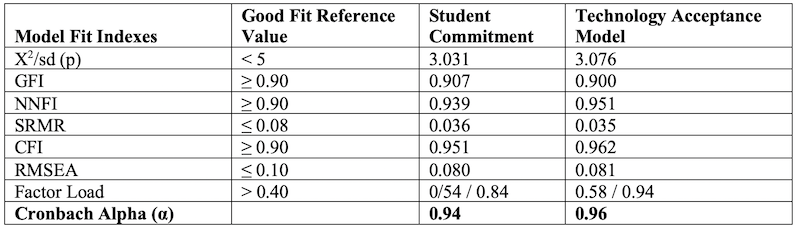
The research employed a questionnaire as the data collection tool. This was based on a five-point Likert scale ranging from strongly disagree = 1 to strongly agree = 5. The questionnaire consisted of three sections. In the first section, the Personal Information Form contained details about the participating higher education students' sex, age groups, and department. The second section of the questionnaire included the Higher Education Student Commitment Scale developed by Çınkır et al. (2021). This scale is comprised of 14 items and measured a single dimension. “I feel like a member of this university.”, “I show a sincere commitment to this university.” are examples of the expressions in the scale. The third section of the questionnaire contained the Technology Use Tendency Scale in the Classroom, developed by Günüç and Kuzu (2014). This scale included 16 items and measured two dimensions: emotional tendencies and behavioural tendencies. “I would like technology to be used in every lesson.”, “Using technology in lessons increases my interest.” can be given as examples of the expressions in the scale. The validity and reliability analyses were conducted for both scales used in this research. The results of the analyses for these scales are presented in Table 2.
Table 2: Results of Validity and Reliability Analysis for the Scales
Source: Çokluk et al., (2010).
Confirmatory factor analysis (CFA) was conducted to determine the validity of the Technology Acceptance Model and Student Commitment scale. According to the confirmatory factor analysis results of the scales used in the study, it was determined that the factor loadings were higher than 0.40 and the model fit indices reached good levels. The Cronbach alpha coefficient of the scales was greater than 0.70. Satisfactory model fits were found for the Technology Acceptance Model scale with χ2/df = 3.076, goodness of fit ındex (GFI) = 0.900, Non-Normed Fit Index (NNFI) = 0.951, comparative fit index (CFI) = 0.962, root mean square error of approximation (RMSEA) = 0.081, and standardised root mean residual (SRMR) = 0.035. Satisfactory model fits were found for the Student Commitment scale with χ2/df = 3.031, goodness of fit ındex (GFI) = 0.907, Non-Normed Fit Index (NNFI) = 0.939, comparative fit index (CFI) = 0.951, root mean square error of approximation (RMSEA) = 0.080, and standardised root mean residual (SRMR) = 0.036. According to the findings of validity and reliability analyses, the scales were found to be reliable and valid.
The findings, presented in the order of the research question, are detailed below.
The descriptive statistical results of the scale scores for the research are presented in Table 3.
Table 3: Descriptive Statistics of Scale Scores
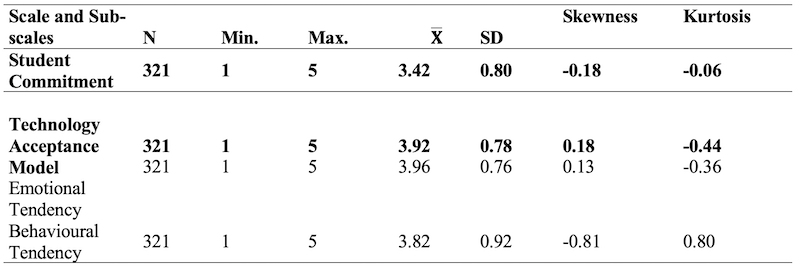
The student commitment in higher education score was determined to be 3.42 ± 0.80, with the lowest possible score (1) and the highest possible score (5), indicating that participating students' commitment in higher education fell within the "undecided" range. Regarding the inclination to use technology in the classroom, the score was determined to be 3.92 ± 0.78, with the lowest possible score (1) and the highest possible score (5), indicating that participating students' inclination towards using technology in the classroom fell within the "agree" range. The Pearson correlation analysis results between the inclination towards using technology in the classroom and student commitment in higher education are presented in Table 4.
Table 4: Pearson Correlation Analysis Results

The results showed a positive and significant relationship between student commitment scores in higher education and emotional tendency (r = 0.38; p < 0.05), behavioural tendency (r = 0.29; p < 0.05), and the scale score for the Technology Acceptance Model (r = 0.36; p < 0.05). Students with a high level of commitment in higher education also exhibited a high inclination towards using digital technology in the classroom. Table 5 presents the path analysis results regarding the effect of the Technology Acceptance Model on student commitment in higher education.
Table 5: Path Analysis Results

According to Table 5, the Technology Acceptance Model explains approximately 12% (r2 = 0.118) of the variance in student commitment in higher education. When examining the regression coefficients and the significance of the t-test values, it was determined that the Technology Acceptance Model positively and significantly affected student commitment in higher education (β = 0.34; t = 6.52; p < 0.05). According to the results obtained, the research hypothesis h1 was accepted.
Upon consideration of both correlation and path analysis, the following assertion can be made: acceptance and utilisation of technology constitutes a significant factor in enhancing students' commitment in their courses. This finding indicates that educational institutions' investment in digital technologies is likely to exert a positive influence on students.
The research findings underscore the significant impact of technology acceptance on student commitment within educational settings. Through rigorous statistical analysis, it was discerned that the Technology Acceptance Model exerted a positive influence on student commitment, with a notable beta coefficient (β = 0.34; t = 6.52; p < 0.05), signifying its substantive effect. Moreover, the predictive capacity of the Technology Acceptance Model variable on student commitment, as evidenced by the coefficient of determination (r2 = 0.118), elucidates the robustness of the relationship between these constructs. Employing advanced statistical methodologies, such as structural equation modeling, facilitated a comprehensive examination of the data, culminating in the validation of the proposed model and the subsequent acceptance of the research hypothesis.
In tandem with empirical findings, extant literature underscores the pivotal role of technology acceptance in shaping students' commitment to their educational endeavours. The notion that students' perceptions of technology's utility and relevance correlate positively with their commitment in technology-mediated learning activities is well-documented across various scholarly inquiries (Kala & Chaubey, 2023; Chen & Jones, 2018; Schindler et al., 2017; Zyad, 2016; Günüç & Kuzu, 2014; Chen et al., 2010). This body of research provides a robust foundation for understanding how the Technology Acceptance Model influences student commitment, drawing attention to the interconnectedness between students' attitudes towards technology and their academic engagement. For instance, seminal works by Venkatesh et al. (2003) elucidate how users' perceptions of technology's usefulness, as posited in the Technology Acceptance Model (TAM), significantly influence their intentions to adopt technology, thus fostering a heightened sense of commitment to the task at hand. Similarly, research by Kay and Lauricella (2011) highlights the transformative potential of educational technology in cultivating interactive and experiential learning environments conducive to fostering student commitment. Moreover, these findings underscore the need for educators and policymakers to prioritise strategies that enhance students' perceptions of technology's relevance and effectiveness in order to foster greater commitment and engagement in educational pursuits. This synthesis of empirical evidence and theoretical frameworks provides a comprehensive understanding of the intricate relationship between technology acceptance and student commitment, offering valuable insights for the design and implementation of effective educational interventions.
Furthermore, empirical studies consistently affirm the instrumental role of the Technology Acceptance Model in enhancing students' academic outcomes. Notably, investigations by Zhang et al. (2016) in blended learning environments underline the positive association between technology acceptance and academic success, thereby elucidating the transformative potential of technology integration in facilitating educational attainment. However, nuanced perspectives within the literature also warrant attention. For instance, contrary findings by Zhao et al. (2022) suggest that while students' perceptions of online learning technologies' utility and ease of use may not directly correlate with academic engagement, digital competence emerges as a salient determinant. This highlights the multifaceted nature of the relationship between technology acceptance and academic outcomes, emphasising the need for a comprehensive understanding of the factors influencing student success in technology mediated learning environments. Additionally, An et al. (2024) posit that students' perceived acceptance of technology can foster self-regulated learning by bolstering intrinsic motivation and engendering a deeper sense of engagement with learning tasks. This perspective underscores the importance of considering not only the direct effects of technology acceptance on academic outcomes but also its indirect influences on students' learning processes and behaviours. By recognising these diverse perspectives, educators and policymakers can better tailor interventions to optimise the benefits of technology integration and support students in achieving their academic goals.
In sum, the synthesis of empirical findings and theoretical insights highlights the multifaceted interplay between technology acceptance, student commitment, and academic outcomes, thereby enriching our understanding of the complex dynamics within technology-mediated educational environments.
Student commitment to higher education is vital for academic success, the time students remain in the university, and their skill development and personal growth. Students with a high level of commitment tend to exhibit higher motivation, active participation, and dedication to their studies, leading to better learning outcomes and a richer educational experience. Research has shown a positive relationship between student commitment and academic success. Student commitment fosters active participation in the learning process, improvement in comprehension, critical thinking, and better knowledge retention (Kuh, 2009). Various factors can influence student commitment, which significantly determines academic success and persistence in higher education. In this research, the aim was to investigate whether students' levels of the Technology Acceptance Model had an impact on their commitment.
In this research, it was found that students exhibited a positive inclination towards using digital technology in the classroom. Students with a high inclination towards using digital technology in the classroom also showed a high level of commitment. According to the results of the path analysis, inclination towards digital technology use explains approximately 12% of the variance in student commitment in higher education. Consequently, when students perceive technology as easy to use and beneficial, they tend to engage more actively in learning.
It is essential to note that the relationship between the Technology Acceptance Model and student commitment is not always linear or guaranteed. Acknowledging challenges and mediating factors that can affect these relationships is necessary. Factors such as access to technology, digital literacy, personal preferences, and individual attitudes can influence how students perceive and embrace technology. Additionally, factors outside of technology, such as the school environment, instructional quality, and personal motivations, can significantly influence students' commitment to school. Understanding participation and commitment levels is essential by considering each student's unique circumstances, motivations, and support systems.
The reciprocal relationships between the Technology Acceptance Model and student commitment are significant factors that must be considered in designing and implementing effective technology-supported learning environments. It is believed that further research is needed to explore the underlying mechanisms and mediating variables of these relationships in different contexts and educational settings.
Ahmad, S.P., Negussie, D.; Hirgo, J.B., Tolani, C., & Japee, G. (2024). The impact of technology on higher education in the 21st century: A systematic literature review. Gap Interdisciplinaries, 7(1), 120-126.
Al-Emran, M., Elsherif, H.M., & Shaalan, K. (2016). Investigating attitudes towards the use of mobile learning in higher education. Computers in Human Behavior, 56, 93-102.
Allen, I.E., & Seaman, J. (2017). Digital learning compass: Digital education enrollment report 2017. Babson Survey Research Group.
An, F., Xi, L. & Yu, J. (2024). The relationship between technology acceptance and self-regulated learning: the mediation roles of intrinsic motivation and learning engagement. Education and Information Technologies 29, 2605-2623 (2024). https://doi.org/10.1007/s10639-023-11959-3
Çakır, H., & Solak, E. (2015). Examining the relationship between pre-service teachers' technological pedagogical content knowledge, technology acceptance, and engagement. Computers & Education, 81, 149-158.
Chang, C.C., Liu, E.Z.F., Chen, N.S., & Huang, C.K. (2014). Developing a mobile learning system for the improvement of student commitment. Interactive Learning Environments, 22(2), 171-184.
Chen, C.H., & Jones, K.T. (2018). The influence of technology acceptance on student engagement. Computers & Education, 126, 148-160.
Chen, L.H., Lambert, A.D., & Guidry, K.R. (2010). Engaging online learners: The impact of Web-based learning technology on college student engagement. Computers & Education, 54(4), 1222-1232.
Çınkır, Ş., Kurum, G., & Yıldız, S. (2021). Yükseköğretimde öğrenci bağlılığı ölçeği: Geçerlik ve güvenirlik çalışması. Cumhuriyet International Journal of Education, 10(1), 273-298. http://dx.doi.org/10.30703/cije.717825
Cohen, L., Manion, L., & Morrison, K. (2007). Research methods in education (6th ed.). Routledge. https://doi.org/10.4324/9780203029053
Çokluk, Ö., Şekercioğlu, G. ve Büyüköztürk, Ş. (2010). Sosyal Bilimler İçin Çok Değişkenli İstatistik. Pegem Yayınları.
Davis, F.D. (1989). Perceived usefulness, perceived ease of use, and user acceptance of information technology. MIS Quarterly, 13(3), 319-340.
Dichev, C., & Dicheva, D. (2017). Gamifying education: What is known, what is believed and what remains uncertain: a critical review. International Journal of Educational Technology in Higher Education, 14(1), 9.
Fishbein, M., & Ajzen, I. (2010). Predicting and changing behavior: The reasoned action approach. Psychology Press.
Fraenkel, J.R., Wallen, N.E., & Hyun, H.H. (2012). How to design and evaluate research in education (8th ed.). McGraw-Hill.
Günüç, S., & Kuzu, A. (2014). Derste teknoloji kullanimina yönelik eğilim ölçeği: Geliştirme, güvenirlik ve geçerlik. Eğitimde Kuram ve Uygulama, 10(4), 863-884.
Johnson, L., Adams Becker, S., Cummins, M., Estrada, V., Freeman, A., & Hall, C. (2017). NMC/CoSN Horizon Report: 2017 Higher Education Edition. The New Media Consortium.
Kahu, E.R. (2013). Framing student engagement in higher education. Studies in Higher Education, 38(5), 758-773.
Kala, D., & Chaubey, D.S. (2023). Examination of relationships among technology acceptance, student engagement, and perceived learning on tourism-related MOOCs. Journal of Teaching in Travel & Tourism, 23(1), 39-56, DOI: 10.1080/15313220.2022.2038342
Kay, R., & Lauricella, A. (2011). Exploring the benefits and challenges of using laptop computers in 1-to-1 classrooms. Journal of Research on Technology in Education, 43(4), 263-286.
Kuh, G.D. (2009). The national survey of student engagement: Conceptual framework and overview of psychometric properties. In R.A. Williams, & J.C. Smart (Eds.), The role of the academy today: An inaugural address by Alexander W. Astin (pp. 165-185). Jossey-Bass.
Lau, F. (2017). Methods for correlational studies. In F. Lau, & C. Kuziemsky (Eds.), Handbook of ehealth evaluation: An evidence-based approach. [Internet]. Victoria (BC): University of Victoria. https://www.ncbi.nlm.nih.gov/books/NBK481614/
Mouratidis, A., Vansteenkiste, M., Lens, W., Sideridis, G., & Van den Broeck, A. (2011). The motivating role of positive feedback in sport and physical education: Evidence for a motivational model. Journal of Sport and Exercise Psychology, 33(4), 712-736.
Nistor, N., & Neubauer, K. (2010). Learning with technology: The impact of laptop use on student achievement. Journal of College Teaching & Learning, 7(4), 41-48.
Pike, G.R. (2016). The roles of commitment and support in student achievement. Journal of College Student Development, 57(4), 369-385.
Robbins, S.B., Lauver, K., Le, H., Davis, D., & Langley, R. (2004). Do psychosocial and study skill factors predict college outcomes? A meta-analysis. Psychological Bulletin, 130(2), 261-288.
Rumberger, R.W. (2011). Dropping out: Why students drop out of high school and what can be done about it. Harvard University Press.
Sánchez-Franco, M.J., & Roldán, J.L. (2005). Web acceptance and usage model: A comparison between goal-directed and experiential web users. Internet Research, 15(1), 21-48.
Sarwar, M., & Ashrafi, G.M. (2014). Students’ commitment, engagement and locus of control as predictor of academic achievement at higher education level. Current Issues in Education, 17(3). http://cie.asu.edu/ojs/index.php/cieatasu/article/view/1314
Schindler, L.A., Burkholder, G.J., Morad, O.A., & Marsh, C. (2017). Computer-based technology and student engagement: a critical review of the literature. International Journal of Educational Technology in Higher Education, 14, 1-28. https://doi.org/10.1186/s41239-017-0063-0
Talan, T., Doğan, Y., & Batdı, V. (2020). Efficiency of digital and non-digital educational games: A comparative meta-analysis and a meta-thematic analysis. Journal of Research on Technology in Education, 52(4), 474-514. https://doi.org/10.1080/15391523.2020.1743798
Teo, T. (2009). Modeling technology acceptance in education: A study of pre-service teachers. Computers & Education, 52(2), 302-312.
Venkatesh, V., & Bala, H. (2008). Technology acceptance model 3 and a research agenda on interventions. Decision Sciences, 39(2), 273-315.
Venkatesh, V., Morris, M.G., Davis, G.B., & Davis, F.D. (2003). User acceptance of information technology: Toward a unified view. MIS Quarterly, 27(3), 425-478.
Wang, J.H., & Wang, X.H. (2012). Investigating the effects of students' technology acceptance on their learning achievement with regard to online and offline learning. Journal of Computer Assisted Learning, 28(1), 27-44.
Willms, J.D. (2003). Student engagement at school: A sense of belonging and participation results from Pisa 2000. OECD.
Wu, J.H., Tennyson, R.D., & Hsia, T.L. (2010). A study of student satisfaction in a blended e-learning system environment. Computers & Education, 55(1), 155-164.
Zhang, Y., Zhao, S., Tan, T., & Chen, H. (2016). Investigating the impact of technology acceptance on individual performance: A blended learning approach. Interactive Learning Environments, 24(6), 1205-1220.
Zhao, J., Awais-E-Yazdan, M., Mushtaque, I., & Deng, L. (2022). The impact of technology adaptation on academic engagement: A moderating role of perceived argumentation strength and school support. Frontiers in Psychology, 13, 962081. doi: 10.3389/fpsyg.2022.962081
Zyad, H. (2016). Technology-mediated ELT writing: Acceptance and engagement in an online Moodle course. Contemporary Educatıonal Technology, 2016, 7(4), 314-330.
Author Notes
Yunus Doğan, PhD, is an associate professor specialising in education sciences and English Language Teaching (ELT). His research spans technology-enhanced learning, curriculum and instruction, AI in education, and innovative research methods. With numerous international research articles and conference papers, Yunus is a dedicated contributor to advancing educational practices and technologies worldwide. Email: jonah.saidson@gmail.com (https://orcid.org/0000-0002-5038-3404)
Coşkun Akça, PhD, completed his undergraduate education at Kahramanmaraş Sütçü İmam University, Department of Business Administration. During his undergraduate education, he studied Business Administration in English at Pannonia University in Veszprém, Hungary, with the Erasmus program. He completed his master's degree at Kahramanmaraş Sütçü İmam University, Social Sciences Institute, Department of Business Administration and received a "Master's Degree Diploma". He completed his doctoral education at Hitit University, Institute of Social Sciences, Department of Business Administration and received a "Ph.D. Diploma". He works as a lecturer at Kastamonu University Tosya Vocational School. He has many national and international publications in the fields of business, management and organisation, entrepreneurship, leadership, career management, human resources management, artificial intelligence and organisational behavior. Email: coskunakca@kastamonu.edu.tr (https://orcid.org/0000-0003-3020-6694)
Cite as: Doğan, Y., & Akça, C. (2025). Effect of technology acceptance on student commitment in Turkish higher education. Journal of Learning for Development, 12(1), 142-153.