
2024 VOL. 11, No. 3
Abstract: Teacher Professional Education (known as PPG) is an Indonesian government programme to produce professional teachers who can implement Higher-Order Thinking Skills (HOTS) in learning so that students in Indonesia can be expected to have high HOTS. However, in reality, students' HOTS in Indonesia are still low, raising questions about the effectiveness of PPG in producing teachers who can implement HOTS. This study aimed at investigating the implementation of HOTS in physical education learning by teachers who participated in the online PPG programme based on gender and tenure, so that it can be a benchmark by the Indonesian government for the effectiveness of the PPG programme. This was a comparative study and the population comprised 35 physical education teachers who participated in the PPG programme online at Padang State University in 2022 Batch I. The research sample of 30 people was determined by the purposive sampling technique. HOTS implementation data was taken from video documentation of participants' teaching practice and then assessed using 19 items of the Teaching Performance Guidelines. Data were analysed with an independent sample t-test and ANOVA test. The results showed that physical education teachers who participated in the online-based PPG programme were able to implement HOTS in the learning process well, and the implementation of HOTS, based on gender and tenure, was not significantly different.
Keywords: Higher Order Thinking Skills (HOTS), professional teacher education, physical education, 21st century learning
Teachers have a crucial function and role in the development of education in Indonesia (Amalia & Saraswati, 2018; Tjabolo, 2020). To achieve quality education, the Indonesian government (Law of the Republic of Indonesia Number 14 Year 2005) stipulates that every teacher and lecturer must have four competencies to become a professional teacher: pedagogical competence, personality competence, professional competence, and social competence. For this reason, the Indonesian government, since 2006, has implemented a teacher certification policy called the Teacher Professional Education programme, also known as PPG. The teacher certification programme is a government effort to improve teacher quality (Kusumawardhani, 2017).
Certification means recognising a person's competency to occupy a professional position (Amalia & Saraswati, 2018). The term "certification" can be understood as referring to a document (licence) that indicates the suitability of a person to carry out a particular job in their profession and is also a certificate given to that person by an authorised institution (Wahyudi et al., 2013). It is hoped that the PPG programme can improve the quality of education in Indonesia because professional teachers are essential in enhancing a nation's human resources (Widodo et al., 2022). This can be realised by improving students' higher-order thinking skills (HOTS). In this case, teachers are very important in implementing HOTS in students (Ahmat et al., 2022).
Professional Teacher Education (PPG) in Indonesia is an educational programme organised by the government to prepare graduates with the interest and talent to become teachers (Huda et al., 2021). The PPG programme aims to produce professional teachers who can turn students into qualified individuals who can face the demands of the times (Kustati, 2020). The Regulation of the Minister of Education and Culture of the Republic of Indonesia (Number 38 of 2020), regarding implementing an in-service teacher professional education programme, states that implementing the PPG programme can be done online, face-to-face, or through blended learning. For this reason, Universitas Negeri Padang, from 2020 until the time of writing, has implemented an online-based PPG programme using the Learning Management System (LMS) developed by the Ministry of Education, Culture, Research and Technology of the Republic of Indonesia (https://paspor-gtk.simpkb.id.). Using an LMS in online learning is the best way to improve thinking skills and has been shown to have a constructive impact on its users (Mustapha et al., 2019).
In this online activity, the material was presented in the form of soft files and is supported by several videos related to the material presented, and the delivery was carried out synchronously, asynchronously, or in a combination of both (Bonk, 2020; Lee, 2019). This online-based learning programme can provide benefits in the form of experience, pedagogy, and preparation of learning content (Scherer et al., 2023), especially to those implementing HOTS in the learning process. Through this online-based activity, teachers become familiar with technology to improve their understanding of HOTS (Mustapha et al., 2019). This is in line with the expectations of PPG graduates, according to Regulation of the Director General of Teachers and Education Personnel Number 1019/PD.00.02/2022, regarding technical instructions for implementing the in-service PPG programme, which explains that graduates produced by the PPG programme activities must have the abilities for the industrial revolution 4.0 era, which prioritises critical thinking, problem-solving, communication, collaboration, and creativity. These abilities are also called higher order thinking skills (HOTS) (Silitonga et al., 2020). After participating in the online-based PPG programme, physical education teachers were expected to implement HOTS in their learning process.
The higher order thinking skills are divided into two levels, namely lower-order thinking skills (LOTS) and higher-order thinking skills (HOTS). LOTS consists of operational verbs: remember, understand and apply (Zohar & Dori, 2003). Meanwhile, HOTS is a thinking ability that involves the skills of analysing, evaluating and creating (Krathwohl, 2002). With HOTS, students can connect their current lesson with previous lessons and retain this knowledge for a long time (Wijnen et al., 2021). In addition, HOTS is a thinking ability involving skills in analysing, evaluating, and creating (Krathwohl, 2002). With HOTS, students can connect their current lesson with previous lessons and can find solutions to effectively complete their work (Wijnen et al., 2021 ; Heong et al., 2012). Therefore, developing student HOTS is very important in education (Lloyd & Bahr, 2010). In the context of physical education, Umar, Okilanda et al., (2023) explained that thinking skills are closely related to psychomotor skills. Therefore, physical education should be conducted effectively and HOTS should be prioritised in physical education learning (Umar, Ihsan et al., 2023; Hardiansyah et al., 2024), so that students are ready to face challenges in society (Umar, Ockta et al., 2023). Based on this, PE teachers must design PE learning as a means to develop students' HOTS. However, teachers' lack of knowledge and understanding of HOTS will make it difficult for them to design effective learning, making it difficult to achieve HOTS-based learning objectives (Seman et al., 2017).
Given the importance of HOTS for students, the PPG programme organised by the government should be able to improve HOTS in students in Indonesia. However, in reality, the HOTS ability of students in Indonesia is still at a low level (Suwarma & Apriyani, 2022; Suhirman et al., 2020); this raises questions about the effectiveness of the PPG programme that has been designed to implement HOTS in the learning process, including physical education. Therefore, the implementation of HOTS-based learning carried out by physical education teachers who take part in the online-based PPG programme needs to be demonstrated through a research process; that is, to guarantee that the aim of implementing the PPG programme, namely producing professional teachers who can implement HOTS-based learning, can be achieved in line with the expectations of the Indonesian government. According to Wenno (2017), teacher performance must be evaluated to improve the quality of education. This investigation is crucial because the shift in learning modes from face-to-face to online mode faces many challenges, including the quality of online learning itself (Hafeez et al., 2022). Research Review
Several previous studies related to HOTS and online educators‘ professional improvement have been conducted, such as Edwar et al.'s, (2023) study which suggested improving teachers' ability to develop HOTS-based questions through online workshops; the research conducted by Cho & Rathbun, (2013), which indicated online teacher professional development programmes using a problem-based approach can help teachers to build knowledge that can be used for their teaching; and Brown, (2014) who examined increasing HOTS in prospective kindergarten teachers through the implementation of active learning and concluded that teachers who took online course activities had better HOTS than teachers who took face-to-face courses. Furthermore, Nussbaum et al., (2021) reported that online learning can facilitate the development of higher order thinking skills such as critical thinking and creativity in teachers. In contrast to these studies, which concentrated on improving HOTS and professional competence through online learning, this study was conducted to investigate the implementation of HOTS by PE teachers who participated in PPG activities online in their learning. Research Objective
Based on the background and review of previous research articles, this research aimed at determining the implementation of HOTS in physical education learning by teachers participating in the online-based PPG programme. HOTS implementation was also reviewed based on gender differences and the length of teaching experience.
A quantitative research design with a comparative approach was used to achieve the purpose of this study, which was to determine the implementation of HOTS by physical education teachers who participated in online-based PPG based on gender and teacher tenure.
The research population comprised physical education teachers participating in the PPG programme in online positions at Universitas Negeri Padang, West Sumatra, Indonesia, in 2022 Batch I, totaling 35 participants. The sample involved 30 teachers (male = 22, female = 8). They were selected using a purposive sampling technique, namely those who stated they were willing to be researched voluntarily by filling out a willingness form. Thirty teachers filled out the form and said they were happy to do so.
Assessment teachers' HOTS-based teaching abilities was done using a teaching performance instrument developed by Maksum (2012), which meets the validity (r = 0.456-0.897) and reliability standards, which are in the high category (r = 0.971) based on tests carried out by Lumba et al. (2021). This instrument uses a form consisting of 19 items and two columns, Yes (1) and No (0), consequently, the maximum result that the sample can obtain is 19, with a percentage of 100% in the "very good" category (if 19 items are on the form checked Yes). This indicates that all HOTS elements in the state were met, however, if all these elements were not met, then the categorisation of HOTS elements achieved by the teacher can be determined through the following norms: ≤ 20%, very poor; 21%-40%, poor , 41%-60%, average; 61%-80%, good, and 81%-100%, very good.
HOTS teaching performance is grouped into three sections, consisting of an introductory section (1-3), composed of three items. including "the teacher conveys learning objectives to students clearly." In this section, it can be seen whether the learning objectives have used HOTS-based operational verbs based on Bloom’s taxonomy (analyse, evaluate, create) or not. The second, or core, section consists of 12 items (4-15): "The teacher asks questions to stimulate students' thinking." In this section, it can be seen whether the teacher asks questions so that they could stimulate higher-order thinking or not. The third, or closing, section consists of four items (16-19). One of the statements is, "Teachers provide feedback to students." Through feedback, teachers can help students evaluate their mistakes, so feedback is needed in implementing HOTS.
Data on teachers' teaching skills were obtained from assessments made on learning video recordings uploaded to the LMS by physical education teachers who participate in the online-based PPG activities. The videos were assessed using predetermined instruments and then analysed using t-tests and ANOVA tests to determine the mean difference between each group. In addition, a percentage calculation was also carried out to assess the achievement of HOTS implementation in physical education learning using the formula:
where, the Ideal Maximum Score (the highest score that each teacher can obtain) is 19 (because it consists of 19 items assessed with the conditions Yes = 1, No = 0), and the Achievement Score is the value obtained based on the learning video assessment.
The research participants stated that they agreed voluntarily to participate, and no names were mentioned in the research results in order to preserve their anonymity.
From a sample of 30 teachers, an assessment was carried out based on demographics as follows: implementation of HOTS by teachers based on gender, implementation of HOTS from the perspective of length of service for teachers, and assessment of the performance of HOTS by teachers who took part in online-based PPG activities as a whole. Frequencies and percentages were determined for the demographic data and were then plotted in tables.
Based on gender, the teachers involved in this research consisted of 22 males and eight females. The results of the learning video assessment from the male teachers obtained a score of 284. In comparison, the ideal maximum score of 418 was obtained (from 22 teachers x 19 items = 418), so an achievement percentage of 67.94% was obtained in the "good" category. Meanwhile, for the eight female teachers, a score of 117 was accepted, and the maximum ideal score was 152 (8 teachers x 19 items = 152) with an achievement percentage of 76.97% in the "good" category. Furthermore, to determine the difference in the implementation of HOTS by male and female teachers, a t-test analysis was conducted, which first carried out a normality test and a homogeneity test. A normality test was conducted with Kolmogorov-Smirnov, the result for male teachers obtained Sig value 0.541 > 0.05, and female teachers Sig value 0.340 > 0.05. So, it can be stated that the data of the two groups were normally distributed. Furthermore, the homogeneity test was carried out with the variance homogeneity test. The result obtained Sig value 0.357 > 0.05 so it is declared homogeneous data variance. Furthermore, an independent sample t-test was conducted (see Table 1).
Table 1: Implementation of HOTS by Gender
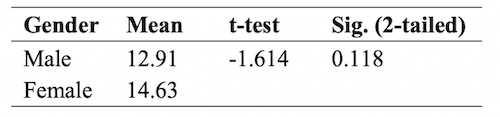
Based on the analysis obtained t-test -1.614 < 2.048 t table and Sig value 0.118 > 0.05, it can be concluded that based on gender, the two groups of data have means that are not significantly different.
Based on length of service, the teachers involved in this research had a teaching work period of 7 to 18 years, and in this section, we divided them into three levels of teaching period, namely, ≤10 years (five people), 11-15 years (20 people) and 16-20 years (five people). The assessment results show that the score obtained for teachers with ≤10 years of service was 71, while the ideal maximum score was 95 (5 teachers x 19 items = 95), so an achievement percentage of 74.74% was obtained in the "good" category. Teachers with 11-15 years of work experience had a score of 258, while the ideal maximum score was 380 (20 teachers x 19 items = 380) with an achievement percentage of 67.89% in the "good" category. For teachers with 16-20 years of service, the score obtained was 72, while the ideal maximum score was 95 (5 teachers x 19 items = 95), with an achievement percentage of 75.79% in the "good" category. Furthermore, to find out the difference in HOTS implementation based on teachers' tenure, ANOVA analysis was conducted, which was undertaken with the normality and homogenisation tests.
Normality test was conducted with Kolmogorov-Smirnov, with the results for the age group ≤ 10 value (Sig 0.200), age group 11-15 (Sig 0.127) and age group 16-20 (Sig 0.069). The results of the Kolmogorov-Smirnov test for all data groups had a Sig value > 0.05 so that the data was declared normally distributed. Furthermore, the results of the variance homogeneity test obtained a Sig value of 0.087 > 0.05 so that the data variance was displayed as homogeneous. The next step was hypothesis testing (see Table 2).
Table 2: HOTS Implementation Based on Teacher Tenure
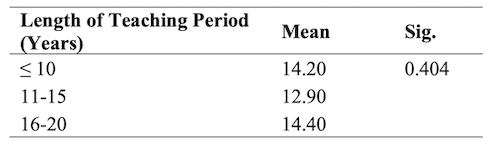
Based on ANOVA analysis, the Sig value was 0.404 > 0.05, and it can be concluded that the three groups have means that were not significantly different.
Implementation of HOTS in Physical Education Learning by Teachers who take part in Online-based PPG
Assessment of the implementation of HOTS by 30 physical education teachers who took part in online PPG activities was undertaken by assessing the learning videos that the teachers had carried out. Based on this assessment, the score obtained was 401, while the ideal maximum score was 570 (30 teachers x 19 indicators = 570), so a percentage of 70.35% was received in the "good" category, (see Table 3).
Table 3: Implementation of HOTS in Physical Education Learning
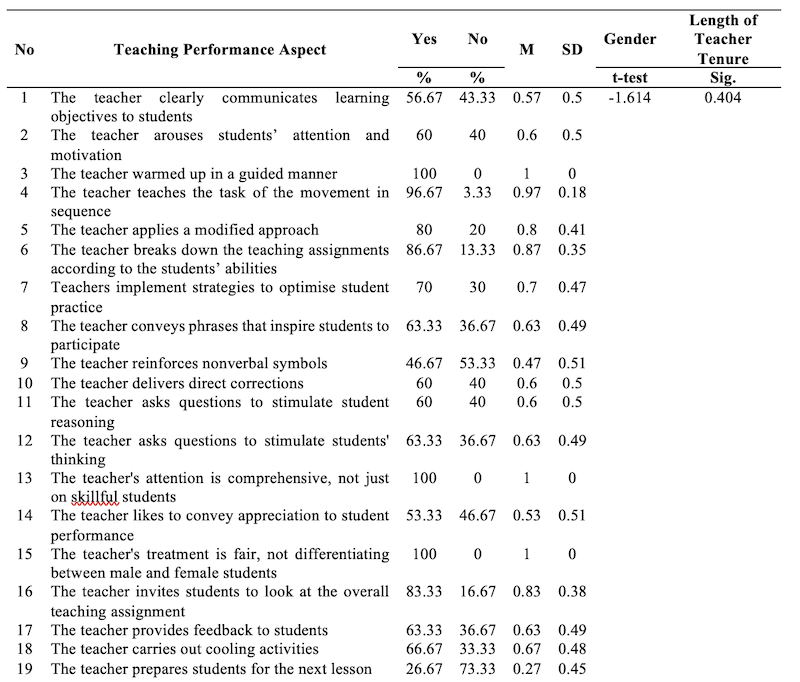
The results show that although the PPG programme was implemented online, it was still able to integrate knowledge, understanding and awareness of the importance of HOTS to teachers so that those who participated in online-based PPG were able to implement HOTS in their learning process well. Teachers who have passed the PPG programme will then be awarded the title of "Professional Teacher" by the government. Therefore, teachers must maintain their performance and continue to improve their skills. According to Goller and Harteis (2017) a change in performance and an increase in knowledge and skills is something that is deemed professional. Based on the results of this study, we reveal several findings, including the following.
A total of 22 male teachers and eight female teachers were involved in this study. The research findings revealed that, in general, both male and female teachers have been able to implement HOTS well. Based on the mean comparison, female teachers had higher scores than male teachers but, based on the t-test, the two groups were not significantly different. This research finding is supported by a study conducted by Abdullah et al., (2016), which showed that the implementation of HOTS in the learning process was not influenced by teachers’ gender. Likewise, students' academic achievement was not affected by teacher gender based on research conducted by Fernández Baños et al. (2018). Although the results of Nikolopoulou and Kousloglou, (2022) suggested that female teachers were more active in improving students' cognition compared to male teachers. However, our research findings showed that there is no significant difference between the two in terms of cognitive enhancement in the HOTS domain. This suggests that online PPG provides equal access for male and female teachers to take part in professional training without restrictions so that there is no inequality between male and female teachers.
The results indicate that, basically, both teachers with short tenure and teachers with long tenure can implement HOTS well in their learning process, indicating that online PPG has had a positive impact on physical education teachers. This finding is in line with the results of Scherer et al. (2023), which revealed that both novice and experienced teachers could benefit from online learning programmes in the form of experience, pedagogy, and content development. However, Downing and Dyment (2013) stated that teachers who have more experience will have an easier time in online-based learning compared to teachers with less experience. This is reinforced by Donkoh (2017) who said that teachers with long teaching experience have obtained more training activities so they can improve their teaching knowledge and skills. However, the results of this study have indicated that teachers with short teaching experience can also implement HOTS as well as experienced teachers. In addition, the online-based PPG programme was designed to be easily implemented by all teachers. Therefore, the implementation of the online-based PPG programme could make both teachers with long teaching experience and teachers with short teaching experience better instructors when implementing HOTS in their learning process.
Research findings reveal that physical education teachers have been able to implement HOTS in the physical education learning process "well." This indicates that the online PPG programme has provided benefits to teachers to improve HOTS-based learning. The online PPG programme organised by the Ministry of Education, Culture, Research and Technology of the Republic of Indonesia provides insight and knowledge to teachers on how to design, manage, and assess learning well. Through online-based PPG, teachers learn about preparing material, increasing understanding, and implementing HOTS comprehensively in the learning process. Hence, they understand the concepts and principles of HOTS in more depth. With a good knowledge of HOTS, it will be easier for teachers to apply it in learning, so it is hoped that it will facilitate students' development of HOTS.
Professional development programmes are necessary for teachers to improve and strengthen teaching strategies (Mehdizadeh et al., 2023; Nabhani et al., 2014). Teachers who have participated in professional education programmes must be able to improve the quality of learning for the better; this is because the quality of learning is the most crucial element for sustainable development in any country in the world (Dhawan, 2020). The government hopes that with the PPG programme, the problem of low HOTS among students in Indonesia can be resolved. Students must be familiar with HOTS because their abilities in all skill areas can increase if they are accustomed to implementing HOTS (Syafryadin et al., 2022).
The results of this research indicate that the government's expectations for the PPG Programme activities have been well achieved (as stated in Regulation of the Director General of Teachers and Education Personnel Number 1019/PD.00.02/2022): the expected learning outcomes for teachers who take part in the in-service PPG programme are to be able to carry out educational learning by applying information and communication technology to build students' attitudes, knowledge and skills in solving problems critically, humanistically, innovatively, creatively, collaboratively and communicatively, using learning models and learning resources supported by research results.
The online-based PPG programme designed by the government to produce professional teachers is the right step because it is more flexible, so that teachers can remain in their respective schools and can carry out their duties as teachers without having to attend the PPG programme campus. Although the activities are conducted online, the expected quality can still be obtained. This has been shown by the results of this study, where physical education teachers who participated in the online-based PPG programme were able to implement HOTS in the learning process. Based on gender, both male and female teachers implemented HOTS in their learning process equally well, just as teachers with long teaching experience and teachers with short teaching experience, so the implementation of HOTS based on gender demographics and tenure was not significantly different.
The results of this study have shown that the online-based PPG programme has been able to maintain the quality of the Teacher Professional Programme activities. This is evidenced by the teachers' ability to implement HOTS in their learning process effectively. Based on the results of this study and the many shortcomings and difficulties caused by teachers having to be present at the PPG organising campus, implementing online activities is the right choice. Therefore, it is suggested that future teacher quality improvement programmes should be organised by the Indonesian government should be conducted online, to increase the effectiveness and efficiency of teacher participation and to save costs without compromising the objectives and quality of the programmes. Furthermore, teachers should be able to participate in activities organised online to the fullest, because the benefits of these activities do not require face-to-face interaction.
This study contributes to the literature on online-based PPG programmes and HOTS implementation in physical education learning by providing insights into how online-based PPG programmes can foster physical education teachers' knowledge and awareness of the importance of HOTS implementation. However, this study was limited to investigating the implementation of HOTS by teachers who participated in the online PPG programme at Universitas Negeri Padang with a relatively small number of 30 people, therefore, a recommendation is given for future researchers to investigate the implementation of HOTS by involving a more significant number of physical education teachers from other universities involved as PPG programme organisers because each university has different characteristics. In addition, future investigations should pay attention to the use of HOTS-oriented online learning models so that participants are not limited to implementing HOTS-based learning but can also use HOTS to innovate lesson plans, learning media and instruments that support the development of student competencies and lesson quality.
Abdullah, A.H., Mokhtar, M., Abd Halim, N.D., Ali, D.F., Tahir, L.M., & Kohar, U.H.A. (2016). Mathematics teachers’ level of knowledge and practice on the implementation of higher-order thinking skills (HOTS). Eurasia Journal of Mathematics, Science and Technology Education, 13(1), 3-17. https://doi.org/10.12973/eurasia.2017.00601a
Ahmat, N., Azmee, N.A., Mohamed, N.H., Zamzamir, Z., Zahari, N.S., Shafie, S., Mohamed, N.A., & Raja Ma’amor Shah, R.N.F.A. (2022). Knowledge, skills and attitude of pre-service mathematics teachers towards higher-order thinking skills. International Journal of Educational Methodology, 8(4), 795-804. https://doi.org/10.12973/ijem.8.4.795
Amalia, L., & Saraswati, T. (2018). The impact of competencies toward teacher’s performance moderated by the certification in Indonesia. KnE Social Sciences, 86-98. https://doi.org/10.18502/kss.v3i10.3363
Bonk, C.J. (2020). Pandemic ponderings, 30 years to today: Synchronous signals, saviors, or survivors? Distance Education, 41(4). Taylor & Francis. https://doi.org/10.1080/01587919.2020.1821610
Brown, A.L. (2014). Implementing active learning in an online teacher education course. American Journal of Distance Education, 28
Cho, M.-H., & Rathbun, G. (2013). Implementing teacher-centred online teacher professional development (oTPD) programme in higher education: A case study. Innovations in Education and Teaching International, 50(2), 144-156. https://doi.org/10.1080/14703297.2012.760868
Dhawan, S. (2020). Online learning: A panacea in the time of COVID-19 crisis. Journal of Educational Technology Systems, 49(1), 5-22. https://doi.org/10.1177/00472395209340
Donkoh, S. (2017). Investigating the effect of teaching experience on teacher knowledge. International Journal of Scientific and Research Publications, 7(6), 319-327. https://www.ijsrp.org/research-paper-0617/ijsrp-p6644.pdf
Downing, J.J., & Dyment, J.E. (2013). Teacher educators’ readiness, preparation, and perceptions of preparing preservice teachers in a fully online environment: An exploratory study. The Teacher Educator, 48(2), 96-109. https://doi.org/10.1080/08878730.2012.760023
Edwar, Putri, R.I.I., Zulkardi, & Darmawijoyo. (2023). Developing a workshop model for high school mathematics teachers constructing HOTS questions through the Pendidikan Matematika Realistik Indonesia Approach. Journal on Mathematics Education, 14(4), 603–626. https://eric.ed.gov/?id=EJ1408903
Fernández Baños, R., Ortiz-Camacho, M. del M., Baena-Extremera, A., & Zamarripa, J. (2018). Efecto del género del docente en la importancia de la Educación Física, clima motivacional, comportamientos disruptivos, la intención de práctica futura y rendimiento académico (Effect of teachers’ gender on the importance of physical education, motivati. Retos, 33, 252-257. https://doi.org/10.47197/retos.v0i33.59991
Goller, M., & Harteis, C. (2017). Human agency at work: Towards a clarification and operationalisation of the concept. Springer International Publishing (August 2019). https://doi.org/10.1007/978-3-319- 60943-0_5
Hafeez, M., Naureen, S., & Sultan, S. (2022). Quality indicators and models for online learning quality assurance in higher education. The Electronic Journal of E-Learning, 20(4), 374-385. https://doi.org/10.34190/ejel.20.4.2553
Hardiansyah, S., Kusmaedi, N., Ma’mun, A., & Mahendra, A. (2024). Physical education teachers’ attitudes towards stimulating higher order thinking skills in elementary school students: Differences in certified and non-certified teachers. Retos: Nuevas Tendencias En Educación Fisica, Deporte y Recreación, 54, 857-866. https://doi.org/10.47197/retos.v54.103844
Heong, Y.M., Yunos, J.M., Othman, W., Hassan, R., Kiong, T.T., & Mohamad, M.M. (2012). The needs analysis of learning higher order thinking skills for generating ideas. Procedia-Social and Behavioral Sciences, 59, 197-203. https://doi.org/10.1016/j.sbspro.2012.09.265
Huda, S.A., Suyanto, Arifi, A., Putranta, H., Azizah, A.N.M. (2021). Experiences of participants in teacher professional education on obtaining soft skills: A case study in Indonesia. European Journal of Educational Research, 10(1), 313-325. https://doi.org/10.12973/eu-jer.10.1.313
Krathwohl, D.R. (2002). A revision of Bloom’s taxonomy: An overview. Theory into Practice, 41(4), 212-218. https://doi.org/10.1207/s15430421tip4104_2
Kustati, M. (2020). The effect of principals’ leadership towards effective learning at an Indonesian secondary school. European Journal of Educational Research, 9(3), 1063-1074. https://doi.org/10.12973/eu-jer.9.3.1063
Kusumawardhani, P.N. (2017). Does teacher certification program lead to better quality teachers? Evidence from Indonesia. Education Economics, 25(6), 590-618. https://doi.org/10.1080/09645292.2017.1329405
Law of the Republic of Indonesia Number 14 Year 2005. (2005). About Teachers and Lecturers. December 30, 2005. State Gazette of the Republic of Indonesia Year 2005 Number 157 (pp. 1-50).
Lee, K. (2019). Rewriting a history of open universities: (Hi) stories of distance teachers. International Review of Research in Open and Distributed Learning, 20(4). Érudit. https://doi.org/10.19173/irrodl.v20i3.4070
Lloyd, M., & Bahr, N. (2010). Thinking critically about critical thinking in higher education. International Journal for the Scholarship of Teaching and Learning, 4(2), 9. https://doi.org/10.20429/ijsotl.2010.040209
Lumba, A.J.F., Blegur, J., & Bayu, W.I. (2021). Teaching performance instruments of physical education teachers. Journal of Educational Research and Evaluation, 5(3), 436-442. https://doi.org/10.23887/jere.v5i3.33893
Maksum, A. (2012). Metodologi penelitian dalam olahraga. UNESA University Press.
Mehdizadeh, M., Pourhaji, M., & Derakhshan, A. (2023). Evolution of communities of practice, realignment of possible selves, and repositionings in EFL teacher professional identity development: A longitudinal case study. The Language Learning Journal, 1-13. https://doi.org/10.1080/09571736.2022.2163685
Ministry of Education, Culture, Research and Technology (2022). About technical guidelines for the implementation of the professional teacher education program in position (pp. 1-131).
Ministry of Education, Culture, Research, and Technology (2020). About procedures for obtaining educator certificates for teachers in position (pp. 1-100).
Mustapha, S., Rosli, M.S., & Saleh, N.S. (2019). Online learning environment to enhance HOTS in mathematics using Polya’s problem solving model. Journal of Physics: Conference Series, 1366(1), 12081. https://doi.org/10.1088/1742-6596/1366/1/012081
Nabhani, M., Nicolas, M.O., & Bahous, R. (2014). Principals’ views on teachers’ professional development. Professional Development in Education, 40(2). https://doi.org/10.1080/19415257.2013.803999
Nikolopoulou, K., & Kousloglou, M. (2022). Online teaching in COVID-19 pandemic: Secondary school teachers’ beliefs on teaching presence and school support. Education Sciences, 12(3), 216. https://doi.org/10.3390/educsci12030216
Nussbaum, M., Barahona, C., Rodriguez, F., Guentulle, V., Lopez, F., Vazquez-Uscanga, E., & Cabezas, V. (2021). Taking critical thinking, creativity and grit online. Educational Technology Research and Development, 69, 201-206. https://link.springer.com/article/10.1007/s11423-020-09867-1
Scherer, R., Siddiq, F., Howard, S.K., & Tondeur, J. (2023). The more experienced, the better prepared? New evidence on the relation between teachers’ experience and their readiness for online teaching and learning. Computers in Human Behavior, 139, 107530. https://doi.org/10.1016/j.chb.2022.107530
Seman, S.C., Yusoff, W.M.W., & Embong, R. (2017). Teachers challenges in teaching and learning for higher order thinking skills (HOTS) in primary school. International Journal of Asian Social Science, 7(7), 534-545. https://doi.org/10.18488/journal.1.2017.77.534.545
Silitonga, H.T.M., Panjaitan, M., & Supriyati, Y. (2020). Problem solving based physics learning strategy to enhance students’ higher order thinking skills. Journal of Physics: Conference Series, 1567(4), 42104. https://doi.org/10.1088/1742-6596/1567/4/042104
Suhirman, S., Yusuf, Y., Muliadi, A., & Prayogi, S. (2020). The effect of problem-based learning with character emphasis toward students’ higher-order thinking skills and characters. International Journal of Emerging Technologies in Learning (IJET), 15(6), 183-191. https://doi.org/10.3991/ijet.v15i06.12061
Suwarma, I.R., & Apriyani, S. (2022). Explore teachers’ skills in developing lesson plan and assessment that oriented on Higher Order Thinking Skills (HOTS). Journal of Innovation in Educational and Cultural Research, 3(2), 106-113. https://doi.org/10.46843/jiecr.v3i2.66
Syafryadin, S., Wardhana, D.E.C., Noermanzah, N., Rofi’i, A., & Awalludin, A. (2022). Students’ perspective and problems in implementing Higher Order Thinking Skill (HOTS) in speaking for presentation class. Journal of Language and Linguistic Studies, 18(1), 477-487. https://doi.org/10.52462/jlls.196
Tjabolo, S.A. (2020). The influence of teacher certification on the performance of elementary school teachers in Gorontalo Province, Indonesia. International Journal of Instruction, 13(4), 347-360. https://doi.org/10.29333/iji.2020.13422a
Umar, Alnedral, Ihsan, N., Mario, D.T., & Mardesia, P. (2023). The effect of learning methods and motor skills on the learning outcomes of basic techniques in volleyball. Journal of Physical Education and Sport, 23(9), 2453-2460. https://doi.org/10.7752/jpes.2023.09282
Umar, Ockta, Y., Mardesia, P. (2023). A correlational study: Pedagogical and professional competence of physical education teachers in relation to the implementation of the Merdeka curriculum. Journal of Physical Education and Sport, 23(12), 3325-3331. https://doi.org/10.7752/jpes.2023.12380
Umar, Okilanda, A., Suganda, M.A., Mardesia, P., Suryadi, D., Wahyuni, D., Widyastuti, S.R., Samodra, Y.T.J., & Kurniawan, F. (2023). Blended learning and online learning with project-based learning: Do they affect cognition and psycho-motor learning achievement in physical conditions? Retos, 50(das), 556-565. https://doi.org/10.47197/retos.v50.99965
Wahyudi, K.E., Supranoto, S., & Suji, S. (2013). Measuring performance of teacher certification program by output target and intended impact achievement. Bisnis & Birokrasi: Jurnal Ilmu Administrasi Dan Organisasi, 19(3). https://doi.org/10.20476/jbb.v19i3.1852
Wenno, I.H. (2017). Effect of principal managerial leadership and compensation towards physics teacher performance in senior high school in Baguala District-Ambon. International Education Studies, 10(1), 233-244. https://doi.org/10.5539/ies.v10n1p233
Widodo, W., Gustari, I., & Chandrawaty, C. (2022). Adversity quotient promotes teachers’ professional competence more strongly than emotional intelligence: Evidence from Indonesia. Journal of Intelligence, 10(3), 1-17. https://doi.org/10.3390/jintelligence10030044
Wijnen, F., Walma van der Molen, J., & Voogt, J. (2021). Measuring primary school teachers’ attitudes towards stimulating higher-order thinking (SHOT) in students: Development and validation of the SHOT questionnaire. Thinking Skills and Creativity, 42(May), 100954. https://doi.org/10.1016/j.tsc.2021.100954
Zain, F.M., Sailin, S.N., & Mahmor, N.A. (2022). Promoting higher order thinking skills among pre-service teachers through group-based flipped learning. International Journal of Instruction, 15(3), 519-542. https://doi.org/10.29333/iji.2022.15329a
Zohar, A., & Dori, Y.J. (2003). Higher order thinking skills and low-achieving students: Are they mutually exclusive? The Journal of the Learning Sciences, 12(2), 145-181. https://doi.org/10.1207/S15327809JLS1202
Author Notes
Sefri Hardiansyah has been a lecturer at the Department of Sport Education, Faculty of Sport Science, Universitas Negeri Padang since 2015. Sefri completed his Bachelor’s of Education at Universitas Negeri Padang in 2011 and his Master’s of Education at Universitas Negeri Padang in 2014. His research focuses on physical education measurement and evaluation tests and physical education learning. Email: Email: hardiansyah@fik.unp.ac.id (https://orcid.org/0009-0007-3895-495X)
Cite as: Hardiansyah, S. (2024). Teachers’ implementation of higher order thinking skills in physical education in an online-based professional teacher education programme. Journal of Learning for Development, 11(3), 502-513.