
Esma Şenel
2025 VOL. 12, No. 1
Abstract: Whether dealing with their native or a foreign language, both teachers and students have consistently found writing skills to be difficult to achieve. Students are concerned about initiating and structuring their thoughts, while teachers struggle to inspire their students to improve their writing capabilities. Hence, this experimental study examined the effect of the creative writing technique at the B2 level by utilising web 2.0 tools on a digital platform. The primary goal of the research was to identify and explore the effect of digital creative writing on preparatory school students’ writing skills, attitudes, and expectations toward writing. The study was conducted at a foundation university, where it involved 66 B2-level students. The data collection process encompassed writing skills quizzes as a pre-test and post-test, and the Turkish version of the Daly-Miller Writing Apprehension Test (adapted by Özbay & Zorbaz, 2011). The findings revealed that engaging in digital creative writing not only enhanced academic writing achievement but also decreased writing apprehension among students.
Keywords: creative writing, writing apprehension, creativity, educational technologies
In every language class, the primary goal of education revolves around facilitating effective communication in the target language. Writing serves as a means of communication within these strategies, encompassing the articulation of thoughts and the transmission of meaning. As an achievement of human symbolic thinking, writing serves as both a medium of communication and an outcome of extensive exploration and experiential learning within the framework of cultural interaction. It is generally believed that writing is very important and a complex process requiring some specific strategies to produce an appropriate product (Flower & Hayes, 1977; Warnock, 1983; Isaacson, 1994). To express feelings and ideas effectively, writers must be able to coordinate many of their cognitive tasks to express their feelings and ideas in the most effective way (Flower & Hayes, 1981). Therefore, special attention must be paid before, during, and after the instruction to comply with many requirements of the target language. In their academic lives, students are expected to express their opinions and defend their ideas through specific strategies and styles (opinion, argumentative, cause, and effect) in a written form. The traditional teaching of academic writing is considered the only way to learn and internalise such specific styles and skills, however, students’ motivation decreases and they feel bored when the writing tasks are dominated by definite rules and structures. These concerns have encouraged researchers to pay more attention to writing research and its application.
The key factors in the process of writing are students’ attitudes, interests, and motivation. Under an oppressive education system that suppresses creativity and distracts critical thinking, it is very difficult to arouse interest in writing and to develop writing skills. To get rid of this unwillingness, frustration, fear of failure, and anxiety, creative writing activities should be a part of the curriculum. The creative writing approach, supported by innovative web technologies, can increase students' motivation and encourage them to learn more independently when time and space limitations are removed. In the process of connecting with a virtual network, valuing interactions with others within the environment, and noticing how language acquisition affects others and their ability to communicate on a personal level, students can begin to understand the purpose of a language. Then, they will be able to connect to that language because it enables them to interact with other people (Wilkerson, 2010). Digital Creative Writing (DCW) is one of the ways of combining imagination with life experiences on a digital platform, enabling individuals to express themselves with their own words. Implementing digital creative writing in their training inspires them to improve their talents and skills, so digital creative writing provides students with new ways of thinking and organising their materials.
The idea that all students have potential for creativity has been shared by several experts and teachers. Creativity may vary from person to person but there is no such thing as a completely uncreative person (Downing, 1997). That is to say, each person has an inherent creative potential due to its acceptance as a naturally occurring process of thought (Cropley, 1997). With a relatively small investment in classroom time, students who are asked to think creatively have significantly enhanced their creativity skills (Sternberg & Lubart, 1995). Meanwhile, Westberg (1996) reports that students who are given systematic instructions in the inventing process create more inventions as compared to students who receive only one introductory lesson on invention. Teachers are thus responsible for setting conditions that foster creativity in and outside the classroom. Students entering academic disciplines benefit from this spark of creativity as it ignites the development of their personalities and language learning abilities.
In the early 1880s, creative writing emerged as a literary education reform. Unlike purely pragmatic intent or purpose, it is regarded as any form of writing with an aesthetic or effective nature (Maley, 2015). On the other hand, Harmer (2001) notes that creativity entails different artistic tasks such as creating poetry, stories, and plays. Sharples (1996) defines creative writing as freedom of mind in re-creating emotional experiences. To put it another way, creative writing is individuals stating their ideas and feelings about a specific topic by using their imagination freely (Oral, 2003). As a skill that develops students' creativity and personality, creative writing is an essential practice that teachers must emphasise (Akkaya, 2014). Unfortunately, in many EFL contexts, learners do not receive adequate training in creative writing, whether in their first or a foreign language. As a result, they often struggle with developing creative writing skills. This requires creative writing in EFL teaching to be taught as a highly effective way of developing a set of language skills, particularly vocabulary, and a sense of rhythmic patterning and ways to enhance students’ motivation, self-esteem, and self-discovery (Maley, 2003).
In the field of creative writing, a large amount of literature has been published and the results of these studies confirm the positive effect of creative writing on learners, providing valuable information about the teaching and learning process. Numerous studies have demonstrated that creative writing helps build up positive attitudes toward writing and enhances academic achievement (Elebdali, 2016; Susar Kırmızı, 2015; Greenlee, 2000; Hammons, 1998). A number of studies have suggested that creative writing pedagogy might improve teaching and learning in schools if developed and incorporated into the curriculum (Manery, 2016; Caine, 2014, Dolgin, 1987). Previous research has also explored the idea that the personality traits of the students are positively influenced by the creative writing approach (Liao, 2012; Zhao, 2011).
As a demanding skill, writing requires students’ attention and the active involvement of the teachers in the process. Different innovative and creative procedures should be integrated to increase motivation for writing as well as to develop good writing attitudes, with the intention of making this process more practical for students.
However, there have been few attempts to investigate Turkish tertiary-level students’ creativity and affective concerns in the EFL writing process. Thus, this study set out to gain a further understanding of Turkish tertiary-level students’ creativity in a foreign language, as well as the attitudes and beliefs they exhibit in the writing process, in order to reduce the lack of research in this field. Focussed on the concerns above, this study tried to answer the following research questions:
As stated before, this study was carried out to investigate the effect of digital creative writing on writing achievement and writing apprehension among EFL students. To this end, the experimental research design was adopted, because it is considered one of the most effective ways to compare the participants in one group to another group by employing random assignment before the experiment is conducted (Cook & Campbell, 1979).
The study was conducted at the School of Foreign Languages of a foundation university in Istanbul in the spring semester of the 2019-2020 academic year. The School of Foreign Languages consisted of the English Preparatory Programme, Russian Preparatory Programme, and English Language Support Programme. There were four different levels of classes, namely, Step 1 (A1), Step 2 (A2), Step 3 (B1), and Step 4 (B2). Students were subjected to the Oxford Placement Test in order to be placed in their classes, and they were placed in the group appropriate to their level according to the results of this test.
A total number of 66 B2-level (Step 4) students participated in this study. They were randomly assigned to the experimental and control groups. In the experimental group, there were 21 female and 12 male participants, whereas, there were 18 female and 15 male participants in the control group.
Data were collected through the implementation of writing quizzes as a pre-test and post-test, and applying the Turkish version of the Daly-Miller Writing Apprehension Test (WAT) adapted by Özbay and Zorbaz (2011) before and after the treatment. In the writing quizzes, students were asked to write an essay choosing one of the topics given to them. A questionnaire was also used to collect data. The first part of the questionnaire was used to gather demographic information about the participants. The second part of the questionnaire consisted of 26 items with a five-point Likert scale to measure writing apprehension, and the reliability of the scale was measured as .90, which indicates high internal consistency. To address the validity estimates, confirmatory factor analysis was utilised to test its construct validity and four factors emerged, namely, appreciation, prejudice, evaluation anxiety, and sharing what was written, explaining 53% of the total variance. The lower scores indicate a high level of writing apprehension, while the higher scores indicate a low level of writing apprehension.
Before carrying out the study, ethical clearance was obtained from the director of the English prep school to conduct the research, and consent from participants was obtained to ensure the ethical aspects of the research. At the beginning of the spring term, participants in the control and experimental groups were given the Writing Apprehension Test (WAT) to assess their apprehension levels. Later, they were given a writing skills quiz as a pre-test and they were expected to write a well-organised essay. After that, the treatment began in the experimental group and lasted for 10 weeks, whereas the control group followed the writing syllabus and received traditional training. The participants in the control group completed only in-class writing assignments. On the other hand, the participants in the experimental group followed both the writing syllabus and completed creative writing tasks on ‘Edmodo,’ which was a virtual classroom. On Edmodo, they completed weekly creative writing tasks and got feedback after each task. At the end of the treatment process, the participants in the experimental group were given the Writing Apprehension test and both groups were given the writing skills quiz again, as a post-test, to compare and contrast the achievement levels.
All analyses were carried out using SPSS, Version 24. To analyse the data, descriptive statistics, independent samples t-test, and paired-samples t-test were adopted. Descriptive statistics were used to determine if gender had an effect on students’ writing achievement. Independent sample t-tests were carried out to assess the effect of gender on academic writing achievement. Paired-sample t-tests were utilised to determine whether there was a significant difference in terms of writing apprehension and academic performance before and after the treatment between the experimental and control groups.
The first research question in this study was to examine whether digital creative writing develops English as a foreign language in academic writing. A paired samples t-test was administered to examine whether there were any differences between the academic achievement levels of the experimental and control groups. Table 1 provides the results obtained from the paired samples t-test.
Table 1: Paired-sample t-test Results of the Post-test Writing Performance in the Experimental and Control Groups
Note: N = 33
It can be seen from the data in Table 1 that there was a significant difference between the control group (M = 14.90, SD = 2.99) and the experimental group (M = 17.98, SD = 1.71) in their academic writing achievement levels (p > .05). Regarding the first research question, it was found that the experimental group outperformed the control group in terms of academic writing. On the other hand, the control group also showed academic achievement to some extent despite following only the academic writing syllabus. The table below illustrates the pre-test and post-test findings of the experimental and control groups to demonstrate the academic writing progress.
Table 2: Paired-sample t-test Results of the Pre-test and Post-test Writing Performance in the Experimental and Control Groups

Note: N = 33
As can be seen from the table above, there was a significant difference between the pre-test (M = 14.44, SD = 2.22) and post-test (M =15.85, SD = 2.10) results of the control group and the pre-test (M = 14.92, SD = 1.28) and post-test (M = 18.12, SD = 1.53) results of the experimental group regarding their academic writing achievement (p < .05).
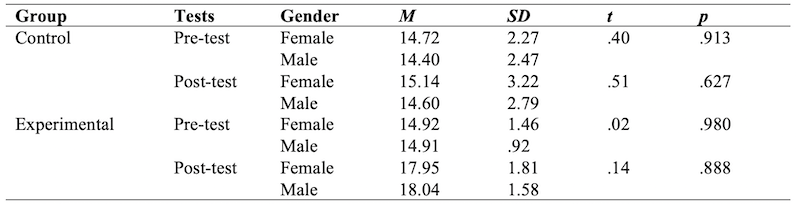
The second research question in this study sought to determine whether participants’ gender had any effect on their academic writing achievement. An independent samples t-test was administered to determine whether there were any differences regarding gender. Table 3 below illustrates the findings from the independent sample t-test.
Table 3: Independent-Samples t-test Results of Participants’ Gender and Academic Writing Achievement
Note: N = 33
From Table 3 we can see that both the experimental and the control group did not indicate a significant difference regarding gender in the learning process (p > 0.5). In light of the findings, the difference in motivation and interest between females and males was not significant.
The final research question in this study was aimed at examining whether digital creative writing decreases the writing apprehension level of students in the experimental and control groups. A paired samples t-test was administered to determine whether there was any difference in terms of writing apprehension. The results obtained from the paired samples t-test are presented in Table 4.
Table 4: Paired-sample t-test Results of the Writing Apprehension Test in the Experimental Group

Note: N = 33
It is apparent from this table that there was a significant difference between pre-WAT (M = 78.72, SD = 12.64) and post-WAT (M = 96.93, SD = 4.94) at the p < .05 level. As indicated before, higher points stand for a lower level of writing apprehension and low points reveal a higher level of writing apprehension.
The aim of the current study was to examine whether digital creative writing contributed to academic writing achievement and lowered writing apprehension. The results showed that there was a statistically significant difference between the experimental group of students who received creative writing training, compared to the control group of students who received conventional instruction. In each instruction process, it was revealed that both groups of students improved their academic writing achievement but the experimental group outperformed the control group. This finding broadly supports the work of other previous studies in this area linking creative writing and academic achievement (Aktaş, 2009; Temizkan, 2011; Susar Kırmızı, 2015; Şenel, 2018; Parida et al., 2016; Pardlow, 2003; Feuer, 2011). A possible explanation for this finding might be attributed to experience in a different writing genre. It was evident that digital creative writing might enhance students' critical thinking and problem-solving skills, indicating that it could contribute positively to their academic success. Furthermore, writing is a productive skill that requires improvement for effective communication and it is necessary to practise often and gain enough experience to improve this skill. As part of this study, participants were provided with a wide range of digital creative writing activities. They were able to improve both their creative and academic writing skills as they produced more writing pieces.
With respect to the second research question, it was asserted that male and female participants did not experience a dramatic increase or decrease in academic writing abilities, whether using the digital creative writing technique or not. This finding supported the results of a study by Jyothsna (2000) who found that male and female students did not show any significant difference concerning their academic achievement. This finding was also consistent with that of Symonette (2018) that reported no significant difference between male and female students in their writing achievement before and after the learning. Despite the observed motivation among males and females in the course of the research, the results were not significant. Although it will require further investigation, the results of this study regarding gender might have been related to the high motivation and interest of the participants who took part in this study. However, it is important to keep in mind that these findings cannot be generalised to all foreign language learners.
The final research question in the study sought to determine whether digital creative writing lowers the writing apprehension level of the students or not. With regard to this, it was found that digital creative writing helped decrease students’ writing apprehension levels, and digital creative writing promoted an increase in the students’ motivation to write. By all means, the rate of decrease in writing apprehension and the increase in motivation to write might be a promising finding of the study. It seems possible to conclude that participants were able to overcome the adverse effects of writing apprehension because the new creative writing activities changed their beliefs and attitudes regarding writing skills. In accordance with the present results, previous studies have demonstrated that creative writing activities help change individuals’ attitudes toward writing skills and foster positive attitudes toward writing skills (Greenlee, 2000; Liao, 2012; Elebdali, Susar Kırmızı, 2015). These results seem to be consistent with other previous research, which indicated that creative writing activities help provide students with psychological relief during the writing process (Oral, 2003). As a whole, the results of this study might provide valuable insights into writing in English as a foreign language and motivation for academic writing. Therefore, it may be concluded from the results of the questionnaire that participants in the experimental group overcame writing apprehension and changed their beliefs and attitudes toward writing.
Taken together, several intriguing conclusions were drawn from these findings regarding the effect and extent of creative writing instruction. Accordingly, it could be inferred that digital creative writing enhanced writing motivation components. On the other hand, a common obstacle learners faced during the writing instruction process was apprehension toward the writing process. The writing apprehension test results revealed that the participants' levels of writing apprehension was significantly lowered. Furthermore, the students in the experimental group demonstrated a significant difference over the control group regarding their academic writing achievement. It is important to note that this study differs from other studies because it was conducted online, which can be viewed as a collaboration between traditional and innovative education systems. In light of this combination of findings, it can be concluded that the integration of creative writing can be an effective method for achieving desired learner writing outcomes and maintaining educational activities. In either synchronous or asynchronous learning environments, digital creative writing can have significant beneficial effects on both educators and students. However, based on the results of this study, it is important to be aware that the findings should be interpreted with caution and cannot be generalised to all individuals studying foreign languages. To make further progress, additional studies will be required to develop a comprehensive understanding of digital creative writing.
The generalisability of these results is subject to certain limitations. As one of the limitations of this current study was the small sample, further studies could be conducted with a larger sample that allows for the use of different data analyses and more comprehensible results. Time constraint was another limitation of the study. It was challenging for the researcher to introduce a new writing genre and a different kind of learning environment to collect and interpret the data within a three-month period. It was very challenging for the researcher to conduct the experimental study, and collect and analyse data in that same period, while trying to introduce the participants to a type of writing genre and learning environment that they were not familiar with. Further studies, with more focus on a longitudinal study are, therefore, suggested. Despite these limitations, the study asserts that digital creative writing enhanced students' motivation and academic performance as they constructed their identities as writers and also promoted their independence. An additional stimulus that encourages students to engage with their schools is the integration of technology. Our understanding of how educational technologies and creativity contribute to EFL writing will be enhanced by using this approach.
Akkaya, N. (2014). Elementary teachers' views on the creative writing process: An evaluation. Educational Sciences: Theory and Practice, 14(4), 1499-1504.
Aktaş, M. (2009). The effect of creative writing on achievement and on writing skill in foreign language teaching [Doctoral Dissertation, Ankara University]. https://tez.yok.gov.tr/UlusalTezMerkezi/tezSorguSonucYeni.jsp
Caine, M. (2014). What is creative about creative writing? A case study of the creative writing of a group of A Level English Language students [Doctoral Dissertation, University of Sussex]. ProQuest Dissertations and Theses Global.
Cook, T.D., & Campbell, D.T. (1979). The design and conduct of true experiments and quasi-experiments in field settings. In R.T. Mowday, & R.M. Steers (Eds.), Reproduced in part in research in organizations: Issues and controversies. Goodyear Publishing Company.
Cropley, A.J. (1997). Fostering creativity in the classroom: General principles. In M. Runco (Ed.), The creativity research handbook, 1(84.114). Hampton Press.
Dolgin, S.A. (1987). Creative writing and the composing process: the role of creative writing in the English curriculum [Doctoral Dissertation, Illinois State University]. ProQuest Dissertations Publishing.
Downing, J.P. (1997). Creative teaching: Ideas to boost student interest. ABC-CLIO.
Elabdali, R. (2016). Wiki-based collaborative creative writing in the ESL classroom [Doctoral Dissertation, Portland State University]. ProQuest Dissertations Publishing.
Feuer, A. (2011). Developing foreign language skills, competence and identity through a collaborative creative writing project. Language, Culture and Curriculum, 24(2), 125-139.
Flower, L., & Hayes, J.R. (1981). A cognitive process theory of writing. College Composition and Communication, 32(4), 365. doi:10.2307/356600
Flower, L.S., & Hayes, J.R. (1977). Problem-solving strategies and the writing process. College English, 39(4), 449-461.
Greenlee, E.D. (2000). Inservice and preservice teacher attitudes toward creative writing as a learning mechanism. [Doctoral Dissertation, West Virginia University]. ProQuest Dissertations and Theses Global.
Hammons, S. (1998). Using creative writing assignments to create favorable conditions for underprepared students. [Master Thesis, Utah State University]. ProQuest Dissertations and Theses Global.
Isaacson, S.L. (1994). Integrating process, product, and purpose: The role of instruction. Reading & Writing Quarterly: Overcoming Learning Difficulties, 10(1), 39-62.
Jyothsna, M.N. (2020). Secondary school students’ creative writing and academic achievement in English. International Journal of Indian Psychȯlogy, 8(1).
Liao, F.Y. (2012). ESL students' writing experiences and perceived poetry writing ability. [Doctoral Dissertation, Indiana University of Pennsylvania]. ProQuest Dissertations and Theses Global.
Maley, A. (2015). Overview: Creativity – the what, the why and the how. In A. Maley, & N. Peachey (Eds.), Creativity in the English language classroom (pp. 6-13). British Council.
Maley, A. (2003). Creative approaches to writing materials. In B. Tomlinson (Ed.), Developing materials for language teaching, (pp. 167-188). Bloomsbury.
Manery, R. (2016). The education of the creative writing teacher: A study of conceptions of creative writing pedagogy in higher education. [Doctoral Dissertation, University of Michigan]. https://deepblue.lib.umich.edu/handle/2027.42/133407
Oral, G. (2003). Yine yazı yazıyoruz [Writing again]. Pegem Publications.
Özbay, M., & Zorbaz, K. (2011). Daly-Miller'ın yazma kaygısı ölçeğinin Türkçeye uyarlanması/adaptation of Daly-Miller's writing apprehension test to Turkish. Mustafa Kemal Üniversitesi Sosyal Bilimler Enstitüsü Dergisi, 8(16), 33-48.
Pardlow, D.K. (2003). Flight to flatland: A descriptive study of using creative-writing pedagogy to improve the teaching of first-year English composition. Indiana University of Pennsylvania.
Parida, A., Rout, P., & Swain, B.K. (2016). An action research study on improving seventh standard students’ creative writing skill in English. IOSR Journal of Humanities and Social Science, (IOSR-JHSS), 22(6), 13-21.
Susar Kırmızı, F. (2015). Yaratıcı drama ve yaratıcı yazma uygulamalarının yaratıcı yazma başarısına etkisi. Eğitim ve Bilim, 40(181).
Sternberg, R.J., & Lubart, T.I. (1995). Defying the crowd. Free Press.
Symonette, P.T. (2018). Gender differences in growth mindset scores and writing test scores in south florida high school students of color before and after completion of a creative writing class [Doctoral dissertation, St. Thomas University].
Şenel, E. (2018). The ıntegration of creative writing into academic writing skills in EFL classes. International Journal of Languages' Education, 6(2), 115-120. doi:10.18298/ijlet.2869
Temizkan, M. (2011). Yaratıcı yazma etkinliklerinin öykü yazma becerisi üzerindeki etkisi. Kuram ve Uygulamada Eğitim Bilimleri, 11(2), 919-940.
Warnock, J. (1983). The writing process. Rhetoric Review, 2(1), 4-27.
Westberg, K.L. (1996). The effects of teaching students how to invent. The Journal of Creative Behavior, 30(4), 249-267.
Wilkerson, A. (2010). Electrate language learning: An analysis of foreign language acquisition in virtual environments. [Master’s thesis, Clemson University]. ProQuest Dissertations and Theses database.
Zhao, Y. (2011). L2 creative writers: Identities and writing processes. [Doctoral Dissertation, University of Warwick]. Warwick Library. https://pugwash.lib.warwick.ac.uk/record=b2565773~S1 7
Author Notes
Esma Şenel is a lecturer at the School of Foreign Languages, İzmir Democracy University, and a PhD candidate in English Language Teaching at Çanakkale On Sekiz Mart University. Her research focuses on academic writing, creative writing, teacher training, educational technologies, burnout studies, and international student mobility. She has published in international journals and presented at numerous academic conferences. Email: esmasenel@gmail.com (https://orcid.org/0000-0002-5301-0830)
Cite as: Şenel, E. (2025). Effect of digital creative writing on academic writing performance and writing apprehension at the tertiary level. Journal of Learning for Development, 12(1), 47-55.