2024 VOL. 11, No. 3
Abstract: Strategic reset is the process of reassessing an institution’s strategic priorities, making changes if warranted, and assessing whether the institution can effectively engage and respond to any zeitgeist in the future through agility, flexibility, innovation, and responsiveness to all key stakeholders. The prerequisite for strategic reset is, Why change? What forces are the catalyst for change? The author notes that stakeholder demands for change in education are not new and not all institutions necessarily have to engage in all priority strategic areas for strategic reset. Moreover, reframing strategic priorities must be phased-in based on priority synergy areas. Attempting to do everything fragments resources, increases negative public perceptions about mission ambiguity and diminished quality and leads to mediocrity. Competitors will reframe their institutions with new architectures and streamlined strategic priorities to ensure focus, agility, and responsiveness to highly complex market forces. Competition will drive your institution off the playing field unless the leaders step back, reset, engage and focus their leadership team on resetting strategic priorities and creating the university of the future.
Keywords: leadership, strategic reset, strategic priorities university futures, credentialing, societal shifts, decision choices, geopolitics
Indeed, perhaps the most enigmatic and paradoxical question facing educational institutions in 2024 is, Why change? This is not a rhetorical question. As universities began transitioning from the global pandemic, there were many strategic choices and options for leaders to navigate and consider in resetting priorities-making choices-taking actions for the future (Olcott et al., 2023). For example, the range of key institutional strategic priority areas that leaders can consider for stabilising existing institutional directions or shifting to new ones is diverse. These include research, digital ODL, internationalisation, workforce development, partnerships, community development and a broad spectrum of service activities. Moreover, emerging areas in open education, micro-credentials, the 4th Industrial Revolution and AI create a vast continuum for institutional leaders.
Without a historical understanding of the normative features of higher education in the 20th century, in concert with the winds of change over the past fifteen years, calling for strategic reset exists as a soundbite without substance and justification. A call for a change of this magnitude demands a conceptual and theoretical framework as well as a clear understanding of the underlying factors, context and culture for change.
In retrospect, there were many trends impinging upon education leading up to the pandemic. Digital transformation, challenges to traditional roles by universities, neoliberal economic policies, and uncertainty about the value of a college education collectively suggested that this was an opportune time for institutional leaders to reexamine their institutional priorities and societal roles. The value-added potential of strategic reset must look at the historical norms of universities, how these have been challenged and/or supported in the early 21st century, and trends and shifts in society that are catalysts for institutions to change. Without a basic conceptual framework for this scenario supported by synergistic theoretical perspectives we cannot argue that strategic reset may be a sound rationale for change.
Indeed, higher education’s core areas are embedded in the global higher education mantra of offering academic programmes, pushing back the frontiers of knowledge with cutting edge research, and embracing service to community, region and nation. And yet, since the millennium, the rapidly changing landscape of HE suggests that perhaps institutions in the future will look more different than similar while moving in new directions and building competitive differentiation whilst, at the same time, preserving the traditional missions of teaching, research and service.
At the core of the critiques facing higher education, perhaps the most important question facing the academy is conceptually about means and ends: What should universities be doing and what kind of students should these agitators of minds (Fulford, 2022) be producing? Again, Why change, and its reasons linger in the shadows for leaders. Moreover, the challenges facing universities suggest an underlying crisis of engagement where students’ escape to safety is driving critical ignorance rather than critical thinking (Deresiewicz, 2015; Lukianoff & Haidt, 2019; Fulford, 2022).
Institutional reset can be undertaken by institutions in the developing and developed world contexts. The pandemic accentuated rather than reduced the disparities between the developing world and the developed world and the digital divide and economic disparities have grown wider (Francis & Weller, 2022; Makoe & Olcott, 2021). Moreover, strategic reset in the developing world often may mean fewer institutional priorities than in the developed world’s HEI models, given some limitations regarding resource capacity (Makoe & Olcott, 2021). Leaders must set focused priorities within a clear strategy that addresses opportunities-constraints, resources, and the historical, political and cultural context of the country and region. Strategic reset will likely mean scaling down and/or phasing out some programmes, initiatives and current strategic foci.
This paper is a descriptive analysis and synthesis about the potential of strategic reset, drawing upon previous research, current critiques of higher education, and the interconnections between historical features of higher education and major shifts and trends in post-millennial society. The paper will address two basic research questions.
Why change? Is strategic reset a potentially viable process for university leaders within the context of historical and normative features of higher education, recent critiques and the impacts of recent global trends and shifts in critical sectors of society (e.g., geopolitical, economic, educational, cultural, and social, etc.)?
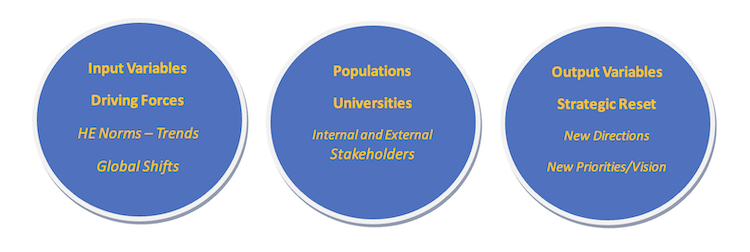
Does the strategic reset framework presented in Figure 1 provide a conceptual starting point for universities to engage in resetting their formal strategic priorities to position themselves for the future?
The first part of the paper provides a working definition for strategic reset and present a basic conceptual framework and theoretical supports. This is followed by a brief discussion of recent major global trends impacting HE, including recent social critiques of higher education by scholars, and historical norms. This is followed by an introduction to a Strategic Reset Framework (SRF) using micro-credentials, AI and open content as an example of current trends that institutional leaders must assess, then defer or adopt, and consider broader implications for their institution based upon key strategic priorities. Finally, the paper concludes with selected potential recommendations for leaders to consider for adopting a strategic reset approach.
The concept of strategic reset applied to universities was first presented in McGreal & Olcott’s papers (2021, 2022) using micro-credentials as a catalyst example, for institutional leaders following the pandemic, aligned with online learning and open content. Despite this macro strategic conceptual framework for reframing multiple institutional priorities, micro-credentials or ADCs were only one example presented by McGreal and Olcott (2021, 2022) in an institution’s reset arsenal — and micro-credentials may or may not be part of a deliberate long-term strategy.
As universities emerged from the global pandemic, many astute leaders and their leadership teams recognised that this could be an opportune time for strategic reset (McGreal & Olcott, 2021, 2022). What does strategic reset mean? It essentially means that, within the constants of uncertainty, increased complexity, and exponential change, universities could pause, re-assess institutional directions, and retro-fit their institutions to be more agile, flexible, and adaptive to the many new normals emerging in their environment from the pandemic. The prerequisite to reset, however, is to answer the question, Why change?
Indeed, this does not mean that leaders could arbitrarily discard the historical and normative values and practices of higher education. Without the prerequisite analysis of these, strategic reset will be reactive rather than proactive and without a firm justification for change. Leaders must also assess the current zeitgeist — the norms of society at the time of change and upheaval — and set priorities of what to do in response and consider how and where reset fits in this mix (Daniel, 2023).
Brown et al. (2023) noted strategic reset could be a viable strategy by writing “after all, micro-credentials provide an opportunity for strategic reset” (p. 3). These esteemed researchers recognised that the complexities of the modern university and its strategic priorities are diverse and interconnected. It is important to recognise that strategic reset is not just about micro-credential priorities, practices, and markets nor is it only about digital transformation. Digital technologies are simply tools, no more and no less.
Institutional reset is dynamic and inclusive of broader strategic priorities ranging from open content and digitalisation to AI and global digital programmes as well as traditional foundational components of teaching, research, and service. It can involve targeting new markets, expanding partnerships, and adding or reducing international operations. Micro-credentials may or may not be part of this composite reset. And, importantly, if strategic reset is deemed a potentially valuable tool for leaders, it will need to be implemented incrementally — in phases.
The competitive HE landscape will likely expand and market differentiation will need to be more than neon-light type marketing slogans. Strategic reset is not, and never will be, about one specific strand of institutional priorities such as micro-credentials or open content, or AI, or internationalisation but, rather, is a synthesis of strategic analyses that concurrently examine multiple decision frames for an institution (McGreal & Olcott, 2022; Brown et al., 2023; Olcott et al., 2023; Olcott, 2021).
The commentaries calling for future-proofing universities against the winds of change, competition, and political-economic shifts are misdirected. Leaders are increasingly coming to grips with the fact that for all the predictive capacity of a university’s arsenal of research and empiricism, its predictive abilities are limited. The pandemic, the global effects of the Ukraine-Russia War and Israel-Gaza crises, in concert with climate change and global migration patterns, illustrate this fact only too well.
Strategic reset will manifest itself much differently in developed and developing world universities and each leader must navigate the existing zeitgeist — prevailing societal norms and realities — to effectively lead his or her institution (Daniel, 2023). For the purpose of this article, strategic reset is defined as follows:
Strategic reset is a systematic leadership process for university leadership teams to re-assess existing institutional teaching, research and service missions; explore new institutional directions, reconfirm strategic priorities, mission, resource allocations, digital infrastructures, and retro-fit their institutions to be more agile, flexible, and adaptive to emerging trends and changing markets; stabilising existing priorities and repositioning institutional capacity to pursue new priorities. Strategic reset is re-setting priorities — making choices — and taking actions to build competitive advantage, quality, and service for the future.
The conceptual basis for strategic reset is provided below in Figure 1. The basic framework attempts to identify the key driving forces comprised of HE norms, trends and shifts that impact universities and their key internal and external stakeholders resulting in a potential catalyst for leaders to engage in strategic reset. More succinctly stated, the global forces impacting universities are creating the shifting inertia for leaders to engage in strategic reset and set new priorities, shift directions, and explore new institutional architectures. The inputs (independent variable), population (universities) and outputs (dependent variable) are all plural. Why? First, the range of forces impacting the HE landscape are diverse. This was noted earlier with reference to the Ukraine-Russia war and Israel-Gaza crisis, climate change and the pandemic.
Secondly, within the university ecosystem there are numerous subgroup stakeholders ranging from students, faculties, donors, staff, volunteers, and auxiliary staff, each with their own subcultures (Schein, 1985). These organisational subcultures are important because they often clash due to different priorities, competing for the same pool of resources, status, prestige, and more. Moreover, these differences can be barriers to institution-wide implementation of new priorities (strategic reset).
Finally, outcome variables linked to strategic reset can be many or few. For example, new priorities such as online education, open content or AI are macro priorities but these will have a multitude of variables and changes during implementation. Moreover, new priorities, no matter how sound, may need to be off-set by phasing out obsolete services, programmes and practices, which takes time and staff even when full elimination is considered. The institution may promote major new directions and priorities but the complexity of university governance and competing stakeholders suggest there will many changes that go into any level of strategic reset. In sum, the conceptual framework may look simple in the schematic but the actual implementation of change is often where strategic reset goes off the tracks.
Whilst the conceptual framework outlines the relationship of key variables in this article and to a large degree addresses the ‘Why change’ question, we must also draw upon theoretical approaches that offer agile and fluid frameworks for addressing the underlying problems facing universities. These theoretical bases comprise a core set of implementation strategies. Strategic reset is essentially about leading change by defining the internal inputs that result in specific outputs. This process suggests that if inputs are different this will produce different outputs. As a dynamic and reflective change process, implementing strategic reset draws upon Kotter’s (2012) Eight Steps of Change; Rogers’ (2003) Diffusion of Innovation theory; Schein’s (1985) theory of organisational culture and Senge’s (2006) Fifth Discipline — systems theory. Finally, this broad theoretically supported framework is informed by Burns’ (1978) theory of transformational leadership.
The detailed implementation of strategic reset and its theoretical underpinnings is beyond the scope of this article. The purpose of this article is to address two research questions: Why universities should consider change and whether the strategic reset framework is a viable response framework for change?
Moreover, the global HE community has generally agreed that the future is not predictable; universities are strategically misaligned with the needs of students, employers and society; and major trends and shifts in the global landscape that began nearly a decade ago and were accentuated during the global pandemic have amplified the need for innovative new university architectures (Olcott, Arnold, & Blaschke, 2023).
Today, climate change, digitalisation, populism, geopolitical shifts and power realignments, Artificial Intelligence and global economic downturns are just a few of the forces that suggest that a massive perfect storm has hit HE (Brown, 2023; Lindsey, 2020, 2021, 2022; Olcott, Arnold, & Blaschke, 2023). Indeed, a single new normal never emerged from the pandemic; rather many new normals are evolving across societal institutions reflective of different norms, cultures, and practices (Bozkurt et al., 2020). In sum, global HE has unprecedented challenges ahead and there is no single silver bullet solution. So where does this leave strategic reset in 2024?
Perhaps the best place to start is to briefly review Table 1 (Olcott et al., 2022, p. 76) that summarises key challenges facing the higher education sector for the 2020s.
Table 1: Global Mega-Trends/HE-Covid-19/Online Education/4 IR (Revolution)
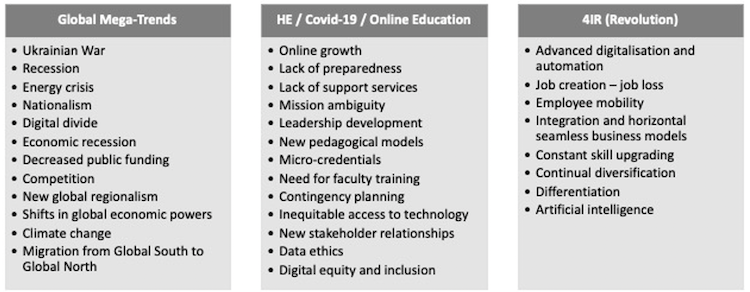
At first glance, perhaps the most glaring revelation from Table 1 is that business as usual and/or returning to pre-pandemic norms is unlikely. New institutional architectures are needed to navigate this complex web of trends, change, and innovation.
Although a detailed discussion of each of these three broad areas and their characteristics is beyond the scope of this paper, the main point is to illustrate the challenging task leaders confront in reframing strategic reset for their institutions post-pandemic. And whilst these moving targets require leaders to be moving simultaneously, it is common sense to assume that different priorities will emerge for different institutions and for different reasons and purposes. Indeed, one size does not and will not fit all. The strategic reset process of setting priorities-making choices-taking action is complex, it entails some level of risk, and in one sense we are all in unchartered waters.
The global trends that are front and centre are the Ukraine-Russia War, the Israel-Gaza crisis, geo-political shifts towards right-wing populist governments, economic downturns due to the pandemic, climate change, south to north migration, a growing disparity between the have and have nots, an expanding rather than contracting digital divide (particularly between the developed and developing world), energy and food shortages, and global realignment of political/military blocks — NATO, China-India-Russia-North Korea, and regional alliances (Menon & Castrillon, 2019; Penprase, 2018; Lindsey, 2020, 2021, 2022).
Perhaps unsurprisingly, the 4th Industrial Revolution, whilst still somewhat difficult to decipher in its entirety, has arrived under the guise of the AI revolution. AI is not new but awareness of it amongst the masses as a potential global gamechanger exploded in 2023. Schäfer (2018) argues that the defining characteristic of the 4th IR is the exponential increase in computer power. The second characteristic which complicates strategic reset is disruption. The vast new technologies, AI, and the rapid race by all sectors to take the AI lead disrupts normal delivery and productions cycles and leaves leaders perplexed with setting priorities and making decisions inclusive of sound judgment and competitive advantage.
In sum, this is just a glimpse of the complexities illustrated in Table 1 above. University leaders are confronted with a rapidly changing and fluid HE environment where focus, judgment and patience will all be required to create flexible and agile organisations for the future. Like Margaret Mitchell’s famous novel business as usual in the modern university is gone with the wind. We can’t go back — only forward.
In recent years, there has been an increasing critique of higher education that neoliberal agendas are adversely affecting the basic goals and purpose of the modern university. Essentially, neoliberalism argues for a hands-off approach to fiscal management by government of universities, reduced funding, and a free market educational market. The negative effects on universities, according to some critics, is a commercialisation of the academic enterprise at the expense of producing socially and educationally adept student-citizens (Deresiewicz, 2015). Some would label this a pseudo-conspiracy between corporations and elite colleges and universities, particularly in the US.
Moreover, some argue we are producing an intellectually bankrupt generation of graduates who learn only for money, jobs, and career and yet become a modern version of Hannah Arnedt’s ‘banality of evil’ — unable to think. Independent thought is forbidden, subversive, and uncomfortable for students according to Deresiewicz in his provocative book, Excellent sheep. Conformity has infiltrated what once was an ivory tower haven for the mind and the unfathomable euphemism is that academic and corporate shepherds are leading our excellent student sheep to slaughter mentally and emotionally, as they are unable to engage in the genuine intellectual exercise known as thinking.
Another insightful perspective is by Lukainoff & Haidt (2019) whose book, The coddling of the American mind: How good intentions and bad ideas are setting up a generation for failure (2019), argues that American universities are so busy with their student customers that they treat them with ultimate safety and refrain from actually engaging them in serious debates about serious issues in the world. According to some commentators, this generation of students is very talented yet without common sense and, hence, susceptible to bad ideas such as authoritarianism and the rejection of diverse viewpoints. Once again, a ‘fragile’ conformity rather than a logical, sound, reasoned perspective that engages the real world. Lukainoff & Haidt link these disturbing and disconcerting campus environments to problematic parenting, cultural and political shifts. This writer would counter by arguing we have made universities safe havens for students without holding them accountable and demanding engagement — we don’t want to hurt their feelings nor lose those precious tuition dollars from Mum and Dad.
Indeed, it would be nice to blame all these campus blues on neoliberal agendas by misinformed politicians, right-wing free market economists, or even Miss Piggy and the Muppets. The problem, of course, is there are other culprits in this story.
Fulford (2022), sharing her British perspective on university woes and using mostly American and European examples, notes the financial crisis of 2008 and the budget cuts to HE that followed played a major role in the shifting roles of universities. She references a European Educational Association (EUA) report that suggests these crises have resulted in a loss of one third of college students in Romania, Lithuania and Slovakia and likely had a similar impact on their national economies. She argues that these financial crises have resulted in universities being unable to deliver high quality graduates and globally competitive research.
And somewhere in this was a global health pandemic, an international student market that came to a standstill along with the revenues from these students, and a predictable Zoom crisis of unsupported teachers trying to implement global online learning during the pandemic. The truth is universities themselves are equally responsible for the inept student populations and disenfranchised faculties on their campuses. The disturbing part of Fulford’s blue-sky approach to all these higher education crises is that the word Brexit was not mentioned once. C’est la vie.
The essence of Fulford’s discourse is that universities are supposed to cause trouble, whether challenging students with opposing arguments, or marching in the streets or in front of the Vice-Chancellor’s office about genocide, anti-Semitism, tuition hikes, or holding classes during World Cup football matches. What’s missing in her argument is the reality that trouble or troublemaking, no matter who makes it or is affected by it, can be an opportunity. In this sense, she does advocate she can save the lecture mode of teaching as a viable medium for ‘agitating the mind’ of students. We should unsettle their perfect worlds by challenging them on critical world issues, social constructs with complex and diverse viewpoints, and take off our kid gloves when dealing with students.
Paradoxically, though, Fulford may think that the inherent elitism of British higher education is kept under wraps in her article but it is readily apparent. And this is not a critique but higher education’s issues are also not the fault of neoliberals hiding out in Hyde Park, London before an Eric Clapton concert with frustrated university students.
In sum, these recent trends in higher education are disconcerting and accentuate the misalignment between the goals of universities and the outcomes that are personified through its graduates. When one looks at the aggregate impacts of global trends and shifts, coupled with the historical norms of higher education and in the light (and dark) of commentaries such as Fulford, Lukainoff and Haidt, and Deresiewicz, one can only conclude that higher education needs to change. Strategic reset is not only justified it is essential to save our universities and return them to their historic roles as servants of students, society and intellectual thought.
Strategic reset is about bringing together complementary and ‘common sense’ priorities of the institution — it is not about revamping the entire institution in three months. Moreover, before the merger of priorities, leaders must first ask, Do we want to engage in this arena and why? Let’s look at how this might evolve in institutional planning and implementation. This is an example only and not an advocacy for digital technologies.
Online learning, open content, and micro-credentials have two salient characteristics in common. First, they are all digitally based (or will be) and will continue to be designed around the broader digitalisation in our universities.
Secondly, all are interconnected and mutually reinforcing contributors to our academic delivery matrix, although, if the reader includes AI, exact applications are emerging. Universities deliver academic programmes and training online, they integrate elements of open content into these programmes in online formats, and micro-credentials (also called alternative digital credentials) are digitally stored and accessible online by the students and employers, often through a third-party partner (McGreal & Olcott, 2021, 2022).
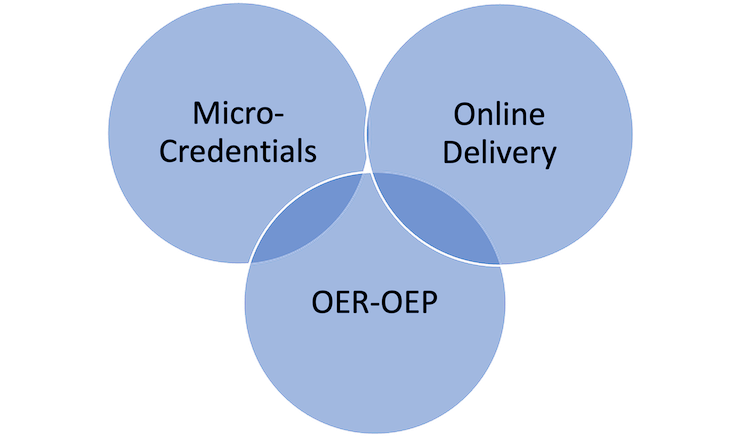
Figure 2, depicting one strategic priority synergy (SPS), provides a visual representation of this multi-dimensional approach to online, open and micro-credentials as a strategic synergy of strategic reset. It is important to note that this only one example of building synergy amongst complementary priority areas. These dimensions are interconnected, and those institutions coming out of the pandemic were faced with different choices for different reasons. Institutions have multiple (three to five) priority synergy areas each with three to four priority and complementary strategic priorities.
Novice online organisations that responded to the pandemic will now have to decide if they will continue to maintain some type of on-going online capacity. Universities that were already doing significant levels of online delivery will have to decide if they will expand online activities, maintain current levels, or even scale down. Perhaps some institutions, K-12, and the university will choose to return to the status quo that existed before the pandemic.
The multi-dimensional framework for mission enhancement that concurrently reframes the interconnected components of online delivery, open content, and micro-credentials (and potentially AI) provides one example of how institutions can reset for the future. Leaders must institute change by exploring these interconnected 21st century gamechangers. This is a strategic reset opportunity for many universities to reposition their competitive position in the marketplace. Universities seldom get an opportunity like this to navigate and reposition the ship to sail in new directions.
A critical facet of strategic reset in the example above is that the common element is obvious. The question is, What do online delivery, OERs, micro-credentials, and AI have in common? The question is, indeed, rhetorical — they are all part of an institution’s digital arsenal. Moreover, together they provide a vast repository for supporting, creating and disseminating teaching, research, and service beyond the institution. These are the three broad mission areas typically associated with modern universities. Conversely, all three are under siege as the world has become more uncertain, complex and characterised by rapid change — institutions must respond faster, turn and pivot, and reposition their priorities to remain competitive.
As a leader and/or member of a leadership team in a university, the second obvious conclusion one can draw from this synergy example is that universities could have three to five key priority synergy groups going on at the same time staggered over five years. All of these are ongoing, adaptive, and interact with each other. Again, we are not engaging in this approach to change the entire institution in three months. Staggering the synergy areas has intrinsic value because it gives leadership the opportunity to scan and make improvements in different synergy areas. This process also does not preclude a generic strategic plan in the traditional sense but the fact is that a one-plan approach for five years is simply ineffective in responding to the rapidly changing world of the 21st century.
What are other possible synergy areas? Below are two more examples:
University Outreach — partnerships, workforce development, technology transfer, branch campuses, international programmes.
School to Work Transition — mentorships in industry, internships, residencies, non-credit adult offerings, skills training.
A delimitation of this study is that the method was a descriptive analysis drawing upon the literature, historical norms of higher education, recent critiques of higher education and global trends and shifts to answer whether these warrant change by universities. Secondly, if change is warranted the second question asks whether the Strategic Reset Framework (SRF) proposed in this paper provides a sound starting point for institutions to reset their institutional priorities.
The author argues that the view in this paper supports both research questions. There was the necessary evidence that suggests universities need to adopt revised strategic priorities for the future. Secondly, the Strategic Reset Framework (SRF) provides a potentially sound framework from which leadership teams can plan their futures.
Strategic reset is the process of reassessing an institution’s strategic priorities and making changes if warranted, and assessing whether the institution can effectively engage in and respond to any zeitgeist (Daniel, 2023) in the future through agility, reflexibility, innovation, and responsiveness to key stakeholders. We have already noted that strategic reset does not focus on one specific strategic area but rather multiple strategic priorities that complement each other.
What can leaders do to plan for strategic reset?
These considerations are not all-inclusive nor a panacea for an institution’s strategic reset process. In fact, the first question is whether your institution will engage in a strategic reset process of your future strategic priorities. Some will, others will continue business as usual until they realise they can’t, and others may integrate the strategic reset concept within traditional strategic planning processes.
The first strategic question for universities is not how we engage in new strategic priority synergy areas. The first question is, Should we engage at all, or to what degree? Does this trend or emerging shift align with our institution mission, the programmatic strengths of our academic programmes, and the increasing importance of good judgment in strategically allocating institutional resources? Why change is a critical question.
Many leaders and their leadership teams assume they are going fully digital, are convinced they are diving into the new assumed (game changer) micro-credential market; have already decided that adopting OERs in every discipline is visionary; and many leaders are already singing the praises of their institution being at the forefront of AI in the coming 4th Industrial Revolution. Moreover, many leaders assume wrongly that their teaching, research and service missions are just fine. Strategic reset means reflecting upon all institutional priority areas, and how key areas create complementary synergies that position the university with competitive advantage in the HE market.
The purpose of this article was to present a Strategic Reset Framework (SRF) for creating a multi-dimensional approach to positioning universities to thrive in the future. The example discussed the SRF strategic priorities of online learning, open education, AI, and micro-credentials/ADCs as potentially sound foci for integration and development (see Figure 2).
For some institutions the priorities will be a combination of different dimensions that may include community service, research, infrastructure upgrades, faculty incentives and resourcing, interinstitutional partnerships and more. The rationale for the online-open-micro-credential framework was made clear — digitalisation is driving all areas (and AI) and they mutually reinforce each other and institutional programme delivery — degrees, training, open textbooks and/or skill domain micro-credentials.
The Strategic Reset Framework (SRF) provides an opportunity for leaders to shift directions and consider alternative strategic priority synergies for the future. This concept was first presented by McGreal & Olcott (2021, 2022) as a part of the institutional options for approaching micro-credentials. The strategic focus on micro-credentials by university leadership was further expanded by Brown et al. (2023). This resource is highly recommended for leaders looking specifically at alternative credentialing. The SRF approach looks at multiple strategic priority synergies and bringing together strategic priority areas that complement each other (see Figure 2).
A final comment on leadership. Indeed, one of the most perplexing dichotomies within the HEI leadership spectrum throughout most of the 19th and 20th centuries was that universities and their leaders lived in the shadows. For the most part, institutions and their leaders minded their own business, managed their own house, and stayed clear of the geopolitical arena. Better to be neutral, out of the fray, than to take a side even when the right side was self-evident. Most leaders preferred to be left alone, inside their bubble, in their own controlled worlds. Many institutions, indeed, followed the elitist ivory tower trek to shield themselves from undue outside influence and to selectively engage in low to moderate risk endeavours aligned with institutional mission and tradition.
Strategic reset presented in this article suggests that leaders must not function from the shadows going forward. The stakes are too high. Climate change, wars of aggression, individual freedoms, human rights, economic and digital divides cannot be addressed in full with university leaders choosing to stay on the sidelines, in the shadows, neutral and naïve.
Leaders must rethink their strategic directions and accept that business as usual in the HE world will be detrimental to the future of their institutions. Your competitors will reframe their institutions with new architectures and streamlined strategic priorities to ensure focus, agility, and responsiveness to highly complex market forces. Competition will drive your institution off the playing field unless you step back, reset, engage, and come out of the shadows. The choice is yours.
Bozkurt, A., Jung, I., Xiao, J., Vladimirschi, V., Schuwer, R., Egorov, G., Lambert, S., Al-Freih, M., Pete, J., Olcott, Jr., D., Rodes, V., Aranciaga, I., Bali, M., Alvarez, A.J., Roberts, J., Pazurek, A., Raffaghelli, J.E., Panagiotou, N., de Coëtlogon, P., Shahadu, S., Brown, M., Asino, T.I., Tumwesige, J., Ramírez Reyes, T., Barrios Ipenza, E., Ossiannilsson, E., Bond, M., Belhamel, K., Irvine, V., Sharma, R. C., Adam, T., Janssen, B., Sklyarova, T., Olcott, N., Ambrosino, A., Lazou, C., Mocquet, B., Mano, M., & Paskevicius, M. (2020). A global outlook to the interruption of education due to COVID-19 pandemic: Navigating in a time of uncertainty and crisis. Asian Journal of Distance Education, 15(1), 1-126. https://www.asianjde.com/ojs/index.php/AsianJDE/article/view/462
Brown, M. (2023). Leading in changing times: Building a transformative culture. In O. Zawacki-Richter & I. Jung (Eds.), Handbook of open, distance and digital education (pp. 509-525). Springer Singapore. http://doi.org/10.1007/978-981-19-2080-6_28
Brown, M., McGreal, R., & Peters, M. (2023). A strategic institutional response to micro-credentials: Key questions for educational leaders. Journal of Interactive Media in Education, 1-17. DOI: https://doi. org/10.5334/jime.801 https://storage.googleapis.com/jnl-up-j-jime-files/journals/1/articles/801/646dff50356e4.pdf
Burns, J.M. (1978). Leadership. Harper and Row.
Daniel, J. (2023). Running distance education at scale: Open universities, open schools and MOOCs. In O. Zawacki-Richter, & I. Jung (Eds.), Handbook of open, distance and digital education (pp. 475-492). Springer Singapore. http://doi.org/10.1007/978-81-19-2080-6_26
Deresiewicz, W. (2015). Excellent sheep. Free Press.
Francis, D.V., & Weller, C.E. (2022). Economic inequality, the digital divide and remote learning during COVID-19. The Review of Black Political Economy, 49(1), 41-60. https://journals.sagepub.com/doi/full/10.1177/00346446211017797
Fulford, A. (2022). The university as troublemaker. Teoría de la Educación. Revista Interuniversitaria, 34(2), 1-22. https://doi.org/10.14201/teri.27819 https://revistas.usal.es/tres/index.php/1130-3743/article/download/27819/27990?inline=1
Kotter, J. (2012). Leading change. Harvard Business Review Press.
Lindsey, J.M. (2022). The most significant world events in 2022. Council of Foreign Relations. https://www.cfr.org/blog/ten-most-significant-world-events-2022
Lindsey, J.M. (2021). The most significant world events in 2021. Council of Foreign Relations. https://www.cfr.org/blog/ten-most-significant-world-events-2021
Lindsey, J.M. (2020). The most significant world events in 2020. Council of Foreign Relations. https://www.cfr.org/blog/ten-most-significant-world-events-2020
Lukianoff, G. & Haidt, J. (2018). The coddling of the American mind: How good intentions and bad ideas are setting up a generation for failure. Penguin Books.
Makoe, M., & Olcott, D.J. (2021). Leadership for development: Re-shaping higher education futures and sustainability in Africa. Journal of Learning for Development, 8(3), 487-500. https://jl4d.org/index.php/ejl4d/issue/view/25
McGreal, R., & Olcott, D.J. (2022). A strategic reset: Micro-credentials for higher education leaders. Smart Learning Environment, 9. https://doi.org/10.1186/s40561-022-00190https://slejournal.springeropen.com/articles/10.1186/s40561-022-00190-11
McGreal, R., & Olcott, D.J. (2021). Micro-credentials landscape report: Transforming workforce futures: Strategic perspectives and practices for university micro-credentials. Athabasca University. https://auspace.athabascau.ca/handle/2149/3655
Menon, K., & Castrillon, G. (2019). Universities have ‘pivotal role’ to play in Fourth Industrial Revolution. Daily Maverick, 4. https://www.dailymaverick.co.za/article/2019-04-15-universities-have-pivotal-role-toplay-in-fourth-industrial-revolution/
Olcott, D.J. (2021). Micro-credentials: A catalyst for strategic reset and change in U.S. higher education. The American Journal of Distance Education. DOI: 10.1080/08923647.2021.1997537
Olcott, D.J., Arnold D.J., & Blaschke, L.M. (2023). Leadership 2030: Renewed visions and empowered choices for European universities. European Journal of Open and Distance Learning (EURODL), 25(1), 74-92. https://sciendo.com/article/10.2478/eurodl-2023-0006?tab=article
Penprase, B.E. (2018). The Fourth Industrial Revolution and higher education. In N.W. Gleason (Ed.), Higher education and the era of the Fourth Industrial Revolution (pp. 207-229). https://link.springer.com/chapter/10.1007/978-981-13-0194-0_9
Rogers, E.M. (2003). Diffusion of innovations. Free Press.
Schäfer, M. (2018). The fourth industrial revolution: How the EU can lead it? European View. https://doi.org/10.1177/1781685818762890
Schein, E.H. (1985). Organizational culture and leadership. Jossey-Bass.
Senge, P. (2006). The fifth discipline: The art and practice of the learning organization (2nd ed.). Doubleday.
Author Notes
Dr Don Olcott Jr, FRSA is Professor Extraordinarius of Leadership and ODL at the University of South Africa. He is also President of HJ Associates in Romania and a consultant affiliate with Universal Learning Services (ULS), Barcelona, Spain. Don was the 2024 recipient of the United States Distance Learning Association (USDLA) Leadership Award for outstanding contributions to open, distance and online learning. He was the 2023 recipient of the ICDE Prize of Excellence for Lifelong Contributions to open, flexible, distance and online learning. Don is a Senior Fellow of EDEN Digital Learning Europe and was Chair of the EDEN Council of Fellows for 2021-2022. He was adjunct Professor of Leadership and ODL at the University of Maryland Global Campus from 2011-2021. Dr. Olcott is former Chief Executive of The Observatory on Borderless Higher Education (OBHE) in the UK (2007-2011) and former Chairman of the Board of Directors and President of the United States Distance Learning Association (USDLA). Dr. Olcott was the 2013 recipient of the International Council of Distance Education (ICDE) Individual Prize of Excellence for his leadership and contributions to global open and distance education. He was the 2016 Stanley Draczek Outstanding Teaching Award recipient from the University of Maryland Global Campus for excellence in online teaching and learning. Don will be inducted into the International Adult and Continuing Education Hall of Fame at the University of Florence in November 2024. Email: don.olcott@gmail.com (https://orcid.org/0000-0003-4542-9305)
Cite as: Olcott Jr, D. (2024). Leading strategic reset: A framework for revisioning university strategic priorities. Journal of Learning for Development, 11(2), 514-527.