Aigerim Mynbayeva, Kamchat Yessenova and Anzhelika Karabutova
2025 VOL. 12, No. 1
Abstract: The digitalisation of education has accelerated the transition toward heutagogical approaches, particularly in postgraduate education, fostering learner autonomy and self-directed learning. This study investigates how Master’s degree students perceived and engaged with the principles of Education 3.0 and Education 4.0, focusing on their awareness, self-development practices, and attitudes toward heutagogical principles. The survey involved 149 Master’s students from four Kazakh universities, using a questionnaire structured into two blocks: self-assessment of engagement in self-development and evaluation of heutagogical principles. The findings demonstrate that the majority of students recognised the importance of self-directed learning, with 79.2% consistently engaging in self-development and 88.59% supporting the principle of “knowing how to learn as a key skill.” However, mixed responses to other principles, such as “learning goes beyond specific disciplines,” reveal varying degrees of acceptance of heutagogical approaches. The study highlights the need to balance heutagogical frameworks with traditional educational methods to address students' diverse learning preferences. The theoretical part connects the concepts of Education 3.0 and 4.0 with the development of self-directed learning and its integration into digital education. The results suggest that further exploration of heutagogical approaches in postgraduate education is necessary, including the design of Massive Open Online Courses (MOOCs) to support heutagogical principles and Education 4.0 practices.
Keywords: distance learning, digitalisation, self-education, self-development
The shift to hybrid and online learning, driven by the pandemic, has necessitated a rethinking of pedagogical theories, the introduction of innovative concepts such as Education 3.0 and Education 4.0, and the cultivation of rhizomatic thinking in university students. In this context, the digitalisation of education is prompting a gradual transition toward heutagogical foundations and peeragogy, particularly in postgraduate education. However, several critical questions arise: What do these new approaches entail? How do Education 3.0 and Education 4.0 differ? How do postgraduate students, especially those pursuing Master’s degrees, perceive these new paradigms of self-education? Education 3.0 emphasises collaborative, participatory, and learner-driven processes, often integrating digital tools and open access resources to foster shared knowledge creation. In contrast, Education 4.0 builds upon these principles, aligning education with the demands of the Fourth Industrial Revolution by integrating artificial intelligence, adaptive learning technologies, and a focus on interdisciplinarity, problem-solving, and real-world applications. Heutagogy, often described as self-determined learning, emphasises learner autonomy and self-direction (Sargsyan, 2014). This approach advocates for creating a learning environment where students actively reflect on their educational processes, engage in critical thinking, and apply metacognitive strategies to identify and address their learning needs and preferences. The foundational principles of heutagogy include learner-centeredness, self-motivation, and the enhancement of metacognitive skills, preparing individuals to navigate the complexities of the 21st-century knowledge economy (Miranda et al., 2021; Tarde, 2013).
The pandemic intensified and accelerated this process. As assessed by Tazhigulova et al. (2020), in Kazakhstan, before the pandemic, only 38.8% of teachers had experience using distance learning technologies, although almost 80% of teachers had above-average computer skills. In Europe, according to Thorvaldsen and Madsen (2021), 60% of respondents did not use online learning before the crisis and 95% now believe that the Covid-19 crisis was a point of no return for education and learning technologies. Thus, the pandemic has greatly accelerated the massification of distance and blended learning, and not all students will want to return to face-to-face learning (Sidhi Menon & Unni, 2020).
In his book, Teaching digital natives, Prensky (2010) calls the new generation “digital natives” and justifies a partnership approach to learning for them. Other scholars call schoolchildren and students born after the 1990s and the emergence of the internet, the digital generation, the social and digital generation (Hietajärvi et al., 2015), Generation Z, or Next (Brdička, 2012). According to Prensky (2010), it is important to shift the specificity of students' learning towards finding, analysing, and presenting content using multimedia. It was already mentioned about the specifics of the digital generation, and the shift in emphasis from “knowledge reproduction” to “knowledge, how to find knowledge” (Miranda et al., 2021; Spankulova et al., 2019). Nowadays, the load on cognitive processes is changing in education: from memory loading to thinking development, which is similar to Benjamin Bloom's levels — from (knowledge/understanding/application) to (analysis/synthesis/evaluation). And this is characteristic not only for higher and postgraduate education but also for high school education. The knowledge society and the constant increase in knowledge and information is changing the paradigm of education to “lifelong learning”, and “life lasting learning”. Bolgova et al. (2021) have visually constructed a trajectory of transition from the existing education system to “lifelong learning”, which clearly demonstrates the importance of self-education in professional life. In fact, it is about the heutagogical approach, Education 3.0 (Halupa, 2015), and some authors refer to it as Education 4.0 (Miranda et al., 2021).
The concept of “heutagogy” was introduced by Hase and Kenyon (2000). Heutagogy is a “network-centred theory” based on connectivism (Halupa, 2015), reflexivity, and metacognitive skills. According to Blaschke (2023), heutagogy as a pedagogy of “self-determined learning” and self-education takes advantage of the possibilities of the internet, can be applied with distance learning technologies, and will be the basis for the digital age of teaching and learning (Chumachenko, 2020). Blaschke (2023) also notes that heutagogy and distance education have some close “key attributes, such as learner autonomy and self-reliance, and have pedagogical roots in adult teaching and learning”. That is, heutagogy as a theory of “self-determined learning” develops andragogy as a theory of adult education. For teachers, the differences between classical pedagogy and new approaches are clear. In classical pedagogy, characteristic of the 17th to the first half of the 20th century, the teacher is the leader of the learning process and the student is a subordinate child, not an independent learner (pedagogy 1.0). Conventionally, the teacher is the subject of the learning process and the learner is the object influenced by the teacher. One can think of the classic comparisons of the child as a “blank slate” (tabula rasa), a “filled jug” of knowledge and other metaphors.
In pedagogy 2.0, the child acts like a subject or a small partner in the learning process who can be motivated, “fired up” to learn; in andragogy, also understood as pedagogy 2.0, the adult learner has a sustained interest in the educational content and self-motivated learning, and has developed cognitive skills. Here, the learner acts as a subject of learning, and as a partner in the interaction (Kálmán & Poyda-Nosyk, 2023). The understanding of “version 2.0 pedagogy” by analogy is related to the development of Web 2.0, where the web has enabled feedback, user evaluation of events and processes, and virtual communication capabilities. Heutagogy as pedagogy 3.0 further autonomises the learning process for the learner since the learners initiate the learning process themselves, choose the methods and means of learning, the learning environment, their courses (i.e., educational content/resources), self-control the process, and seek facilitation themselves if they fail with the content elements. Thus, from “pedagogy → to andragogy → heutagogy” (PAH) the learner's autonomy in the learning process and proactivity increases. McAuliffe (2009) suggested the following principles of heutagogy:
Other authors, in particular Blaschke and Hase (2016), have identified five principles of heutagogy, and Agonács and Matos (2019) updated them: learner-centred and learner-defined learning; personal capacity development; self-reflection and metacognition; non-linear learning; and the PAH continuum principle. The analysis and comparison demonstrate that the principles of the two lists are formulated from different perspectives of heutagogy, and complement each other. The first list is formulated from the perspective of the teacher, emphasising the cognitive approach; the second list is formulated from the perspective of the learner and here the humanistic approach to education is clearly expressed. At the same time, some of the principles flow into each other. For example, the first principle in the first list, “knowing how to learn is a key skill,” is connected to the third principle in the second classification, “self-reflection and metacognition,” because through self-reflection and metacognition knowledge and strategies for self-learning are formed. The fifth principle of the first list overlaps with the first and second principles of the second list and emphasises the humanistic potential of learning.
Consider the last principle of the second list of the “PAH continuum.” Luckin et al. (2010) refer to this principle as the fulcrum or “theoretical stability” of heutagogy, calling it a concept. The notion of PAH continuum was introduced by Garnett (Luckin et al., 2010). It refers to the fusion of educational space and the action of “pedagogy-andragogy-heutagogy” within it. In modern society, a person learns constantly, “here and now” and “everywhere.” According to heutagogy, the internet, search engines, massive online open courses, video resources, and electronic and learning applications, currently offer great potential for self-education to mankind. The PAH continuum principle underlines the importance of both classical pedagogy and the andragogic development stage, and the transition to heutagogy in the holistic flow of learning. The PAH demonstrates that the modern lifelong learning paradigm is complemented by “lifelong learning,” where everyone is in the flow of learning: formal, non-formal, and informal education. And it is informal learning as an individual's self-education that is often compared to the heutagogical approach (Ignatovich, 2013).
While prior studies have addressed the evolution from pedagogy to heutagogy and their respective principles, there remains a gap in understanding how these frameworks are perceived and adopted by postgraduate students, specifically Master’s degree students. The existing literature has predominantly focused on theoretical discussions or the practical implications of these paradigms in broader educational contexts but has not adequately explored the subjective perspectives of learners transitioning to self-directed educational systems in the digital age. The problem addressed in this study centres on the limited empirical investigation into the perspectives of postgraduate students on heutagogical principles and their application within the frameworks of Education 3.0 and 4.0. Despite the increasing relevance of self-directed learning in higher education, there is insufficient research on students’ awareness, engagement, and attitudes toward these evolving approaches, particularly in contexts that require balancing traditional pedagogical structures with the demands of lifelong learning.
The aim of the study was to investigate the perspectives of Master’s degree students on heutagogical approaches and self-directed learning within the framework of Education 3.0 and 4.0, focusing on their awareness, engagement in self-education and self-development systems, as well as their attitudes toward the principles of heutagogy. Specifically, the research objectives were as follows:
The study employed a mixed-methods approach to explore Master’s degree students’ awareness, engagement, and attitudes toward heutagogical principles and self-directed learning. A structured survey was developed to assess students' self-assessment of their self-development level, engagement with online learning platforms, and perspectives on key heutagogical principles. The survey included quantitative components, such as Likert-scale items, and qualitative open-ended questions that allowed participants to elaborate on their self-study practices and the role of heutagogy in their education.
The population for this study comprised Master's degree students from four universities in Kazakhstan: Al-Farabi Kazakh National University, Abai Kazakh National Pedagogical University, M. Auezov South Kazakhstan University, and South Kazakhstan Pedagogical University. A purposive sampling method was used to select participants who were enrolled in eight Master's degree programmes, ensuring that they had a foundational understanding of independent learning strategies acquired during their undergraduate studies. The sample size for the survey was 149 students, selected to represent diverse disciplines across the four universities. The number of participants was determined based on the total available students who met the inclusion criteria and agreed to participate in the study during the data collection period.
The primary instrument for data collection was a structured questionnaire designed based on the theoretical framework of heutagogy. The questionnaire comprised two main sections: the first focused on assessing students’ awareness and engagement in self-education and self-development systems, while the second evaluated their attitudes toward the principles of heutagogy using a Likert attitude scale. The attitude scale included 15 statements, reflecting key heutagogical principles, with respondents rating their agreement on a 5-point Likert scale ranging from "strongly disagree" to "strongly agree." Overall, the questionnaire consisted of 25 questions, combining both closed-ended and open-ended formats. To ensure the instrument's validity, a thorough literature review was conducted, and the questionnaire was reviewed by a panel of experts specialising in educational technology and pedagogy. A pilot study was conducted with 20 students from the target population to test reliability and clarity. The statistical reliability of the questionnaire was evaluated using Cronbach’s alpha, which yielded a score of 0.87, indicating a high level of internal consistency. Based on the pilot study feedback, minor revisions were made to improve the clarity and comprehensibility of certain items.
Data collection was conducted over a three-month period, utilising an online survey platform to facilitate easy access and completion by the participants. The quantitative data from the survey were analysed using descriptive statistics to determine the distribution of responses to the Likert-scale questions and to calculate the mean scores for each heutagogical principle. Qualitative responses to open-ended questions were analysed using thematic analysis to identify common themes and insights related to students' perceptions of self-directed learning and the effectiveness of the heutagogical approach in their education.
The study received ethical clearance from the IRB of the Al-Farabi Kazakh National University. All participants were informed about the study's purpose, their rights as participants, including the right to withdraw at any time without penalty, and the measures taken to ensure their responses remained confidential. Informed consent was obtained from all participants before their participation in the survey, ensuring compliance with ethical standards for research involving human subjects.
To better understand the engagement of Master’s degree students in self-development and their awareness of heutagogical principles, a survey was conducted focusing on their self-assessment, participation in online learning platforms, and evaluation of heutagogical principles. This section presents the analysis of key findings, providing insights into students’ levels of engagement, preferences, and attitudes toward self-directed learning.
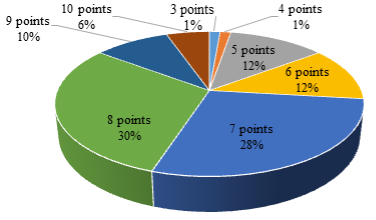
The survey revealed that 79.2% of respondents stated they consistently engaged in self-development activities, while 19.46% did so sporadically, and the remaining 1.34% found it difficult to respond. In response to the coaching question on self-assessment of self-development level on a 10-point scale, the Master’s degree students responded as follows: assessed themselves at 3-4 points (2%), 5-6 points (24%), 7-8 (58%), and 9-10 (16%) (Figure 1).
Analysis of the results demonstrates that more than half of the students rated their self-development abilities at 7-8 points. This result is explained by the fact that students had completed the first cycle of university studies (Bachelor's degree) and, accordingly, had documentary/symbolic confirmation of their achievements (for example, Bachelor's degree diploma), and experience in professional activities. Quite a high percentage of Master's degree students gave themselves a maximum possible score of 10 points (6% or eight persons). Only 24.8% of students were learning with MOOCs (Massive Open Online Courses) — about a quarter of the respondents indicated that they were engaged in MOOCs. Most students indicated such platforms as Coursera (2022), Open KazNU (2022), Stepik (2022), and sometimes Lectorium (2022), Schoology (2022), or Cisco Netacad (2021). This result can be attributed to various reasons. For example, poor awareness of MOOCs, the workload of undergraduate students, as most of them have a part-time or extra full-time job, or the disinterest of a certain proportion of students in additional self-study. The answers to the second set of questions in the questionnaire were as follows (Figure 2). The first set of heutagogical principles (McAuliffe, 2009) was used in the questionnaire because, firstly, they set the field's boundaries and characteristics more clearly and uniquely, and secondly, the principles-positions were written as full sentences.
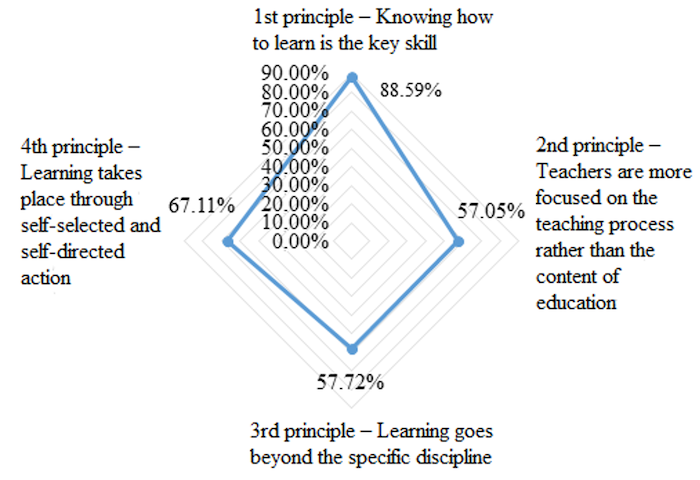
The majority of Master's and Doctoral degree students approved of the known principles of heutagogy when others challenged them or suggested improvements. For example, the first principle “Knowing how to learn is the key skill” was supported by 88.59% of students, while 7.38% disagreed with it, the remaining respondents gave other answers: “I cannot answer unambiguously,” “it is too strict,” “influences and how to study, what to study for, ways of motivation...”, “warm relationship between teacher and student is important.” The second principle “Teachers are more focused on the teaching process rather than the content of education” was supported by 57.05% of respondents, while 32.88% “did not agree” with this principle. Other variants of answers: 10.07% were “I don't know”, “Different teachers may have different attitudes,” “Teachers attach equal importance to both what to teach and how to teach,” and “It depends on a teacher.” A little more than a third of the sample (about 50 respondents), and around 10% (about 15 respondents), expressed this opinion. Specifically, 50 respondents believed that different teachers may prioritise both content and teaching methods equally, while 15 respondents preferred traditional teaching, where the teacher is viewed as the primary professional source of knowledge and competencies for students.
The third principle “Learning goes beyond the specific discipline” was endorsed by only 57.72% of undergraduates, while 38.93% disagreed, and the rest either partially agreed or found it difficult to answer. This principle proved to be the least approved by the students. This situation can be explained by several reasons: firstly, by students' wish to see specialisation, clear contours, and delimitation of subject knowledge-competencies in the taught course, the need to form and develop subject-specific or “hard skills,” and concentration on them, or, secondly, students confused this principle of self-education with the principle of formal education (classical pedagogy), and were not willing to follow it. Here, as can be seen, almost half of the students did not agree with this principle. The fourth principle “Learning takes place through self-selected and self-directed action” in heutagogy was agreed to by 67.11% and disagreed with by 28.19%. The rest of the participants expressed their answers: from optimistic and agreeing – “learning happens all the time, we are always learning (by reading something, talking, watching TV)”, “we learn even sometimes without realising it,” “In most cases, it is for the best,” to sceptical – “sometimes we need direction and perspective,” “it depends on circumstances,” and “What is the teacher for?”
Considering the peculiarities of self-study, one group of Master's degree students (113 people) was asked the question: “What is necessary for successful self-learning?” and 91.2% of undergraduate students indicated “willpower,” 70% indicated self-motivation, 53.4% indicated creativity, and 47.2% openness. In addition, 90.4% of respondents indicated that constant self-learning allows the development of spiritual and moral qualities. Another group (36 students) was asked about preferences of resources and sources of information for self-study: paper books were chosen by 36.1% of Master’s degree students; e-books by 25%; internet resources, 22.2%; video resources, 11.1%, and social networks by 5.6%.
The attitudes of Master’s degree students toward heutagogical principles were analysed using a Likert Attitude Scale. Table 1 presents the item-based quantitative findings for the principles explored in the survey.
Table 1: Students’ Attitudes toward Heutagogical Principles
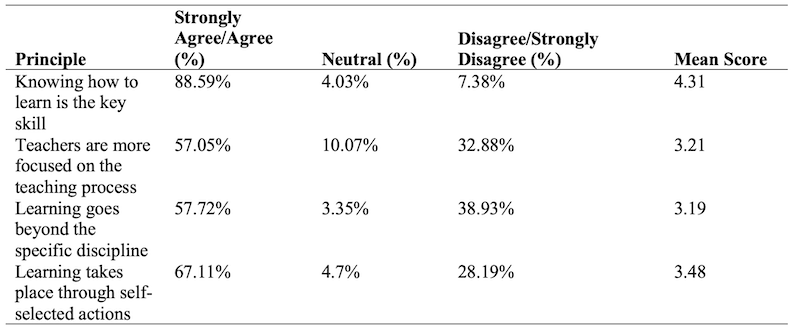
Analysis of the results demonstrates a general acceptance of heutagogical principles among students, albeit with notable variations across different principles. The principle "Knowing how to learn is the key skill" received overwhelming support (88.59%), reflecting students' recognition of the importance of metacognition in their education. The principle "Teachers are more focused on the teaching process rather than content" garnered mixed responses, with 57.05% agreeing and 32.88% disagreeing. This highlights a preference for a balance between teaching methodology and subject content. The principle "Learning goes beyond the specific discipline" had the lowest approval (57.72%), with 38.93% disagreeing. This indicates a preference for specialised knowledge and structured subject boundaries. The principle "Learning takes place through self-selected and self-directed action" was endorsed by 67.11%, though 28.19% disagreed, emphasising the need for mentorship and external guidance in some contexts.
These findings reveal a complex landscape of perspectives, reflecting both acceptance of and resistance to self-directed learning approaches. While students valued the autonomy and independence offered by heutagogy, there remained a significant preference for traditional educational models involving teacher-led instruction and discipline-specific learning.
The survey results regarding the attitude of students toward the principles of heutagogy revealed a complex landscape of perspectives, reflecting both acceptance of and resistance to self-directed learning approaches. While some students embraced the heutagogical approach, others expressed reservations, highlighting a divide between traditional educational models and the evolving heutagogical framework. A significant portion of students supported the core principles of heutagogy, recognising the value of self-directed learning and its potential to foster independence and critical thinking. However, the responses also show a degree of scepticism, particularly regarding the role of the teacher and the perceived necessity for structured guidance in the learning process. This suggests that while students were open to self-directed learning, many still felt that certain aspects of traditional pedagogy, such as teacher involvement and discipline-specific knowledge, remain essential for effective education.
The principle that "learning goes beyond the specific discipline" received mixed reactions, with only a slight majority of students endorsing it. This indicates a preference among some students for a more focused and specialised educational approach, where the boundaries of subject knowledge are clearly defined. The disagreement with this principle reflects a concern that broad, interdisciplinary learning may dilute the depth of knowledge within their chosen field, emphasising the need for a balance between specialised education and the development of broader skills.
The principle of "learning through self-selected and self-directed action" also sparked diverse responses. While the majority agreed with the idea, a notable proportion expressed the view that external direction is sometimes necessary, particularly in cases where learners feel uncertain about the path forward. This highlights a common concern among students that, without proper guidance, self-directed learning might lack focus and coherence, underscoring the importance of mentorship and feedback in the learning process.
In conclusion, the students' attitudes toward heutagogy demonstrated both enthusiasm for its principles and a cautious adherence to traditional educational models. While many recognised the benefits of self-directed learning, there was still a strong attachment to teacher-led instruction and structured learning pathways, suggesting that heutagogy, while valuable, may need to be integrated with more conventional approaches to meet the diverse needs of learners.
The findings of this study underscore the critical role heutagogy plays in the education of Master’s degree students, particularly in the context of knowledge management and rhizomatic learning. The concept of heutagogy emphasises self-determined learning, where students take responsibility for their own educational paths, a principle that was largely supported by the majority of respondents. As Blaschke (2023) points out, heutagogic learning environments foster independence, adaptability, and self-direction — qualities that are increasingly necessary in a rapidly evolving academic and professional landscape. A key observation from this research is the varied responses toward the principles of heutagogy. For example, the principle of "learning going beyond specific disciplines" was met with notable resistance, with nearly 39% of students disagreeing with the idea. This aligns with Spankulova’s (2020) and Meisner’s (2012) discussion of the diffusion of innovation and the “overflow” of scientific and technical knowledge, which suggests that students, especially at the Master’s level, may prioritise specialised knowledge that directly aligns with their career trajectories or professional development. This resistance to interdisciplinary learning can also be understood through the lens of knowledge management as described by Ignatieva (2006), where tacit knowledge and deep expertise within a specific field remain valuable and hard to replace in traditional learning environments.
However, the support for self-directed learning was evident in the responses, particularly the principle that learning is self-selected and occurs through self-directed actions. The results show that 67.11% of the participants agreed with this principle, highlighting the growing importance of autonomy in modern education, as emphasised by Huretska (2023). This reflects a shift toward Education 4.0, where students need to develop the ability to learn independently and continuously evolve their skill sets in line with technological advancements (Miranda et al., 2021). The platforms used by students, such as those in Coursera and other MOOCs, further demonstrate their engagement with new forms of learning, though it is worth noting that only 24.8% of the respondents were engaged in MOOCs, suggesting the need for greater awareness or better integration of these tools in formal education settings.
Moreover, the mixed reception of the principle that "teachers focus more on the teaching process rather than the content" highlighted a tension between traditional pedagogical models and heutagogy. A significant portion of students (32.88%) disagreed with this principle, indicating a continued preference for a more content-driven and teacher-led educational approach. This is consistent with Kálmán and Poyda-Nosyk’s (2023) findings, which emphasise the enduring significance of the teacher-student relationship in education, even in more innovative, self-directed learning environments.
The implications of these findings suggest that while heutagogy is gaining traction among Master’s students, there remains a strong attachment to conventional educational methods, especially when it comes to discipline-specific knowledge and the role of the teacher. As Bolgova et al. (2021) highlight, the pandemic accelerated shifts in educational paradigms but it also revealed the need for a balanced approach that combines the flexibility of self-directed learning with the structure and expertise provided by traditional pedagogical models. The challenge for educators, then, is to design learning environments that encourage autonomy and innovation while maintaining the depth and rigour of specialised knowledge.
In conclusion, this study demonstrates that heutagogy, while widely accepted in theory, encounters resistance when it challenges deeply ingrained educational practises. As education continues to evolve in response to new challenges and technologies, it will be crucial to find a balance that accommodates both self-directed learning and the structured guidance students still value. This balance is essential for preparing students not only for academic success but also for the complex and dynamic demands of the global workforce.
This research investigates the basics of heutagogy as a theory of self-education. The analysis of the results of a survey of Master’s degree students on heutagogy principles showed that students, on the one hand, understand the changes taking place and the importance of self-learning and self-education. On the other hand, just over half of the students supported the second and third principles, which suggests that it will take time to transform and accept the changes. The internet system and the digital space have created new opportunities for self-learning and self-development. Understanding heutagogy as a theory of self-determined learning by students and teachers should develop the readiness of a new generation of professionals to work productively in a knowledge economy.
In addition, the weaknesses of heutagogy include the following. Firstly, the difficulties in the process of choosing one's learning trajectory among students. At present, students are more adapted to a traditional education system and using classical learning strategies; they expect to be shown a direction and a learning trajectory. Secondly, the students might make the mistake of choosing disciplines, courses, and resources independently. Thirdly, there is a lack of motivation and a lack of consistency in independent e-learning and self-education. Previously, a focus interview was conducted with Bachelor’s degree students — future teachers — to assess the PAH continuum, in which they identified risk areas of heutagogy, in particular, dependence on human motivation and willpower, lack of unambiguous systematic knowledge, and others. In the future, there is a plan to develop a MOOC on heutagogy and Education 4.0.
This research was funded by the Committee of Science of the Ministry of Science and Higher Education of the Republic of Kazakhstan (Grant No. AP08856223) “Synergetic foundations and heutagogy for personal self-development and development of spiritual and moral qualities”.
Agonács, N., & Matos, J.F. (2019). Heutagogy and self-determined learning: A review of the published literature on the application and implementation of the theory. Open Learning: The Journal of Open, Distance and e-Learning, 34(3), 223-240. https://doi.org/10.1080/02680513.2018.1562329
Blaschke, L.M. (2023). Self-determined learning: Designing for heutagogic learning environments. In: M.J. Spector, B.B. Lockee, M.D. Childress (Eds.), Learning, design, and technology (pp. 1-22). Springer International Publishing. https://doi.org/10.1007/978-3-319-17461-7_62
Blaschke, L.M., & Hase, S. (2016). Heutagogy: A holistic framework for creating twenty-first-century self-determined learners. In The future of ubiquitous learning (pp. 25-40). Springer. https://doi.org/10.1007/978-3-662-47724-3_2
Bolgova, V., Garanin, M., Krasnova, E., & Khristoforova, L.V. (2021). Education after the pandemic: Fall or preparation for the jump? Higher Education in Russia, 7, 9-30. https://doi.org/10.14515/monitoring.2022.6.2270
Brdička, B. (2012). New information technologies of education. http://www.slideshare.net/bobr/
Chumachenko, M. (2020). Distance education as an answer to today’s challenges: Cultural and artistic aspect. Kultura і suchasnist: Almanakh, 1, 43-50. https://doi.org/10.32461/2226-0285.1.2020.221333
Cisco Netacad. (2022). https://www.netacad.com/ru
Coursera. (2022). https://www.coursera.org
Halupa, C.M. (2015). Pedagogy, andragogy, and heutagogy. Transformative Curriculum Design in Health Sciences Education, 22(4), 143-158. https://doi.org/10.4018/978-1-4666-8571-0.ch005
Hase, S., & Kenyon, C. (2000). From andragogy to heutagogy. https://www.researchgate.net/publication/301339522_
Hietajärvi, L., Tuominen-Soini, H., Hakkarainen, K., Salmela-Aro, K., & Lonka, K. (2015). Is student motivation related to socio-digital participation? A person-oriented approach. Procedia-Social and Behavioral Sciences, 171, 1156-1167. https://doi.org/10.1016/j.sbspro.2015.01.226
Huretska, N. (2023). Modern challenges and prospects for the development of remote education: A systematic review of the literature. Scientific Bulletin of Mukachevo State University. Series Pedagogy and Psychology, 9(4), 107-115. https://doi.org/10.52534/msu-pp4.2023.107
Ignatieva, E. (2006). About knowledge management and tacit knowledge in education. Higher Education in Russia, 12, 36-41.
Ignatovich, E.V. (2013). Heutagogy as a foreign concept of self-study. https://lll21.petrsu.ru/journal/article.php?id=2151.
Kálmán, B.G., & Poyda-Nosyk, N. (2023). The role of the teacher-student relationship in the innovation of education: Interdisciplinary review of the issue. Scientific Bulletin of Mukachevo State University. Series Pedagogy and Psychology, 9(3), 72-81. https://doi.org/10.52534/msu-pp3.2023.72
Lectorium. (2022). https://www.lektorium.tv/
Luckin, R., Clark, W., Garnett, F., Whitworth, A., Akass, J., Cook, J., & Robertson, J. (2010). Learner-generated contexts: A framework to support the effective use of technology to support learning. In M.J.W. Lee, & C. McLoughlin (Eds.), Web 2.0-based e-learning: Applying social informatics for tertiary teaching (pp. 70-84). IGI Global. https://doi.org/10.4018/978-1-60566-294-7.ch004
McAuliffe, M. (2009). Does pedagogy still rule? Australasian Journal of Engineering Education, 15(1), 13-18. https://doi.org/10.1080/22054952.2009.11464018
Meisner, D. (2012). Economic effects of the “overflow” of the results of scientific and technical and innovative activities. Foresight, 6(3), 20-31. https://doi.org/10.1051/shsconf/202112805001
Miranda, J., Navarrete, Ch., Noguez, J., Molina-Espinosa, J.-M., Ramírez-Montoya, M.-S., Navarro-Tuch, S.A., Bustamante-Bello, M.-R., Rosas-Fernández, J.-B., & Molina, A. (2021). The core components of education 4.0 in higher education: Three case studies in engineering education. Computers & Electrical Engineering, 93, article number: 107278. https://doi.org/10.1016/j.compeleceng.2021.107278
Oakley, B. (2018). Learning how to learn: Powerful mental tools to help you master tough subjects. https://cutt.ly/7GHUARi
Open KazNU. (2022). Online courses from leading teachers. https://open.kaznu.kz/
Prensky, M.R. (2010). Teaching digital natives: Partnering for real learning.
Sargsyan, A.S. (2014). Principles and features of the development of heutagogy as a field of pedagogical science. Person and Education, 3(40), 11-116.
Schoology. (2022). Schoology Learning K-12 Learning Management System. https://www.schoology.com/
Sidhi Menon, U., & Unni, M.V. (2020). The paradigm shift in the Indian education system during COVID19: Impact, opportunities and trends. https://cutt.ly/uGG0iEN
Spankulova, L. (2020). Diffusion of innovations and knowledge flows in the regions of Kazakhstan. Almaty: Technological University.
Spankulova, L., Chulanova, Z., & Ibraimova, S. (2019). Influence of innovation activity, human capital, knowledge flow on the economic growth of regions. Economy: Strategy and Practice, 4(14), 53-66.
Stepik. (2022). Dreams of knowledge lead on Stepik. Educational platform and marketplace of online courses. https://welcome.stepik.org/ru
Tarde, G. (2013). The laws of imitation. Patterson Press.
Tazhigulova, Y., Artykbayeva, A., & Arystanova, A. (2020). Problems of the application of distance educational technologies in higher education in Republic of Kazakhstan. Vestnik KazNU, 62(1), 115-127. https://doi.org/10.26577/JES.2020.v62.i1.11
Thorvaldsen, S., & Madsen, S. (2021). Decoding the digital gap in teacher education: Three perspectives across the globe. https://cutt.ly/5GG1DSD
Author Notes
Aigerim Mynbayeva is a Full Doctor, Professor at the Department of General and Applied Psychology, Al-Farabi Kazakh National University, Almaty, Republic of Kazakhstan. Email: Aigerimmynbayeva@outlook.com (https://orcid.org/0000-0001-9613-6030)
Kamchat Yessenova is a PhD, Senior Lecturer at the Department of Pedagogy and Educational Management, Al-Farabi Kazakh National University, Almaty, Republic of Kazakhstan. Email: kamchatyessenova@yahoo.com (https://orcid.org/0009-0006-0130-8797)
Anzhelika Karabutova is a Leading Researcher at the Department of Educational Programs, National Institute of Harmonious Human Development, Almaty, Republic of Kazakhstan. Email: Anzhelika10karabutova@proton.me (https://orcid.org/0009-0008-8456-4060)
Cite as: Mynbayeva, A., Yessenova, K., & Karabutova, A. (2025). Master’s degree students’ perspectives on heutagogy: Self-directed learning in the context of Education 3.0 and 4.0. Journal of Learning for Development, 12(1), 154-166.