
Jiraporn Poonyawatpornkul, Supranee Pitsamai, Onuma Methakesorn and Kotchakorn Mangmee
2025 VOL. 12, No. 1
Abstract: This case study investigated the conceptual understanding of the Simple Pendulum topic amongst physics student-teachers using online experiments. A pre-experimental design was utilised, employing a one-group pretest-posttest approach with 20 student-teachers. The research instruments included a high-speed video activity conducted within Online Experiments (OEs) and a conceptual understanding test assessing various aspects of the Simple Pendulum topic. Average gain and normalised gain were employed to assess student learning progress. The findings revealed that OEs had a significant positive impact on students' understanding of oscillation concepts, particularly the Simple Pendulum. Following the intervention, most students exhibited improvement in their learning outcomes. The average score increased significantly, from 35.25% in the pretest to 82.50% in the posttest. Normalised gain scores, ranging from 0.20 to 1.00, confirmed substantial improvement in students' understanding of scientific concepts.
Keywords: high-speed video, online experiments, conceptual understanding level, physics student-teachers, simple pendulum
The Covid-19 pandemic significantly disrupted various aspects of our lives, with education experiencing one of the most significant impacts. This necessitated a swift shift from traditional classroom settings to online learning platforms. Online learning swiftly emerged as a vital alternative, allowing students to continue their education from the safety of their homes (Gomes & Thomas, 2022). Although online learning is widespread, there remains a need for in-depth exploration to ensure students achieve a comprehensive understanding of complex concepts (Nichols, 2023). This study was designed to address this gap by specifically investigating the use of online experiments (OEs) with high-speed video analysis to enhance the understanding of physics student-teachers. The following sections explore existing research and theoretical frameworks that support this investigation.
Recent studies have explored the effectiveness of various online learning approaches. Sarekenova et al. (2023) investigated the "Online Learning and Digital Conversation-Based Activities" method, finding that students using this approach achieved significantly higher results in the literature compared to those in traditional education settings. Similarly, Sharkia and Kohen (2022) implemented the flipped classroom model in an online environment, demonstrating improved student learning outcomes, particularly in the areas of explanation and evaluation within the examined lectures.
Within the context of the OEs, it is crucial to enhance both student learning achievement and conceptual understanding. Strategic use of information technology as a learning tool is crucial for fostering students' experimentation skills and potential. This notion is supported by examples from existing research. Noris et al. (2022) integrated a virtual laboratory into problem-based learning, finding it highly advantageous for enhancing the scientific literacy and critical thinking skills of junior high school students. Similarly, Hamed and Aljanazrah (2020) highlighted the effectiveness of virtual experiments in improving students' achievement levels, practical skills, and perceptions of using them in general physics labs. Additionally, Poonyawatpornkul and Luksameevanish (2019) employed high-speed video analysis to study projectile motion. Their findings revealed significant improvement in undergraduate students' scientific understanding, with scores increasing from around 12% to 69%. The study concluded that this technique effectively connects classroom physics theories with real-world motion, bridging the gap between theory and practice.
Furthermore, the high-speed video analysis technique has been employed in diverse motion studies, including investigations of full and partial ring pendula by Poonyawatpornkul et al. (2022). This specific example demonstrates the technique's capacity to analyse complex mechanics. Their findings clarified that oscillation periods depended on the ring's radius of curvature rather than the circumference's length. Additionally, Poonyawatpornkul and Luksameevanish (2021) employed this technique to investigate the impact of drag force on a falling paper cone, revealing that the paper cone's terminal velocity was only 0.87% of the theoretical value.
However, in online science learning, it is crucial to consider students' conceptual understanding and their difficulties. A correct grasp of concepts signifies their ability to explain phenomena and solve problems (Taqwa et al., 2020). In the field of physics, misconceptions encompass students' preconceived notions or misunderstandings about scientific concepts, frequently in conflict with scientifically accepted explanations. Additionally, they frequently bring informal physics knowledge to the classroom (Liang, 2016), resulting in misconceptions that conflict with established scientific facts and principles.
As demonstrated in a study by Somroob and Wattanakasiwich (2017), many students encounter misunderstandings and difficulties in linking concepts through graphical representations, particularly evident in the context of Simple Harmonic Motion (SHM) and defining an equilibrium position. These challenges extend to interpreting graphs, with many students struggling to relate displacement-time, velocity-time, and acceleration-time graphs. Notably, most students struggled to identify a valid velocity-time graph and lacked a full understanding of phase, hindering their ability to plot a graph with the correct phase relationship. These findings highlight the potential difficulties students face when grappling with abstract concepts like SHM solely through online learning environments, where the absence of real-time demonstrations and interactive activities may exacerbate existing misconceptions.
To tackle the challenges identified in interpreting SHM graphs in online learning environments, our study suggests the integration of a high-speed video activity into OEs, with a specific focus on the Simple Pendulum. This approach aims to enhance students' conceptual understanding of SHM and its graphical representations.
The main objective of this research was to investigate the conceptual understanding level of physics student-teachers regarding the topic of the Simple Pendulum through the use of the OEs. To evaluate this, students were asked to respond to open-ended questions both before and after utilising the OEs. This investigation addresses the following research questions:
To address the research questions outlined previously, a pre-experimental, one-group pretest-posttest design was chosen, which allowed examination of the effects of an intervention on a given sample. The intervention involved participation in OEs specifically designed to incorporate high-speed video analysis of the Simple Pendulum. All activities were conducted online. The details of the high-speed video activity within the OEs, worksheet, and both the pretest and posttest delivered via Microsoft Teams in advance of the experiment is shown in the next sections. These materials were provided in various formats, including .mp4, .jpeg, .docx, and .pdf files.
The participants in this study were 20 physics student-teachers from a university in northern Thailand (Department of Physics and General Science, 2022 academic year). These student-teachers possessed prior knowledge of Tracker software, a programme instrumental in the high-speed video activity, a key component of the intervention.
In this study, we developed OEs using guided enquiry steps to assist students in conducting laboratory experiments on the topic of the Simple Pendulum. The primary objective of the OEs was twofold: to facilitate students in independently conducting experiments while also fostering a comprehensive understanding of concepts. Additionally, the OEs aimed to enhance students' abilities in experiment planning and execution, graph creation, data interpretation, result evaluation, and the integration of findings with pertinent theoretical frameworks. These OEs incorporated high-speed video analysis techniques, a unique element that allowed students to observe the behaviour of the Simple Pendulum in slow motion. This facilitated a deeper understanding of the motion compared to traditional laboratory activities. The specific components of the OEs included a set of high-speed videos, Tracker software, and accompanying worksheets.
Each video featured an oscillating pendulum with varying lengths (L), masses (m), and initial release angles (φ). These videos were recorded in slow motion at 120 frames per second, allowing students to observe the pendulum's motion in greater detail. To facilitate this detailed observation, the OEs also incorporated Tracker software, which enabled students to perform position tracking of the pendulum's motion. Students used Tracker to manually mark the position of the pendulum bob in each video frame, allowing them to generate graphs of the pendulum's displacement over time. The sample group accessed these experiments through their university accounts on Microsoft Teams. Subsequently, they independently conducted the practical activities outlined in the videos, followed by completing the hands-on worksheets.
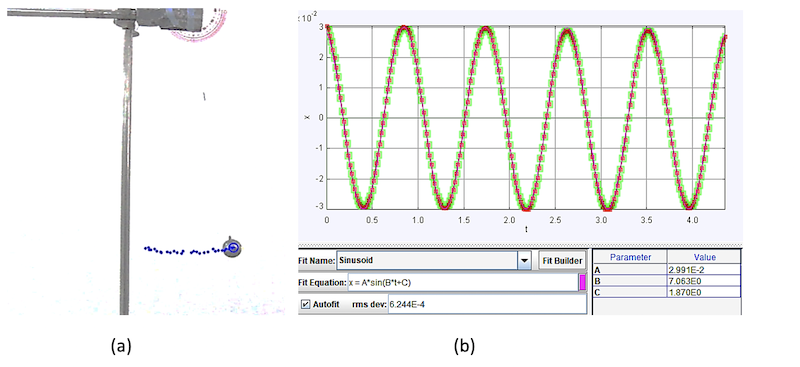
Figure 1 shows an example of a student's work. Based on this figure, students were able to determine the angular frequency (ω) by fitting the graph with the equation:
This value (ω) could then be used to determine the oscillating period (T) of the pendulum using the equation:

By analysing all the provided videos, they could gain a comprehensive understanding of the relationship between the pendulum's mass, length, and the initial release angle with the oscillating period. Each student individually composed their own report within the worksheets, encompassing the experimental objective, background theory, methodology, data collection, plotting a graph, results, discussion, and conclusion. After submitting the report, it was reviewed by the instructor who provided written feedback.
This study employed two data collection tools. The first tool was a conceptual understanding test specifically designed to assess students' level of understanding of the Simple Pendulum topic. The second was a subjective test that evaluated and categorised students' understanding into five levels based on their written responses to complex problems in various scenarios.
We devised a test comprising five questions, drawing content from academic journals and university textbooks. To ensure the validity of content, construct, and appropriateness, three physics education experts evaluated the test using the item-objective congruence index (IOC). Each item was assigned a rating based on its clarity in measuring the objective. A score of "1" indicated clear measurement, "0" indicated unclear measurement, and "-1" indicated a measurement not clearly aligned with the objective. This process yielded an IOC of 0.87, indicating the test's content validity. The experts' suggestions were then implemented to revise the data collection tool, further enhancing its quality and effectiveness.
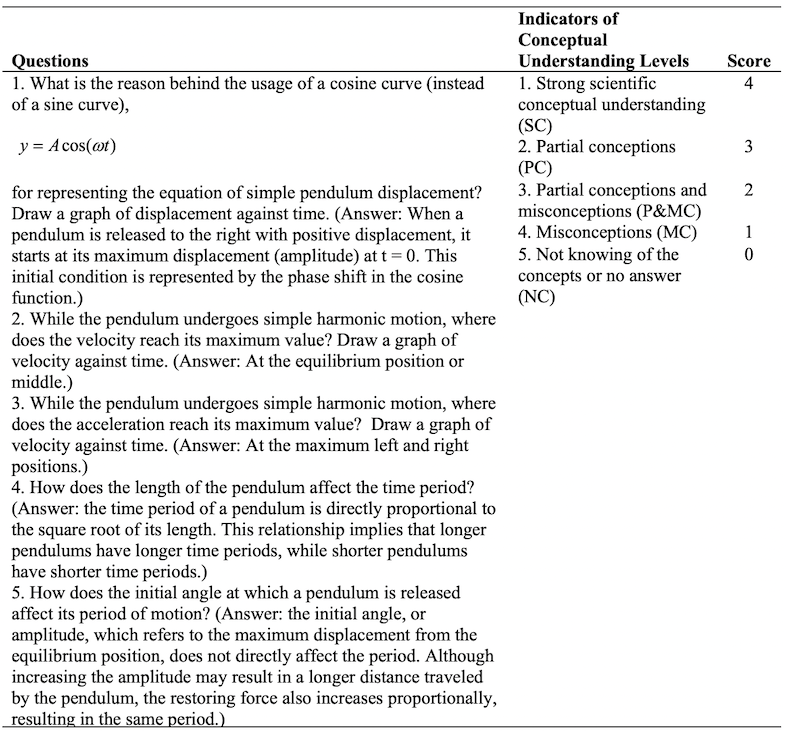
This test was used as both pretest and posttest. Student responses to each item in both the pretest and posttest were analysed using a scoring rubric based on five levels of conceptual understanding. These levels were: strong scientific conceptual understanding with correctness and all components (SC), partial understanding or correctness with some components but no misconceptions (PC), partial understanding with misconceptions (P&MC), misconceptions (MC), and not knowing of the concepts or no answer (NC) (Wahyuni & Taqwa, 2022). The details of the questions, indicators, and scoring are shown in Table 1.
Table 1: Details of the Questions, Indicators, and Scoring Analysis
To evaluate students' conceptual understanding of the Simple Pendulum, a five-week study was conducted. In the initial phase of data collection, 20 participants completed a pretest within 60 minutes of accessing the lesson website. Following this, the participants completed the OEs for a duration of four weeks. After completing the OEs, all participants underwent a posttest. The level of conceptual understanding was evaluated by analysing the results obtained from both the pretest and the posttest.
The data analysis involved descriptive statistics (average, median, mode, standard deviation) and the N-gain score (Heck, 1998) to assess student learning gains. This score, calculated using the formula in Equation (1), utilised pretest and posttest scores as percentages. The N-gain scores obtained were then classified according to the criteria outlined in Table 2:

Table 2: Classification of the N-gain scores (Heck, 1998)

The analysis of pretest and posttest scores in this study provides insights into students' conceptual understanding of the Simple Pendulum topic. The following section details and discusses these findings.
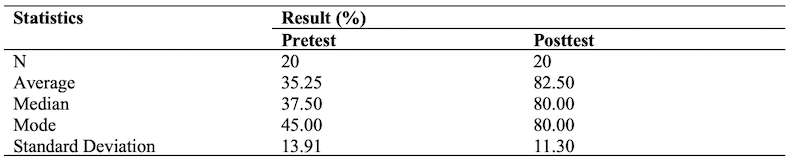
This section presents descriptive statistical data from the pretest and posttest, which were used to assess students' understanding of the Simple Pendulum topic. Table 3 details these scores, shown as percentages of the 20 students participating in the study. The average pretest score was 35.25%, reflecting their initial level of understanding before any intervention or instruction. However, the posttest average score significantly improved to 82.50%, indicating substantial progress in their understanding following the intervention. The median score for the pretest was 37.50%, suggesting a relatively balanced distribution of scores, while the posttest median score was 80%, reflecting a similar pattern but with higher scores overall. The mode of 45.00% for the pretest and 80.00% for the posttest indicates the most frequently occurring scores. The standard deviation for the pretest was 13.91%, highlighting the variability of scores around the average initial understanding. The posttest standard deviation of 11.30% indicates a slightly reduced spread, suggesting a more consistent improvement in conceptual understanding.
Table 3: Descriptive Statistical Data Scores on Students' Conceptual Understanding of the Simple Pendulum Topic
These findings revealed a significant improvement in students' conceptual understanding of the Simple Pendulum topic. Following the treatment the results demonstrate that OEs are effective in improving students' conceptual understanding. This is supported by a study conducted by Hamed and Aljanazrah (2020), which found no significant difference in student achievement between virtual and hands-on experiments in a physics lab setting. Their findings suggest that interactive and adaptable online learning platforms can help students develop a deeper understanding of physics concepts. By utilising virtual experiments, students can save time and reduce the expenses associated with attending physical laboratories at universities. Furthermore, this approach addresses the challenges posed by Covid-19 restrictions, allowing students to develop practical skills and engage in scientific inquiry from the convenience of their own homes. This is further supported by Abakumova et al. (2019), who found that active learning strategies in distance education increased students' internal motivation, particularly for those engaged in independent cognitive tasks. This suggests that OEs, which can promote active learning and student autonomy, may also contribute to increased motivation for learning physics concepts.
The level of conceptual understanding was obtained through analysing written responses in the subjective test. It was categorised into five levels of the conceptual understanding. The distribution of the conceptual understanding is presented in percentages in Table 4.
Table 4: Classification of Student’s Reasons into Five Levels of Conceptual Understanding
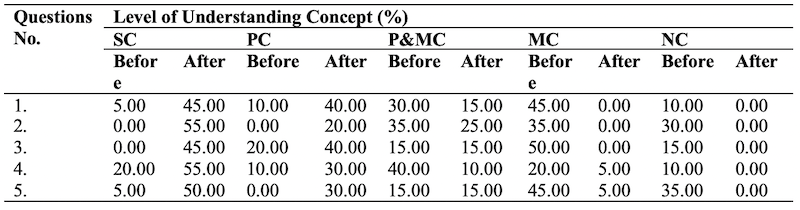
As shown in Table 4 and further illustrated in Figure 2, the students' responses were categorised based on their conceptual understanding levels for each question.
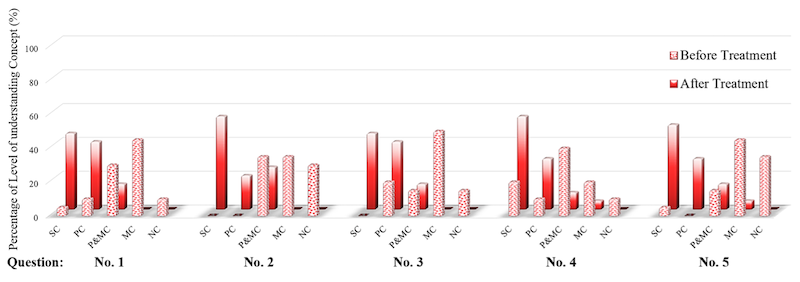
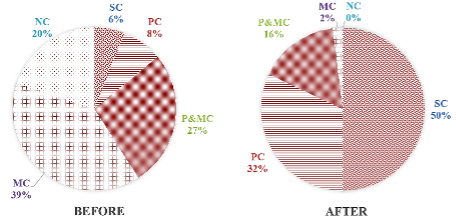
Figure 2 presents the results of categorising student explanations, indicating their level of conceptual understanding for each concept item before and after the experiment. As shown in Figure 2, students exhibited a range of understanding across the P&MC, MC, and NC categories prior to the intervention. This suggests that many students were confused about or lacked a clear grasp of the Simple Pendulum concept. However, a notable improvement was evident after the experiment. Students were able to address their misconceptions and demonstrate higher levels of understanding, as evidenced by the shift towards the SC and PC categories. Based on this analysis, Figure 3 allows us to draw conclusions about the changes in conceptual understanding levels before and after the intervention.
The positive results demonstrated in this study can be attributed to the implementation of high-speed video in the OEs. By actively engaging in activities and following a constructivist approach (Zuljan et al., 2021), students were able to enhance their conceptual understanding. The interactive nature of the activities, combined with the students' own analytical thinking, contributed to this improvement. This result was consistent with previous studies that have utilised a range of active learning methods in both online and offline learning environments, demonstrating the effectiveness of active learning approaches in improving students' conceptual understanding (Saricayir et al., 2016; Andayani et al., 2018; Hamed & Aljanazrah, 2020; Wahyuni & Taqwa 2022). These findings emphasise the beneficial influence of active learning strategies in fostering students' conceptual understanding.
The analysis of students' most common explanations, obtained from the pretest and posttest on Simple Pendulums, is presented in this section.
Question 1: Prior to the intervention, most students (45%) exhibited the MC. Their response was: "When a pendulum is released, at t = 0, it starts with a displacement of y = 0" and then they drew an incorrect graph. However, after the treatment, significant progress was observed. The students were able to rectify their misconceptions by providing the correct answer and graph, demonstrating higher levels of understanding. This progress is reflected in the finding that 45% of students achieved the SC category.
Question 2: No students achieved the SC prior to the intervention. Most students (35%) exhibited both the P&MC and MC. Some responses included statements like "at the maximum left or right positions have the maximum velocity" and incorrect graphs. After undergoing the treatment, the students demonstrated improvement by providing the correct answer and graph, illustrating higher levels of understanding. This progress is reflected in the finding that 55% of students achieved the SC category after the intervention.
Question 3: Prior to the intervention, no students achieved the SC. Most students (50%) exhibited the MC. Some student responses included statements like "the middle position has the maximum acceleration" and incorrect graphs. However, after undergoing the treatment, notable improvement was observed. Students were able to provide the correct answer: "the maximum acceleration occurs at the extreme left and right positions," and drew accurate graphs, demonstrating a higher level of understanding. This progress is reflected in the finding that 45% of students achieved the SC category after the intervention.
Question 4: Before the treatment, most students (40%) exhibited the P&MC. Some student responses revealed the misconception that longer pendulums have shorter periods, and conversely, shorter pendulums have longer periods. Substantial progress was observed following the treatment, when students displayed notable improvement in their understanding, providing accurate and concise answers that demonstrated higher levels of comprehension. This advancement was reflected in the finding that 55% of the students achieved the SC category.
Question 5: Prior to the intervention, most students (45%) exhibited the MC. Their response indicated the misconception that the initial angle of release affects a pendulum's period, with larger angles leading to longer periods. Following the treatment, students demonstrated improved understanding by addressing these misconceptions and providing accurate answers. This progress was evident with 50% of students achieving the SC category, signifying a higher level of comprehension.
We evaluated students' conceptual understanding by analysing their written responses using a detailed marking rubric. While student writing revealed their existing knowledge about oscillation concepts, the pretest scores indicated that most students held misconceptions and lacked the ability to provide clear explanations. The posttest scores indicated a significant improvement in students' written explanations, as evidenced by their performance on the SC criteria of the rubric. This improvement suggests that incorporating activities that involve students writing clear and concise explanations of scientific concepts encountered during the activities was beneficial. This practice was valuable in both the pretest and post-test stages. Therefore, it is important to consider the development of explanation skills as a necessary competency for science teaching.
These findings are in line with a study conducted by Cabello and Topping (2018), which identified clarity as the most straightforward aspect of scientific concept explanation for pre-service teachers. Additionally, the study highlighted the strengths of pre-service teachers in explaining concepts effectively using examples, graphs, and images. Furthermore, another study by Cabello et al. (2019) demonstrated that constructing explanations of scientific concepts is one of the most employed strategies in the science classroom. This study also emphasised that constructing explanations is a high-leverage teaching practice.
To highlight the effect of OEs on students' understanding of scientific concepts, we analysed the N-gain focusing on the SC category. Figure 4 illustrates the individual N-gain scores, revealing that most students (95%, n = 19) demonstrated a gain in their learning progress about oscillation concepts, with N-gain scores ranging from 0.20 to 1.00. Remarkably, three students achieved the high gain (0.80 to 1.00). Additionally, 10 students (50%) exhibited a medium gain in their learning progress, with the N-gain scores ranging from 0.40 to 0.60. On the other hand, five students (25%) showed a low gain, with the N-gain scores ranging from 0.20 to 0.25. It is worth noting that only one student (5%) did not show any gain, as indicated by an N-gain score of 0.00, indicating no learning progress. To gain a deeper understanding of the sole student who exhibited no learning gains (N-gain = 0.00), we conducted an interview. The student stated, “I did not have enough time to complete all the activities and, consequently, did not pay attention to the posttest. I apologise for not paying attention; if I had, I would have achieved better results.” This finding highlights the importance of time management during these activities and offers insights into the distribution of N-gain scores, reflecting the varying levels of improvement students achieved in their understanding of scientific concepts.
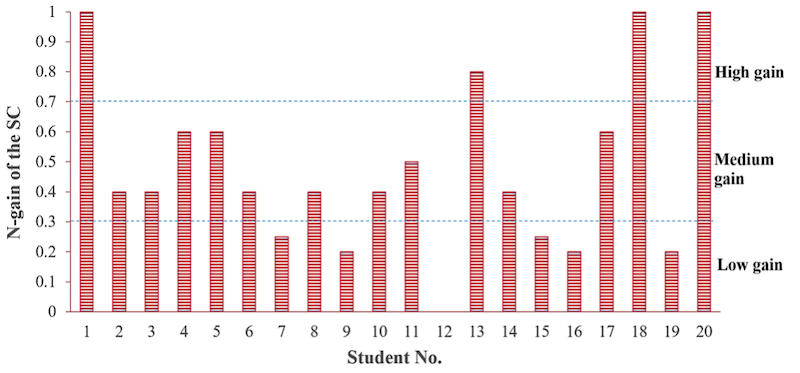
The N-gain scores are a valuable tool for researchers and educators in physics education. They enable comparisons between instructional methods and interventions by considering students' initial understanding. This standardised measure allows for meaningful assessments across diverse groups and studies, thereby identifying effective teaching approaches. In this specific study, the N-gain analysis supports the conclusion that the OEs intervention strongly affected students' understanding of scientific concepts, particularly oscillation concepts. The N-gain scores of the SC category, ranging from 0.20 to 1.00, revealed the intervention's effectiveness for most students. However, the scores also indicated some individuals with lower gains or no progress, emphasising the need for targeted support.
Overall, the study's findings, backed by the N-gain analysis, provided quantitative evidence of the positive effect of the OEs’ intervention. This evidence highlights the varying levels of improvement observed among the students. Previous studies, such as Wee et al. (2015) and Poonyawatpornkul and Luksameevanish (2019), have also used the N-gain scores to analyse data and enable comparisons between instructional methods and interventions. These studies, in particular, employed a high-speed video analysis technique while considering students' initial understanding.
After finishing the posttest, we sought to deepen our understanding of the conditions and procedures observed during the OEs. To achieve this, we requested all students to provide us with their reflections. Some of the positive reflections were as follows:
Some of the negative reflections were as follows:
The study also included student reflections that provided valuable insights into the advantages and challenges students experienced during the OEs. Positive reflections emphasised the convenience, visualisation of real motion, and the ability to establish connections between scientific concepts learned in class. However, negative reflections highlighted issues such as slow internet connections, the requirement for additional instructional guidance, and a preference for traditional classroom settings. These reflections contribute to a comprehensive understanding of the effectiveness and limitations of the OEs in an online learning environment. Overall, the students' reflections contribute to a deeper understanding of the conditions and procedures of the OEs. They highlight both the strengths and weaknesses of the OEs’ intervention, providing valuable feedback for future iterations and improvements. By incorporating students' perspectives, future work could more effectively address their needs and improve the overall efficacy of online learning experiences. This aligns with research conducted by Kuzmanović et al. (2019), which highlights the importance of considering student preferences in the design of e-learning systems.
This case study, conducted at a university in Northern Thailand during the 2022 academic year, provides compelling evidence for the positive effect of OEs on physics student-teachers ' conceptual understanding of the Simple Pendulum topic. This study observed a correlation between the OEs’ intervention and improved comprehension, as evidenced by higher average scores and decreased variation in student performance. Future research using a more controlled design, such as a randomised controlled trial, could strengthen the evidence for the intervention's effectiveness.
Prior to the intervention, analysis of student responses revealed a lack of clarity and the presence of misconceptions regarding the Simple Pendulum. However, the introduction of OEs sparked a remarkable transformation. Students actively engaged with the interactive learning environment, allowing them to visualise real-world phenomena and rectify their misconceptions.
The effectiveness of the intervention was demonstrably validated using normalised gain (N-gain) analysis. This analysis, directly addressing Research Question 1, revealed a significant increase in student understanding levels. The N-gain scores ranged from 0.20 to 1.00, indicating substantial learning progress for most participants.
The positive impact extended beyond numerical scores, directly addressing Research Question 2. Students showcased a marked improvement in applying their newfound knowledge. They demonstrated enhanced proficiency in responding to open-ended questions and generating precise graphs, reflecting a deeper grasp of the subject's practical aspects.
Valuable insights emerged from student reflections, addressing Research Question 3. Positive feedback highlighted the convenience and ability to visualise real motion, which facilitated a deeper understanding. However, some participants pointed to challenges like slow internet connections, a desire for additional guidance, and a preference for traditional classroom settings. These reflections provided a comprehensive picture of the effectiveness and limitations of the OEs within this online learning environment.
In conclusion, this case study demonstrated the significant positive impact of the OEs on physics student-teachers' understanding of the Simple Pendulum topic. The findings directly align with the research objectives, indicating significant progress in student learning. This progress is evidenced by students addressing misconceptions and achieving a deeper understanding of the topic through their engagement with the OEs.
This study also underscores the benefits and challenges associated with online learning, offering valuable insights for future implementation of OEs. The successful integration of technology offers a roadmap for enriching physics education by fostering student engagement, promoting deeper understanding of complex concepts, and empowering future physics student-teachers to create interactive learning experiences. Therefore, it is essential to explore best practices for optimising the integration of online learning technologies, developing standardised assessment tools, and investigating the long-term impact of OEs on teacher preparation and student outcomes.
Acknowledgement: The authors would like to thank the Faculty of Science and Technology, Chiang Mai Rajabhat University, the Faculty of Education, Phetchabun Rajabhat University, and the Faculty of Sciences and Agricultural Technology, Rajamangala University of Technology Lanna for providing facilities in support of this research. Special thanks are also given to physics student-teachers for providing valuable fundamental data.
Abakumova, I., Bakaeva I., Grishina, A., & Dyakova, E. (2019). Active learning technologies in distance education of gifted students. International Journal of Cognitive Research in Science, Engineering and Education, 7(1), 85-94. https://doi.org/10.5937/ijcrsee1901085A
Andayani, Y., Hadisaputra, S., & Hasnawati, H. (2018). Analysis of the level of conceptual understanding. Journal of Physics: Conference Series, 1095. 012045(1-6). https://doi.org/10.1088/1742-6596/1095/1/012045
Cabello, V.M., Real, C., & Impedovo, M.A. (2019). Explanations in STEM areas: An analysis of representations through language in teacher education. Research in Science Education, 49, 1087–1106. https://doi.org/10.1007/s11165-019-9856-6
Cabello, V.M. & Topping, K.J. (2018). Making scientific concepts explicit through explanations: Simulations of a high-leverage practise in teacher education. International Journal of Cognitive Research in Science, Engineering and Education, 6(3), 35-47. https://doi.org/10.5937/ijcrsee1803035C
Gomes, R.F., & Thomas, L. (2022). Virtual community mentoring models for middle school underachievers’ psychosocial development and well-being during COVID-19. Journal of Learning for Development, 9(1). 137-144. https://doi.org/10.56059/jl4d.v9i1.614
Hamed, G., & Aljanazrah, A. (2020). The effectiveness of using virtual experiments on students’ learning in the general physics lab. Journal of Information Technology Education: Research, 19, 976-995. https://doi.org/10.28945/4668
Heck, R.R. (1998). Interactive-engagement versus traditional methods: A six-thousand-student survey of mechanics test data for introductory physics courses. American Journal of Physics, 66(11), 64-74. https://doi.org/10.1119/1.18809
Kuzmanović, M., Andjelković Labrović, J., & Nikodijević, A. (2019). Designing e-learning environment based on student preferences: Conjoint analysis approach. International Journal of Cognitive Research in Science, Engineering and Education, 7(3), 37-47. https://doi.org/10.5937/IJCRSEE1903037KUDK
Liang, S. (2016). Teaching the concept of limit by using conceptual conflict strategy and demos graphing calculator. Journal of Research in Education and Science, 2(1). 35-48. https://doi.org/10.21890/ijres.62743
Nichols, M. (2023). Commentary: What, exactly, is 'online' education? Journal of Learning for Development, 10(2), 142-148. https://doi.org/10.56059/jl4d.v10i2.1054
Noris, M., Saputro, S., & Saputro. (2022). The virtual laboratory based on problem based learning to improve students' critical thinking skills. European Journal of Mathematics and Science Education, 3(1), 35-47. https://doi.org/10.12973/ejmse.3.1.35
Poonyawatpornkul, J., Mangmee, K., & Methakeson, O. (2022). Oscillation of full and partial ring pendulum: Physics laboratory experiment. Science & Technology Asia, 27(3), 85-94. https://ph02.tci-thaijo.org/index.php/SciTechAsia/article/view/247441
Poonyawatpornkul, J., & Luksameevanish, V. (2021). Effect of dragging force on paper cone falling using high-speed video analysis technique. RMUTP Research Journal, 15(2), 147-157. https://doi.org/10.14456/jrmutp.2021.28
Poonyawatpornkul, J., & Luksameevanish, V. (2019). Development of scientific understanding using high speed video analysis technique: Case study on projectile motion. Journal of Education, Prince of Songkla University, Pattani Campus, 30(1), 71-84.
Sarekenova, K., Aimukhambet, Z., Malikov, K., Salikzhanova, S., Zhylkybay, G., & Assanbayeva, Y. (2023). Effects of online learning and digital conversation-based activities on the transfer of cultural values in language and literature classes. International Journal of Education in Mathematics, Science, and Technology, 11(2), 471-492. https://doi.org/10.46328/ijemst.3135
Saricayir, H. Ay, S., Comek, A., Cansiz, G., & Uce, M. (2016). Determining students’ conceptual understanding level of thermodynamics. Journal of Education and Training Studies, 4(6), 69-79. http://dx.doi.org/10.11114/jets.v4i6.1421
Sharkia, H., & Kohen, Z. (2022). Implementing the 5E inquiry model in an online platform of a flipped classroom environment. Paper presented at the HAL 2022: 12th Congress of the European Society for Research in Mathematics Education. Bozen-Bolzano, Italy. https://hal.science/hal-03747804
Somroob, S., & Wattanakasiwich, P. (2017). Investigating student understanding of simple harmonic motion. Journal of Physics Conference Series, 901, 012123 (1-5). https:// doi :10.1088/1742-6596/901/1/012123
Taqwa, M.R.A., Zainuddin, A., & Raintoni, C. (2020). Multi representation approach to increase the students’ conceptual understanding of work and energy. Journal of Physics Conference Series, 1567(3), 032090(1-4). https://doi:10.1088/1742-6596/1567/3/032090Wahyuni, I.H., & Taqw, M.R.A. (2022). Level of students conceptual understanding and resource theory view: Geometric optics. International Journal of Education and Teaching Zone, 1(2), 146-158. https://doi.org/10.57092/ijetz.v1i2.38
Wee, L.K., Tan, K.K., Leang, T.K., & Tan, C. (2015). Using Tracker to understand ‘toss up’ and free fall motion: A case study. Physics Education, 50(4), 436-442. http://10.1088/0031-9120/50/4/436
Zuljan, D., Valenčić, Z.M., & Pejić, P.P. (2021). Cognitive constructivist way of teaching scientific and technical contents. International Journal of Cognitive Research in Science, Engineering and Education, 9(1), 23-36. http://doi:10.23947/2334-8496-2021-9-1-23-36
Author Notes
Dr Jiraporn Poonyawatpornku is an Associate Professor who specialises in mechanics and high-speed video analysis. Her research focuses on innovative physics education, particularly in dynamics, oscillations, impact physics, and rotational mechanics. She has published extensively and is dedicated to enhancing students' understanding through experimental and analytical methods. Email: jiraporn_poo@cmru.ac.th (https://orcid.org/0009-0000-5244-0436)
Dr Supranee Pitsamai is an Assistant Professor in science education and physics. Her research is related to the development of science teaching. Email: supranee.pit@pcru.ac.th (https://orcid.org/0009-0000-6887-3842)
Onuma Methakesorn is a research collaborator who is beginning to explore research in science learning management to enhance understanding of science education concepts, promote analytical thinking skills in science, and integrate technology in science teaching Email: pookonuma_k@rmutl.ac.th (https://orcid.org/0009-0005-9416-5002)
Kotchakorn Mangmee is a physics educator specialising in analytical teaching methods and foundational principles. With a Master's degree, she inspires students to appreciate science by connecting theory to real-world applications. Email: kot_ch@rmutl.ac.th (https://orcid.org/0009-0008-6768-2938)
Cite as: Poonyawatpornku, J., Pitsamai, S., Methakesorn, O., & Mangmee, K. (2025). Effectiveness of online experiments for conceptual understanding of simple pendulum by physics student-teachers. Journal of Learning for Development, 12(1), 204-218.