2024 VOL. 11, No. 3
Abstract: The self-perception of one's mathematical abilities is a critical component that academics study to improve mathematics education. Amidst the Covid-19 pandemic, the majority of educational institutions used a blended learning method, specifically including both online and modular distance learning. This research investigated the contribution of blended learning experiences in mathematics to learners' self-perception of their mathematical abilities in the new learning environment. This research used deliberate sampling to select and conduct focus group conversations with ten (10) students studying Science, Technology, Engineering, and Mathematics (STEM). The data obtained underwent thematic analysis. The findings revealed that students' experiences of the teacher’s mastery of the topic, observations about learner-learner relations, the importance of rereading transcripts, and utilisation of internet-based resources fostered their mathematics self-perception, while their experiences such as inadequate teacher-student connections, distracting educational settings, clashes with domestic obligations, and sensations of solitude hindered it. The findings show that comprehending these encounters in this demanding educational setting presents a constant prospect for students to enhance their mathematical learning and their perception of their own ability to excel in the topic.
Keywords: online and modular distance learning, learning experiences, mathematics self-perception, STEM learners
The learners' perceptions of mathematics are an important factor to consider while providing high-quality mathematics education. Although educational academics have acknowledged its significance, the literature has given little attention to this attribute in the middle of the pandemic. Self-concept is often used to describe an individual's degree of self-awareness (Sultra et al., 2018). Shavelson et al. (1976), well-known researchers in the area of self-concept, defined it as a complete term that incorporates an individual's view of themselves and is frequently referred to as an appraisal of one's skills and beliefs. They also pioneered the formation of self-concepts in a variety of fields, resulting in the establishment of mathematics self-concept as an important construct in education.
This study used the Skill Development Model (SDM) proposed by Calsyn and Kenny (1977). One's self-concept is influenced by one’s social environment and past experiences (Shavelson et al., 1976). Based on SDM, academic self-concept primarily develops as a result of academic accomplishment in activities and the instructional environment. The study highlights the causal link between students' experiences in blended learning courses and their mathematical self-concept. The skill development model elucidates this relationship.
This study examined the link between blended learning with self-concept of mathematics among Science, Technology, Engineering, and Mathematics (STEM) students. The research issues that were addressed were: "Which blended learning experiences in mathematics enhance the mathematics self-concept of STEM students?", and "Which integrated learning experiences in mathematics limit the mathematics self-concept of STEM students?"
Teachers can support students in attaining successful mathematics learning and improving mathematics education by exploring their experiences in blended learning courses about their mathematical self-perception, particularly when faced with the limitations imposed by the absence of physical classrooms.
Erdogan and Sengul (2014) define mathematics self-concept as how pupils see their skill and confidence when it comes to studying mathematics. Students with a favourable mathematics self-concept have a high regard for themselves in the subject, grasp topics more rapidly, and excel in mathematics. Having a positive self-perception may enhance children's mathematical abilities in the long run. Recent research has examined the correlation between an individual's perception of their mathematical abilities and their academic success in the setting of blended learning and training that incorporates technology. Bringula et al. (2021) found that students' perception of their mathematical abilities played a crucial role in their learning experience throughout the Covid-19 pandemic, particularly when courses were transitioned to online and mixed modes. Students who had a stronger sense of self-confidence in mathematics were more adept at overcoming the difficulties associated with remote and hybrid learning settings. Briede (2014) discovered that the use of instructional technology, such as interactive whiteboards and math learning software, had a beneficial impact on students' perception of their own mathematical abilities. Utilising technology in math instruction may enhance students' self-assurance and perceived proficiency in the subject by including captivating visual elements.
Moreover, according to Erdogan and Sengul (2014), having a favorable perception of one's mathematical abilities is a crucial factor in predicting student achievement, especially in learning environments that combine traditional and technology-based methods in mathematics. Teachers should aim to enhance students' mathematics self-perception by using instructional strategies that enhance their skills, self-assurance, and enjoyment of the subject.
The correlation between one's perception of one’s mathematical abilities and one’s academic performance has been consistently shown to be very favourable. A study conducted by Peteros et al. (2019) in Cebu, Philippines, revealed that the level of self-concept in mathematics was a more accurate indicator of academic success among junior high school students, than their passion for the subject. This highlights the significance of students’ opinions and perspectives about their mathematical proficiency and about their academic advancement.
Gribbins et al. (2007) contended that, in the context of technology-enabled learning, mathematics self-concept has more significance. With the growing integration of digital technologies in education, students' beliefs about their mathematical skills may significantly impact their involvement, drive, and achievements in technology-enhanced learning environments. When using hybrid and online learning approaches, educators should prioritise strategies that emphasise a positive mathematics self-concept.
The current difficulties faced by the Philippines in mathematics education underscore the need to prioritise students' mathematical self-perception. One of these challenges is the nation's difficulty with mathematical proficiency. Mendoza (2020) reported that Filipino children performed poorly in the mathematics topic of the TIMSS 2019, an international assessment that analyses trends in student performance in mathematics, science, and reading worldwide. Moreover, the Department of Education's analysis of PISA 2018 data reveals that the majority of senior high school students in the nation attained a proficiency level of just two out of six in mathematical literacy.
Multiple studies in the academic literature have identified factors that impact students' self-perception in mathematics, while others have suggested strategies for enhancing students' self-perception in mathematics. Mamolo and Sugano (2020) discovered that the teacher, the environment, and certain personal traits all play a role in shaping students' mathematical proficiency. Nevertheless, the aforementioned research was carried out in a traditional classroom environment where students and instructors interacted in person.
Amidst the pandemic, Bringula et al. (2021) examined the mathematical self-concept of students within the framework of online learning. Amidst the worldwide health crisis, the country's Department of Education used several learning modalities, such as online distance learning. Most schools used blended learning as a method of providing instruction. This kind of education combines online and modular distance learning methods, specifically designed for situations where traditional in-person classroom instruction is not feasible. Nevertheless, the examination of self-perception in mathematics within this specific educational setting was atypical in existing research.
The study used a qualitative research approach, especially a phenomenological research design, to evaluate STEM students' blended learning experiences in mathematics and their impact on their mathematical self-concept. Phenomenology allows academics to focus on how people see and interpret the world, providing insight into their perspectives (Sutton & Austin, 2015). Using this study design allowed the researchers to have a more thorough understanding of the participants' awareness in certain situations (Umanailo, 2019). Given the nature of this research, the most appropriate mode of inquiry was phenomenological. This technique allowed for a thorough examination of the participants' experiences, insights, perceptions, and beliefs about their blended learning experiences in mathematics, as well as their mathematical self-concept.
To get a more distinct understanding and effectively investigate the main phenomena under inquiry, the researchers used purposive sampling to pick the study participants. According to Creswell (2012), purposive sampling gives researchers the power to carefully choose individuals and study sites that provide abundant information. The research participants of this study consisted of ten (10) STEM students who were selected via purposive sampling from the University of Southern Mindanao, University Laboratory School. The participants in the second semester of the school year 2021-2022 were only Grade 12 STEM students. This is because Grade 12 students had completed all the mathematical topics in the STEM strand. The participants were given the option to decline the request to participate in the research. All of the chosen participants were 18 years of age. They were provided with an Informed Consent document, in which they voluntarily agreed to to participate. This document outlined their rights and the advantages they would get from participating in the research, from start to finish. To preserve anonymity, the participants were assigned codes such as "Participant 1", "Participant 2", ..., "Participant 9", and "Participant 10".
The research included a semi-structured interview, with guiding questions for the focus group talks. It consisted of 11 open-ended questions. This material underwent validation by three university faculty members who were professionals in the area of qualitative research. In addition, voice recorders and note-taking equipment were used to facilitate the collection of participants' perspectives and ideas, as well as for the subsequent transcription of the acquired information.
The researchers conducted a focused group discussion (FGD) to gather data for the study. The FGD was structured and facilitated by the researchers to ensure that the discussion remained focused on the central phenomenon being studied. The FGD was held in a quiet and comfortable setting at the University of Southern Mindanao, University Laboratory School, where the participants felt at ease to share their thoughts and experiences.
The FGD session lasted for about 30-45 minutes and was audio-recorded with the consent of the participants. The researchers used a semi-structured interview guide to facilitate the discussion, which included open-ended questions that allowed the participants to elaborate on their experiences and perspectives. The researchers also encouraged the participants to engage in a dialogue, allowing for a more natural and interactive discussion.
The data collected during the FGD was transcribed verbatim by the researchers. The transcripts were then carefully reviewed and analysed using a conceptual framework based on the research objectives. Also, the researchers employed a thematic analysis approach to analyse the data collected during the FGD. Thematic analysis is a widely used qualitative research method that involves identifying, analysing, and reporting patterns or themes within the data (Braun & Clarke, 2006). The researchers followed a systematic six-step process to conduct the thematic analysis, following the Qualitative Research Methods suggested by Hennick et al. (2020) as cited in the paper of Muhammad and Norah (2023): i) Familiarisation with the data: The researchers thoroughly read and re-read the transcripts to become familiar with the content and identify any emerging patterns or themes; ii) Generating initial codes: The researchers assigned initial codes to relevant segments of the data, which helped to organise and categorise the information; iii) Searching for themes: The researchers grouped the initial codes into broader themes that captured the essence of the participants' experiences and perspectives; iv) Reviewing themes: The researchers reviewed and refined the identified themes to ensure they accurately reflected the data and addressed the research objectives; v) Defining and naming themes: The researchers defined and named the final themes, providing clear and concise descriptions of each theme; iv) Reporting the findings: The researchers presented the findings of the thematic analysis, including the identified themes and supporting quotations from the participants.
According to Alhojailan (2012), thematic analysis is a qualitative analytical method that seeks to identify and portray themes related to an issue. Through adhering to this rigorous and methodical methodology for data analysis, the researchers were able to acquire a profound comprehension of the participants' experiences and viewpoints, and then convey the results in a lucid and significant manner.
To maintain the credibility of this study, it adhered to the four criteria proposed by Lincoln and Guba (1985) in the field of qualitative research. The study's credibility was established by the researchers' provision of verbatim transcriptions of focus group talks jointly with the corresponding themes and confirmed codes, which were reviewed by both the participants and the research advisor. The second aspect is the study's transferability, which involves the researchers applying the results to various contexts by comparing and contrasting the data collected with relevant studies in the existing literature. The third aspect to consider is the reliability of the study. The investigators ensured the uniformity of the results by presenting a thorough description of the data collecting technique, supported by evidence such as documented data collection and statements of recurring themes from many participants. The last criterion is conformability, which was achieved by the researchers via maintaining an impartial reading. This was accomplished by constructing themes based only on the participants' replies throughout the focus group talks.
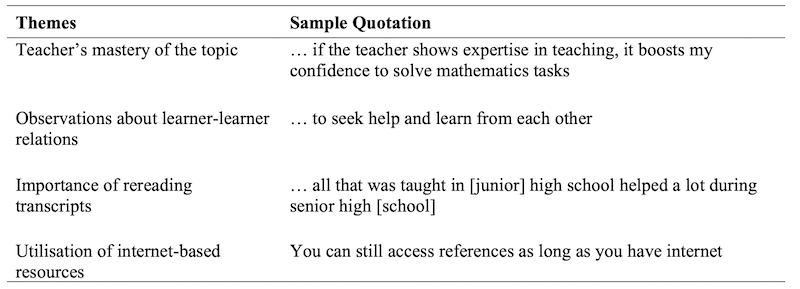
Data analysis revealed four experiences reported in themes that promoted the mathematics self-concept of STEM students (Table 1). These were: (1) teacher’s mastery of the topic, (2) observations about learner-learner relations, (3) importance of rereading transcripts, and (4) utilisation of internet-based resources.
Table 1: Summary of Themes on Blended Learning Experiences that Promoted the Mathematics Self-concept of STEM Students
Teacher's mastery of the topic. STEM students had the belief that instructors' proficiency in teaching mathematics had a beneficial impact on their own perception and confidence in mathematics. According to them, their teacher's confident delivery of mathematics classes instilled in them a strong belief in their ability to excel in the subject. A participant said that when a teacher demonstrates experience in teaching, without any question, it enhanced their confidence in dealing with mathematical challenges.
Observations about learner-learner relations. STEM students opined that receiving encouragement and support from more competent peers enhanced their confidence in achieving success in studying mathematics. They recognised the crucial significance of their friends in acquiring mathematical knowledge and said that the mutual support and assistance they provided each other in tackling challenging mathematical ideas instilled them with confidence to excel in mathematics. When questioned about their strategies for achieving success in a topic, participants highlighted the need for seeking assistance and gaining knowledge from one another. They also emphasised the significance of receiving words of motivation and encouragement in their group chat, with such phrases as 'We can do this'.
Importance of rereading transcripts. STEM students were confident in learning mathematics because of their ability to recollect earlier information relevant to the current subject provided in their notes. The participants said that a strategy they used to achieve success in the subject was to examine their prior mathematics notes when encountering mathematics topics in the STEM strand. One participant acknowledged the value of taking notes and elaborated that the knowledge acquired in junior high school benefited them in senior high school.
Utilisation of internet-based resources. STEM students considered internet resources to be a valuable tool for enhancing their perception of their own mathematical abilities. They recognised the availability of online learning tools as a means to enhance their confidence in achieving success in mathematics education. A participant suggested that if one was unable to comprehend the instruction, one could seek more resources elsewhere. Today's circumstances are distinct from previous occasions when there was a scarcity of materials. Currently, participants have the ability to access the internet from any location. References may be accessed as long as there is an internet connection available.
On the other hand, data analysis revealed four experiences reported in themes that constrained the mathematics self-concept of STEM students (Table 2). These were: (1) inadequate teacher-student connection, (2) distracting educational settings, (3) clash with domestic obligations, and (4) a sensation of solitude.
Table 2: Summary of Themes on Blended Learning Experiences that Constrained the Mathematics Self-concept of STEM Students
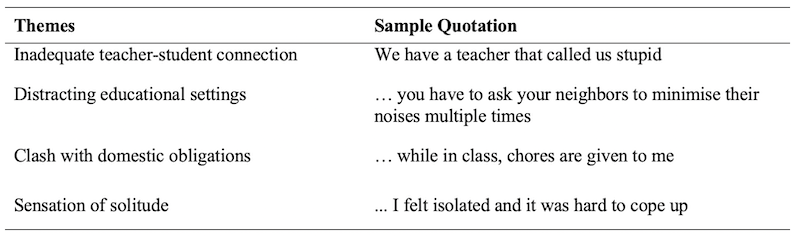
Inadequate teacher-student connection. STEM students highlighted the limited student and teacher connection as a factor that hindered their development of a positive self-perception in mathematics. They disclosed that they had experienced dissatisfactory encounters with their instructors. They were subjected to verbal abuse and derogatory name-calling. This specific encounter instilled worries in them, hindering them from expressing their work due to apprehension about being evaluated by their instructor. Their apprehension towards their instructor and the possibility of a similar occurrence recurring diminished their self-assurance to excel in the topic. Participants said that one of their teachers referred to them as unintelligent. In the online class, according to their teacher, they did not promptly respond to her inquiry. She used that actual phrase. Another participant reported that the experience left him feeling disheartened about engaging in class. Despite his knowledge of the answer, he was apprehensive that she would criticise him in the event of an incorrect response.
Distracting educational setting. The majority of the students said that the extraneous sounds they encountered in their environment hindered their ability to focus on studying. This diminished their concentration on studying mathematics at home, thereby diminishing their self-perception in understanding the topic. A student noted that the task was challenging due to the need to repeatedly request neighbouring individuals to reduce their noise levels, particularly with regard to boisterous music.
Clash with domestic obligations. STEM students also noted that their domestic obligations, such as allocated household tasks, negatively impacted their confidence in succeeding in mathematics since they were unable to fully concentrate on their studies. A participant said that his ability to concentrate on studying was hindered by the occasional assignment of household tasks during class.
Sensation of solitude. The students' mathematical self-concept was further impeded by a lack of motivation stemming from feelings of isolation experienced during integrated learning. Students disclosed that engaging in remote learning diminished their drive to acquire knowledge and achieve success in the subject. During the pandemic, individuals were deprived of the opportunity to enjoy the companionship of peers, which would have facilitated collaborative learning and studying. A participant admitted that he lacked motivation during modular learning, save for the noise factor. “I have become devoid of my drive to engage in mathematical activities”, he said. Due to several distractions, he had a sense of isolation and found it difficult to manage. Mathematics was more enjoyable throughout junior high school due to the opportunity to engage in collaborative problem-solving with peers. Even if he had a dislike for studying, his friends might nevertheless influence him to engage in academic pursuits.
The lack of physical classrooms during the pandemic not only made mathematics teaching and learning more difficult but it also presented a significant difficulty in fostering students' perception of achievement in the subject. The results of this research on the integration of online and traditional learning methods in mathematics had several significant consequences. Multiple studies have proven that blended learning has a beneficial influence on student attitudes and performance. This instructional technique has significant potential for enhancing mathematics teaching, especially as schools face the problems brought up by the pandemic. The significance of teacher-student and student-student interactions in influencing students' perception of their mathematical abilities emphasises the necessity for teachers to deliberately cultivate these interactions in blended learning settings by offering chances for collaboration, feedback, and peer learning (Perera & John, 2020). Moreover, the involvement of student initiative and autonomy in accessing supplementary resources and reviewing notes, indicates that blended learning may be highly suitable for fostering self-directed learning abilities as students gain more independence and accountability for their education (Mantasiah et al., 2020).
The favourable influence of blended learning on mathematics attainment aligns with prior research, further contributing to the expanding corpus of data endorsing the use of blended learning in mathematics instruction. Teacher-student interactions have a significant impact on students' self-perception of their mathematical abilities. This is backed by social learning theory by Albert Bandura and research on how teachers can foster positive academic self-concepts. These findings further emphasise the crucial role teachers have in supporting students' beliefs about their math skills (Slavin, 2018). The possible adverse effects of isolation and distractions that arise when students engage in remote learning from home align with existing studies on the difficulties of distance learning during the pandemic. This underscores the need for schools and instructors to actively tackle these concerns within the framework of blended learning.
Moreover, the implementation of blended learning with an emphasis on promoting meaningful interactions and empowering student autonomy could enhance student engagement and academic performance in mathematics. It is crucial to prioritise these aspects in the professional development of teachers, as highlighted by Moliner and Alegre (2020). The efficacy of blended learning hinges on the caliber of the collaboration between educational institutions and households, since educational institutions must closely cooperate with families to guarantee that students have access to a favourable learning milieu and the necessary assistance when studying remotely. Blended learning can be an effective method for fostering 21st-century skills like self-directed learning and collaboration. Schools can prepare students for success in a digital world by deliberately creating blended learning experiences that prioritise these skills (Kumi-Yeboah et al., 2018). Conclusion
This research emphasised the significant impact of mathematics professors/instructors on improving the mathematics self-concept of STEM students via blended learning experiences. In order to adequately facilitate students' learning and enhance their self-perception, instructors should prioritise the following crucial areas:
In addition, by focusing on these crucial elements, mathematics educators may efficiently use the advantages of blended learning to enhance STEM students' perception of their mathematical abilities, thereby enabling them to excel in their academic pursuits and future aspirations.
Acknowledgment: The researchers express their sincere appreciation to the College of Education, University of Southern Mindanao for granting them permission to carry out this study.
Alhojailan, M.I. (2012). Thematic analysis: A critical review of its process and evaluation. West East Journal of Social Sciences, 1, 39-47.
Braun, V., & Clarke, V. (2006). Using thematic analysis in psychology. Qualitative Research in Psychology, 3(2), 77-101.
Bringula, R., Reguyal, J.J., Tan, D.D., & Ulfa, S. (2021). Mathematics self-concept and challenges of learners in an online learning environment during COVID-19 pandemic. Smart Learning Environments, 8, 1-23. https://doi.org/10.1186/s40561-021-00168-5
Calsyn, R., & Kenny, D. (1977). Self-concept of ability and perceived evaluations by others: Cause or effect of academic achievement? Journal of Educational Psychology, 69, 136-145. https://doi.org/10.1037/0022-0663.69.2.136
Creswell, J.W. (2012). Educational research: Planning, conducting, and evaluating quantitative and qualitative research (4th ed.). Pearson.
Erdogan, F., & Sengul, S. (2014). A study on the elementary school students’ mathematics self-concept. Procedia-Social and Behavioral Sciences, 152, 596-601. https://doi.org/10.1016/j.sbspro.2014.09.249
Gribbins, M., Hadidi, R., Urbaczewski, A., & Vician, C. (2007). Technology-enhanced learning in blended learning environments: A report on standard practices. Communications of the Association for Information Systems, 20. https://doi.org/10.17705/1CAIS.02046
Kumi-Yeboah, A., Dogbey, J., & Yuan, G. (2018). Exploring factors that promote online learning experiences and academic self-concept of minority high school students. Journal of Research on Technology in Education, 50, 1-17. https://doi.org/10.1080/15391523.2017.1365669
Lincoln, Y., & Guba, E.G. (1985). Naturalistic inquiry. Sage. https://doi.org/10.1016/0147-1767(85)90062-8
Mamolo, L.A., & Sugano, S.G.C. (2020). Self-perceived and actual competencies of senior high school students in general mathematics. Cogent Education, 7, Article 1779505 https://doi.org/10.1080/2331186X.2020.1779505
Mantasiah, R., Yusri, Sinring, A., & Aryani, F. (2021). Assessing verbal positive reinforcement of teachers during school from home in the COVID-19 pandemic era. International Journal of Instruction, 14, 1037-1050. https://doi.org/10.29333/iji.2021.14259a
Mendoza, J.E. (2020). PH last in math, science among 58 countries. https://www.manilatimes.net/2020/12/10/news/top-stories/ph-last-in-math-science-among-58-countries/807487
Moliner, L., & Alegre, F. (2020). Effects of peer tutoring on middle school students’ mathematics self-concepts. PloS ONE, 15, Article e0231410. https://doi.org/10.1371/journal.pone.0231410
Perera, H.N., & John, J.E. (2020). Teachers’ self-efficacy beliefs for teaching math: Relations with teacher and student outcomes. Contemporary Educational Psychology, 61, Article 101842. https://doi.org/10.1016/j.cedpsych.2020.101842
Peteros, E., Gamboa, A., Etcuban, J.O., Dinauanao, A., Sitoy, R., & Arcadio, R. (2019). Factors affecting mathematics performance of junior high school students. International Electronic Journal of Mathematics Education, 15, Article em0556. https://doi.org/10.31578/jebs.v7i1.252
Shavelson, R.J., Hubner, J.J., & Stanton, G.C. (1976). Self-concept: Validation of construct interpretations. Review of Educational Research, 46, 407-441. https://doi.org/10.3102/00346543046003407
Sultra, W.S.R.Y., Usodo, B., & Pramudya, I. (2018). Self-concept of junior high school student in learning mathematics. The International Conference on Mathematical Analysis, its Applications and Learning 2018, 1, 44-49.
Sutton, J., & Austin, Z. (2015). Qualitative research: Data collection, analysis, and management. The Canadian Journal of Hospital Pharmacy, 68, 226-231. https://doi.org/10.4212/cjhp.v68i3.1456
Umanailo, M.C.B. (2019). Overview phenomenological research. https://doi.org/10.31222/osf.io/4t2fvnch
Author Notes
Diana Rose Jasmin is a graduate of the Bachelor of Secondary Education programme at the College of Education, University of Southern Mindanao, Philippines. She is currently taking her Master's degree in mathematics education at Mindanao State University, Iligan Institute of Technology, Philippines. Email: djasmin@usm.edu.ph (https://orcid.org/0000-0002-8259-0408)
Paul John Ongcoy is an associate professor at the College of Education, University of Southern Mindanao, Philippines. His field of specialisation is educational leadership and mathematics education. E Email: pjbongcoy@gmail.com (https://orcid.org/0000-0001-9215-6421)
Cite as: Jasmin, D.R., & Ongcoy, P.J. (2024). Study on school students’ blended learning experiences and mathematical self-concept during Covid-19. Journal of Learning for Development, 11(3), 492-501.