2024 VOL. 11, No. 3
Abstract: The study of ‘technological readiness and online learning self-efficacy’ has been thoroughly examined across multiple fields in recent years. Most investigations on this topic have consistently shown a contradictory relationship between the two factors. Moreover, there is a dearth of studies undertaken in the field of Physical Education within higher education, particularly in the setting of the Philippines. This study aimed to investigate the correlation between Technological Readiness (TR) and Online Learning Self Efficacy (OLSE) among a sample of 305 Physical Education Teacher Education (PETE) students in a higher education institution in the Philippines. Correlational and predictive analyses, specifically Pearson-r and Multiple Regression, were employed to ascertain the association between the four aspects of TR (Optimism, Insecurity, Innovativeness, and Discomfort) and OLSE. The findings indicate a positive and direct correlation between TR and OLSE. Moreover, the four dimensions of TR, exhibit a positive correlation with OLSE. According to the results, PETE students’ inclination to utilise advanced tools through online learning platforms could greatly enhance their online learning self-efficacy. The following recommendations and prospective research initiatives are hereby provided.
Keywords: higher education; online learning self-efficacy, physical education, technological readiness
In an effort to prevent the spread of the deadly Covid-19 virus, universities around the world, including in the Philippines, switched to online or distance learning in 2020 (Foo et al., 2021). Because of the catastrophic impacts of the virus, higher education institutions worldwide were compelled to cease their campus operations, though they intended to maintain instructional activities through e-learning. (Muhaimin et al., 2023). Despite the challenges faced by both instructors and students alike, distant learning, online courses, and continuing education have been the silver bullet for this historic global epidemic (Stankovska et al., 2022). In accordance with the pressing needs of students, especially the 3.5 million tertiary-level students enrolled in over 2,400 HEIs across the Philippines, certain universities adopted preventive measures for the continued delivery of educational activities regardless of the shutdown (Joaquin et al., 2020). Now, after the worldwide spread of the Covid-19 virus, most universities have adopted what is being called the "new normal" in higher education (García-Morales et al., 2021). Several universities and colleges throughout the world adopted this method of teaching so that their students could further their education without leaving the comfort of their own homes. There are various ways in which e-learning has helped educational institutions, and even with the arrival of this new norm, it will continue to be a huge help to HEIs in their pursuit of providing their students with a top-notch education (Pokhrel & Chhetri, 2021). Scholars from a wide range of disciplines have found value in e-learning due to its malleability, accessibility, and the two-way nature of student-teacher interaction (Elshami et al., 2021). However, there is no denying that students’ comfort and proficiency with the use of digital tools, such as cellphones and online learning systems, can have a negative impact on their ability to learn effectively in an online environment. According to previously conducted studies, findings suggest that one of the main drawbacks of online learning has been students’ lack of readiness, which includes a lack of familiarity with devices for network access and online educational platforms (She et al., 2021; Wagiran et al., 2022). Students’ confidence in their ability to learn online may be significantly influenced by their familiarity and comfort with cutting-edge technologies but this has not been investigated extensively in the scholarly literature. This research aims to better understand and explain the relationship between students’ level of technology readiness and their confidence in their ability to learn online in the setting of higher education in the discipline of Physical Education in the Philippines.
Technological Readiness refers to students’ predisposition to adopt new technologies as a means of achieving educational objectives (Blut & Wang, 2020; Geng et al., 2019; Wagiran et al., 2022). Recent investigations have revealed that students who possess advanced technological skills perform better in the classroom, and this impact is amplified when learning takes place in an online setting (Kampa, 2023; Wang et al., 2022). To begin, there is confusion over how TR concepts are to be conceptualised. Originally, it was thought to have four distinct components: innovation, optimism, insecurity, and discomfort. Scholars in a number of studies have ignored the differences among the four factors by using a composite score to evaluate the variables (Parasuraman & Colby, 2015).
In this study, technological readiness can be broken down into a two-dimensional construct known as motivators and inhibitors. These two-dimensional constructs can be further divided into two additional distinct constructs known as motivators (optimism and innovativeness) and inhibitors (insecurity and discomfort), respectively (Blut & Wang, 2020). Optimism refers to the concept that technological advancements can help individuals achieve greater autonomy, choice, and effectiveness in their daily lives. Optimists are predisposed to feel that they have a firm grasp on a technological tool and that tool will aid them in efficiently completing their tasks (Li et al., 2023). Meanwhile, innovativeness refers to a propensity toward being a technological trailblazer as well as a thought leader (Uren & Edwards, 2023). Innovative individuals are often drawn to online educational platforms and are eager to learn more about their features and benefits (Alhammadi et al., 2023). Insecurity refers to distrust of technology, originating from scepticism about its ability to perform effectively and reservations regarding its possible detrimental implications (Bondanini et al., 2020). Doubts regarding the dependability of the internet or the system can lead to a pervasive sense of discomfort (Ramírez-Correa et al., 2023), therefore diminishing the significance attributed to the advantages of using online learning platforms. Lastly, discomfort refers to a sense of powerlessness in the face of technological advances and an overwhelming burden brought on by these advances (Durst et al., 2023). When users of online educational platforms feel they lack control over the platform, they are more likely to experience anxiety when utilising such technology. The experience of being overwhelmed, along with a lack of familiarity with using online learning platforms, might provoke feelings of mistrust and uncertainty over their usefulness (Williamson McDiarmid & Zhao, 2023).
Meanwhile, various scholars have provided their own definition of what is known as online learning self-efficacy (OLSE). Alamri (2023) emphasised this term as indicating confidence in one’s own abilities to employ technological means to enhance educational results. Meanwhile, Yildiz Durak (2018) accentuated that learners need to have confidence in their own abilities to use technology in order to fully engage in an online course, including gaining access to course materials, making effective use of virtual instructional tools, communicating with instructors and classmates, and participating in class discussions and solving problems. Hence, students’ confidence in their ability to succeed in an online course plays a crucial role in their overall academic performance (Ahmadipour, 2022).
After performing an extensive search into the relationship between TR and OLSE, it was discovered that the vast majority of the literature on the topic posited a reverse correlation between the two. This implies that the majority of the publications that were undertaken looked at how OLSE affects TR. Fascinatingly, results from a variety of research show various degrees of linkage between the two variables, some of which imply a positive correlation (Burçin Hamutoğlu et al., 2021; Fitriawan et al., 2023) and others a negative one (Qin et al., 2022) or perhaps no correlation at all (Ogbodoakum et al., 2022). On a positive note, few studies were detected that performed a thorough analysis on how TR affected OLSE. One particularly useful illustration of this may be found in the research conducted by Okuonghae et al. (2022), in which 320 respondents were chosen at random and subjected to an investigation into the factors that indicated whether or not individuals would adopt e-learning in the Nigerian context. In addition to their other findings, it was discovered that there is a substantial association between technological readiness and computer self-efficacy, indicating that both factors had joint influence on the utilisation of e-learning by Library Information Systems (LIS) students in Nigeria. However, there is limited research on the correlation between TR and OLSE, particularly within the field of physical education in higher education. Furthermore, there were few studies conducted by deepening the relationship between the four constructs of TR and OLSE.
The selected 248 respondents for the study were students taking a Bachelor of Physical Education in a selected university in the Philippines, and enrolled in an online class during the semester. Purposive sampling technique was utilised in the selection of the respondents. This sampling methodology is a non-probability sampling strategy where researchers select respondents based on certain criteria that are extremely relevant to the present investigation. In this, selection criteria have been formulated to obtain the most reliable and accurate data from the respondents:
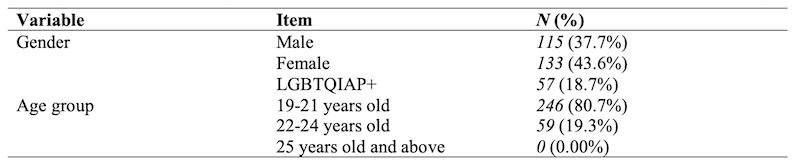
The study was conducted during the second semester of the academic year to include first-year college students who had already experienced this learning modality in various Physical Education courses. Table 1 represents the demographic profiles of the respondents. Most of the respondents were female, followed by male and LGBTQIAP+ members [NFEMALE = 133(37.7%), NMALE = 115(37.7%), NLGBTQIAP+ = 57(18.7%)] respondents. Lastly, most of the respondents fell in the 19-21 years old age group, followed by 22-24 years old [N19-21 YEARS OLD = 246(80.7%), N22-24 YEARS OLD = 59(19.3%), N25 YEARS OLD AND ABOVE = 0(0.00%)].
Table 1: Demographic Profile of the Respondents
Source: Primary Data
To collect data from the participants, the current study employed a survey approach utilising Google Forms. Online surveys provide the advantage of effectively addressing a wide and varied audience, offering rapid and cost-efficient collection and analysis. In this regard, two distinct questionnaires were utilised in this study. First, the ‘Technological Readiness Index’ developed by Parasuraman and Colby (2002), is a 10-item questionnaire that measures students’ technological readiness based on two dimensions subdivided into four distinct constructs: positive feelings toward adopting technology, that is, Optimism (e.g., “You find technologies to be mentally stimulating.”), and Innovativeness (e.g., “You can usually figure out new high-tech products and services without help from others.”), and Inhibitors of Technology Readiness, that is, Discomfort (e.g., “It is embarrassing when you have trouble with a high-tech gadget while people are watching.”), and Insecurity (e.g., “Other people come to you for advice on new technologies.”). Responses were recorded on a 5-point Likert Scale from 1 - “Strongly disagree” to 5 - “Strongly agree.” Lastly, ‘Online Learning Self-Efficacy in Students’ by Zimmerman and Kulikowich (2016), is a 22-item questionnaire which measures online learning self-efficacy encompassing a wide variety of tasks required for successful online students. An example of a statement was, “Navigate online course materials efficiently.” The responses were encoded on a 7-point Likert Scale from 1 - “Strongly disagree” to 7 - “Strongly agree.”
First, a normality test was performed. All variables obtained the threshold value [-2, 2], hence it can be postulated that all data were normally distributed [OPT (M = 3.65, SD = .43; Skew = .391, Kurt = .256), INS (M = 3.59, SD = .60; Skew = .574, Kurt = -.212), INNO (M = 3.48, SD = .77; Skew = -.393, Kurt = -.088), DISC (M = 3.20, SD = .95; Skew = -.234, Kurt = .052), and OLSE (M = 3.65, SD = .43; Skew = .391, Kurt = .256)]. Hence, a parametric test could be used. For this study, Pearson-r was utilised to test the relationship between variables. To test the direct relation and influence of TR and its four distinct constructs to OLSE, Multiple Regression analysis was used.
The study adhered strictly to ethical guidelines, with data gathered via an online survey using Google Forms. The survey clearly explained the study’s purpose, inclusion criteria, instruments, and the specific variables to be measured. Participants were informed that their involvement was voluntary, and they could withdraw at any time without consequence. Potential minor risks, such as discomfort from answering personal or sensitive questions, were also highlighted. No monetary compensation was offered for participation, and data was stored securely with password protection, accessible only to the principal investigator. Data would be kept for three months and then permanently deleted. Respondents’ anonymity and confidentiality were maintained throughout, and the study complied with the Data Privacy Act of 2012 (Republic Act 10173).
Table 2 illustrates the findings on the correlational analysis that was performed. First, it was observed that overall technological readiness is positively associated with OLSE (r(303) = .945, p < .05). It can be postulated that the level of students’ readiness in utilising technology in learning various concepts in Physical Education may significantly increase their OLSE.
The following results were specifically the constructs of TR that were tested in relation to OLSE. It was observed that optimism was statistically related to OLSE (r(303) = .628, p < .05). It can be construed that the level of optimism that students showed in using various technologies in absorbing various concepts and skill-related topics in Physical Education significantly bolstered OLSE.
Additionally, it was observed that insecurity is significantly interrelated to OLSE (r(303) = .494, p < .05). Focusing on the questionnaire that was utilised for the study, the finding suggests that the level of attentiveness students showed pertaining to the data or information they shared with technologies in learning Physical Education may positively boost OLSE.
Furthermore, it was also observed that innovativeness is positively correlated with OLSE (r(303) = .628, p < .05). In connection with this, it can be assumed that students’ innovativeness in using technologies in learning Physical Education may significantly leverage their OLSE.
Lastly, it was found that Discomfort is positively interconnected with OLSE (r(303) = .703, p < .05). Based on this finding, it can be hypothesised that students feeling a high level of discomfort in operating various technologies may increase their OLSE. This finding was somewhat peculiar. However, it is worth noting that those who perceive themselves as being exploited by those with greater knowledge, or who struggle with technological advancements, may experience an increase in their effectiveness in online learning.
Table 2: Correlational Analysis Results
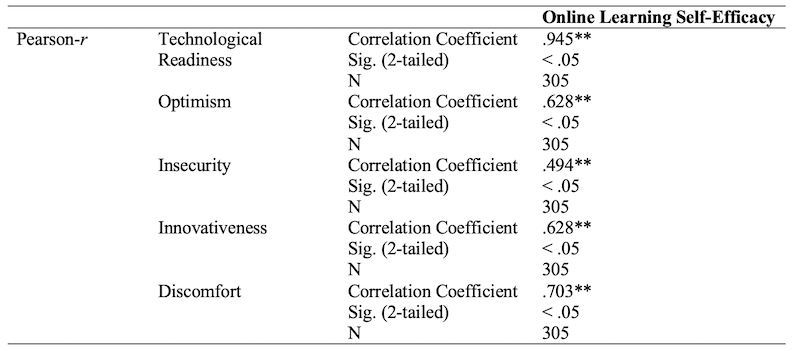
** significance value is at p < .05
Source: Primary Data
It was found that TR predicts OLSE, indicating that TR is directly correlated and affects OLSE [F (4, 300) = 718.416, p < .001]. The R2 model = .905 indicated that the model accounts for 90.5% of the variance in OLSE. This could be interpreted as evidence that students’ technological preparedness greatly improves and boosts OLSE. This result is illustrated in Table 3.
The coefficients were further analysed to determine each factor’s influence to the dependent variable. First, it was observed that OPT predicts OLSE, indicating that OPT has a direct significant influence on OLSE (β = .211, t = 16.230, p < .001). This suggests that a student’s level of optimism regarding technology may have a direct and substantial influence on their overall OLSE.
Also, it was detected that INS predicts OLSE, signifying that INS directly influences OLSE (β = .219, t = 16.167, p = < .001). Therefore, it can be inferred that higher awareness of online safety and a more cautious approach to sharing personal data on learning platforms are significantly connected to increased levels of OLSE.
It was found that INNO predicts OLSE, suggesting that INNO exerts a direct influence on OLSE (β = .202, t = 17.718, p = < .001). Students’ OLSE appeared to be increasing in tandem with their demonstrated creativity in applying a variety of technological tools to the educational process.
Finally, DISC was found to be a predictor of OLSE, which suggests that DISC has a beneficial effect on OLSE (β = .211, t = 24.336, p = < .001). While it may seem counterintuitive, it is possible that OLSE is considerably boosted by the experience of being exploited by others when using technological platforms and the associated feelings of shame.
Table 3: Multiple Regression Analysis Findings
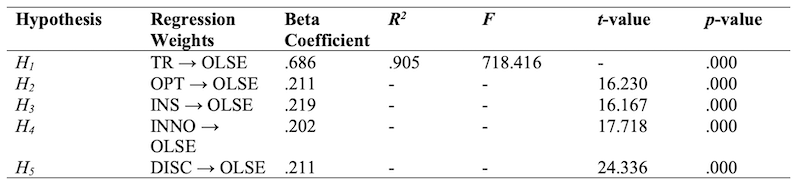
Note: *p < .05. OLSE - Online Learning Self-Efficacy, OPT - Optimism, INS - Insecure, INNO - Innovativeness, and DISC - Discomfort
Source: Primary Data
While other scholarly studies have shown that this assumption that variables should be associated in order to undertake multiple regression analysis is incorrect, it serves as the foundation for this study’s correlational analysis. Based on the findings of this study, it was found that overall, TR was directly related to and predicted OLSE. It can be assumed that readiness to use cutting-edge technology via various online educational platforms was of great help to boost students’ OLSE. Although the approach used in the study was considerably different from the general one used currently, the conclusion was corroborated by the one study reported in this paper that looked at the connection between the two variables (Okuonghae et al., 2022). Students’ predisposition to embrace new technologies, such as online educational platforms, may positively leverage students’ efficiency in using these sorts of tools in order to perform and achieve better in online classes. In addition, the degree to which they are prepared technologically may have a beneficial effect on the learners’ perception of their own capacity to carry out the online academic tasks required of them (Abuhassna et al., 2020; Basri et al., 2018).
Moreover, it was found that optimism is highly correlated to and positively influences OLSE. As mentioned earlier, OPT means the belief that people may exercise more control over their life by making use of available technologies. Additionally, optimists tend to believe that they have a good handle on a technology tool and that it will help them get their work done quickly and effectively (Li et al., 2023). It follows that students’ proficiency with technological resources, such as online educational learning platforms, could improve their ability to complete their educational tasks in an online environment. Furthermore, scholars have recognised the usefulness of optimism for its impact on psychological regulation, self-control, and self-efficacy (Lei & Lei, 2022; Zhang, 2022), most especially in an online environment.
Fascinatingly, INS has been observed to positively influence OLSE. This was due to the distrust of technology, stemming from doubt about its efficacy and worries about its potential negative repercussions (Bondanini et al., 2020). Furthermore, the benefits of adopting online learning platforms may be undervalued if they are associated with a general sensation of anxiety caused, in part, by worries about the reliability of the internet or the system (Ramírez-Correa et al., 2023). Focusing on the questionnaire that was used, the findings suggest that students’ OLSE may benefit from their increased focus on the data and information they shared with technologies throughout their PE classes. In other words, if students are cautious about sharing details about themselves, their coursework, and their projects, they may be able to make better use of their time studying online and improve their academic performance as a result. Additionally, concentrating on the definition of the construct according to related literature, it is proposed that students may flip the script and use their feelings of helplessness and being overwhelmed as a driving force to work on and improve their OLSE. Although several researchers have found that a lack of confidence in one’s ability to use technology results in lower self-efficacy (Tłuściak-Deliowska, 2022; Wu & Tu, 2019), instructors of physical education can improve OLSE by introducing students to healthy coping mechanisms for dealing with feelings of helplessness and being overwhelmed when engaging in online learning through various educational platforms.
Moreover, innovation has been observed to have a significant and positive relationship with TR. It has been intellectualised that innovativeness suggests a tendency to be at the forefront of new developments in both technology and ideas. Also, creative people tend to be naturally drawn to online learning environments, and they are often interested in expanding their knowledge of the tools available to them online. Based on this finding, it can be postulated that students’ creativity and curiosity in using technology, such as various online educational platforms, may boost students’ self-efficiency in online learning. There is a growing consensus that the use of digital technology in the classroom is inevitable as the prevalence of ICTs in all spheres of human activity increases (Rosar & Weidlich, 2022). Students’ confidence in their own abilities to succeed in school may be boosted when they demonstrate inventiveness and curiosity in their use of technology through various learning platforms (Abu Hanifah et al., 2022; Landrum, 2020; Vidergor, 2023).
Lastly, it was observed that discomfort has a positive and significant influence on TR. Discomfort is defined as the feeling of helplessness that comes from being overwhelmed by the demands of modern technology (Blut & Wang, 2020; Nafia et al., 2023). Users of online learning platforms are more likely to suffer anxiety when they feel they have little say over the features available on their platform (Roetzel, 2019). Feelings of doubt and scepticism about the efficacy of online learning platforms may result from a combination of having previously felt overwhelmed and being unfamiliar with using such tools. Based on the finding, students’ self-efficacy in online learning may be boosted, at least in part, by the fact that they are uncomfortable using technology through online educational learning platforms. The unusual nature of this discovery inspired the investigators behind the current study to employ an integrative strategy. In this regard, providing in-depth instruction in using online educational platforms may help alleviate the anxiety felt by students enrolled in Physical Education courses. Hence, teachers and students working together could help dispel some of the anxiety that some students feel while using digital learning platforms (Özbek et al., 2023). Studies have shown that teachers’ own positive views of technology can have a significant impact on their students’ willingness to adopt the same tools for learning, reducing the anxiety that some students may experience when exposed to online learning environments (An et al., 2022; Lin & Yu, 2023; Ndebele & Mbodila, 2022).
The conceptualisation of Technology Readiness (TR) has varied significantly over the years (Blut & Wang, 2020; Kampa, 2023). Due to its multifaceted nature, there is ongoing debate regarding whether TR is best understood through four dimensions (innovation, optimism, insecurity, discomfort), two dimensions (motivators and inhibitors), or as a single overall construct. A substantial body of research has treated TR as a four-dimensional construct, analysing the effects of each component separately (Lam et al., 2008; Son & Han, 2011). This approach provides a more nuanced understanding of TR and its influence, though it has faced criticism. Additionally, empirical evidence suggests that the motivators and inhibitors often exhibit similar effects, raising the question of whether these dimensions should be treated distinctly (Blut & Wang, 2020). Conversely, some studies have employed a one-dimensional approach, using a single composite measure to represent total TR (Tuasikal et al., 2023). While practical, this method may need to be revised to include the unique contributions of each TR dimension and the complex interactions between them. The study’s strength lies in applying the four-dimensional model, which allowed researchers to explore how each TR variable influenced students’ perceptions of their ability to succeed in online learning, specifically within Physical Education classes using online educational platforms. Notably, previous studies have yet to thoroughly examine the relationship between TR and OLSE, particularly in higher education and physical education, especially in the Philippines. Therefore, further research is recommended to deepen understanding of the TR-OLSE relationship. Given that the results of this study are still inconclusive, testing these variables across different populations could help validate or challenge the findings.
The results of this survey administered to 305 future teachers majoring in Physical Education revealed a correlation between Technological Readiness and students’ perceptions of their own ability to succeed in online Physical Education courses. Furthermore, this study exemplified the direct influence of the four constructs of TR to OLSE. The results suggest that the use of innovative educational technologies like online learning platforms may greatly enhance and increase students’ ability to study in a digital setting, thereby resulting in higher academic performance.
Furthermore, this study emphasises the significance of technology readiness in enhancing student achievements in online education. By showcasing the beneficial implications of educational technologies, it emphasises the necessity of incorporating digital tools into instructional methods. The results indicate that improving technology proficiency among future educators could result in improved academic achievement and adaptability in digital educational settings.
However, as have mentioned earlier, there is a scarcity of studies conducted in relation to this current investigation. This study highly recommends conducting a similar inquiry in order to support or reject the results. Additionally, other factors or attributes that may greatly affect the relationship between the two variables may be added and tested in future research endeavours. This study has created a bridge to cross the gap left by previous investigations in relation to this current topic.
Abu Hanifah, S.S., Ghazali, N., & Mohd Ayub, A.F. (2022). Factors Influencing teachers’ use of digital technology: A structural model. 30th International Conference on Computers in Education Conference, ICCE 2022 - Proceedings, 2, 197-207. https://icce2022.apsce.net/uploads/P2_W04_026.pdf
Abuhassna, H., Al-Rahmi, W.M., Yahya, N., Zakaria, M.A.Z.M., Kosnin, A.B.M., & Darwish, M. (2020). Development of a new model on utilizing online learning platforms to improve students’ academic achievements and satisfaction. International Journal of Educational Technology in Higher Education, 17(1), 38. https://doi.org/10.1186/s41239-020-00216-z
Ahmadipour, H. (2022). Online learning self-efficacy: A necessity for virtual education. Journal of Education and Health Promotion, 11(1), 113. https://doi.org/10.4103/jehp.jehp_848_21
Alamri, H. (2023). Instructors’ self-efficacy, perceived benefits, and challenges in transitioning to online learning. Education and Information Technologies. https://doi.org/10.1007/s10639-023-11677-w
Alhammadi, K., Marashdeh, H., & Hussain, M. (2023). Assessing the effect of innovation diffusion and technology readiness theories on attitude, behavioral intention and implementation of smart learning. Cross Cultural & Strategic Management. https://doi.org/10.1108/CCSM-12-2022-0213
An, F., Yu, J., & Xi, L. (2022). Relationship between perceived teacher support and learning engagement among adolescents: Mediation role of technology acceptance and learning motivation. Frontiers in Psychology, 13. https://doi.org/10.3389/fpsyg.2022.992464
Basri, W.S., Alandejani, J.A., & Almadani, F.M. (2018). ICT adoption impact on students’ academic performance: Evidence from Saudi universities. Education Research International, 2018, 1-9. https://doi.org/10.1155/2018/1240197
Blut, M., & Wang, C. (2020). Technology readiness: A meta-analysis of conceptualizations of the construct and its impact on technology usage. Journal of the Academy of Marketing Science, 48(4), 649-669. https://doi.org/10.1007/s11747-019-00680-8
Bondanini, G., Giorgi, G., Ariza-Montes, A., Vega-Muñoz, A., & Andreucci-Annunziata, P. (2020). Technostress dark side of technology in the workplace: A scientometric analysis. International Journal of Environmental Research and Public Health, 17(21), 8013. https://doi.org/10.3390/ijerph17218013
Burçin Hamutoğlu, N., N Ünveren-Bilgiç, E., Cem Salar, H., & L Şahin, Y. (2021). The effect of e-learning experience on readiness, attitude, and self-control/self-management. Journal of Information Technology Education: Innovations in Practice, 20, 093-120. https://doi.org/10.28945/4822
Durst, S., Davila, A., Foli, S., Kraus, S., & Cheng, C.-F. (2023). Antecedents of technological readiness in times of crises: A comparison between before and during COVID-19. Technology in Society, 72, 102195. https://doi.org/10.1016/j.techsoc.2022.102195
Elshami, W., Taha, M.H., Abuzaid, M., Saravanan, C., Al Kawas, S., & Abdalla, M.E. (2021). Satisfaction with online learning in the new normal: perspective of students and faculty at medical and health sciences colleges. Medical Education Online, 26(1). https://doi.org/10.1080/10872981.2021.1920090
Fitriawan, A.S., Kurniawan, D., Nailufar, Y., Retnaningsih, L.N., Achmad, B.F., & Setyaningsih, W.A. W. (2023). Association between self-efficacy and psychological distress with readiness for online learning among nursing students. Malaysian Journal of Medicine and Health Sciences, 19(1), 125-134. https://doi.org/10.47836/mjmhs.19.1.18
Foo, C-chung, Cheung, B., & Chu, K-man. (2021). A comparative study regarding distance learning and the conventional face-to-face approach conducted problem-based learning tutorial during the COVID-19 pandemic. BMC Medical Education, 21(1), 1-6. https://doi.org/10.1186/s12909-021-02575-1
García-Morales, V.J., Garrido-Moreno, A., & Martín-Rojas, R. (2021). The transformation of higher education after the COVID disruption: Emerging challenges in an online learning scenario. Frontiers in Psychology, 12. https://doi.org/10.3389/fpsyg.2021.616059
Geng, S., Law, K.M.Y., & Niu, B. (2019). Investigating self-directed learning and technology readiness in blending learning environment. International Journal of Educational Technology in Higher Education, 16(1), 17. https://doi.org/10.1186/s41239-019-0147-0
Joaquin, J.J.B., Biana, H.T., & Dacela, M.A. (2020). The Philippine higher education sector in the time of COVID-19. Frontiers in Education, 5. https://doi.org/10.3389/feduc.2020.576371
Kampa, R.K. (2023). Combining technology readiness and acceptance model for investigating the acceptance of m-learning in higher education in India. Asian Association of Open Universities Journal. https://doi.org/10.1108/AAOUJ-10-2022-0149
Lam, S.Y., Chiang, J., & Parasuraman, A. (2008). The effects of the dimensions of technology readiness on technology acceptance: An empirical analysis. Journal of Interactive Marketing, 22(4), 19-39. https://doi.org/10.1002/dir.20119
Landrum, B. (2020). Examining students’ confidence to learn online, self-regulation skills and perceptions of satisfaction and usefulness of online classes. Online Learning, 24
Lei, F., & Lei, L. (2022). How does the optimism of students learning a foreign language affect their creative self-efficacy? The mediating effects of hope and empathy. Frontiers in Psychology, 13. https://doi.org/10.3389/fpsyg.2022.831593
Li, X., Zhou, Y., Liu, Y., Wang, X., & Yuen, K.F. (2023). Psychological antecedents of telehealth acceptance: A technology readiness perspective. International Journal of Disaster Risk Reduction, 91, 103688. https://doi.org/10.1016/j.ijdrr.2023.103688
Lin, Y., & Yu, Z. (2023). Extending technology acceptance model to higher-education students’ use of digital academic reading tools on computers. International Journal of Educational Technology in Higher Education, 20(1), 34. https://doi.org/10.1186/s41239-023-00403-8
Muhaimin, M., Habibi, A., Riady, Y., Alqahtani, T.M., Chaerunisaa, A. Y., Wijaya, T. T., Milanda, T., Yusop, F. D., & Albelbisi, N. A. (2023). Covid-19 distance and online learning: a systematic literature review in pharmacy education. BMC Medical Education, 23(1), 367. https://doi.org/10.1186/s12909-023-04346-6
Nafia, Z.I., Hidayati, D., & Sulisworo, D. (2023). The application of the technology readiness acceptance model on education. Journal of Novel Engineering Science and Technology, 2(01), 9-15. https://doi.org/10.56741/jnest.v2i01.265
Ndebele, C., & Mbodila, M. (2022). Examining technology acceptance in learning and teaching at a historically disadvantaged university in South Africa through the technology acceptance model. Education Sciences, 12(1), 54. https://doi.org/10.3390/educsci12010054
Ogbodoakum, N., Ayub, A.F.M., & Abiddin, N.Z. (2022). The influence of individual and organizational factors on readiness to accept online learning among higher education lecturers in Nigeria. Knowledge Management & E-Learning: An International Journal, 14(3), 304-328. https://doi.org/10.34105/j.kmel.2022.14.017
Okuonghae, O., Igbinovia, M.O., & Adebayo, J.O. (2022). Technological readiness and computer self-efficacy as predictors of e-learning adoption by LIS students in Nigeria. Libri, 72(1), 13-25. https://doi.org/10.1515/libri-2020-0166
Özbek, T., Wekerle, C., & Kollar, I. (2023). Fostering pre-service teachers’ technology acceptance – Does the type of engagement with tool-related information matter? Education and Information Technologies. https://doi.org/10.1007/s10639-023-12047-2
Parasuraman, A., & Colby, C.L. (2015). An updated and streamlined technology readiness index. Journal of Service Research, 18(1), 59-74. https://doi.org/10.1177/1094670514539730
Pokhrel, S., & Chhetri, R. (2021). A literature review on impact of COVID-19 pandemic on teaching and learning. Higher Education for the Future, 8(1), 133-141. https://doi.org/10.1177/2347631120983481
Qin, C., He, H., Zhu, J., Hu, J., & Yu, J. (2022). Do learners with higher readiness feel less anxious when studying online at home? Frontiers in Psychology, 13. https://doi.org/10.3389/fpsyg.2022.945914
Ramírez-Correa, P.E., Arenas-Gaitán, J., Rondán-Cataluña, F.J., Grandon, E.E., & Ramírez-Santana, M. (2023). Adoption of social networking sites among older adults: The role of the technology readiness and the generation to identifying segments. PLOS ONE, 18(4), e0284585. https://doi.org/10.1371/journal.pone.0284585
Roetzel, P.G. (2019). Information overload in the information age: A review of the literature from business administration, business psychology, and related disciplines with a bibliometric approach and framework development. Business Research, 12(2), 479-522. https://doi.org/10.1007/s40685-018-0069-z
Rosar, M., & Weidlich, J. (2022). Creative students in self-paced online learning environments: An experimental exploration of the interaction of visual design and creativity. Research and Practice in Technology Enhanced Learning, 17(1), 8. https://doi.org/10.1186/s41039-022-00183-1
She, L., Ma, L., Jan, A., Sharif Nia, H., & Rahmatpour, P. (2021). Online learning satisfaction during COVID-19 pandemic among Chinese university students: The serial mediation model. Frontiers in Psychology, 12. https://doi.org/10.3389/fpsyg.2021.743936
Son, M., & Han, K. (2011). Beyond the technology adoption: Technology readiness effects on post-adoption behavior. Journal of Business Research, 64(11), 1178-1182. https://doi.org/10.1016/j.jbusres.2011.06.019
Stankovska, G., Memedi, I., & Grncarovska, S.P. (2022). Impact of COVID-19 on Higher education: challenges and opportunities. Bulgarian Comparative Education Society, 20, 181-188. https://eric.ed.gov/?id=ED622717
Tłuściak-Deliowska, A. (2022). Sense of self-efficacy and helplessness among students of higher grades of primary school during the COVID-19 pandemic. The New Educational Review, 69(3), 107-118. https://doi.org/10.15804/tner.2022.69.3.08
Tuasikal, A.R.S., Ridwan, M., Marhaendra, F.J., Ristanto, K.O., Yulfadinata, A., Abdullah, K.H., & Setiawan, E. (2023). Technological readiness and psychological well-being serve as predictors of students’academic performance? Sportske Nauke i Zdravlje, 13(1), 48-54. https://doi.org/10.7251/SSH2301048T
Uren, V., & Edwards, J.S. (2023). Technology readiness and the organizational journey towards AI adoption: An empirical study. International Journal of Information Management, 68, 102588. https://doi.org/10.1016/j.ijinfomgt.2022.102588
Vidergor, H.E. (2023). The effect of teachers’ self- innovativeness on accountability, distance learning self-efficacy, and teaching practices. Computers & Education, 199, 104777. https://doi.org/10.1016/j.compedu.2023.104777
Wagiran, W., Suharjana, S., Nurtanto, M., & Mutohhari, F. (2022). Determining the e-learning readiness of higher education students: A study during the COVID-19 pandemic. Heliyon, 8(10), e11160. https://doi.org/10.1016/j.heliyon.2022.e11160
Wang, Y., Xia, M., Guo, W., Xu, F., & Zhao, Y. (2022). Academic performance under COVID-19: The role of online learning readiness and emotional competence. Current Psychology. https://doi.org/10.1007/s12144-022-02699-7
Williamson McDiarmid, G., & Zhao, Y. (2023). Time to rethink: Educating for a Technology-transformed world. ECNU Review of Education, 6(2), 189-214. https://doi.org/10.1177/20965311221076493
Wu, S., & Tu, C.-C. (2019). The impact of learning self-efficacy on social support towards learned helplessness in China. EURASIA Journal of Mathematics, Science and Technology Education, 15(10). https://doi.org/10.29333/ejmste/115457
Yildiz Durak, H. (2018). Flipped learning readiness in teaching programming in middle schools: Modelling its relation to various variables. Journal of Computer Assisted Learning, 34(6), 939-959. https://doi.org/10.1111/jcal.12302
Zhang, Y. (2022). The effect of educational technology on EFL learners’ self-efficacy. Frontiers in Psychology, 13. https://doi.org/10.3389/fpsyg.2022.881301
Zimmerman, W.A., & Kulikowich, J.M. (2016). Online Learning self-efficacy in students with and without online learning experience. American Journal of Distance Education, 30(3), 180-191. https://doi.org/10.1080/08923647.2016.1193801
Author Notes
Sherina D. Dimo, PhD is an Associate Professor V and the Division Chair for Physical Education at West Visayas State University, Lambunao Campus, Philippines. Her research interests encompass dance and sports education, health and wellness, and educational management. Dr. Dimo is committed to developing effective stress management programs, enhancing teacher preparation, and exploring innovative assessment tools in physical education. Her work also delves into the therapeutic benefits of dance and sports, their contributions to community health, and their intersections with cultural studies and social justice issues. Her research has been widely presented at international conferences and published in Scopus- and Web of Science-indexed journals. Email: sherina.dimo@wvsu.edu.ph (https://orcid.org/0000-0003-4987-1459)
Joeven Deo Abalayan, EdD is a dynamic, dedicated Physical Education professional with a solid academic foundation, having earned a Bachelor of Secondary Education major in Music, Arts, Physical Education and Health, a Master of Arts in Teaching Physical Education, and a Doctor of Education in Physical Education. Am Instructor III at Northern Iloilo State University, Lemery Campus, Philippines, he also serves as the Research and Extension Coordinator of the BEED Program and is an active GAD Researcher. Email: joevendeo.abalayan@nisu.edu.ph (https://orcid.org/0009-0002-7434-5389)
Elvie Celestial is an Associate Professor III at Northern Iloilo State University Lemery, Iloilo, Philippines, where she teaches Physical Activities Toward Health and Fitness 3 and 4 (PATH-Fit). She holds a Bachelor of Secondary Education major in Physical Education, Health and Music from Capiz State University, Philippines and both a Master of Arts in Teaching Physical Education and Doctor of Education in Physical Education from Filamer Christian University, Roxas City, Philippines. Dr. Celestial is a dedicated researcher, having presented at various national and international platforms. Her commitment to research continues to impact the fields of physical education and teacher education. Email: sheanleenicole0205@gmail.com (https://orcid.org/0009-0007-2027-8228)
Michael Molina Achas, EdD is a distinguished educator with a robust background in arts and physical education. He graduated with a Bachelor of Secondary Education, majoring in Music, Arts, Physical Education and Health from Capiz State University, Roxas City, Philippines in 2014. He also earned a Master of Arts in Education, specialising in Music, Arts, Physical Education and Health in 2017 and achieved his Doctor of Education in Physical Education at Filamer Christian University, Philippines, in 2020. He is a faculty member at Northern Iloilo State University, where he serves as the adviser for the NISU Maambong Dance Troupe and is also Director for Socio-Cultural Affairs. His expertise and passion for both education and the arts make him a highly respected figure in his field. Email: michael.achas@nisu.edu.ph (https://orcid.org/0009-0006-8440-8020)
Niqui Joy Majarucon is an Instructor I at Northern Iloilo State University, Philippines, specialising in Physical Education. With over 13 years of experience in teaching and leadership roles at Department of Education, she has held positions such as Sports Coordinator, MAPEH Department Chairman, and PE Subject Group Head. Ms. Majarucon earned her Bachelor of Physical Education from West Visayas State University, Philippines, and her Master of Arts in Education in Physical Education from the University of Southern Philippines Foundation. Currently pursuing her Doctor of Education at Filamer Christian University, Philippines, she remains committed to her professional growth. A passionate advocate for dance and sports, she is an active member of the International Association of Physical Education and Sports (IAPES) and the Philippine Folk Dance Society. Her dedication to innovation and her diverse skill set make her a dynamic and effective educator in her field. Email: niquijoymajarucon@nisu.edu.ph (https://orcid.org/0009-0004-5251-7412)
Robinson Tolentino is currently affiliated at the Northern Iloilo State University, Estancia. Robinson is a dedicated educator and coach with a strong background in physical education and music. He graduated with a Bachelor of Science in Education, majoring in Physical Education, Health, and Music, from Central Philippine University in Jaro, Iloilo City, Philippines. He also earned a Master of Arts in Teaching Human Kinetics from Southwestern University in Cebu City, Philippines. Email: robinsontolentino2019@gmail.com (https://orcid.org/0009-0009-4492-3679)
Edi Setiawan is a dedicated lecturer at the Department of Physical Education, Health, and Recreation, Faculty of Teacher Training and Education, Universitas Suryakancana, Cianjur, Indonesia. He is pursuing a PhD at Universiti Utara Malaysia. Edi’s research passions lie in the fields of Physical Education, Sport Education, and Sports Technology. With a wealth of experience in both publishing and reviewing scholarly articles, his work has appeared in prestigious journals globally. A respected reviewer, he lends his expertise to several renowned journals, including Journal Sport Area (JSA), JOPE, IJLTER (Q3), Journal of Learning for Development (Q3), and Frontiers in Psychology (Q1). To date, he has contributed 79 articles to Scopus-indexed journals. Email: edisetiawanmpd@gmail.com (https://orcid.org/0000-0001-7711-002X)
Joseph Lobo is an Assistant Professor IV at the College of Sports, Exercise, and Recreation, Bulacan State University, Philippines. Nearing completion of his Doctorate in Education with a focus on Physical Education at Filamer Christian University, Joseph continues to push the boundaries of research in fields such as Physical Education, Sports, Teacher Education, Pedagogy, Educational Leadership, Culture Education, and Educational Technology. His prolific work has earned recognition, with many of his articles featured in top-tier academic journals indexed in Scopus and Web of Science. As an Associate Member of the National Research Council of the Philippines, he contributes to advancing Social Sciences through Division VIII (Education and Communication), further cementing his role as a thought leader in education and physical movement. Email: joseph.lobo@mcc.edu.ph (https://orcid.org/0000-0002-2553-467X)
Cite as: Dimo, S., Abalayan, J.D., Celestial, E., Achas, M., Majarucon, N.J., Tolentino, R., Setiawan, E., & Lobo, J. (2024). Students’ technological readiness and online learning self-efficacy in physical education. Journal of Learning for Development, 11(3), 463-477.