Adil Hamamous and Nadia Benjelloun
2025 VOL. 12, No. 1
Abstract: CAEx (Computer-Assisted Experimentation) enables real-time experiments to be carried out using a computer; it includes data acquisition and sensor systems, as well as real-time measurement of numerous physical properties. The use of computer-assisted experimentation in the teaching of physics and chemistry in Moroccan secondary schools underwent significant development in 2009. We conducted an exploratory study of 122 physics teachers in Morocco, from the Fez-Meknes Regional Academy of Education and the Casablanca and Guercif provincial directorates, during the 2021-2022 school year. This study was carried out using an anonymous questionnaire. We undertook this study to evaluate the use of computer-assisted experimentation (CAEx) in physics teaching, particularly in secondary schools. The aim was to understand the reasons why some teachers make only limited use of CAEx, despite its supposed pedagogical richness. The data collected in our study, processed using SPHINX V5 software, revealed that most of the teachers surveyed were convinced of the pedagogical benefits of CAEx in the classroom. However, the overall results also confirmed the limited use of this technology. This contradiction is mainly explained by several factors, such as the lack of hardware in secondary schools, the absence of specialised software, student overload, the lack of teacher training and the failure to regularly maintain equipment. The results of this study are important because they highlight the obstacles to the more widespread and effective use of computer-assisted experimentation (CAEx) in physics teaching in Morocco. These obstacles include problems of infrastructure, training, and the availability of the necessary resources. Understanding these challenges is essential for education officials and policymakers, as it could guide the investments and reforms needed to improve science teaching in Moroccan secondary schools.
Keywords: CAEx, physical sciences, high schools, teacher training, barriers
New information and communication technologies (ICT) have rapidly emerged in Morocco, impacting various sectors of society with significant economic, social, political, cultural and educational consequences. Several studies (Abouzaid et al., 2017; Caena & Vuorikari, 2021; Collin & Karsenti, 2013; Kaikai, 2014) have highlighted the scale of these changes. Moreover, ICT can improve the quality and standards of education by integrating it into all phases of learning (Das, 2019). The integration of ICT has also demonstrated a reduction in teacher workload, higher student motivation and increased classroom interaction (Aparicio Gómez, 2020). The findings of studies by Amini and Oluyide (2020), Lubuva et al. (2022), and Shala and Grajcevci (2023) confirm that knowledge acquisition is significantly higher when ICT is integrated.
The use of ICT is universally recognised, with notable differences between fields of study (Monroy García et al., 2022). In Morocco, the authorities have made major efforts to disseminate ICT in the education system, with the aim of ensuring equal opportunities in terms of access to information and communication and overcoming barriers in education and training. Royal speeches have stressed the importance of preparing future generations to embrace modern technologies and understand their impact on working practices and culture. Programmes such as GENIE 2006-2013 and the Digital Morocco 2013 plan were launched to equip schools and train teachers in ICT (Omar & Benjelloun, 2013; Ismaili, 2020). Initiatives such as the national Taalimtice website provide information on ICT in education to all stakeholders in the Moroccan education system, while the Strategic Vision for School Reform (2015-2030) focuses on the use of ICT in education (CSEFRS, 2015).
The aim of this research is to analyse teachers' perceptions of the use of CAEx in teaching physical sciences at secondary schools (Abdellah Aroui High School, Salah Eddine El-Ayoubi High School, Ibn Sina High School, etc.) in the Fez-Meknes Regional Academy of Education and the Casablanca and Guercif provincial directorates.
The computer-assisted experimentation (CAEx) system consists of data acquisition tools (chemical and physical) coupled with computer and mathematical analysis software. There are four essential components: the computer, the measurement sensors, the interface, and the software (Girouard & Nonnon, 1999).
CAEx is similar to traditional academic experiments. The only difference is that the process is accelerated by the automatic collection of data by electronic sensors. This data is then processed and presented in real time in the form of graphs or tables. This enables the learner to focus more closely on the scientific subject being studied (Khaldoune, 2015). This approach allows learners to immerse themselves in a real laboratory environment. There, they can design, plan and carry out experiments in various fields such as physics, electronics, chemistry, biology, geology and technology (El Ouargui et al., 2019).
Morocco has also implemented the CAEx system in its secondary schools, gradually equipping schools in 2009 through the acquisition of regional education and training academies. This initiative continued until 2012, with priority given to equipping schools with CAEx (Elazhar & Laaziz, 2012). The study by Menchafou et al. (2023) indicates that most Moroccan physics teachers at the secondary level do not reach the required rate of integrating CAEx due to several challenges, including the need for coaching and training, and lack of coordination between policymakers and practitioners.
The use of the computer-assisted experimentation in physical science education is the focus of this research; at this level, our challenge is expressed by the following questions:
To achieve the aim of this research, a questionnaire survey was chosen. This approach was chosen because this type of survey allowed us to interview many secondary school physics teachers. The sample was composed of 122 teachers belonging to the Regional Academy of Education and Training of Fez-Meknes and the two provincial directorates of Casablanca and Guercif in Morocco, during the school year 2021-2022.
We did exploratory research, through the anonymous questionnaire, to analyse our problem. It consisted of a total of 27 questions (closed and semi-closed questions) divided into the ten following parts:
The survey was administered online using Google Forms, in collaboration with the Regional Academy of Education and Training. The study participants were invited to complete the questionnaires via email and various social networks, with a focus on Facebook groups for Physical Science teachers. To assess the questionnaire's reliability, we calculated Cronbach's alpha internal consistency coefficient, yielding a reliability value of 0.71, signifying an acceptable level of reliability.
After collecting the responses from the physics teachers, we processed the data using SPHINX V5 software. This software was mainly used for the descriptive analysis of the various questions in the questionnaire.
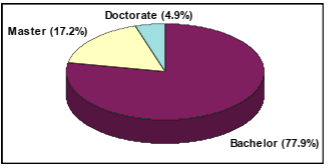
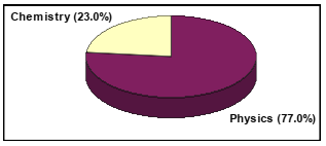
Our respondents consisted of 122 science teachers, the majority (83.6%) being men, and the rest (16.4%) women. On the other hand, the largest group of the respondents had an average age between 29 and 40 years, 29.5% of them were younger than 28 and about 24.6% were older than 41. Many respondents to the questionnaire held a bachelor's degree (77.9%), while the remainder were divided between those with a master's degree (17.2%) and those with a doctorate (4.9%). In addition, the main specialisation of the teachers surveyed was physics (77%), while 17.2% specialised in chemistry (Figures 1 and 2).
Regarding teaching experience, 31.1% of the respondents had less than four years, 44.3% had between five and 16 years, and 24.6% had more than 17 years (Figure 3).

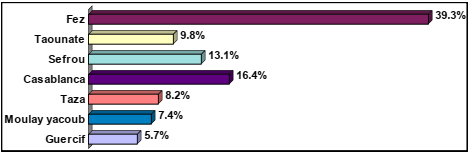
The survey respondents were distributed according to the provincial directorate of education as follows: 39.3% worked in Fès, 13.1% in Sefrou, 9.8% in Taounate, 8.2% in Taza, 7.4% in Moulay Yacoub, 5.7% in Guercif, and 16.4% in Casablanca. These teachers were spread across numerous lycées in the Fez-Meknes regional academy, as well as in the two provincial directorates of Casablanca and Guercif in Morocco (see Figure 4).
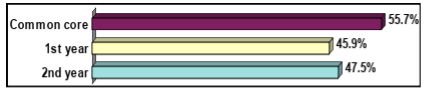
The questionnaire was addressed to the physical science teachers of the first (45.9%) and second (47.5%) year of the Experimental Sciences Baccalaureate and Common Core (55.7%) (Figure 5).
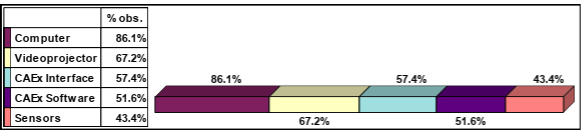
According to the statistical results presented in Figure 6, respondents indicated that their physical science classrooms were generally equipped with the following: a computer (86.1%), a video projector (67.2%), a CAEx interface (57.4%), CAEx software (51.6%), and sensors (43.4%). All teachers reported a lack of hardware, which plays a crucial role in the integration of CAEx in the classroom.
These results clearly underline the fact that, despite all our efforts in this area, our state still has not managed to close the equipment gap.
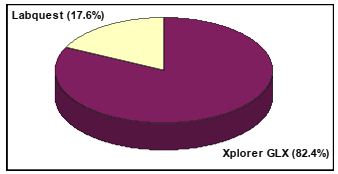
In the Académie de Fès-Meknès and the Direction Provinciale de Guercif, the interface used was Xplorer GLX (82.4%) with Data Studio software (80.3%) (Figures 7 and 8). In contrast, the Casablanca provincial directorate opted for the Labquest interface (17.6%) with Loggerpro software (19.7%) (Figures 8 and 9).
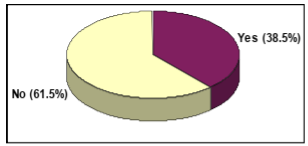
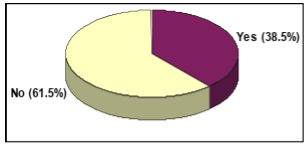
The results revealed that more than 61.5% of the teachers questioned did not integrate CAEx into their teaching, while 38.5% stated that they used CAEx in the classroom (Figure 9). This survey revealed that the use of CAEx in the classroom by teachers in their practical work was very limited; this observation had already been reported in the regional academies of Marrakech-Safi and Greater Casablanca (Atibi et al., 2017; El Ouargui et al., 2019). On the other hand, the use of CAEx by teachers in Northern European countries is the highest, for example, 90% in Finland (Atibi et al., 2017). According to the French Ministry of Education's Profetic survey, 77% of educators practise computer-assisted experimentation with their students at least once a week.
The Chi-Square test of independence was performed to test the following hypotheses:
H0: Use of CAEx by physical science teachers is not gender dependent.
H1: Use of CAEx by physical science teachers depends on gender.
The Chi-square test (Table 1) showed a non-significant dependence between physical science teachers' use of CAEx and gender, which confirms the rejection of hypothesis H1 and the maintenance of hypothesis H0 and allows us to state that the gender variable did not impact CAEx use.
Table 1: Relationship between Respondents' use of CAEx and Gender

The dependence is not significant. Chi-Square = 0.73, ddl = 1, 1-p = 60.84%. The values in the table are the total percentages based on 122 observations.
In addition, the result of the Chi-Square test (Table 2) allows us to conclude that there was no significant relationship between the use of CAEx by respondents and the specialty of the diplomas.
Table 2: Independence between the Use of CAEx by Respondents and the Specialty of the Diplomas

The dependence is not significant. Chi-Square = 1.52, ddl = 1, 1-p = 78.24%. The values in the table are the total percentages based on 122 observations.
With regard the teachers carrying out the practical work mentioned in the school textbooks for core, first- and second-year high school experimental sciences, it is notable that the practical work most commonly carried out was that which required less equipment and preparation time. These included acid-base titration (30.3%), the study of the RLC dipole (28.7%), practical work linked to sound analysis (18.9%), the study of Ohm's law (15.6%), and the characteristics of certain dipoles (10.7%). On the other hand, the determination of the time constant of an RC dipole (4.9%) and the experimental verification of Boyle-Mariotte's law (10.7%) were less frequently carried out, mainly due to the difficulties associated with the conditions under which these practical tasks are carried out in the classroom (Figure 10).
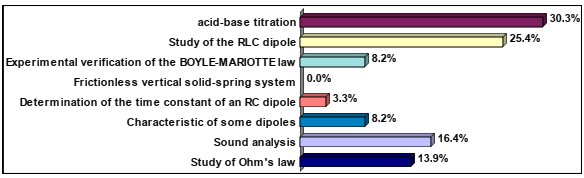
Table 3 indicates the advantages of using the CAEx by teachers.
Table 3: Teachers' Statements on the Benefits of Using CAEx

Respondents reported that CAEx saved time (71%), simplified comprehension (77%), increased student motivation (72%) and promoted correct use of scientific concepts (59.8%). It can therefore be said that CAEx represents a solution, on the one hand, for the student to be more attentive and serious, receive scientific information and engage in the teaching process. On the other hand, the teachers said that they became facilitators in the practical work.
According to most of the respondents, the disadvantages included students relying solely on manually manipulating data on their computer rather than creating their own graphs, neglecting measurement errors, and failing to develop analytical skills. Consequently, students did not become self-reliant and became dependent on this teaching tool.
According to the results in Figure 11, most of the physical science teachers surveyed (27%) acquired CAEx knowledge through self-training. However, a small percentage of the respondents acquired this knowledge through the initial training (15.6%) they reported receiving of about 14 hours. Note that 22.1% of the teachers received continuous training in the use of CAEx of about five hours with the education inspector, while 39.3% of the respondents never received training in the use of CAEx in practical work, despite the efforts made, which implies a complete revision of the strategy adopted by the Ministry of Education in the training of pedagogical actors is needed (Mastafi, 2014).

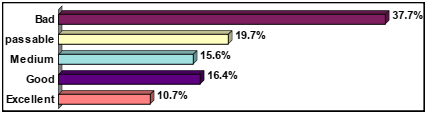
However, when it comes to the teachers questioned in our survey, most of them had a level of mastery of CAEx that was, in general, moderately high. Indeed, only 37.7% rated their level of CAEx proficiency as low, with 19.7% as fair, 15.6% as average, 16.4% as good, and 10.7% as excellent (see Figure 12). This was partly due to the low percentage of teachers who had not been trained to use CAEx.
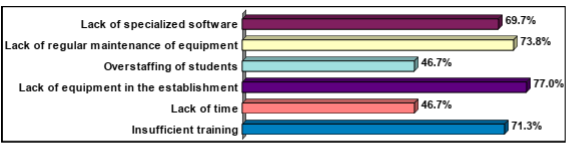
Most teachers confirmed that insufficient training (71.3%), lack of regular maintenance of equipment (73.8%), and too many students (46.7%) remained the major obstacles to the use of CAEx in the classroom. Other problems added to this, such as the lack of specialised software (69.7%), and the lack of equipment in the school (77%), while the lack of time (46.7%) was a minor obstacle to the integration of CAEx (Figure 13).
The directors of high schools also stated that the main obstacles to the general use of ICT by physical science teachers were the lack of training in the field and too many students (Gil-Flores et al., 2017; Messaoudi & Talbi, 2012; Unal & Ozturk, 2012).
The data in Table 4 below reveal the essential conditions, according to respondents, for the successful use of CAEx in high school physics. The most interesting conditions reported by respondents to our questionnaire were:
Table 4: The Conditions of Use of the CAEx

Finally, in additi on to the main conditions mentioned above, other elements could encourage the use of CAEx in education in general, such as, the motivation of educational stakeholders to make more efforts, the desire to improve students' academic performance, the pleasure of providing students with high-quality materials, and the wish to increase students' autonomy (Alluin et al., 2010; Aoki et al., 2013).
The results of the study highlight a limited pedagogical integration of computer-assisted experimentation (CAEx) systems in physical science teaching and assessment practices within the academy of Fez. This finding is in line with similar observations in the Marrakech and Casablanca academies, as highlighted in studies by Atibi et al. (2017). Several factors contributed to this situation. Firstly, the lack of in-service training for teachers was a major obstacle. Similarly, large class sizes and programme overload limit the possibility of conducting experiments due to time constraints.
Although the Ministry has made efforts to provide CAEx materials to teachers, the results of the study by El Ouargui et al. (2019) highlight that, despite these advances, only about 60% of schools were equipped with these materials. Therefore, there is still an urgent need to increase the quantity and availability of this tool within secondary schools. In addition, it is essential to note that the types of sensors available in schools were unevenly distributed, accentuating disparities in access to quality science education. On the other hand, self-training played a crucial role in the integration of CAEx, underlining the need for greater investment in in-service training programmes tailored to the specific needs of physical science teachers.
The use of CAEx also offers undeniable advantages. It saves time by processing data and generating graphical representations, thus, facilitating the teacher's work during the session. What is more, the use of CAEx makes it possible to measure the benefits for students in terms of concept assimilation (Gourja & Tridane, 2015). Studies by Yusuf and Afolabi (2010) have shown improved student performance when using CAEx, whether individually or collaboratively. However, our research also highlighted a disadvantage of using CAEx as a teaching tool. Students tended to manipulate data manually on the computer and were not encouraged to draw graphs themselves. As a result, they may become dependent on this teaching tool and fail to develop sufficient autonomy.
At the end of this research, we conclude that the results obtained indicate that the use of CAEx in the classroom by teachers for their practical work remains limited. However, it is important to note that most physics teachers showed a keen interest in CAEx. It can be said that CAEx played a crucial role in the understanding and assimilation of scientific concepts, offering a solution for increasing student attention and engagement. In addition, CAEx can foster the development of a sense of initiative among learners.
The results of this research also revealed that the main obstacles to the use of CAEx in physics in high schools in the Moroccan regional academy of Fez-Meknes, as well as in the two provincial directorates of Casablanca and Guercif, were: insufficient training, lack of regular maintenance of equipment, overcrowding of students, lack of specialised software and insufficient equipment in schools.
In order to improve the use of CAEx in the teaching of physics at the secondary level, some perspectives are presented: the excessive number of students per class must be reduced; teachers must be qualified and trained in the pedagogical use of CAEx in the classroom; science teachers must be motivated and encouraged to integrate CAEx in their teaching; schools must be equipped with the necessary and appropriate equipment to carry out practical work with CAEx; and textbooks should be accompanied by guides for practical work with CAEx.
At the end of this research, it is possible to see that the use of CAEx in high school was very practical and it could greatly respond to the expectations of the Ministry of National Education and Vocational Training within the framework of its new orientation towards computerisation and digitalisation of education. Therefore, administrators or educational planners must include CAEx in their programmes for the teaching and learning of physics, so that it becomes mandatory for all high schools.
Abouzaid, A., Taoufik, M., Moufti, A., & Lamsalmi, A. (2017). Intégration des TICE dans l’enseignement des Sciences de l’Ingénieur dans la filière Sciences Technologies Mécaniques aux lycées du Maroc : Réalité et Obstacles. European Scientific Journal, ESJ, 13(13), 476. https://doi.org/10.19044/esj.2017.v13n13p476
Alluin, F., Billet, M., & Gentil, R. (2010). Les technologies de l'information et de la communication (TIC) en classe au collège et au lycée: éléments d'usages et enjeux. Ministère de l'Education nationale, Direction de l'évaluation, de la prospective et de la performance.
Amini, M., & Oluyide, O. (2020, March). Analysis of ICT competencies among distance learning students in selected study centres of the National Open University of Nigeria. Journal of Learning for Development, 7(1). https://jl4d.org/index.php/ejl4d/article/view/376/457
Aoki, H., Kim, J., & Lee, W. (2013). Propagation and level: Factors influencing in the ICT composite index at the school level. Computers & Education, 60(1), 310-324.
Aparicio Gómez, O.Y. (2020). The education of desire and the use of ICT. In In M. Bosch (Ed.), Desire and human flourishing: Perspectives from positive psychology, moral education and virtue ethics, Springer. 325-337.
Atibi, A., El Kababi, K., Radid, M., Tridane, M., & Belaaouad, S. (2017). Integration of the CAEx in the education (teaching) of the physical sciences in the Moroccan high school. New Trends and Issues Proceedings on Humanities and Social Sciences, 3(1), 88-94.
Caena, F., & Vuorikari, R. (2021). Teacher learning and innovative professional development through the lens of the personal, social and learning to learn European key competence. European Journal of Teacher Education, 1-20.
Collin, S., & Karsenti, T. (2013). Usages des technologies en éducation : analyse des enjeux socioculturels. Éducation et francophonie, 41(1), 192-210.
Das, K. (2019). The role and impact of ICT in improving the quality of education: An overview. International Journal of Innovative Studies in Sociology and Humanities, 4(6), 97-103.
El Ouargui, Y., Gourja, B., Tridane, M., & Belaaouad, S. (2019). Use of Computer-Assisted Experimentation (CAEx) in teaching science in Moroccan high schools. International Journal of Web Applications, 11(4), 119. https://doi.org/10.6025/ijwa/2019/11/4/119-124
Elazhar, Y., & Laaziz, I. (2012). CAEx & science education in Morocco: Current status, challenges and perspectives. CNTE Educational Congress, 2012, Marrakech, December 21, 2012. Ministry of Education.
Gil-Flores, J., Rodríguez-Santero, J., & Torres-Gordillo, J.J. (2017). Factors that explain the use of ICT in secondary-education classrooms: The role of teacher characteristics and school infrastructure. Computers in Human Behavior, 68, 441-449. https://doi.org/10.1016/j.chb.2016.11.057
Girouard, M., & Nonnon, P. (1999). La lunette cognitive : pour l’acquisition d’un langage graphique de codage, son influence sur l’atteinte d’objectifs terminaux des cours de physique à l’éducation des adultes. In Actes du 5e colloque international de robotique pédagogique (pp. 139-179).
Gourja, B., & Tridane, M. (2015). The use of Computer-Assisted Experimentation (CAEx) in Moroccan schools. IJLRET Journal, 5, 43-47. http://www.ijlret.com/Papers/Vol-1-issue-6/7-A179.pdf
Ismaili, J. (2020). Evaluation of information and communication technology in education programmes for middle and high schools: GENIE programme as a case study. Education and Information Technologies, 25(6), 5067-5086.
Kaikai, H.A. (2014). Appropriation des Technologies de l’Information et de la Communication au sein de l’Université marocaine : Perceptions des étudiants. Frantice. net, 8.
Khaldoune, H. (2015). Comment exploiter une interface GLX pour réaliser des expériences en physique. [Master’s Thesis, Kadi Ayyad University, Marrakech, Morocco.]
Leu, E. (2005). The role of teachers, schools, and communities in quality education: A review of the literature. Academy for Educational Development. https://eric.ed.gov/?id=ED490174
Lubuva, E.E., Ndibalema, P., & Mbwambo, E. (2022). Assessment of tutors’ level of ICT competencies in teaching in teacher education in Tanzania. Journal of Learning for Development, 9(3), 436-454.
Mastafi, M. (2014). Obstacles à l’intégration des technologies de l’information et de la communication (TIC) dans le système éducatif marocain. CARISM and IREC, University Panthéon Assas Paris, 2, 50-65.
Menchafou, Y., Aaboud, M., & Chekour, M. (2023). Effectiveness of real and computer-assisted experimental activities in Moroccan secondary school physics education. International Journal of Interactive Mobile Technologies, 17(16).
Messaoudi, F., & Talbi, M. (2012). Réussir l’intégration des TICE au Maroc: regard sur le déploiement de la stratégie nationale GENIE. Revue, (143).
Monroy García, F.A., Llamas Salguero, F., Fernández-Sánchez, M.R., & Carrión del Campo, J.L. (2022). “Dis-connected university students?" Knowledge and use of digital technologies among university students. Journal of Educators Online, 19(2). https://files.eric.ed.gov/fulltext/EJ1347019.pdf
Omar, A., & Benjelloun, N. (2013). Intégration des TIC dans l’enseignement des sciences physiques au Maroc dans le cadre du programme GENIE : difficultés et obstacles. Revue internationale des technologies en pédagogie universitaire, 10(2), 49-65.
Shala, A., & Grajcevci, A. (2023). ICT and internet usage among Kosovar students: The impact of trends on achievement in the PISA scales. Journal of Learning for Development, 10(1), 122-133.
Unal, S., & Ozturk, I.H. (2012). Barriers to ITC integration into teachers’ classroom practices: Lessons from a case study on social studies teachers in Turkey. World Applied Sciences Journal, 18(7), 939-944. https://doi.org/10.5829/idosi.wasj.2012.18.07.1243
Yusuf, M.O., & Afolabi, A.O. (2010). Effects of Computer Assisted Instruction (CAI) on secondary school students' performance in biology. Turkish Online Journal of Educational Technology-TOJET, 9(1), 62-69.
Author Notes
Adil Hamamous was recruited by the Ministry of Education as a teacher at the Physical Sciences High School. His research focuses on the integration of Information and Communication Technologies (ICT) in the classroom. He began his current doctoral research entitled "The relationship between simulations, CAEx and cognitivism in the physical sciences" at the Université de Sidi Mohamed Ben Abdellah, Faculty of Science, Dhar El Mahra, Fez, Morocco. Email: adil.hamamous@usmba.ac.ma (https://orcid.org/0000-0002-7628-7170)
Nadia Benjelloun's research focuses on pupils' and students' misconceptions and misrepresentations in the fields of mechanics, optics and electricity, and on developing teaching scenarios to overcome learners' difficulties. She has directed several doctoral theses and published several research papers. Email: nadia.benjelloun@usmba.ac.ma (https://orcid.org/0000-0002-6837-3896)
Cite as: Hamamous, A., & Benjelloun, N. (2025). Computer-assisted experimentation in physical science education for Moroccan students. Journal of Learning for Development, 12(1), 191-203.